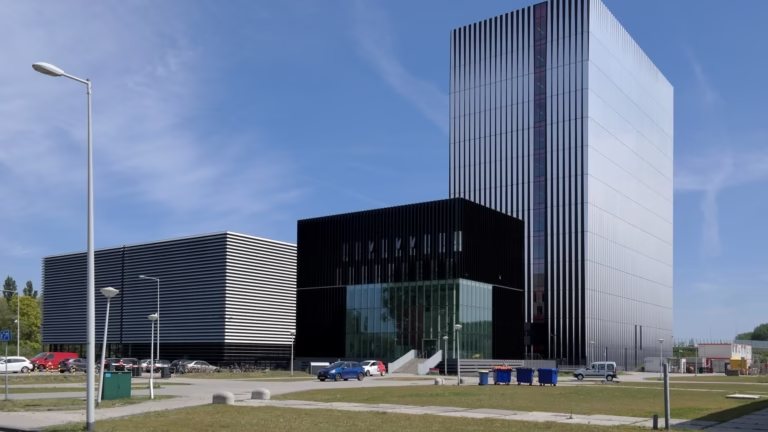
On February 12, 2026, the City of St. Louis quietly released a document that may well become the blueprint for modern urban planning in the artificial intelligence age. The text was a draft of new zoning regulations, but its contents addressed a phenomenon that has moved rapidly from theoretical white papers to physical reality: the arrival of Urban Micro-Data Centers. As the demand for low-latency AI inference and edge computing explodes, the massive, warehouse-sized server farms in remote deserts are no longer sufficient. The cloud is coming down to earth, and specifically, it is moving into the neighborhood.
This regulatory move by St. Louis officials marks a critical inflection point. For the first time, a major American municipality has formally codified a distinction between “Standard Data Centers” and “Micro Data Centers”—facilities under 10,000 gross square feet with power demands below 5 megawatts. This definition is not merely semantic; it is the opening salvo in a global shift toward decentralized infrastructure. The rigorous search for a solution to the AI industry’s “last mile” problem has landed on the street corners of mid-sized cities.
The End of the Hyperscale Monopoly
For the past decade, the internet has been physically centralized. Hyperscale facilities—gargantuan structures consuming as much power as small nations—dominated the landscape. However, the generative AI boom has exposed the cracks in this model. Training large language models (LLMs) requires massive centralized compute, but running them (inference) requires proximity to the user to minimize latency. Self-driving cars, augmented reality, and real-time voice translation cannot afford the milliseconds it takes to round-trip data to a server farm three states away.
This technical bottleneck is driving the proliferation of Urban Micro-Data Centers. According to reports surfacing this week, the industry is hitting a “deployment wall” with traditional builds, which take 24 to 36 months to complete. In contrast, modular, containerized units can be deployed in weeks. This speed is attractive to tech giants, but it presents a nightmare for city planners who are unprepared for industrial-grade computing equipment to be dropped into mixed-use zones.
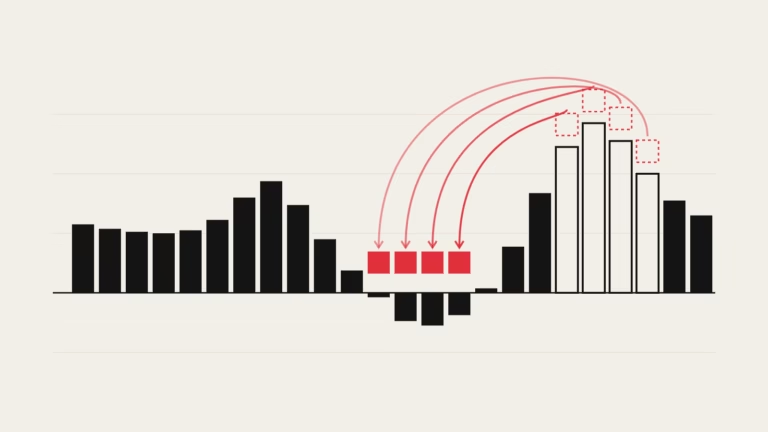
Deployment Velocity: Hyperscale vs. Micro
Source: February 2026 Infrastructure Deployment Analysis
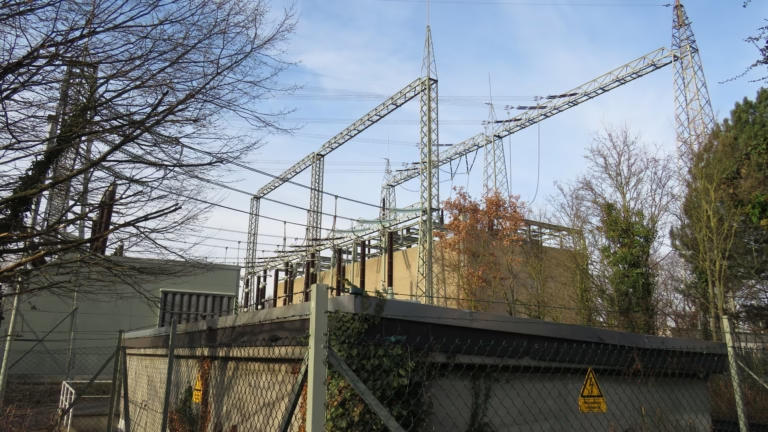
The St. Louis draft regulations explicitly address this by categorizing these smaller facilities as potential neighbors to commercial and even residential areas, provided they meet strict noise and buffer requirements. The proposal mandates a 300-foot buffer from sensitive uses for larger facilities, but the “Micro” designation carves out a pathway for integration. This suggests a future where Urban Micro-Data Centers are as common as electrical substations or cell towers—hidden in plain sight, humming quietly behind a facade that matches the local architecture.
The Physics of Heat and the Economics of Zoning
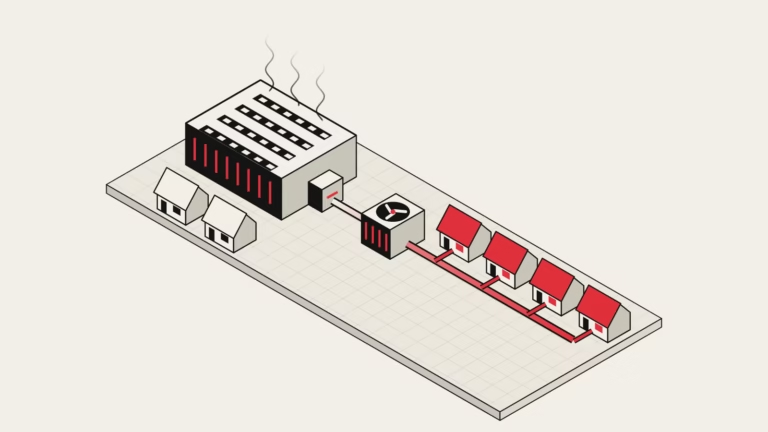
One of the most compelling arguments for bringing Urban Micro-Data Centers into populated areas is the potential for heat recapture. Data centers turn electricity into processing power, with heat as the primary waste product. In a remote desert, this heat is vented into the atmosphere. In a cold climate city, however, it is a resource.
Companies like Deep Green and Qarnot have already demonstrated the viability of this model, using “digital boilers” to heat public swimming pools and social housing. The proximity required for Urban Micro-Data Centers to function efficiently for AI also places them close enough to district heating networks to make heat transfer economically viable. The St. Louis zoning hearing featured residents questioning utility costs, with some arguing that responsible data center integration could actually lower rates if the waste heat is monetized correctly.
The Circular Energy Flow of Urban Compute
This circular economy is the “carrot” that developers are dangling before hesitant city councils. If a data center can subsidize the heating bill of a low-income housing complex, the zoning variance becomes much easier to obtain. However, the skepticism remains high. The “not in my backyard” (NIMBY) sentiment is strong, particularly regarding noise pollution. Cooling fans, even high-tech ones, generate a constant low-frequency drone that can be psychologically taxing. The St. Louis draft specifically targets this by requiring enclosed cooling systems for facilities near residential zones.
Get the next one by email
Power, cooling, chips and the rules that shape them. No spam, unsubscribe any time.
The AI Bottleneck: Why Cities Can’t Say No
Despite local resistance, the pressure to approve Urban Micro-Data Centers is mounting from the federal and economic levels. The United States is currently in a race to maintain AI supremacy, and infrastructure is the primary choke point. Major tech conglomerates are lobbying for expedited permitting, arguing that without a distributed network of edge nodes, the next generation of AI services—from autonomous logistics to personalized education bots—will stall.
The February 12 report from Built In highlighted that hyperscalers are “sitting on their hands” waiting for massive facilities, while smaller, agile competitors are buying up modular units. These modular units are designed to bypass the traditional construction supply chain, which is currently plagued by shortages of steel and skilled labor. A modular unit can be dropped onto a concrete pad in a converted parking lot, hooked up to the grid, and operational in days. This “guerilla infrastructure” tactic forces cities to regulate reactively, as St. Louis is doing now.
URBAN EDGE KEY PERFORMANCE INDICATORS
The St. Louis text defines “Large Load Data Centers” (75MW+) as inappropriate for the city, essentially banning hyperscale campuses within city limits. This is a crucial distinction. It signals that cities are willing to host the edge, but not the core. They want the connectivity and the potential heat benefits of Urban Micro-Data Centers without the massive water consumption and land use of traditional server farms. This bifurcated regulatory landscape—”Yes” to Micro, “No” to Macro—likely foreshadows the national standard for 2026 and beyond.
“We are moving from an era of ‘Data Centers as Fortresses’ to ‘Data Centers as Utilities.’ The St. Louis zoning draft is not an anomaly; it is the first ripple of a tidal wave. Cities that fail to regulate and integrate Urban Micro-Data Centers will find themselves with a crumbling digital infrastructure and no mechanism to capture the economic value of the heat currently being wasted into the sky.”
— Infrastructure Synthesis Report, Feb 2026
Conclusion: The Hyper-Local Cloud
The news out of St. Louis is a bellwether. We are witnessing the fragmentation of the cloud. Just as the electrical grid evolved from massive central plants to a distributed mix of solar, wind, and storage, the computing grid is atomizing. Urban Micro-Data Centers represent the physical manifestation of this change. They are the inevitable result of an insatiable demand for intelligence combined with the hard limits of physics.
For investors, the signal is to look at companies specializing in modular, quiet, and heat-recycling infrastructure. For city planners, the task is to write code that protects residents while inviting innovation. And for the average citizen, the future is likely one where the cloud is no longer “out there,” but right down the street, silently heating the local pool while it dreams up the answers to our questions.
Sources & Further Reading
- builtin.com
- hotpress.com
Cite this article
Editorial, S. (2026, February 17). Urban Micro-Data Centers: Explore the Era of Neighborhood Cloud Infrastructure. ScienceShot. https://scienceshot.com/post/urban-micro-data-centers-st-louis-zoning-draft-signals-the-era-of-neighborhood-cloud-infrastructure
Editorial, ScienceShot. “Urban Micro-Data Centers: Explore the Era of Neighborhood Cloud Infrastructure.” ScienceShot, 17 Feb. 2026, scienceshot.com/post/urban-micro-data-centers-st-louis-zoning-draft-signals-the-era-of-neighborhood-cloud-infrastructure.
Editorial, ScienceShot. “Urban Micro-Data Centers: Explore the Era of Neighborhood Cloud Infrastructure.” ScienceShot, February 17, 2026. https://scienceshot.com/post/urban-micro-data-centers-st-louis-zoning-draft-signals-the-era-of-neighborhood-cloud-infrastructure.
@online{scienceshot-urban-micro-data-centers-2026,
  author       = {Editorial, ScienceShot},
  title        = {{Urban Micro-Data Centers: Explore the Era of Neighborhood Cloud Infrastructure}},
  organization = {ScienceShot},
  date         = {2026-02-17},
  year         = {2026},
  url          = {https://scienceshot.com/post/urban-micro-data-centers-st-louis-zoning-draft-signals-the-era-of-neighborhood-cloud-infrastructure}
}
https://scienceshot.com/post/urban-micro-data-centers-st-louis-zoning-draft-signals-the-era-of-neighborhood-cloud-infrastructure
Get the weekly brief
Sourced analysis of data-centre engineering and regulation, every Monday. No spam, unsubscribe any time.