
If the last week in the digital infrastructure world proves anything, it is that the laws of physics and economics are finally crashing the artificial intelligence party. For the past two years, the narrative has been one of unbridled expansion—a terraforming of the American countryside into server farms. But as of mid-February 2026, the script has flipped. We are no longer merely discussing capacity; we are discussing culpability.
Two distinct signals cut through the noise this week. First, the arrival of DeepSeek—a Chinese AI model boasting frightening efficiency—sent a momentary shudder through the markets. Investors briefly panicked that smarter code might reduce the need for heavier concrete. They were wrong. Second, and perhaps more telling, was Anthropic’s extraordinary pledge on Valentine’s Day to subsidize electricity costs for American consumers, a tacit admission that the AI sector’s 50-gigawatt appetite is becoming a political liability.
These events are not isolated. They are the twin pillars of a new reality where data center trends are governed not by chip speeds, but by grid constraints and social licenses. The era of “build it and they will come” is over. The era of “build it if you can power it without bankrupting the neighborhood” has begun.
1. The Jevons Paradox: Why Efficiency Won’t Save Us
The tech world loves a silver bullet, and for a moment, DeepSeek looked like one. The logic was seductive: if we can train frontier models with a fraction of the compute, surely the demand for sprawling data centers will plateau? This fundamental misunderstanding of economics—specifically the Jevons Paradox—was swiftly corrected by the market this week.
William Stanley Jevons, a 19th-century economist, observed that as coal engines became more efficient, coal consumption did not drop; it skyrocketed, because the resource became useful for a wider array of tasks. The same is happening with AI. DeepSeek’s efficiency hasn’t curbed the appetite for silicon; it has simply lowered the barrier to entry, inviting thousands of smaller players to train models that were previously out of reach.
Industry reports from FMI Corp and PERE this week confirm that hyperscalers are not cancelling projects. Instead, they are reallocating “saved” CAPEX into even denser clusters. The efficiency gains are being reinvested immediately into scale. The implication is stark: data center trends point toward a future where efficiency drives more power consumption, not less. The pipe doesn’t get smaller; the flow just gets faster.
2. The Social License and the 50GW Apology
If efficiency is the accelerator, public sentiment is the brick wall. The most significant news of the week was Anthropic’s preemptive strike against regulation. By pledging to cover the electricity price hikes caused by their data centers, they have acknowledged a dirty secret: AI is parasitic on the public grid.
Consider the optics. In Aurora, Illinois, city officials have already placed a moratorium on new data centers, citing water usage and power stability. This is not nimbyism; it is survival. When a single facility consumes as much water as a mid-sized town, the “cloud” becomes a very terrestrial problem. Anthropic’s move is a desperate attempt to purchase a social license to operate before Congress or local municipalities revoke it entirely.
3. Capital Warfare: The $125 Billion Shuffle
Follow the money, and the story gets even darker. Amazon’s decision to cut 30,000 corporate jobs while simultaneously pouring $125 billion into AI infrastructure is a brutal clarification of priorities. The modern tech giant is shedding human capital to acquire fixed capital. They are trading middle managers for megawatts.
This massive reallocation of resources is reshaping the physical world. Blackstone, the world’s largest landlord, is betting the house on this transition. Their recent ₹10,000 crore investment in a Chennai hyperscale campus and the billion-dollar debt facility for Aligned Data Centers in the Americas signals that private equity views data centers as the new oil wells. Unlike oil, however, the extraction cost here is measured in grid stability and fresh water.
The financial markets have digested the “AI Bubble” fears and spat them out. The consensus view, reinforced by Microsoft’s latest earnings, is that the risk of under-investing exceeds the risk of over-investing. This FOMO (Fear Of Missing Out) is driving a construction boom that ignores traditional vacancy metrics. We are building cathedrals to calculation before we even know if the congregation will show up.
4. The Rise of “Sovereign” Stacks
Globalization is dying, and the data center is its graveyard. A Gartner report surfaced this week with a chilling prediction: by 2027, 35% of nations will be locked into “regional AI stacks.” This fragmentation is driving a new trend in data center construction—sovereignty.
Countries are no longer content to have their citizens’ data reside in a Virginia server farm. They want domestic compute. This is fragmenting the market, forcing providers like Digital Realty and Equinix to build smaller, distributed nodes rather than just massive central hubs. It is inefficient, expensive, and politically necessary. The “splinternet” has arrived, and it requires concrete foundations in every jurisdiction.
Quick Insight: The "Social License" Checklist
To break ground in 2026, developers must now tick boxes that didn’t exist in 2024:
- ✔ Grid Neutrality: Must bring own power (SMR/Fuel Cell) or subsidize grid upgrades.
- ✔ Water Independence: Zero potable water use for cooling (Liquid/Closed-loop only).
- ✔ Sovereign Compliance: Data residency guarantees for local government scrutiny.
- ✔ Heat Recapture: Mandated district heating integration in EU/Northern zones.
5. The Nuclear Option (Literally)
Finally, we must address the energy elephant in the room. With the grid buckling under the strain of 1018 floating point operations per second, the romance between Big Tech and nuclear power has consummated. The search results from the last week are littered with references to “microgrids” and “private generation.”
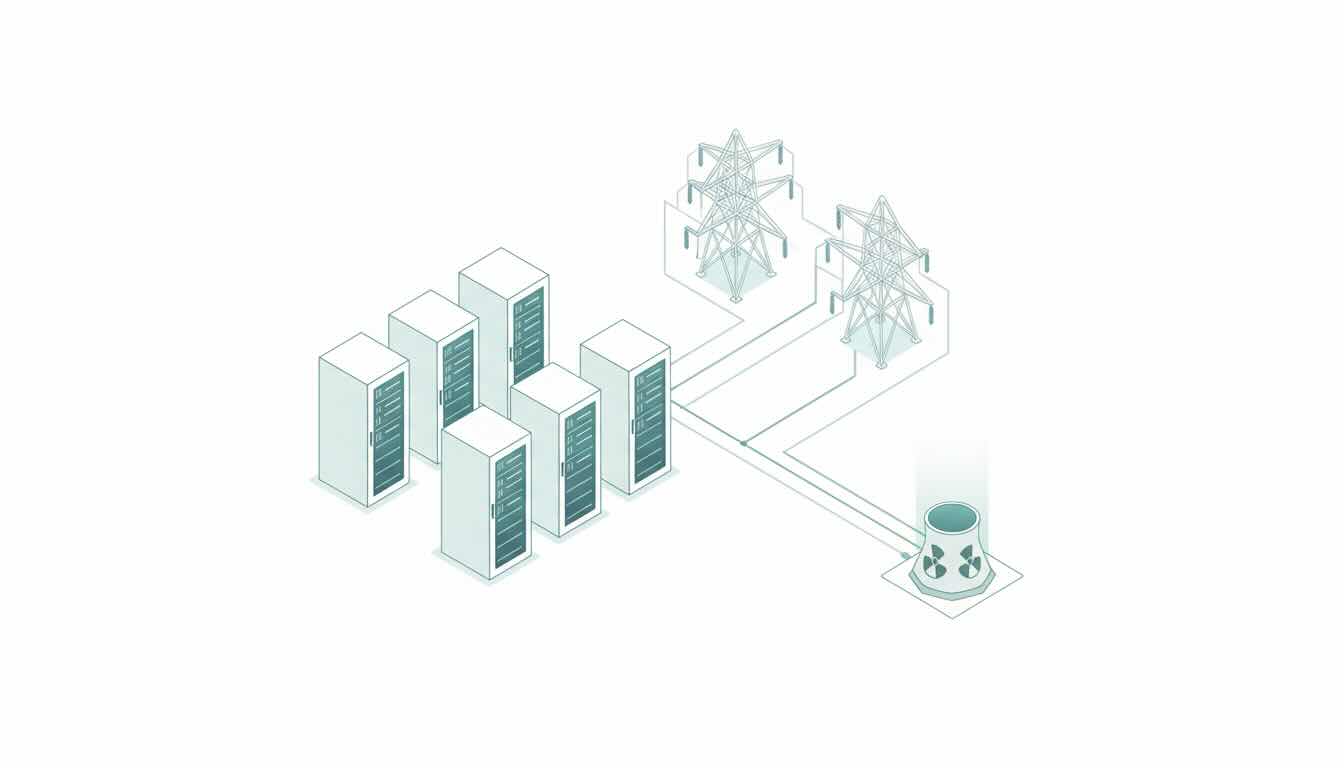
The delay in utility hookups—now stretching to seven years in parts of Virginia and California—is unacceptable to a sector moving at the speed of code. The solution? Data centers are becoming power plants. Whether it is small modular reactors (SMRs) or hydrogen fuel cells, the trend is toward behind-the-meter generation. The data center of 2026 is an island, connected to the world by fiber but increasingly severed from the public electric grid.
Conceptual Frame
"We are trading middle managers for megawatts. The modern tech giant is shedding human capital to acquire fixed capital, turning the American suburb into a high-voltage engine room."
Conclusion: The Guilt Phase
We have entered the “Guilt Phase” of the AI revolution. The initial euphoria is gone, replaced by a grim determination to build the necessary infrastructure at any cost—financial or social. Anthropic’s pledge to pay the public’s electric bill is not charity; it is “danegeld”—protection money paid to keep the regulators at bay.
For investors and industry watchers, the signal is clear. Ignore the noise about efficiency reducing demand. Bet on the companies that have secured the three scarcest resources on Earth: land, power, and permission. The data center is no longer just a box with computers in it; it is a fortress in a hostile environment, and its walls are getting higher by the day.
Get the weekly brief
Sourced analysis of data-centre engineering and regulation, every Monday. No spam, unsubscribe any time.