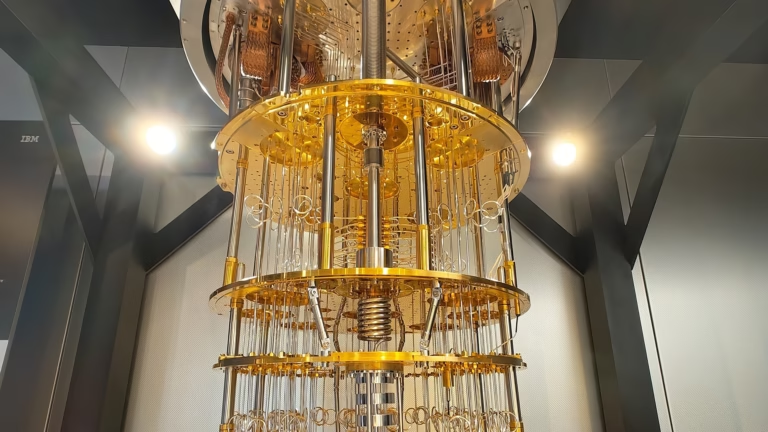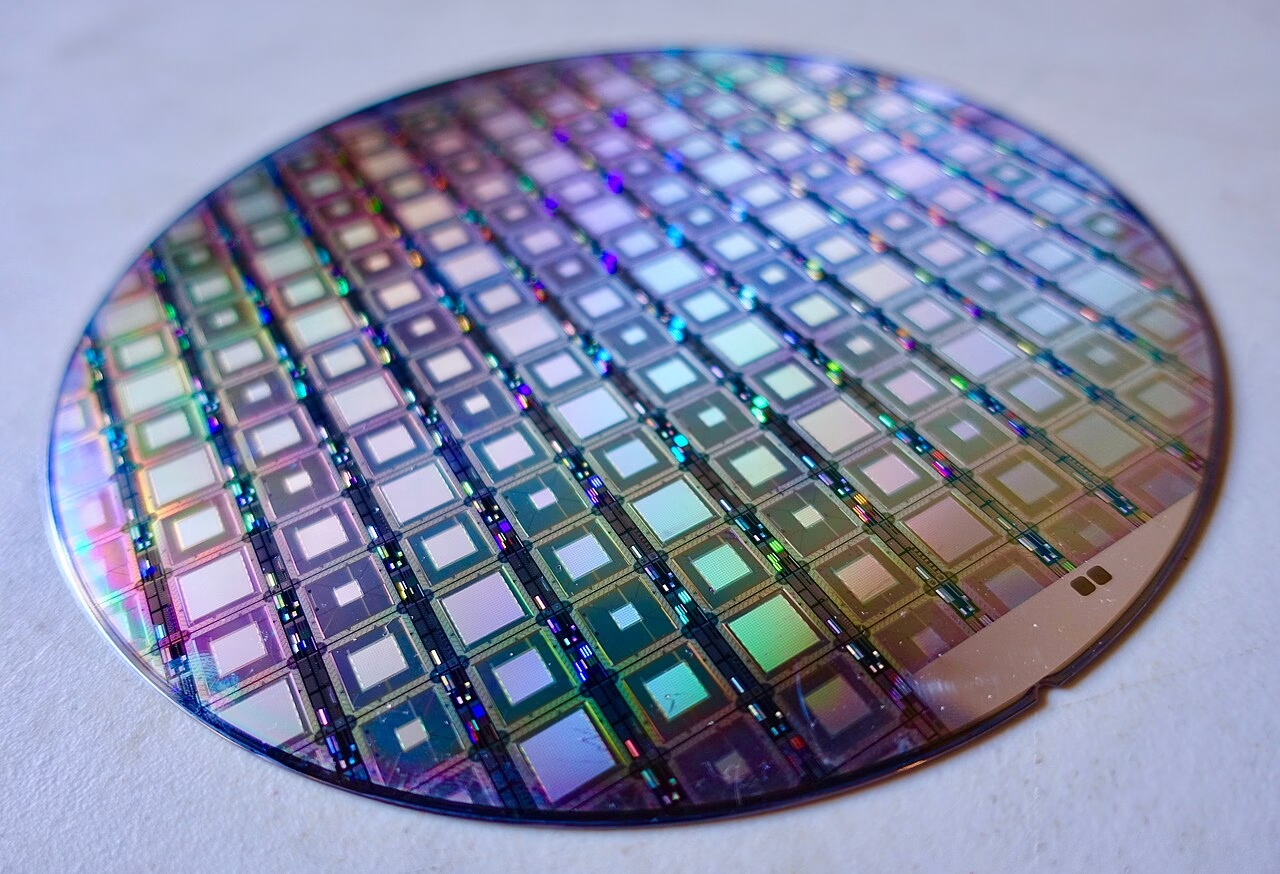

Here’s a number that should stop you cold: 20 seconds. That’s how long Microsoft’s new Majorana 2 chip can hold a qubit’s quantum state—compared to roughly 10 milliseconds on its predecessor. A more than 2,000-fold improvement. In the brutally unforgiving world of topological quantum computing, where environmental noise destroys quantum coherence in microseconds, 20 seconds is an eternity. The secret? They swapped out aluminum for lead.
The Fragility Problem at the Heart of Topological Quantum Computing
If you want to understand why quantum error correction is the hardest engineering problem of our era, consider what a qubit actually is. Unlike a classical bit—a transistor either on or off—a qubit exists in a superposition of 0 and 1 simultaneously. That quantum state is extraordinarily fragile. A stray photon, a vibration, a fluctuation in the ambient electromagnetic field: any of these will collapse the state. This is called decoherence, and it’s the primary reason quantum computers haven’t yet replaced classical ones for practical problems.
Microsoft’s bet has always been on a fundamentally different approach: topological qubits. Rather than error-correcting after the fact—spending enormous overhead on redundant physical qubits—topological qubits encode information non-locally across the material itself. The particles that make this possible are called Majorana fermions—exotic quasiparticles that are their own antiparticles, first predicted by Italian physicist Ettore Majorana in 1937. Think of it this way: imagine writing your password not on one piece of paper, but encoding each character across twenty separate locations simultaneously. Local noise can’t corrupt what’s distributed across the entire topology of the system.
Get the next one by email
Power, cooling, chips and the rules that shape them. No spam, unsubscribe any time.
Lead vs. Aluminum: The Materials Science Behind Majorana 2
The Majorana 2 chip, announced June 2, 2026, achieves its extraordinary improvement in qubit parity lifetime through a deceptively simple material substitution. Previous designs used aluminum as the superconducting layer paired with indium arsenide semiconductor. Aluminum’s superconducting gap is approximately 300 microelectronvolts—the energy barrier shielding the topological phase from thermal disruption. Microsoft replaced it with lead, which has a superconducting gap of approximately 1,300 microelectronvolts—more than four times higher.
That larger gap makes it significantly harder for quasiparticle excitations—the primary enemy of qubit stability—to penetrate and destabilize the quantum state. The topological gap itself grew from roughly 30 microelectronvolts with aluminum to approximately 70 microelectronvolts with lead. The semiconductor region was also redesigned: from pure indium arsenide to a composite of indium arsenide and indium arsenide antimonide grown on a gallium antimonide substrate, producing a cleaner topological phase boundary. The result: mean parity lifetimes of 22 seconds, with peaks exceeding one full minute.
Source: Microsoft Quantum / Nature (June 2026)
Having worked with superconducting materials in the context of CERN’s cryogenic accelerator infrastructure, I understand viscerally how difficult it is to maintain phase coherence at millikelvin temperatures. What Microsoft has achieved here—a material substitution that delivers an order-of-magnitude improvement in energy gap stability in a precision nanoscale heterojunction—is the kind of result that looks elegant in hindsight and requires years of brutally difficult materials science in practice. Lead’s higher critical temperature and larger superconducting gap were known properties. Engineering them reliably into an InAs/InAsSb composite at the nanoscale was the hard part. That part is now done.
The 2029 Race—and the Skeptics Who Won’t Be Quiet
Microsoft says Majorana 2 puts it on track to build a fault-tolerant quantum computer by 2029, cutting its previous timeline in half. IBM announced the same week a commitment of more than $10 billion to quantum computing, also targeting 2029 for its Quantum Starling system. Google’s Willow chip demonstrated exponential error suppression with 105 superconducting qubits in late 2025. Three of the world’s most powerful technology companies are now all pointing at the same finish line: a commercially useful, fault-tolerant quantum computing system before the decade ends.
Source: Microsoft, IBM, Google public roadmaps (2026)
Here’s where I must be honest about the controversy, because it is real and it matters. Microsoft retracted a high-profile Nature paper in 2021 after outside experts found the data could have come from material imperfections rather than genuine topological Majorana modes. Several prominent physicists have said bluntly that Microsoft has not demonstrated its topological qubits work in the way the company claims. The Majorana 2 announcement has renewed that debate immediately and sharply.
My actual assessment: the parity lifetime data is extraordinary and hard to dismiss. Twenty-two seconds of coherence, reproducibly, in a system claiming topological protection would be a landmark result regardless of the exact underlying mechanism. Whether the quasiparticle modes being stabilized are truly topological Majorana modes—or non-topological Andreev bound states mimicking them—is not yet settled science. Microsoft’s 2029 roadmap rests heavily on that distinction. What this really means is that we are watching a bet of historic proportions being pressed hard, in public, in real time.
The industry is nowhere near ready for the disruption that will follow when fault-tolerant quantum computing actually arrives. Cryptographic infrastructure built on RSA and elliptic curve assumptions, drug discovery pipelines, financial optimization systems, materials simulation for battery and semiconductor design—all of these fields will be fundamentally altered. If the 2029 delivery date is real, that disruption begins in three years. One material swap, aluminum for lead, might be the hinge point future historians point to. Pay close attention to what emerges from independent replication labs over the next eighteen months. That is where this story resolves.
Get the weekly brief
Sourced analysis of data-centre engineering and regulation, every Monday. No spam, unsubscribe any time.