Latest
MoS2 Radio Survives Nine Months in Orbit: What It Shows
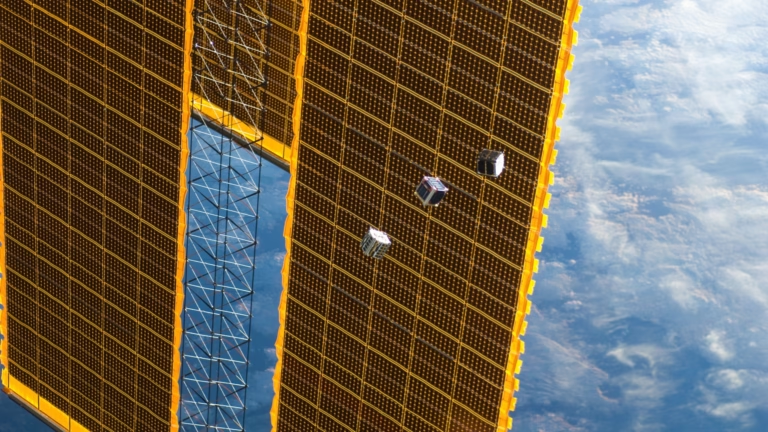
A 2026 orbital MoS2 radio experiment ran for nine months. Its measured error rate supports a promising result, with mission qualification still ahead.

Section
Chips, memory and the supply chains that decide what computing can do next.
28 articlesFree tools and guides
Latest
A 2026 orbital MoS2 radio experiment ran for nine months. Its measured error rate supports a promising result, with mission qualification still ahead.
Intel's glass core substrate is not in Clearwater Forest, which uses organic substrate and EMIB. What ECTC 2026 showed, and why glass is years…
3D chip stacking's thermal limit lets cache stack almost free, but logic-on-logic still cooks itself — a split that won't close for years.
Over 30 years of applying optoelectronic links in high energy physics experiments reveal key lessons. Discover which one.
Discover how Diamond Sensor are changing the world of high energy physics forever
An overview on spatial resolution and on the capability to reconstruct the crossing point of a particle in silicon sensor
The epitaxial layer in a CMOS sensor is grown, not implanted, and its thickness and doping set the pixel's quantum efficiency and dark current.
Silicon pixel sensors revolutionized particle detection with microscopic tracking precision, enabling huge physics discoveries.
Czochralski vs Float Zone silicon growth compared — how each works, their strengths and limits, and which to choose for your application.
The impact of radiation on silicon's sensors from leaky currents to doping fluctuations
Spintronics uses an electron's spin, not just its charge, for logic and memory -- the physical effects, the devices built so far, and what's…
Graphene, a revolutionary wonder material with remarkable properties. Explore its limitless applications in technology and industry.
How electrons and holes are created in a semiconductor: energy bands, the band gap, and the energy it takes to free a charge carrier,…
What a CMOS active pixel sensor is, how each pixel amplifies its own charge, and why it replaced the passive-pixel design in almost every…
Optical computing has gained renewed interest due to its potential speed and energy-efficiency advantages over electronics. Check how this is possible.