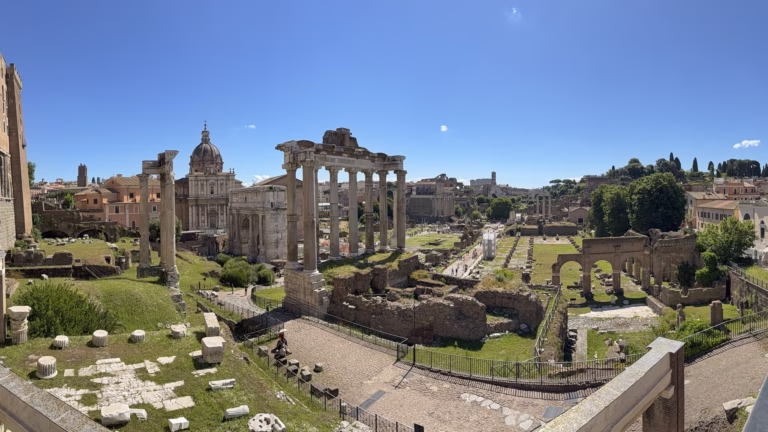

History is often taught as a series of biographies—great men doing great things, or terrible men doing terrible things. But to the analytical mind, to the physicist of sociology, history looks less like a soap opera and more like a biology textbook. Empires are super-organisms. They consume energy, they grow, they achieve homeostasis, and inevitably, they succumb to entropy. This is not poetry; it is a structural reality observed across five thousand years of human civilization. Just as a star runs out of hydrogen or a cell reaches its Hayflick limit, political entities face a point of diminishing returns where the cost of maintaining the system exceeds the energy the system can extract.
The study of this lifecycle is sometimes called “Cliodynamics”—a field that treats history as a science subject to mathematical modeling rather than just a collection of stories. When we look at the data, a disturbing pattern emerges. The average lifespan of a “great power” is roughly 250 years. The United States, founded in 1776, is currently 249 years old. While numerology is not science, the convergence of structural indicators—fiscal health, social cohesion, and geopolitical leverage—suggests that we are approaching a phase transition. The question is not if American hegemony will end, but how. Will it be a violent implosion, a slow decay, or a transformation into something unrecognizable? To answer this, we must first dissect the corpses of the empires that came before.
The Algorithms of Decay: How Giants Fall
Before diagnosing the patient, we must understand the disease. Historical analysis identifies three primary mechanisms that kill empires. These are distinct from external shocks (like a meteor or a plague) and represent internal systemic failures.
• Imperial Overstretch (The Logistics Trap):
Coined by historian Paul Kennedy in The Rise and Fall of the Great Powers, this theory posits that an empire eventually expands to a point where the cost of defending its borders exceeds the economic value those borders generate. The Roman Empire in the 3rd century is the textbook example. Maintaining legions from Hadrian’s Wall to the Euphrates required massive taxation. As the military budget devoured the economy, the currency was debased (the denarius lost 95% of its silver content), leading to hyperinflation. The empire didn’t just “fall” to barbarians; it bankrupt itself trying to keep them out.
• Diminishing Returns on Complexity (The Tainter Curve):
Joseph Tainter, in his seminal work The Collapse of Complex Societies, argues that societies solve problems by becoming more complex (creating bureaucracies, regulations, and specialized classes). Initially, this yields high returns. Eventually, however, every new layer of complexity costs more to maintain than it solves. Late-stage civilizations become rigid. They cannot adapt to new challenges because their resources are entirely tied up in maintaining the existing, inefficient structure. The Mayans didn’t vanish because they forgot how to farm; they vanished because their sociopolitical structure became too costly for their environment to support.
• Elite Overproduction and Discord (The Turchin Cycle):
Peter Turchin’s secular cycle theory is perhaps the most relevant today. He argues that periods of stability and growth lead to an explosion in the number of wealthy, educated elites.

Eventually, there are too many elites fighting for too few power positions. This “elite overproduction” leads to vicious intra-elite conflict, fragmentation of social norms, and the weaponization of the populace against opposing factions. The “Asabiyyah” (social cohesion), as described by the 14th-century scholar Ibn Khaldun, dissolves. The state is no longer a unified entity but a battleground for warring oligarchies.
Case Study: The British Exit
The most useful parallel for the United States is not Rome, but Great Britain. The British Empire was the architect of the first global order. Its end was not marked by the burning of London or a barbarian horde in Parliament. Instead, it was a “Bank Run on Power.”
By 1945, Britain was victorious but fiscally hollowed out. Two world wars had transferred its gold reserves to the United States. It faced a choice: maintain the Sterling Bloc and the Empire, or build a welfare state at home. It could not do both. The Suez Crisis of 1956 was the definitive end. When Britain tried to assert imperial force in Egypt, the United States threatened to sell off British pound reserves, crashing the currency. Britain retreated. The empire didn’t die on the battlefield; it died on the balance sheet. This “Sterling Crisis” model—where the loss of economic primacy forces a geopolitical retreat—is the most statistically probable roadmap for the end of American empire.
Get the next one by email
Power, cooling, chips and the rules that shape them. No spam, unsubscribe any time.
The American Diagnosis: Three Pillars of Collapse
Applying these historical algorithms to the current United States reveals a system flashing red warning signs across all three major categories of decline.
1. The Fiscal Singularity (Debt and the Dollar)
The American Empire is built on a unique foundation: the US Dollar as the global reserve currency. This “exorbitant privilege” allows the US to export inflation and run deficits that would destroy any other nation. However, this privilege is being abused to a breaking point.
• The Data: The US Debt-to-GDP ratio has surpassed 120%, a level historically associated with sovereign default or currency debasement. Interest payments on the debt have recently exceeded the national defense budget.
• The Mechanism: We are seeing the “weaponization” of the dollar (sanctions) driving adversaries (China, Russia, the Global South) to build alternative payment rails (BRICS pay systems, gold accumulation). If the dollar loses its monopoly, the demand for US Treasury bonds evaporates. Without that demand, the US cannot fund its 800 military bases or its domestic entitlements without hyperinflating the currency.
2. The Internal Rot (Political Entropy)
Using Turchin’s models, the US is in a classic phase of “disintegrative social instability.”
• Elite Overproduction: The US produces far more law and policy graduates expecting power than there are seats in Congress or high-level corporate boards. This surplus of elites has split into warring factions, using identity politics and populism as battering rams.
• Loss of Legitimacy: Trust in institutions (media, congress, science, judiciary) is at historic lows. When a population no longer believes the state acts in their interest, the “cost” of governing rises exponentially. Coercion replaces consensus.
3. The Geopolitical Overstretch
The US Navy guarantees the safety of global trade lanes, essentially subsidizing the exports of its competitors. The US is currently committed to defending borders in Eastern Europe, the Middle East, and the South China Sea simultaneously.
• The Reality Check: The US industrial base, hollowed out by globalization, struggles to replenish munitions stocks for even proxy wars. A direct conflict with a peer competitor (China) would reveal that the US has become a “financialized” empire—great at moving capital, but atrophied in moving atoms.
The Most Probable Scenario: The Great Unwinding
So, how does it end? Hollywood has conditioned us to expect a nuclear mushroom cloud or a Handmaid’s Tale revolution. The data suggests something more mundane but equally transformative: The Sovereign Debt Crisis and the Retreat.
Here is the likely sequence of events for the end of American empire:
1. The Trigger: A domestic financial crisis or a geopolitical standoff (likely over Taiwan or a blockade) spikes interest rates. The US government finds it cannot print enough money to bail out the system and fund the military without causing catastrophic inflation.
2. The Choice: Faced with the “British Choice” of 1956—save the currency or save the empire—Washington will choose the domestic economy.
3. The Retreat: To cut costs, the US will withdraw security guarantees. NATO will effectively become dormant; bases in the Pacific will be shuttered. The US will retreat to the Western Hemisphere, focusing on energy independence and regional dominance (Fortress America).
4. The Multipolar Consequence: Without the “World Policeman,” the globe will fracture into regional spheres of influence. China will dominate Asia; the EU (or a German-led bloc) will try to manage Russia; India will control the Indian Ocean.
5. The Domestic Aftermath: The standard of living in the US will drop as the “dollar subsidy” ends. Imports will become expensive. This will lead to a decade of intense internal political volatility, perhaps bordering on low-level civil conflict, before a new equilibrium is found.
Conclusion: The Post-American World
The end of the American Empire does not mean the end of the United States. Rome continued as a relevant city-state for centuries. Britain is still a wealthy, culturally influential nation. The “End” refers to the loss of hegemony—the ability to dictate the rules of the global game.
For the science enthusiast, this transition is fascinating. We are watching a complex adaptive system undergo a phase shift in real-time. The energy that was once directed outward (expansion, war, space race) is turning inward (fighting over debt, identity, and resources). The laws of thermodynamics apply to nations just as they do to engines: you cannot output more energy than you input forever. The American machine is overheating, and the laws of physics demand a cooldown. The future is not American; it is multipolar, messy, and fiercely competitive.
Cite this article
Turner, A. (2026, January 9). Is the American Empire’s Dominance About to End? ScienceShot. https://scienceshot.com/post/how-is-the-american-empire-going-to-end
Turner, Alex. “Is the American Empire’s Dominance About to End?” ScienceShot, 9 Jan. 2026, scienceshot.com/post/how-is-the-american-empire-going-to-end.
Turner, Alex. “Is the American Empire’s Dominance About to End?” ScienceShot, January 9, 2026. https://scienceshot.com/post/how-is-the-american-empire-going-to-end.
@online{scienceshot-how-is-the-american-2026,
  author       = {Turner, Alex},
  title        = {{Is the American Empire’s Dominance About to End?}},
  organization = {ScienceShot},
  date         = {2026-01-09},
  year         = {2026},
  url          = {https://scienceshot.com/post/how-is-the-american-empire-going-to-end}
}
https://scienceshot.com/post/how-is-the-american-empire-going-to-end
Get the weekly brief
Sourced analysis of data-centre engineering and regulation, every Monday. No spam, unsubscribe any time.