In a week that may well be remembered as a pivotal moment in the history of information technology, two separate but synchronous announcements from New York City and Berlin have fundamentally altered the trajectory of the quantum internet. For decades, the concept of a global network connecting quantum computers has been a theoretical holy grail, limited by the fragility of quantum states over long distances. However, the events of mid-February 2026 have moved this technology from the chalkboard to the city streets.
On February 18, 2026, a collaboration between networking giant Cisco and quantum startup Qunnect demonstrated high-fidelity Quantum Entanglement Swapping on the "GothamQ" network in New York City. Simultaneously, across the Atlantic, Deutsche Telekom announced a successful 30-kilometer quantum teleportation trial in Berlin using similar architecture. These twin achievements prove that the delicate physics required for a quantum internet can survive the harsh, noisy environment of commercial fiber infrastructure.
At the heart of these breakthroughs is a specific mechanism that solves the "distance problem" in quantum communication. Unlike classical signals, which can be amplified by repeaters when they fade, quantum signals cannot be copied or amplified without being destroyed (a rule known as the No-Cloning Theorem). The solution lies in a protocol called Quantum Entanglement Swapping, which allows particles that have never interacted to become entangled, effectively teleporting the quantum connection across vast distances. The success of these trials suggests that the infrastructure for a quantum-secure future is not decades away, but is being built beneath our feet today.
GothamQ & Berlin Trial: Key Performance Indicators
The Mechanics of Quantum Entanglement Swapping
To understand the magnitude of this week’s news, one must first grasp the physical challenge of the quantum internet. In a classical network, if you want to send a bit of information from New York to London, the signal travels through fiber optic cables, getting boosted by repeaters every 50 to 80 kilometers to ensure it arrives with sufficient strength. In the quantum realm, this is impossible. If you try to amplify a qubit (quantum bit), you disturb its state, collapsing the information it carries.
This is where Quantum Entanglement Swapping becomes the enabling technology. It acts as a "quantum repeater." Imagine two pairs of entangled photons. Pair A is located at node 1 and the central hub. Pair B is located at node 2 and the central hub. By performing a specific measurement on the two photons that meet at the central hub (one from Pair A and one from Pair B), the remaining photons at node 1 and node 2 instantly become entangled with each other, even though they have never physically met. This "swapping" of entanglement extends the range of the connection.
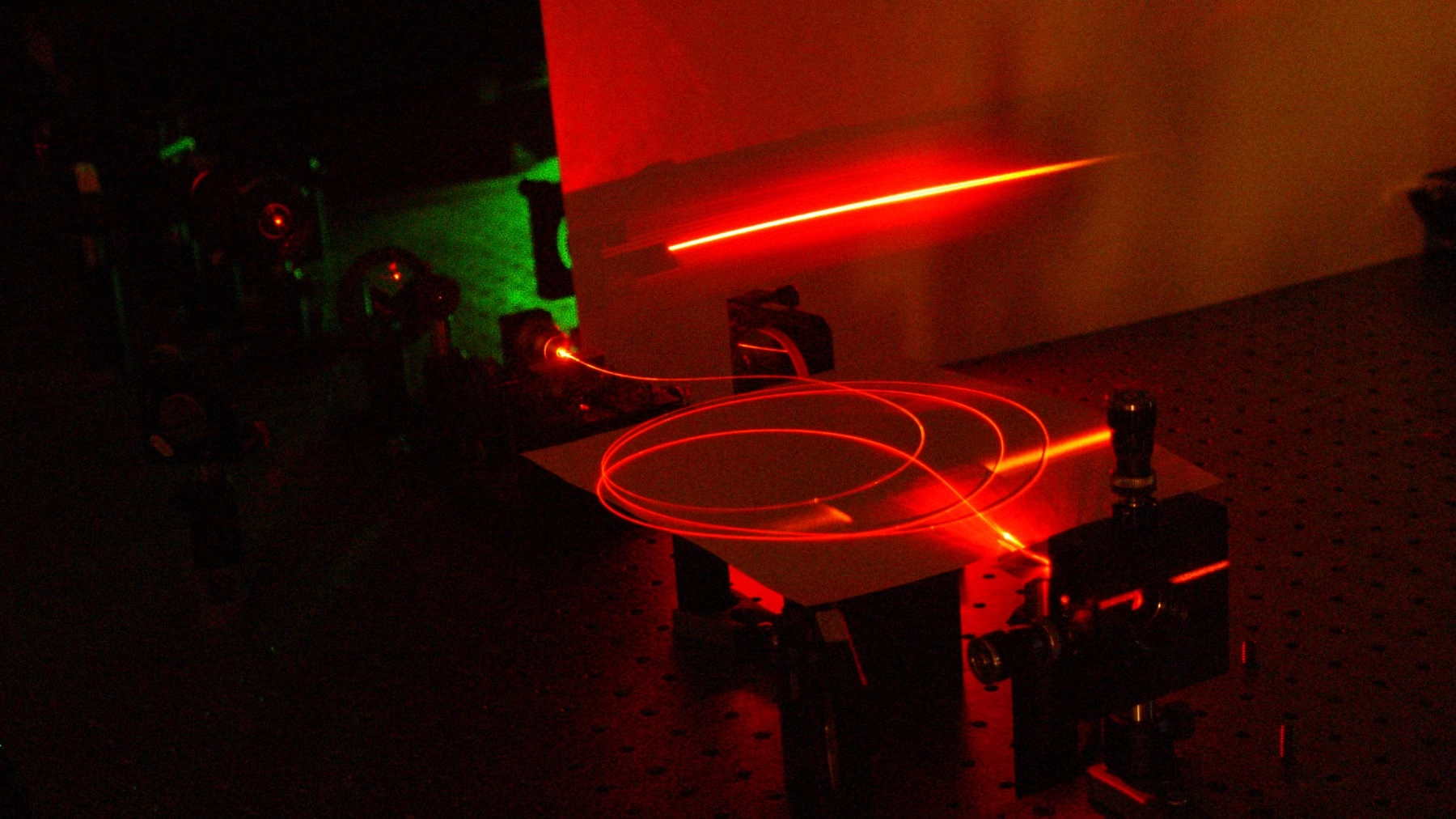
The Cisco and Qunnect demonstration in NYC utilized a "hub-and-spoke" topology to execute this protocol. Independent entanglement sources in Brooklyn sent photons through 17.6 km of standard telecom fiber to a central hub in Manhattan. There, the Quantum Entanglement Swapping occurred, linking the Brooklyn nodes. The success of this operation relies heavily on synchronization; the photons must arrive at the hub within femtoseconds of each other, a feat that is exponentially more difficult when dealing with the thermal fluctuations and physical vibrations of a living city.
Protocol Architecture: Entanglement Swapping Flow
Nodes A and B generate independent entangled photon pairs (Start-Hub pairs).
Photons travel via Commercial Fiber to Central Hub (Manhattan/Berlin).
Hub performs joint measurement on incoming photons, consuming them to forge a link.
Remaining qubits at Node A and Node B become entangled. A secure channel is formed.
Breaking the Rate Barrier: The GothamQ Achievement
One of the most significant aspects of the GothamQ announcement is the rate at which entanglement was established. Historically, entanglement rates over long distances have been painfully slow—often measured in just a few pairs per minute—rendering them useless for practical data transmission. The Qunnect hardware, however, achieved a local swapping rate of over 1.7 million pairs per hour (approx. 470 pairs per second) and a deployed rate of 5,400 pairs per hour over the 17.6 km loop.
While 5,400 pairs per hour might sound modest compared to classical gigabit speeds, in the context of Quantum Entanglement Swapping, it is a commercial milestone. It is sufficient for establishing frequent Quantum Key Distribution (QKD) keys, which can be used to secure vast amounts of classical data. This moves the technology from "scientific curiosity" to "security product." The system’s robustness is also notable; it operated with a polarization fidelity above 99%, meaning the quantum information remained intact despite the environmental noise of New York City’s underground infrastructure.
The hardware differentiation is key here. The outlying nodes used room-temperature SPAD (Single Photon Avalanche Diode) detectors, which significantly lowers the barrier to entry for deploying these nodes in standard server racks. Only the central hub required cryogenic cooling for the more sensitive SNSPDs (Superconducting Nanowire Single Photon Detectors), a strategic design choice that centralizes the most expensive and energy-intensive equipment.
Entanglement Rate Evolution vs. Commercial Viability
Analysis of entanglement pair generation rates (pairs/hour) showing the rapid ascent from 2022 laboratory baselines to the 2026 GothamQ breakthrough. The dashed line represents the estimated threshold for real-time, high-bandwidth quantum cloud computing.
The Berlin Connection: A Global Validation
While NYC hosted the rate breakthrough, Berlin’s demonstration by Deutsche Telekom added a crucial layer of validation: integration. The German trial focused heavily on the coexistence of quantum data with classical internet traffic. Using the same Qunnect "Carina" platform, the team successfully teleported quantum information over a 30 km loop of the city’s commercial fiber network. This is critical because building a dedicated fiber network solely for quantum traffic would be prohibitively expensive.
Deutsche Telekom’s success in filtering out the noise from classical data streams while maintaining the integrity of the Quantum Entanglement Swapping process proves that the "Quantum Internet" can be an overlay on the existing internet, rather than a replacement. This "brownfield" deployment strategy drastically reduces the capital expenditure required for global scaling. It implies that telecom operators can upgrade their existing data centers to become quantum nodes, leveraging the billions of dollars of fiber already buried in the ground.
Get the next one by email
Power, cooling, chips and the rules that shape them. No spam, unsubscribe any time.
Sector Impact and Future Implications
The immediate application of these technologies is Quantum Key Distribution (QKD). In a world where "Harvest Now, Decrypt Later" attacks are a genuine threat (where adversaries steal encrypted data today to decrypt it later with future quantum computers), the ability to distribute unhackable keys via Quantum Entanglement Swapping is a defense necessity. Financial institutions and government agencies are the primary early adopters.
However, the long-term vision is Distributed Quantum Computing. Today’s quantum computers are limited by the number of qubits they can hold on a single chip. By using entanglement swapping to link multiple small quantum computers together, they can function as a single, massive quantum processor. This modular approach could be the fastest path to fault-tolerant quantum computing.
Global Sector Impact: 2026-2030 Outlook
| Sector | Impact Level | Primary Application | Time Horizon |
|---|---|---|---|
| Defense & Intelligence | High | Secure Communications (QKD) & Satellite Links | Immediate (1-2 Years) |
| Financial Services | High | High-Frequency Trading Security & Asset Protection | Near-Term (2-3 Years) |
| Cloud Infrastructure | Medium | Distributed Quantum Computing Clusters | Mid-Term (4-6 Years) |
| Telecommunications | Medium | Quantum-Ready Network-as-a-Service (NaaS) | Mid-Term (3-5 Years) |
Analysis: The defense and finance sectors are the immediate beneficiaries due to the urgency of post-quantum cryptography. Telecom providers face a medium-term opportunity to restructure their business models around quantum-secured bandwidth.
The Remaining Bottleneck: Quantum Memory
Despite the euphoria surrounding these announcements, a significant hurdle remains: quantum memory. While Quantum Entanglement Swapping allows for transmission, we still lack efficient, long-duration storage for quantum states at the repeater nodes. Currently, the synchronization requires photons to arrive at the hub at nearly the exact same instant. If one photon is delayed, the swap fails. Quantum memory would allow a node to "hold" a photon until its partner arrives, exponentially increasing the efficiency and success rate of the network.
The Cisco and Qunnect trials succeeded by using precise timing and synchronization electronics rather than memory, a valid strategy for metropolitan distances (Metropolitan Area Networks or MANs). However, for a true cross-continental quantum internet, viable quantum memory will be the next necessary breakthrough. Until then, we can expect the proliferation of "Quantum MANs" in major tech hubs like New York, Berlin, London, and Tokyo, creating islands of high-security connectivity.
Conclusion
The events of February 2026 mark a decisive transition point for quantum physics. We have moved beyond the question of "is it possible?" to the engineering challenge of "how do we scale it?" The demonstrations of Quantum Entanglement Swapping in New York and Berlin are not just scientific experiments; they are proofs of concept for a new global communication architecture. As telecom giants and networking leaders like Cisco and Deutsche Telekom step into the ring, the quantum internet is no longer a physicist’s dream—it is an emerging utility.
Sources & Further Reading
- quantumcomputingreport.com
- insidehpc.com
- forbes.com
- tomshardware.com
- usdsi.org
- sciencealert.com
Cite this article
Piro, V. (2026, February 21). Quantum Internet Just Got Real: Inside the New York-Berlin Entanglement Trials. ScienceShot. https://scienceshot.com/post/quantum-entanglement-swapping-new-york-and-berlin-trials-mark-the-dawn-of-the-quantum-internet
Piro, Viros. “Quantum Internet Just Got Real: Inside the New York-Berlin Entanglement Trials.” ScienceShot, 21 Feb. 2026, scienceshot.com/post/quantum-entanglement-swapping-new-york-and-berlin-trials-mark-the-dawn-of-the-quantum-internet.
Piro, Viros. “Quantum Internet Just Got Real: Inside the New York-Berlin Entanglement Trials.” ScienceShot, February 21, 2026. https://scienceshot.com/post/quantum-entanglement-swapping-new-york-and-berlin-trials-mark-the-dawn-of-the-quantum-internet.
@online{scienceshot-quantum-entanglement-swapping-new-2026,
  author       = {Piro, Viros},
  title        = {{Quantum Internet Just Got Real: Inside the New York-Berlin Entanglement Trials}},
  organization = {ScienceShot},
  date         = {2026-02-21},
  year         = {2026},
  url          = {https://scienceshot.com/post/quantum-entanglement-swapping-new-york-and-berlin-trials-mark-the-dawn-of-the-quantum-internet}
}
https://scienceshot.com/post/quantum-entanglement-swapping-new-york-and-berlin-trials-mark-the-dawn-of-the-quantum-internet
Get the weekly brief
Sourced analysis of data-centre engineering and regulation, every Monday. No spam, unsubscribe any time.



.jpg)