To look at the world around us is to see a masterpiece of reliability. When you drop a coffee cup, gravity pulls it down with predictable certainty. When you push a swing, it moves in a calculable arc. This is the comfort of the macroscopic world, governed by laws that feel intuitive and solid. However, if we were to zoom in—past the ceramic of the cup, past the molecules of the air, and down into the very building blocks of matter—we would enter a domain where these familiar rules disintegrate completely. We would find ourselves in the Quantum Realm, a landscape so bizarre and counterintuitive that it resembles magic more than the mechanics we use to build bridges or drive cars.
The beauty of this subatomic universe lies not in its predictability, but in its infinite potential. It is a world where objects can exist in two places at once, where particles communicate instantly across vast distances, and where the act of watching an event fundamentally changes its outcome. Understanding this invisible architecture requires us to suspend our common sense and accept that the universe, at its core, is a vibrant, vibrating dance of probabilities rather than a rigid machine of certainties.
Subatomic Scales: The Reality Gap
The Planck Length. The theoretical limit of measurement where classical geometry ceases to exist and quantum gravity dominates.
Matter Density. An atom is 99.9999999% empty space; the sensation of solidity is merely electromagnetic repulsion.
Superposition State. The theoretical potential outcomes a particle holds simultaneously before a measurement is forced.
The Dance of Duality
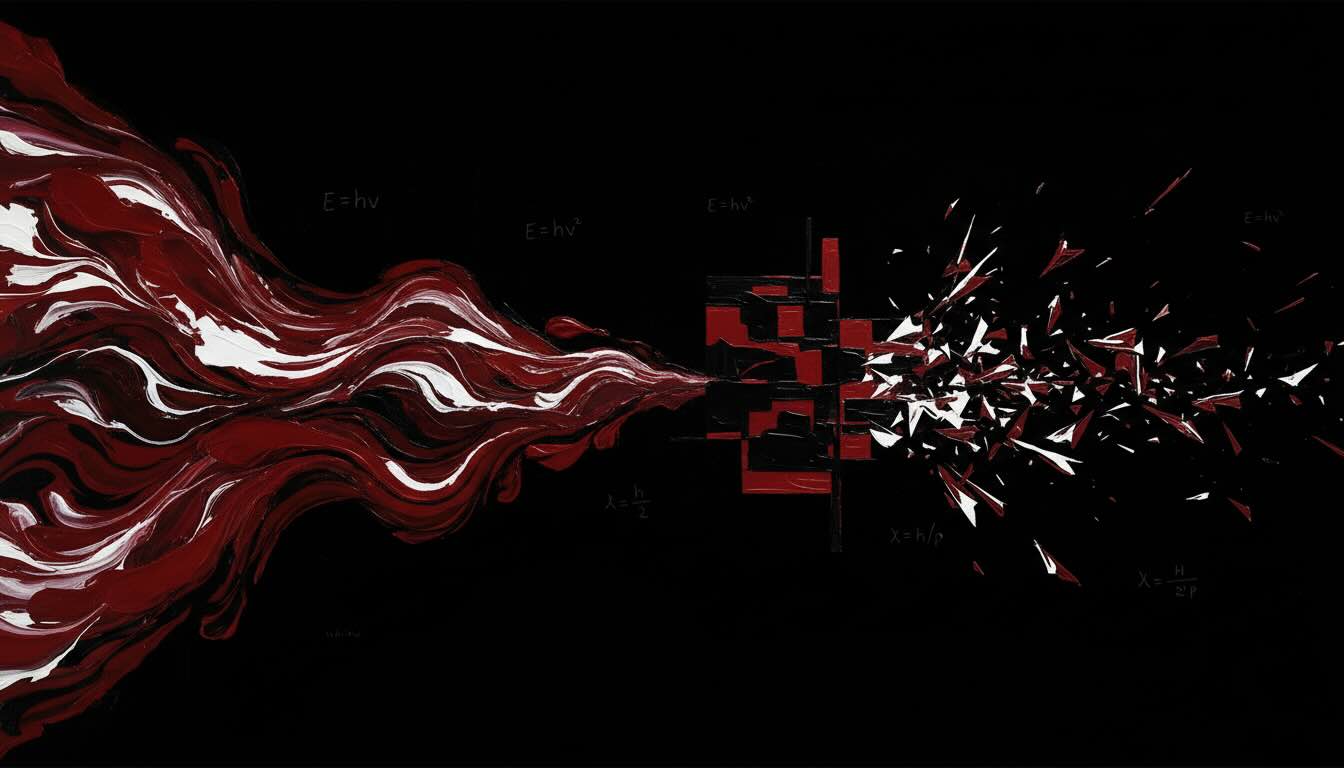
In our daily lives, things are distinct categories. A tennis ball is a particle; the sound of a violin is a wave. They behave differently. A ball bounces off a wall; sound waves bend around corners. However, deep within the Quantum Realm, this distinction vanishes. Matter possesses a dual nature, behaving as both a particle and a wave simultaneously. This concept, known as wave-particle duality, is the heartbeat of quantum mechanics.
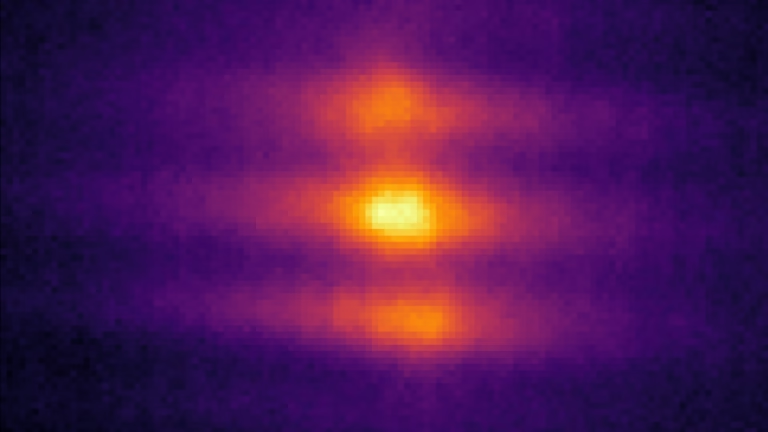
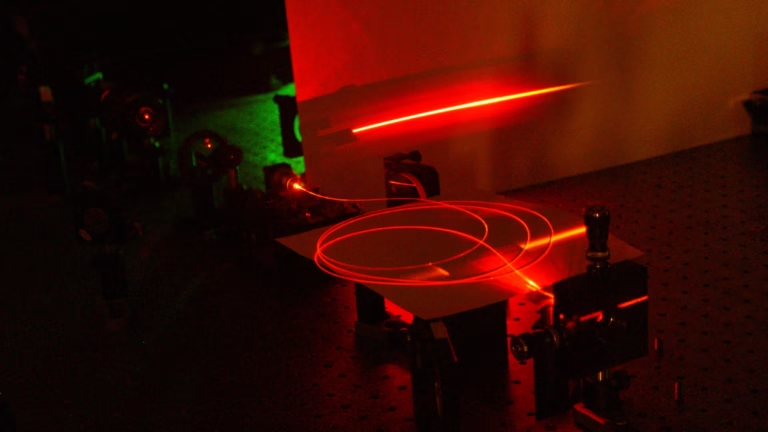
Imagine a bowler rolling a ball down a lane toward two open doors. In our world, the ball goes through one door or the other. But if the bowling ball were a quantum particle, it would behave like a ripple in a pond. It would pass through both doors at the same time, interfere with itself on the other side, and strike the back wall in a pattern that only a wave could create. Yet, the moment we place a sensor to track which door it went through, the wave collapses. The ball suddenly behaves like a solid object again, choosing a single path. This suggests that the universe operates on a system of fluid probabilities until an interaction forces it to make a decision.
This duality implies that the fundamental building blocks of you, me, and the stars are not static points in space. Instead, they are smears of possibility. An electron orbiting a nucleus is not a planet orbiting a sun; it is a vibrating cloud of potential locations. It exists everywhere in that cloud at once, only settling into a specific coordinate when it is required to interact with something else.
Visualizing the Observer Effect
The Mystery of Superposition
The concept of the “smear of possibility” leads us to the idea of superposition. This is perhaps the most famous and misunderstood aspect of the Quantum Realm. To visualize this, imagine a coin spinning on a table. While it is spinning, is it heads or tails? It is neither, and yet, in a blur of motion, it is effectively both. It represents the potential for heads and the potential for tails simultaneously. It is only when the coin is stopped—when it is measured—that it becomes one or the other.
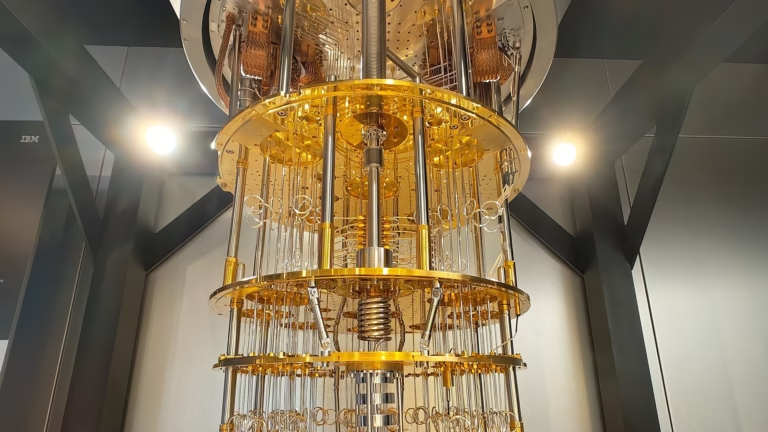
In the quantum world, particles remain in this spinning state indefinitely until they are observed. This allows for complex systems where atoms can explore multiple pathways at the same time. This is the underlying principle behind the immense power of quantum computing. Where a classical computer works with bits that are either 0 or 1 (heads or tails), a quantum computer works with qubits that are in superposition (spinning). This allows them to perform vast numbers of calculations simultaneously, solving problems in seconds that would take traditional supercomputers millions of years.
It is difficult for the human mind to grasp because we never see a chair that is both there and not there. We never see a car that is simultaneously red and blue. But the data confirms that at the microscopic level, this state of multiplicity is the default setting of reality. We live in a world of definite outcomes built upon a foundation of infinite maybe’s.
Probability Distribution in a Quantum State
The particle does not exist at A or B until observed. It exists as a wave function distributed across these probabilities.
Get the next one by email
Power, cooling, chips and the rules that shape them. No spam, unsubscribe any time.
The Connection of Entanglement
If superposition challenges our idea of location, quantum entanglement challenges our idea of separation. This phenomenon occurs when two particles become linked in such a way that the state of one instantly influences the state of the other, regardless of how far apart they are. Albert Einstein famously referred to this as “spooky action at a distance,” as it seemed to violate the rule that nothing can travel faster than the speed of light.
Imagine you have a pair of magical dice. You take one to New York and send the other to Tokyo. When you roll your die in New York and it lands on a six, the die in Tokyo—at that exact same instant—will land on a one (assuming they are entangled to show opposite results). There is no signal sent between them; the radio waves would take too long. Instead, they behave as a single entity sharing a single existence, despite the physical space between them.
This suggests that, at a fundamental level, the universe is far more interconnected than it appears. Space may not be the divider we think it is. In the Quantum Realm, separation is an illusion. Two particles that have interacted once may remain connected forever, dancing in unison across the cosmos. This has profound implications for the future of communication, potentially allowing for the transfer of information that cannot be intercepted or hacked, creating a security system guaranteed by the laws of physics themselves.
The Observer Effect in the Quantum Realm
Perhaps the most philosophical aspect of this science is the role of the observer. We tend to think of science as the study of an objective reality that exists “out there,” independent of us. But quantum mechanics introduces a subjective element. The observer effect dictates that we cannot watch the system without becoming part of the system. The tools we use to measure—light, electrons, sensors—interact with the quantum particles, altering their state.
This does not necessarily mean that human consciousness controls reality, but it does mean that interaction is inescapable. We are not merely an audience watching the play of the universe; we are actors on the stage. Every measurement is an intervention. This realization forces a humility upon science. We can predict probabilities with incredible accuracy, but we cannot predict specific individual events with certainty. We trade the comfort of the absolute for the accuracy of the probable.
Quantum Computing Power: A Trajectory
Strategic Insight: The curve represents the “Quantum Advantage” inflection point, where quantum systems begin to solve problems physically impossible for classical supercomputers.
The Fabric of Reality
Why does any of this matter to the layperson? Because the Quantum Realm is not just a theory on a chalkboard; it is the engine of our reality. The sun shines because of quantum tunneling, which allows particles to fuse together despite not having enough energy to do so according to classical physics. Your smartphone works because we have learned to manipulate the flow of electrons using quantum principles. The stability of matter itself relies on the specific rules of electron orbits.
More importantly, exploring this field expands the horizon of human thought. It reminds us that the universe is not obligated to make sense to us. It operates on a logic that is stranger, more fluid, and more interconnected than our intuition can handle. The beauty of physics at this level is that it replaces the rigid bars of a cage with the fluid notes of a song. It tells us that at the deepest level, reality is not made of hard, unyielding stuff, but of potential, relationship, and change.
As we continue to peel back the layers of the Quantum Realm, we are likely to find even more surprises. We may discover that time is an emergent property, or that multiple universes exist stacked on top of one another. But even with what we know now, the view is breathtaking. We are part of a universe that is vibrant and alive with possibility, a place where the act of looking is an act of creation, and where everything, from the smallest particle to the largest galaxy, is engaged in a mysterious, elegant dance.
Cite this article
Piro, V. (2026, February 28). Unveiling the Quantum Realm: The Invisible Architecture of Reality. ScienceShot. https://scienceshot.com/post/unveiling-the-quantum-realm-the-invisible-architecture-of-reality
Piro, Viros. “Unveiling the Quantum Realm: The Invisible Architecture of Reality.” ScienceShot, 28 Feb. 2026, scienceshot.com/post/unveiling-the-quantum-realm-the-invisible-architecture-of-reality.
Piro, Viros. “Unveiling the Quantum Realm: The Invisible Architecture of Reality.” ScienceShot, February 28, 2026. https://scienceshot.com/post/unveiling-the-quantum-realm-the-invisible-architecture-of-reality.
@online{scienceshot-unveiling-the-quantum-realm-2026,
  author       = {Piro, Viros},
  title        = {{Unveiling the Quantum Realm: The Invisible Architecture of Reality}},
  organization = {ScienceShot},
  date         = {2026-02-28},
  year         = {2026},
  url          = {https://scienceshot.com/post/unveiling-the-quantum-realm-the-invisible-architecture-of-reality}
}
https://scienceshot.com/post/unveiling-the-quantum-realm-the-invisible-architecture-of-reality
Get the weekly brief
Sourced analysis of data-centre engineering and regulation, every Monday. No spam, unsubscribe any time.