
Key takeaways
- NVIDIA’s own Open Compute Project blog gives 120 kW of cooling capacity for a GB200 NVL72 rack, Supermicro lists 132 kW, and Lenovo gives 135 kW TDP (up to 155 kW at peak) for the GB300 NVL72.
- In our worked example, a 132 kW rack needs about 191 L/min of water at a 10 K temperature rise if all heat goes into the liquid, and about 172 L/min if 90% does. A 25% propylene glycol mix needs 3.4% more volume.
- Lenovo’s flow table for a GB300 rack rises from 59 L/min at 25 °C supply water to 177 L/min at 45 °C. By our reading, 177 L/min is what a 10 K rise needs, so warmer water means more flow.
- German law (EnEfG §11) requires a PUE of 1.2 and a heat-reuse share of 10% for sites starting from 1 July 2026, with planned shares of 15% and 20% from 1 July 2027 and 2028. A government bill would loosen the limits for existing sites and is not law.
- 3M said in December 2022 that it would stop making fluorinated fluids by the end of 2025. The EU-wide PFAS restriction was still in committee in May 2026, and no opened source says whether immersion fluids will be exempt.
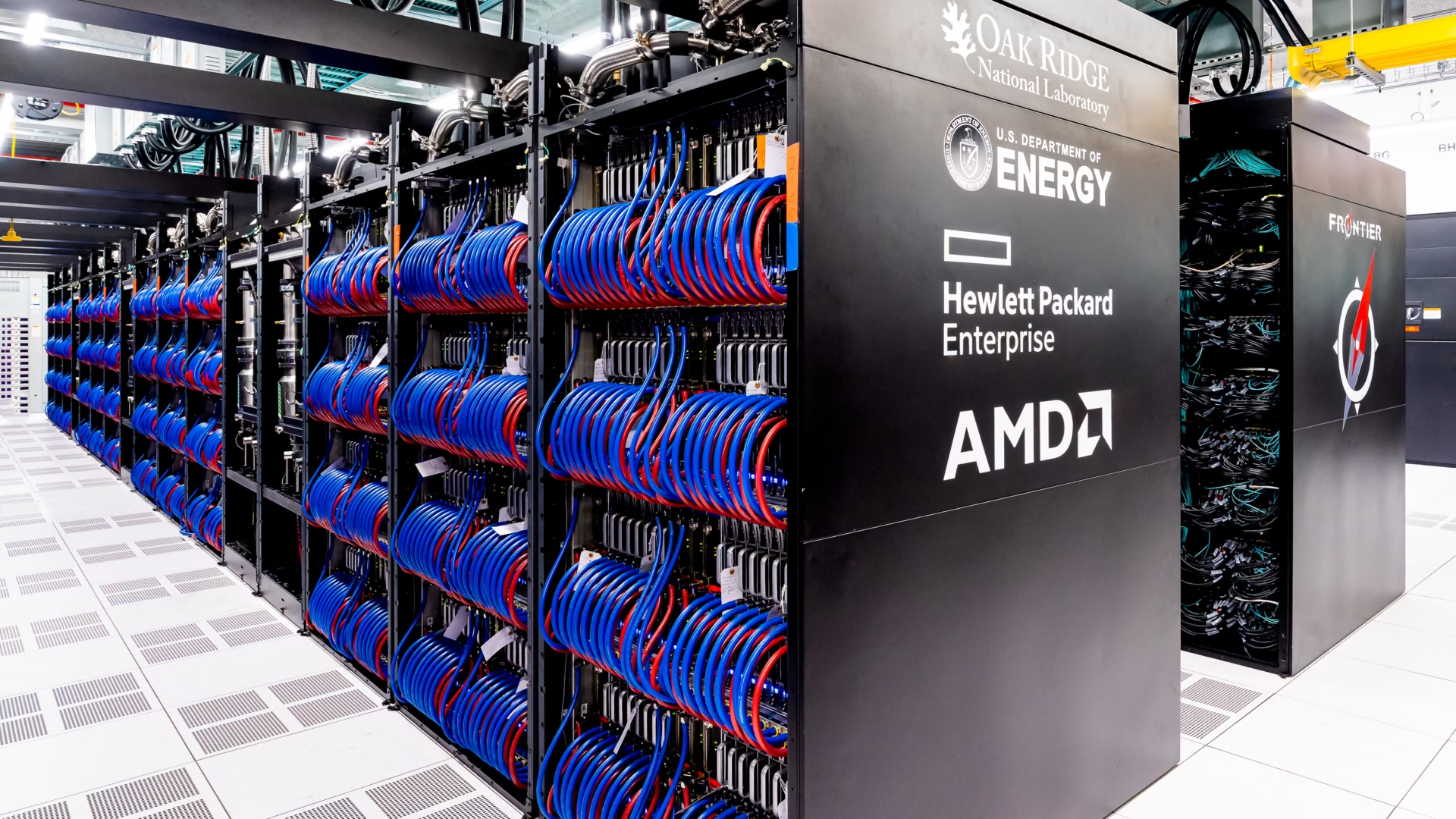
NVIDIA’s product page for the GB200 NVL72 gives no rack power. Two other documents fill the gap. NVIDIA’s contribution to the Open Compute Project says the rack needs 120 kW of cooling capacity, met with direct liquid cooling. Supermicro’s page for the same rack lists a total power of 132 kW. For the GB300 NVL72, Lenovo’s product guide gives 135 kW TDP (thermal design power, the heat the hardware is built to shed) and up to 155 kW at peak.
The next rack, Vera Rubin NVL72, is fully liquid-cooled with a 45 °C supply temperature, according to NVIDIA. We found no rack power figure from NVIDIA for it. NVIDIA does say its 800 VDC power design is meant to support 1 MW IT racks starting in 2027. Our reference on 800 V DC power for AI racks covers the electrical side, and the AI accelerator power dataset lists the per-chip figures behind these racks.
Air has no single published ceiling, but ASHRAE gives the arithmetic. A 2021 white paper from ASHRAE Technical Committee 9.9 says a 40 to 50 kW rack could need up to 5,000 cfm of air (cubic feet per minute). The best floor tile it cites delivers 1,900 cfm. That is about 2.6 tiles for one rack (our arithmetic). The same paper says fans take 10% to 20% of power in denser servers, at least 5 kW in a 50 kW rack. These figures describe a raised-floor hall, so they are a limit of that layout. A 132 kW rack is roughly three times the range ASHRAE examined.
How each method moves heat
Direct-to-chip cooling fits a cold plate, a metal block with channels inside, onto each hot chip. Coolant (water, or water with propylene glycol) flows through the plates and carries heat to a coolant distribution unit, or CDU. The CDU passes the heat through a heat exchanger to the building’s facility water. The share of heat that reaches the liquid depends on how many parts carry cold plates. Lenovo cools the processors and switch chips of its GB300 rack with liquid and leaves optical modules, drives and power boards to air. It puts the split at about 90% to liquid and 10% to air. A 2014 test by the US National Renewable Energy Laboratory (NREL) of CPU-only cold plates put up to 64% of server heat in the liquid at an outlet of 89 °F (32 °C), and about 48% near 100 °F (38 °C). Supermicro claims up to 98% per rack for its newest design, which is a vendor claim. NVIDIA says Rubin has no fans. The range therefore depends on the hardware generation, from under half to all of the heat.
In single-phase immersion, servers sit in a bath or a sealed chassis filled with a dielectric liquid, one that does not conduct electricity. The liquid stays liquid. Natural or forced flow moves it across the hardware and through a heat exchanger. The Open Compute Project’s immersion requirements name three fluid groups: synthetic hydrocarbons, esters and fluorochemicals. They say mineral oils should be avoided. The vendor Asperitas says about 99% of IT energy is captured in the liquid. We treat that as a claim.
Two-phase immersion uses a fluid that boils at the hot surfaces. The vapour rises to a heat exchanger, condenses and returns to the bath, driven by buoyancy. The fluid must boil at a low temperature, so in practice it is a fluorinated liquid (our reading, since the same OCP document lists fluorochemicals among the immersion fluid groups).
Retrofitting air-cooled halls is a separate question that this page does not cover.
Worked example: coolant flow for a 132 kW rack
The question is how much coolant must flow to carry the heat of a 132 kW rack when the coolant warms by 10 K between inlet and outlet. A 10 K step is 10 degrees Celsius. We use the Supermicro figure for a GB200 NVL72 rack. The energy balance gives two lines:
mass flow (kg/s) = P ÷ (cp × ΔT)
volume flow (m³/s) = mass flow ÷ ρ
P is the heat in kW. The specific heat cp (kJ/kg/K) is the energy needed to warm 1 kg by 1 K. ΔT is the temperature rise in K. The density ρ is in kg/m³. We take properties at 35 °C, the middle of a 30 to 40 °C loop. For water, cp is 4.1795 and ρ is 993.99, from the NIST Chemistry WebBook. For PG25, a mix of 25% propylene glycol by volume, cp is 3.947 and ρ is 1017.95. Those are our linear averages of the 20% and 30% columns in Dow’s DOWFROST guide, whose columns are percent by volume and which has no 25% column.
For water with 100% of the heat in the liquid: 132 ÷ (4.1795 × 10) = 3.158 kg/s. Dividing by 993.99 kg/m³ gives 3.177 × 10⁻³ m³/s, which is 190.6 L/min. For PG25: 132 ÷ (3.947 × 10) = 3.344 kg/s, which is 3.285 × 10⁻³ m³/s or 197.1 L/min. The table repeats the sum for the capture fractions from the previous section.
| Case | Heat to liquid | Water (kg/s) | Water (L/min) | PG25 (kg/s) | PG25 (L/min) |
|---|---|---|---|---|---|
| 100% to liquid | 132.0 kW | 3.16 | 190.6 | 3.34 | 197.1 |
| 90% (Lenovo GB300 split) | 118.8 kW | 2.84 | 171.6 | 3.01 | 177.4 |
| 64% (NREL 2014, CPU-only, upper figure) | 84.5 kW | 2.02 | 122.0 | 2.14 | 126.2 |
At a 10 K rise the rule of thumb is about 1.44 L/min per kW with water and 1.49 L/min per kW with PG25. Flow scales with 1/ΔT, so a 5 K rise doubles it. PG25 needs 3.4% more volume and 5.9% more mass flow than water. Using the GB300 figure of 135 kW TDP instead adds 2.3%.
A vendor table gives a cross-check. Lenovo’s GB300 NVL72 guide lists the flow the rack needs at each supply temperature: 59 L/min at 25 °C, 71 at 30 °C, 89 at 35 °C, 119 at 40 °C and 177 L/min at 45 °C, with a pressure drop of 2.3 to 18.4 psi. Lenovo does not state the coolant or the temperature rise. We took 90% of 135 kW, which is 121.5 kW, and worked backwards with water properties. The rise comes out at 29.7 K at 59 L/min and 9.9 K at 177 L/min. The 10 K reading is our inference. It matches NVIDIA’s blog, which describes coolant entering a chip at 45 °C and leaving at roughly 55 °C. Warmer supply water needs more flow, probably because the chips then tolerate a smaller rise.
The calculation covers one loop in steady state with a uniform 10 K rise. It does not size pumps or pipes, and it ignores pressure drop and the balance of flow between servers. Dow’s table reads about 1.5% low for pure water against NIST, and the PG25 value may be low by a similar amount. Treat the last digit as noise.
Facility water temperature
Facility water is the loop between the CDU and the heat-rejection equipment outside. In 2021 ASHRAE TC 9.9 renamed its water classes so that each name carries the upper supply temperature in °C. Every class has a lower limit of 2 °C (source: the same white paper).
| Class | Former name | Supply temperature |
|---|---|---|
| W17 | W1 | 2 to 17 °C |
| W27 | W2 | 2 to 27 °C |
| W32 | W3 | 2 to 32 °C |
| W40 | new in 2021 | 2 to 40 °C |
| W45 | W4 | 2 to 45 °C |
| W+ | W5 | Above 45 °C |
Three temperatures are easy to confuse. The W class describes facility water. NVIDIA’s 45 °C is the supply to the rack loop. The CDU sits between them and needs a temperature gap across its heat exchanger, called the approach. Vertiv rates its liquid-to-liquid CoolChip CDU models at a 4 °C approach, and the CoolIT CHx2000 at 5 °C. A 45 °C rack supply therefore needs facility water of roughly 40 to 41 °C, at or just above the W40 limit (our arithmetic).
Warm water has a cost. ASHRAE says most cold plate designs run well on W32 water, with chip case temperatures of 80 to 90 °C. In its dense 1U test case, W45 water cuts cooling capability to about that of a conventional air-cooled system with a low cold aisle temperature. It also warns that facility water may have to come down toward W32 or W27 as chips are designed to run cooler.
What warm water can allow is shown by NLR, the US national laboratory formerly named NREL. Its high-performance computing hall has no mechanical refrigeration. The water used for computer cooling is up to 75 °F (24 °C), and it leaves the systems at around 100 °F (38 °C) to heat the site’s offices and labs. The lab reports a PUE of 1.036. PUE, power usage effectiveness, is total facility energy divided by IT energy. Water use still depends on the heat-rejection device. NLR says its evaporative towers would have consumed about 2 million gallons a year. It describes a hybrid approach, with a prototype thermosyphon cooler (a type of dry cooler, which rejects heat to outside air through finned coils with no evaporation) placed ahead of the towers, as cutting annual cooling water by more than half. The page gives no achieved figure. Our article on AI data centre water moved offsite covers the wider water picture.
ASHRAE says warm-water cooling minimizes or eliminates the need for chillers. It cites SuperMUC-NG in Germany, cooled with 40 to 45 °C water. Lenovo says inlet water for the GB300 rack can be as high as 45 °C and that dry coolers use a fraction of the energy of chillers. The roughly 10% of heat that goes to air still needs room air conditioning. Ali Heydari of NVIDIA says some climates might need chillers only outside roughly 1% of the year, an estimate with no climate stated.
Direct-to-chip against immersion
Each cell below is backed by a source named in this page. Where we found none, the cell says so.
| Row | Direct-to-chip (cold plate) | Single-phase immersion | Two-phase immersion |
|---|---|---|---|
| How heat leaves the chip | Cold plates on chips, coolant loop to a CDU | Dielectric liquid circulates across the hardware and through a heat exchanger, and stays liquid | Fluid evaporates at hot surfaces, vapour condenses at a heat exchanger and returns (OCP) |
| Heat captured by the liquid | About 90% (Lenovo, GB300); 48% to 64% for CPU-only plates (NREL, 2014); up to 98% (Supermicro claim); 100% for Rubin (NVIDIA) | About 99% (Asperitas claim) | Not established |
| Fluid | Water, or water with propylene glycol; Lenovo lists deionised water or PG25 for GB300 | Synthetic hydrocarbons, esters or fluorochemicals; OCP says to avoid mineral oils | Fluorinated liquids in practice (our reading); OCP lists fluorochemicals as an immersion fluid group |
| Facility water | 45 °C supply for Rubin (NVIDIA); inlet up to 45 °C for GB300 (Lenovo) | GRC lists 13 kW (Nano model, 32 °C water) up to 368 kW per CDU (13 °C water; the footnote assumes coolant near 50 °C) | Not established |
| Format | Cold plates and manifolds in the rack, CDU in or beside it | Sealed chassis or open bath tank (OCP) | Not established |
| PFAS exposure | Water and glycol coolants are not fluorinated | Hydrocarbons and esters sit outside 3M’s fluorinated stream (our reading) | Depends on the fluorinated fluid; exemption outcome not established |
| Floor loading and serviceability | Not established | Not established | Not established |
Fluids and PFAS
PFAS (per- and polyfluoroalkyl substances) are a large family of fluorine-based chemicals. On 20 December 2022 3M announced that it would exit PFAS manufacturing by the end of 2025. The release lists fluorinated fluids among the products it would discontinue. It does not name individual product lines, and we could not open the 3M pages that do.
The EU is also working on a restriction covering PFAS in general. Our only readable source on its status is a May 2026 review by the law firm Greenberg Traurig, because ECHA’s own site blocked automated reading. The review says the Risk Assessment Committee supports strict EU-wide limits, that the Socio-economic Analysis Committee published a draft opinion in March 2026, and that its final opinion is expected at the end of 2026. The European Commission would then propose an amendment to REACH Annex XVII. The review does not mention cooling fluids, and we found no opened source that says whether immersion fluids will be exempt.
The exposure differs by fluid. The water and glycol loops in the systems above use no fluorinated fluid. Single-phase hydrocarbons and esters fall outside the fluorinated stream, in our reading. Two-phase systems depend on a fluorinated fluid, and their supply and future status are the open question. We verified no two-phase product page, so we describe the method and name no vendor.
German and EU rules
Germany’s Energy Efficiency Act, in §11 of the EnEfG, sets two limits. Data centres that were in operation before 1 July 2026 must reach an annual average PUE of 1.5 or lower from 1 July 2027, and 1.3 or lower from 1 July 2030. Data centres that start operating from 1 July 2026 must reach a PUE of 1.2 or lower. They must also reuse a share of their energy, measured as ERF (energy reuse factor, here the share of energy reused as heat under DIN EN 50600-4-6). The required share is 10% for sites starting from 1 July 2026, and a planned share of 15% from 1 July 2027 and 20% from 1 July 2028. Sites must meet these on an annual average within two years of start. The act allows exemptions from the ERF target, for example when a heat-network operator does not accept a cost-based offer within six months. It does not mention liquid cooling or fluid temperatures.
A government bill, Drucksache 21/8027 of 16 September 2026, would change this. It sets PUE 1.6 from 1 July 2027 and 1.4 from 1 July 2030 for existing sites, gives new sites four years instead of two, and keeps the ERF steps at 10%, 15% and 20%. It is not law. The Bundestag held a first reading on 24 September and a committee hearing on 5 October 2026, and we found no final vote. The bill’s explanatory text says a PUE of 1.2 cannot be reliably reached with modern circulating-air cooling, citing industry information. That is the government’s assumption. Our PUE dashboard article covers PUE figures for 2025.
At EU level, Article 12 and Annex VII of the Energy Efficiency Directive (EU) 2023/1791 require operators with at least 500 kW of installed IT power to publish data every year by 15 May. The KPIs include energy use, power utilisation, temperature set points, waste heat use, water use and renewable energy. Article 26(6) says data centres above 1 MW of rated energy input must use their waste heat unless that is not technically or economically feasible. Article 26(7) asks for a cost-benefit analysis for new or refurbished sites above 1 MW. The analysis must consider cooling solutions that capture waste heat at a useful temperature with minimal extra energy. That sentence is the clearest textual link to warm-water liquid cooling.
The reporting scheme in Delegated Regulation (EU) 2024/1364 defines the numbers. Annex II asks for waste heat reused, the average waste heat temperature (the temperature of the fluid cooling the ICT equipment, averaged over the year, measured where it enters the heat exchangers) and the average intake air set point. Annex III defines ERF as reused energy divided by total data centre energy. The EU and German ERF are in the same family but not guaranteed to match in every case. A 55 °C return loop and a 35 °C return loop would report different waste heat temperatures, in our reading. Our EED KPI calculator, the guide to EED reporting and the regulation tracker work through these figures, and the glossary defines the terms.
Who makes what
The table lists products whose own page we opened, sorted by company name. A listing is not a recommendation, and every capacity figure is the vendor’s own and untested. CDU means coolant distribution unit.
| Company | Product | Category | What the vendor page says |
|---|---|---|---|
| Asperitas | PNC and DFCX1 | Single-phase immersion | PNC uses natural convection with no pump. DFCX1 uses forced convection with an integrated CDU. The page’s capacity figures are inconsistent, so we quote none. |
| CoolIT Systems | CHx2000 | CDU | Row-level liquid-to-liquid unit rated at 2,000 kW at a 5 °C approach, with 2,125 L/min at 35 psi. |
| CoolIT Systems | Coldplates | Cold plate | Plates for CPUs, GPUs, ASICs and peripherals. The page lists a validated 15kW coldplate. |
| GRC (Green Revolution Cooling) | ICEraQ | Single-phase immersion | Racks in fluid with a CDU. The page lists capacities from 13 kW (the Nano model, with 32 °C water) up to 368 kW of IT load per CDU with 13 °C water. The 368 kW footnote assumes coolant near 50 °C, and capacity depends on the hardware. |
| Iceotope | Precision liquid cooling and data centre reference design | Chassis-level immersion | Cools processors, memory, storage and power supplies in one design that combines direct-to-chip and full immersion cooling. |
| LiquidStack | CDU-1MW | CDU | A 1,350 kW CDU for direct-to-chip cooling, certified ETL, CSA and CE, announced 22 August 2024. |
| Motivair by Schneider Electric | Coolant Distribution Units | CDU | Units scaling from 105 kW to 2.5 MW each. |
| Motivair by Schneider Electric | Dynamic Cold Plates | Cold plate | Plates for AMD SP3, SP5 and MI300, Intel Ice Lake and Sapphire Rapids, and NVIDIA SXM5. |
| nVent | RackChiller CDU800 | CDU | Row-level liquid-to-liquid unit rated at 800+ kW at 6 K (the page does not say which temperature difference this is), with 850 L/min on the primary side. |
| Vertiv | CoolChip CDU | CDU | In-rack, in-row and perimeter models. The page’s table runs from 70 kW (liquid-to-air, 11 °C approach) to 2,300 kW (liquid-to-liquid, 4 °C approach), while its FAQ says 70 to 1,350+ kW. |
Two ownership changes affect this list. Schneider Electric completed the purchase of an initial 75% controlling stake in Motivair on 28 February 2025, and expects to acquire the remaining 25% in 2028. Schneider’s announcement of 17 October 2024 put the cash price for that stake at USD 850 million, which includes the value of a tax step-up. Boyd said on 12 March 2026 that it had completed the sale of its thermal business to Eaton for USD 9.5 billion, first announced on 3 November 2025. We could not open Eaton’s own release.
References
- NVIDIA Technical Blog, 15 October 2024, NVIDIA Contributes NVIDIA GB200 NVL72 Designs to Open Compute Project
- Supermicro, SuperServer SRS-GB200-NVL72 product page
- Lenovo Press LP2357, Lenovo NVIDIA GB300 NVL72 Rack Scale AI Product Guide, updated 30 August 2026
- NVIDIA Technical Blog, 20 May 2025, NVIDIA 800 VDC Architecture Will Power the Next Generation of AI Factories
- NVIDIA Technical Blog, 5 January 2026, Inside the NVIDIA Rubin Platform
- NVIDIA blog, 21 June 2026, Hotter Than a Hot Tub: The 45°C Breakthrough to Cool AI’s Biggest Machines
- ASHRAE TC 9.9, Emergence and Expansion of Liquid Cooling in Mainstream Data Centers, white paper, 2021
- Supermicro press release, 14 May 2025, DLC-2 direct liquid cooling solutions
- NREL TP-2C00-62905, Sickinger, Van Geet and Ravenscroft, November 2014 (OSTI record)
- Asperitas homepage
- Open Compute Project, Immersion Requirements, Revision 2.0, 21 January 2022
- NIST Chemistry WebBook, thermophysical properties of water, 30 to 40 °C
- Dow, Engineering and Operating Guide for DOWFROST and DOWFROST HD, February 2008
- NLR, warm-water liquid cooling in the HPC data center, updated 17 February 2026
- NLR, reducing water usage, updated 17 April 2026
- NLR, HPC data center overview
- 3M news release, 20 December 2022, 3M to Exit PFAS Manufacturing by the End of 2025
- Greenberg Traurig, EU PFAS Restriction: Final Consultation on Socio-Economic Analysis Closes 25 May 2026
- Energieeffizienzgesetz (EnEfG), §11, Klimaneutrale Rechenzentren
- Deutscher Bundestag, Economics and Energy Committee hearing on the Energy Efficiency Directive bill, October 2026
- Directive (EU) 2023/1791 on energy efficiency, Official Journal L 231, 20 September 2023
- Commission Delegated Regulation (EU) 2024/1364 of 14 March 2024
- CoolIT Systems, CHx2000 CDU
- CoolIT Systems, coldplate technology
- Vertiv, CoolChip CDU
- Motivair, Coolant Distribution Units
- Motivair, Dynamic Cold Plates
- nVent, RackChiller CDU800
- LiquidStack, CDU-1MW
- GRC, ICEraQ
- Asperitas, systems
- Iceotope, technology
- Iceotope, data centre reference design
- Schneider Electric, 17 October 2024, announcement of the Motivair acquisition
- Schneider Electric, completion of the Motivair acquisition, 28 February 2025
- Bundestag Drucksache 21/8027, government bill, 16 September 2026
- Boyd, 12 March 2026, Boyd Completes the Sale of its Thermal Business to Eaton
- Vertiv, 3 March 2026, completion of USD 2.1 billion senior unsecured bond offering and USD 2.5 billion revolving credit facility
- Vertiv, Q4 and full-year 2025 results, 11 February 2026 (Form 8-K Exhibit 99.1)
Correction, 11 October 2026: this page was rewritten. The earlier version said Vertiv made a USD 4.6 billion liquidity overhaul for liquid cooling on 5 March 2026. Vertiv’s release of 3 March 2026 describes a USD 2.1 billion bond and a USD 2.5 billion revolving credit facility that refinanced existing debt. It does not tie either to liquid cooling. The earlier 252% order growth (Q4 2025 organic orders against Q4 2024) and USD 15 billion backlog (31 December 2025) are Vertiv’s figures for the whole company, not for liquid cooling. The earlier text also gave 1 MW Rubin racks in 2028, whereas NVIDIA’s own statement is that its 800 VDC design supports 1 MW racks from 2027. Statements attributed to Huawei and HPE could not be verified and were removed, as was a rack-density chart with no source.
Cite this article
Turner, A. (2026, March 7). High-Density Liquid Cooling: Direct-to-Chip vs Immersion. ScienceShot. https://scienceshot.com/post/high-density-liquid-cooling-the-4-6-billion-bet-on-gigawatt-scale-ai-factories
Turner, Alex. “High-Density Liquid Cooling: Direct-to-Chip vs Immersion.” ScienceShot, 7 Mar. 2026, scienceshot.com/post/high-density-liquid-cooling-the-4-6-billion-bet-on-gigawatt-scale-ai-factories.
Turner, Alex. “High-Density Liquid Cooling: Direct-to-Chip vs Immersion.” ScienceShot, March 7, 2026. https://scienceshot.com/post/high-density-liquid-cooling-the-4-6-billion-bet-on-gigawatt-scale-ai-factories.
@online{scienceshot-high-density-liquid-cooling-2026,
  author       = {Turner, Alex},
  title        = {{High-Density Liquid Cooling: Direct-to-Chip vs Immersion}},
  organization = {ScienceShot},
  date         = {2026-03-07},
  year         = {2026},
  url          = {https://scienceshot.com/post/high-density-liquid-cooling-the-4-6-billion-bet-on-gigawatt-scale-ai-factories}
}
https://scienceshot.com/post/high-density-liquid-cooling-the-4-6-billion-bet-on-gigawatt-scale-ai-factories
Get the weekly brief
Sourced analysis of data-centre engineering and regulation, every Monday. No spam, unsubscribe any time.

.jpg)