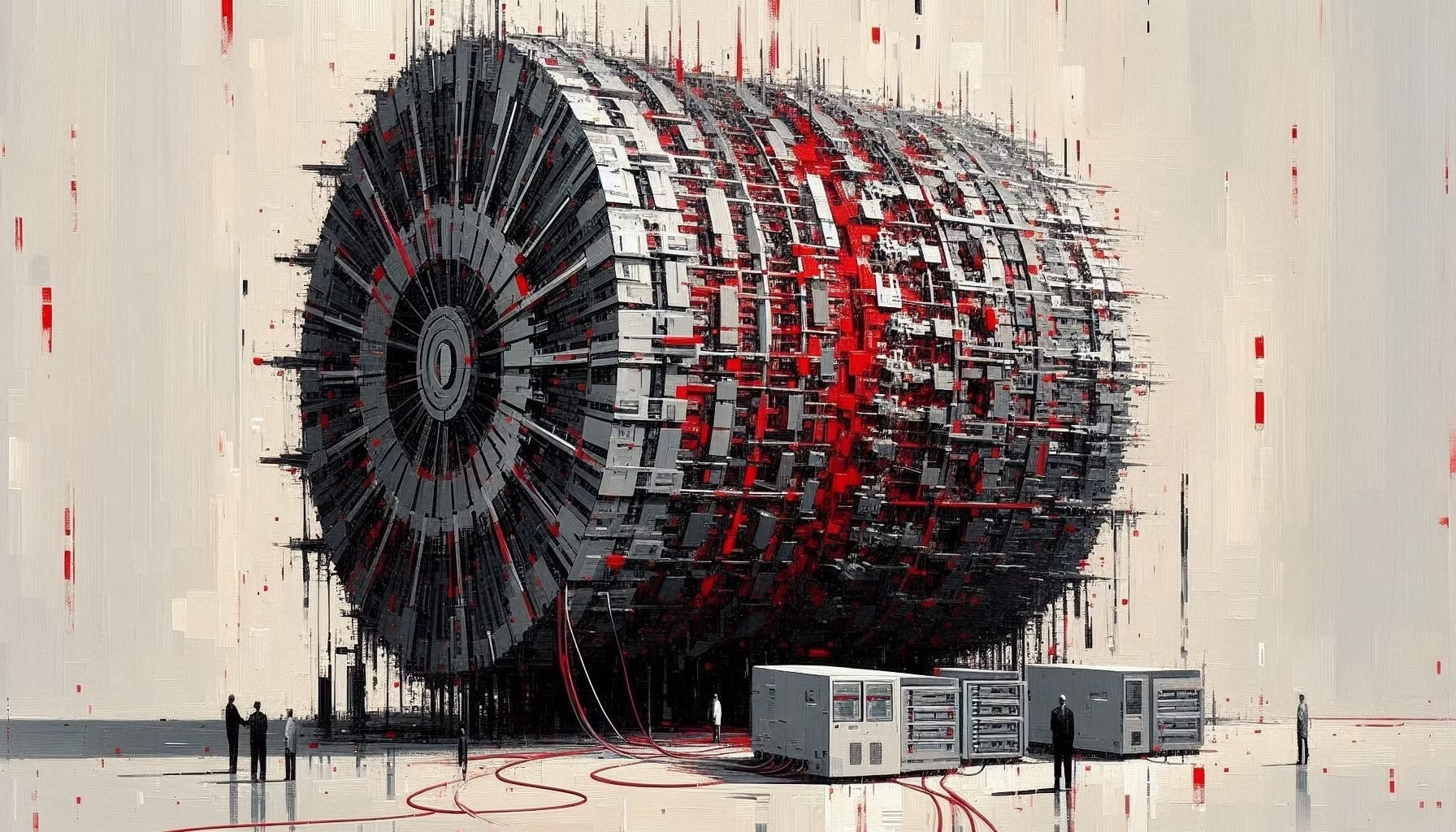
When most people think of CERN, they picture the Large Hadron Collider, massive detectors, and physicists hunting for the building blocks of the universe. What they rarely see is the computing infrastructure that makes it all possible.
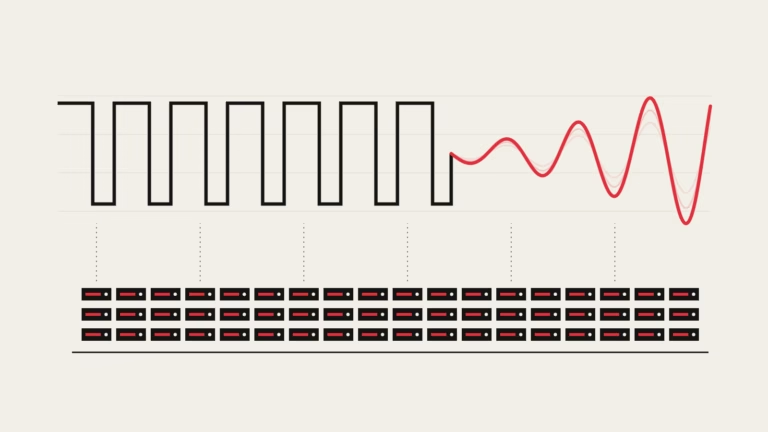
Every collision inside the LHC produces a staggering volume of data — billions of events per second, each recorded by detectors that convert subatomic chaos into digital signals. Most of it is discarded within microseconds. What remains is still enormous: tens of petabytes per year, stored, distributed, and processed across thousands of servers.
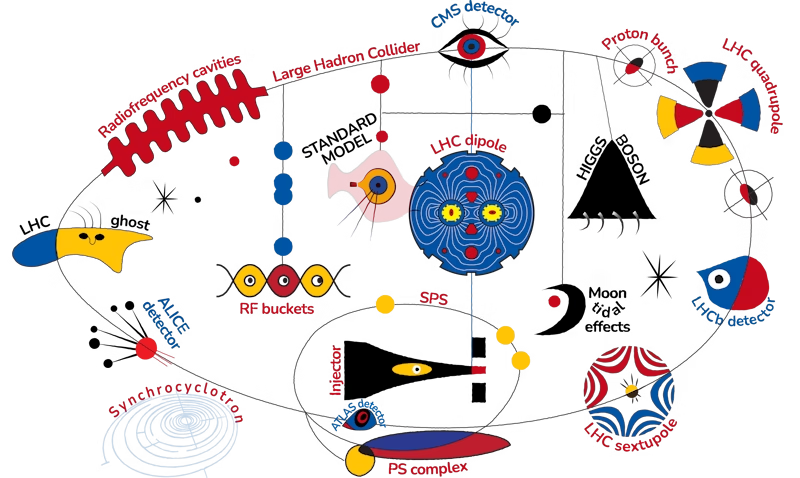
I spent 13 years at CERN, including my PhD on Quantum Physics studying how electrons and protons interact with silicon. What fascinated me most was not just the scale — it was the discipline behind it. Data had to move quickly, securely, and reliably, from where it was generated to where it could be understood. The data centres were the brain of the laboratory. The fibre networks were its neural pathways.
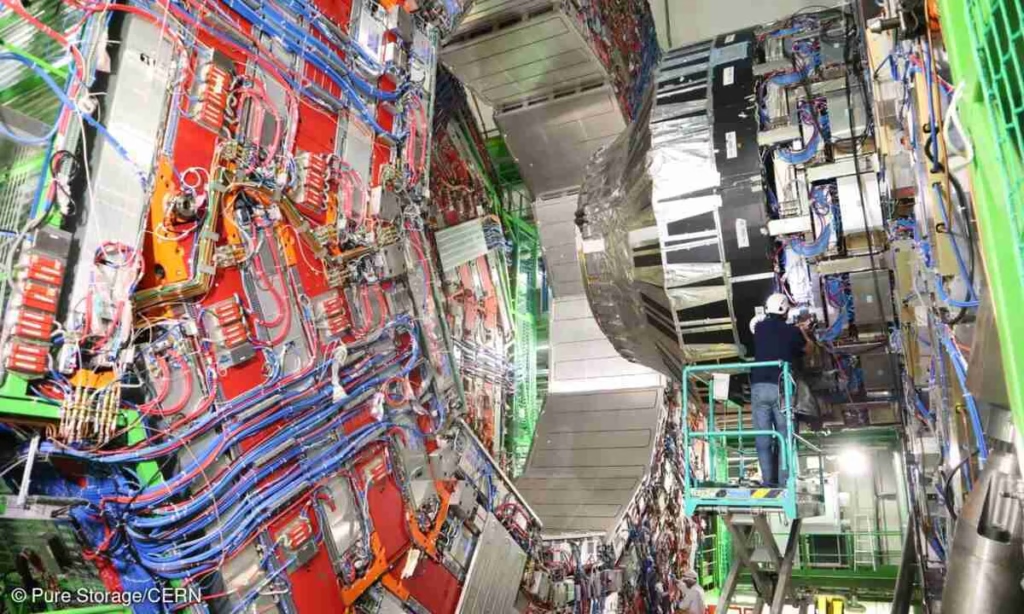
Building those pathways required the same precision as the science they supported. Some optical fibres had to resist radiation and extreme environments. The supply chain alone was a lesson in complexity: fibres manufactured in Japan, cabled in Germany, terminated in China, installed by Polish vendors in Geneva.
I still remember meetings with suppliers where five languages were spoken in a single 30-minute call.
Uptime was non-negotiable. Behind every optical strand was a chain of information pointing toward a potential discovery. You learn quickly that science depends on reliability as much as on intelligence.
Get the next one by email
Power, cooling, chips and the rules that shape them. No spam, unsubscribe any time.
Edge Data Centers: A Familiar Pattern
What many people don’t realise is that CERN’s computing architecture closely mirrors today’s edge data centre model. Small computing nodes sat close to the detectors, processing data locally to reduce volume before sending it upstream. That is exactly the principle behind modern edge infrastructure: keep computation close to the source, reduce latency, save bandwidth.
The analogy goes further. CERN’s data centers must deal with enormous throughput, distributed workloads, and tight energy constraints. Cooling and power optimization became central topics, just like in the commercial data center world. In the past decade, CERN introduced high-efficiency cooling systems and sophisticated monitoring to lower its PUE to about 1.5 in the main Meyrin data centre, with around 1.1 targeted at the new Prévessin centre opened in 2024 — the Power Usage Effectiveness, a metric now familiar to every operator in the industry.
” I still remember the first PUE readings, what an achievement”
The transition from underground caverns to the data hall is, in fact, a journey from chaos to order. Raw data from collisions are incomprehensible streams until they are reconstructed, filtered, and stored. The data center is where matter becomes meaning. And that process, though driven by physics, has its parallels in every modern technology sector. Whether it’s AI models learning from sensor networks, or edge nodes processing industrial telemetry, the pattern is identical: collect, filter, transmit, compute.
Over the years, CERN also became a pioneer in distributed computing through the Worldwide LHC Computing Grid, a network connecting more than 170 data centers in 42 countries. Scientists could analyze data remotely, without ever touching the local servers. It was, in essence, a precursor to today’s cloud computing. The same principle now fuels n-connect network in our nLighten data center : instead of moving petabytes across the planet, you move the computation to the data.
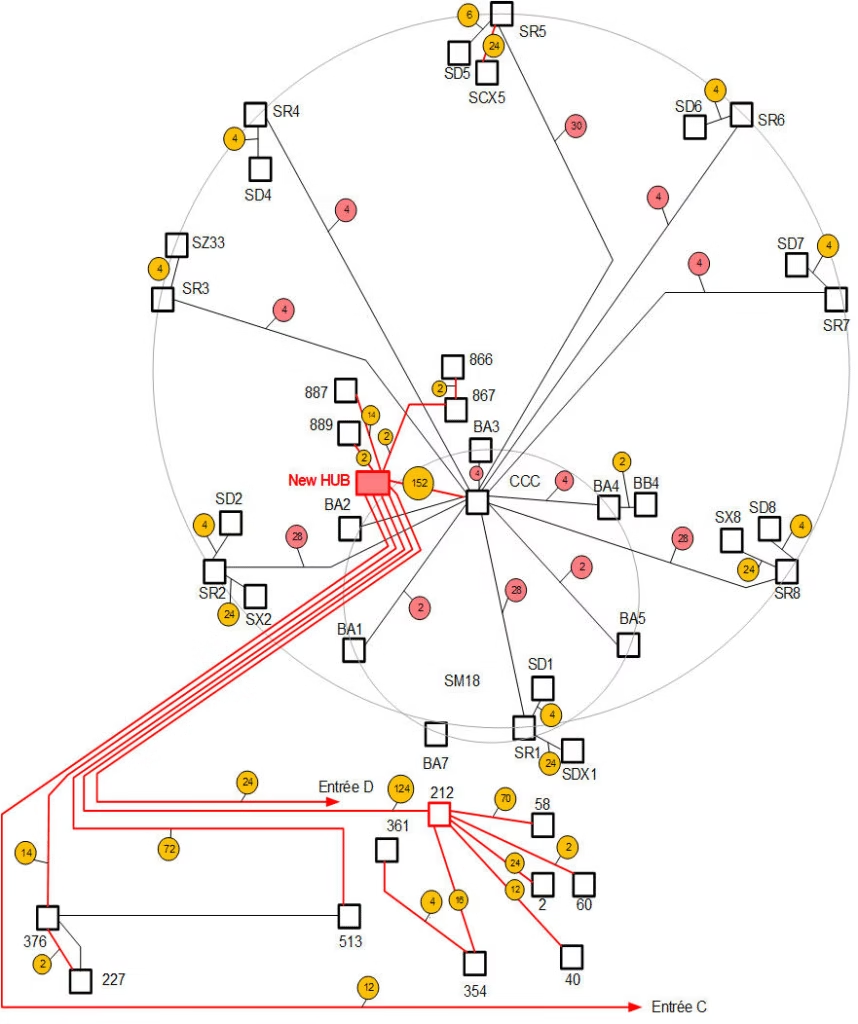
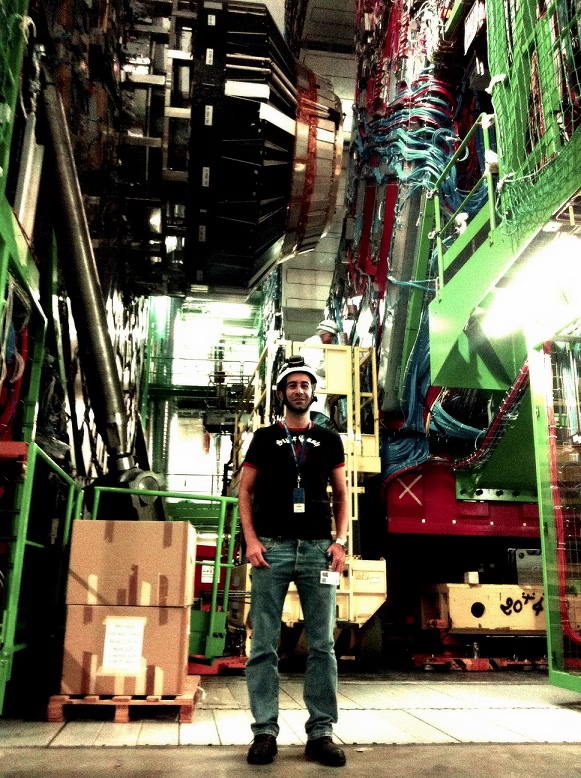
Working inside that ecosystem changed the way I see data centers. They are not warehouses for machines; they are living systems where information flows like energy in a circuit. Every decision — a cable route, a power redundancy, a cooling setting — affects the flow. When you stand in front of a rack, you are not looking at infrastructure, but at an instrument. Each server contributes to the reconstruction of an event that might rewrite the laws of nature.
From Protons to Platforms: Shared Challenges
Eventually, I made the move from science to industry — joining nLighten, a European edge data centre operator. I now lead operations across 34 sites in 7 countries.
At first glance, it might seem like moving from physics to business, from cosmic questions to commercial systems. But the connection is deeper. Today’s edge data centers face similar challenges to those at CERN: the need for reliable low-latency connectivity, sustainable operations, and intelligent data management. The objectives differ, but the mindset doesn’t.
Power efficiency, once a secondary concern, is now a defining one — at CERN and in every commercial facility. The push for lower PUE and renewable integration is universal.
At CERN, the next frontier is the High-Luminosity LHC, expected to produce ten times more data than the current collider. The infrastructure will need to evolve again, with faster fiber links, denser compute nodes, and more intelligent data distribution. In parallel, the commercial world is dealing with its own data explosion — driven by AI, IoT, and the digital economy. Both are trying to answer the same fundamental question:
How do we move and process data — efficiently, reliably, and responsibly?
That question drove me underground at CERN. It drives me across Europe today.
Cite this article
Editorial, S. (2026, May 30). From CERN to the Edge Data Centers. My Long Journey. ScienceShot. https://scienceshot.com/post/from-cern-to-the-edge-data-centers-my-journey
Editorial, ScienceShot. “From CERN to the Edge Data Centers. My Long Journey.” ScienceShot, 30 May 2026, scienceshot.com/post/from-cern-to-the-edge-data-centers-my-journey.
Editorial, ScienceShot. “From CERN to the Edge Data Centers. My Long Journey.” ScienceShot, May 30, 2026. https://scienceshot.com/post/from-cern-to-the-edge-data-centers-my-journey.
@online{scienceshot-from-cern-to-the-2026,
  author       = {Editorial, ScienceShot},
  title        = {{From CERN to the Edge Data Centers. My Long Journey}},
  organization = {ScienceShot},
  date         = {2026-05-30},
  year         = {2026},
  url          = {https://scienceshot.com/post/from-cern-to-the-edge-data-centers-my-journey}
}
https://scienceshot.com/post/from-cern-to-the-edge-data-centers-my-journey
Get the weekly brief
Sourced analysis of data-centre engineering and regulation, every Monday. No spam, unsubscribe any time.