
Here is a number that should stop every AI executive cold: inside a one-million-GPU cluster, the tiny optical plugs that shuttle data between chips draw roughly 180 megawatts all by themselves — enough to power a small city, spent before a single useful calculation happens. That is the dirty secret the industry finally admitted this year, and co-packaged optics is the fix everyone is now racing to ship.
Everyone is reporting that co-packaged optics makes AI networks more power-efficient. My take is blunter: this is the quiet execution of the pluggable transceiver, the most-swapped, most-ignored component in the entire data center. The industry is trading modularity and serviceability for raw bandwidth — and that trade will redraw who controls AI infrastructure.
The GPU Was Never the Real Bottleneck
For three years the AI story has been about GPUs — how many, how hot, how expensive. But a modern AI data center is really a giant network with some accelerators bolted on. Every one of NVIDIA’s flagship GPUs needs roughly six optical transceivers to talk to its neighbours, and those little plugs have quietly become the single largest consumer of networking power in the building.
Scale that up. Across a one-million-GPU cluster, the optical transceivers alone burn close to 180 megawatts — a figure that would have sounded absurd in the 400G era just four years ago. The plugs are also the parts that fail most often, because every pluggable module is a socket, and every socket is a mechanical joint waiting to drift out of spec.
This is the same escalating-cost pattern I flagged when the $1 trillion data center boom started breaking the grid: the industry keeps discovering that the thing nobody was watching is the thing that breaks first. With power it was the substations. With heat it was the rack. Now it is the humble transceiver.
Improving network power efficiency is no longer optional accounting. When the interconnect draws hundreds of megawatts, a 3x reduction is not a rounding error — it is the difference between a feasible cluster and one that cannot be built because the local grid physically cannot supply it. Optics went from an afterthought line item to a first-order constraint on how large a model you can train.
What Co-Packaged Optics Actually Changes
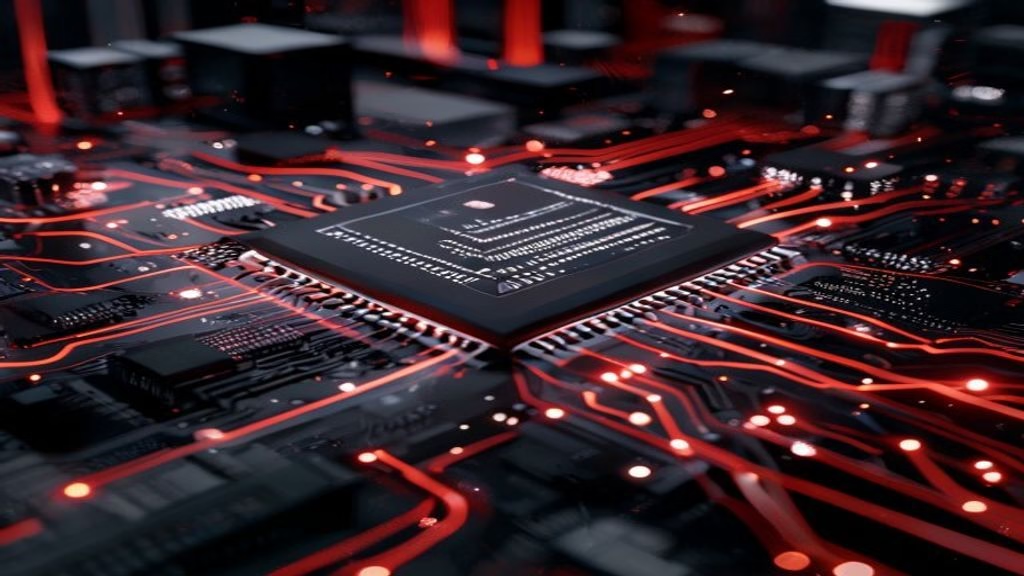
Co-packaged optics (CPO) does something deceptively simple: it moves the optical engine off the switch faceplate and solders it directly onto the same package as the switch chip. Instead of an electrical signal crawling across centimetres of circuit board to reach a pluggable module, light is generated millimetres from the silicon. Shorter electrical paths mean less signal loss, which means less power spent shouting to be heard.
The numbers are striking. Broadcom’s CPO delivers roughly 5.5 watts per 800G port versus about 15 watts for an equivalent pluggable — a 3x cut. NVIDIA goes further, claiming its silicon photonics Spectrum-X switches drop a 1.6T port from around 25 watts to just 9, with up to 3.5x better power efficiency and 10x the network resiliency of pluggable-based designs.
Source: NVIDIA (Spectrum-X Photonics) and SemiAnalysis / Broadcom CPO figures, 2025-2026
There is a subtler win hiding in the architecture. Traditional pluggables each carry their own digital signal processor to clean up the degraded electrical signal — a chip that itself sips several watts and adds latency. By shortening the electrical run, co-packaged optics can lean on far simpler retiming, and external laser sources can be pooled and hot-swapped separately. You are not just saving power per port; you are deleting entire components from the signal chain.
That resiliency point matters more than the wattage. When you remove the connector, you remove the failure mode. This is exactly the lesson we learned at CERN moving petabytes off the LHC detectors: at the bleeding edge of data rates, every pluggable joint is a liability, so the fastest optical links get soldered as close to the silicon as physics allows. The AI data center is now, belatedly, relearning that principle.
Get the next one by email
Power, cooling, chips and the rules that shape them. No spam, unsubscribe any time.
Why 2026 Forced the Industry’s Hand
Timing is everything, and 2026 is the year the math stopped working for pluggables. This is being called the “Year of 1.6T networking,” with the fastest AI clusters adopting it as the default — and 3.2T already visible on the horizon. Each doubling of per-module bandwidth makes the electrical path harder to drive and the power budget uglier.
Copper, the old workhorse for short in-rack links, is hitting a hard physical wall past a meter or two at these speeds. That pushes optics deeper into the system than ever before — which is why the interconnect problem has migrated from between buildings to between chips.
Source: Industry optical-module roadmaps (400G to 3.2T), compiled from OFC 2026 reporting; *3.2T projected.
NVIDIA’s Spectrum-X Photonics switches — up to 409.6 Tb/s across 512 ports — are slated for commercial availability in the second half of 2026, with Broadcom’s Bailly platform already shipping to early customers. Yet co-packaged optics still accounts for only about 0.5% of optical modules in AI data centers today. This is a technology at the very start of a steep adoption curve, not the end.
“By integrating silicon photonics directly into switches, NVIDIA is shattering the old limitations of hyperscale and enterprise networks and opening the gate to million-GPU AI factories,” said CEO Jensen Huang when he unveiled the platforms. Grand, yes — but for once the marketing and the physics point in the same direction.
⚡ PHOTON’S TAKE
Co-packaged optics is being sold as an efficiency story, but it is really a control story. When you solder the light onto the switch, you kill the swappable optic that let operators mix vendors and fix a dead link in sixty seconds. We gain 3.5x power efficiency and lose the ability to open the box. The fastest data centers on Earth are about to become the least repairable ones — and almost nobody is pricing that in.
The Hidden Cost: Modularity Dies
Here is what the celebratory coverage misses. The pluggable transceiver was not a bug; it was a feature. Modularity let operators mix vendors, swap a dead optic in under a minute, and upgrade speeds without ripping out a switch. Co-packaged optics throws much of that away.
When the optics are fused to the switch ASIC, a single failed laser can mean replacing the entire switch. Serviceability collapses, and so does vendor choice — you increasingly buy the optics, the switch, and the GPUs from the same handful of companies. We watched a version of this with power and even with water, where the water didn’t vanish, it just moved off-site and out of sight. Here the cost is optionality itself.
The same density pressure that forced liquid cooling to solve AI’s heat problem is now forcing integration onto the network. Efficiency and consolidation are two sides of the same coin, and the AI supply chain gets narrower with every generation. The physics is beautiful; the market structure it creates is worth watching closely.
What Co-Packaged Optics Kills Next
Co-packaged optics is not a tweak; it is the beginning of the end for the swappable optical module, a design principle that survived twenty years of networking. Within a few years, the fastest switches on Earth will carry no faceplate optics at all — just fiber running straight into a photonic engine fused to silicon.
That is a genuine engineering triumph and a real concentration of power at the same time. The winners will be whoever controls the silicon photonics stack; the quiet losers will be anyone who valued being able to open the box and fix it themselves. For an industry addicted to bandwidth, that trade was always going to be irresistible — and 2026 is the year it became inevitable.
Get the weekly brief
Sourced analysis of data-centre engineering and regulation, every Monday. No spam, unsubscribe any time.