
Key takeaways
- Nvidia’s reference design cools chips through a sealed loop of 75% water and 25% propylene glycol, with heat rejected by dry coolers.
- Microsoft’s Fairwater campus in Mount Pleasant, Wisconsin, runs over 90% closed-loop liquid cooling filled during construction and then recirculated.
- Xylem and Global Water Intelligence found on-site cooling accounts for about 4% of AI’s added water demand through 2050, and power generation roughly 54%.
- U.S. data centers consumed about 17.4 billion gallons directly in 2023, a figure projected to reach 38 to 73 billion gallons by 2028.
- Water reporting should combine on-site and off-site use, and powering AI with wind and solar attacks the 54% share directly.
Here is a magic trick worthy of a Vegas stage. Nvidia and Microsoft have both announced data centers that use almost no water, and the headlines cheered the end of AI data center water guilt. The water bill did not shrink, though. It simply walked out the back door and reappeared at a power plant a hundred kilometres away.
So let me say the quiet part out loud. The water AI consumes did not vanish with closed-loop cooling — it moved off-site, where almost nobody is counting it. Every megawatt a GPU hall pulls from the grid is water evaporated somewhere else, and by the best current estimate that hidden water dwarfs anything happening inside the building. The industry proudly solved the four percent it could see and quietly ignored the fifty-four percent it could not.
The Water-Free Headline Everyone Wanted
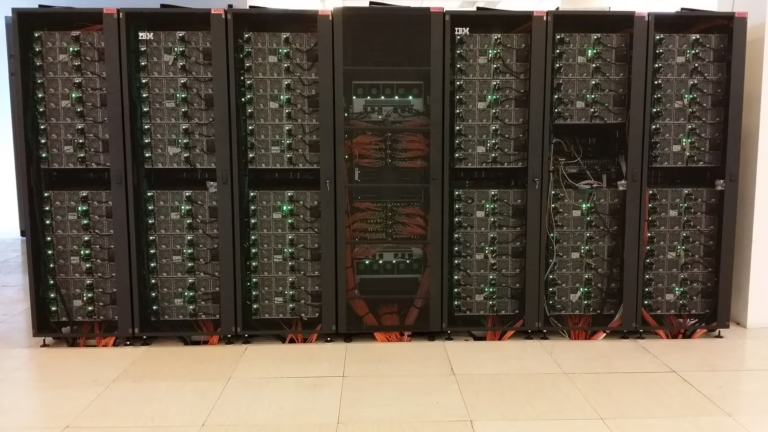
The engineering is genuinely impressive, and I want to be fair to it. Nvidia’s new reference design cools every chip through a sealed loop of 75% water and 25% propylene glycol — the same antifreeze chemistry in your car — pumped through cold plates that sit directly on each processor. There are no fans anywhere in the rack. Heat is carried out to dry cooler radiators and rejected to the air, so the coolant never evaporates and is topped up only once.
Microsoft is telling a similar story with its Fairwater campus in Mount Pleasant, Wisconsin, which runs over 90% closed-loop liquid cooling filled during construction and then recirculated. Its CEO likes to say the site uses about as much water in a year as a single restaurant. That is a real achievement, and it builds directly on the shift I described in how liquid cooling is solving AI’s heat problem. But it is also a carefully drawn boundary — the accounting stops at the data center wall.
Where AI Data Center Water Actually Goes
Here is the number that reframes everything. A 2026 analysis by Xylem and Global Water Intelligence found that on-site cooling accounts for only about 4% of the additional water AI will demand through 2050, while power generation accounts for roughly 54%. In other words, the part Nvidia just drove toward zero was never the main event. The bulk of AI data center water is consumed at the power plants feeding the racks, not in the racks themselves.
Source: Xylem & Global Water Intelligence, 2026 (via TechCrunch). “Other” is the residual to 100%.
Get the next one by email
Power, cooling, chips and the rules that shape them. No spam, unsubscribe any time.
The Closed Loop Is Real Engineering
Let me be clear that closed-loop cooling is not greenwashing. Direct evaporative cooling can burn through 0.26 to 2.4 gallons of water per kWh of server energy, so sealing that loop shut removes a real and thirsty line item. Nvidia estimates a single 50-megawatt facility can save over 4 million dollars a year in combined cooling energy and water costs. The physics is sound and the money is real.
The problem is that a thermoelectric power plant is itself a giant evaporative cooler. To make electricity it boils water into steam, spins a turbine, and then condenses that steam back — usually by evaporating vast amounts of cooling water into a plume above a cooling tower. On the U.S. grid, generating one kilowatt-hour evaporates roughly 7.6 litres of water, versus about 1.8 litres for a data center’s own cooling. The GPU never touches that water, but it is spent all the same.
Source: npj Clean Water; U.S. thermoelectric generation water-intensity averages.
Why Off-Site AI Data Center Water Is Invisible
Having spent years around both particle-physics infrastructure at CERN and the guts of data centers, I have a soft spot for a clean system boundary — it is how engineers keep a problem tractable. But a boundary drawn for convenience becomes a lie when it hides the dominant term. Counting only the water inside the fence is like a factory reporting zero emissions because the smokestack technically belongs to the utility.
The scale of the hidden term is not subtle. TechCrunch reports that off-site power water can double or triple a facility’s true footprint. U.S. data centers already consumed about 17.4 billion gallons directly in 2023, a figure projected to reach 38 to 73 billion gallons by 2028 — and that is still only the visible slice. This is the same demand curve straining the grid I wrote about in the trillion-dollar data center boom breaking the grid.
And the physical demand is colliding with the map. Without new efficiencies, data center cooling alone could need 697 million to 1.45 billion gallons of extra peak water per day by the end of the decade — roughly New York City’s entire daily supply — implying 10 to 58 billion dollars of new waterworks. States from California to Iowa to Michigan are already drafting bills forcing operators to report their water use, and if that reporting only captures the on-site four percent, regulators will be policing a rounding error while the real withdrawal happens upstream at the generator.
⚡ PHOTON’S TAKE
Calling a data center water-free because it recirculates its own coolant is an accounting trick, not an engineering one. The GPUs still boil rivers — just at a power plant over the horizon where the auditors are not looking. I love the closed loop, I really do. But until we measure the water behind the plug, “near-zero water” is a marketing number, and the fastest real fix is not a fancier cold plate. It is powering these machines with generation that does not evaporate a lake to make a kilowatt-hour.
What Actually Fixes The Water Problem
The honest fix follows straight from the chart: attack the 54%, not the 4%. That means powering AI with generation that sips water instead of guzzling it — wind and solar consume almost none per kWh, while combined-cycle gas uses far less than old steam plants. It also means reporting a full water number, on-site plus off-site, the way we already demand full carbon accounting. What gets measured gets managed, and right now we are measuring the wrong end of the pipe.
There is a useful precedent here. The industry learned to obsess over power usage effectiveness, and that discipline transformed efficiency, as I traced in the history of improving data center PUE. A serious water usage effectiveness metric — one that refuses to stop at the wall — would do the same for the resource we are now pretending to have saved.
So celebrate the closed loop, because it is clever and it is real. Just do not confuse a redrawn boundary with a solved problem. The water AI drinks is still very much flowing — we simply moved the tap somewhere the cameras are not pointed. The next honest headline will not be “water-free data center.” It will be the first company brave enough to publish the whole number.
Get the weekly brief
Sourced analysis of data-centre engineering and regulation, every Monday. No spam, unsubscribe any time.