Update, October 2026: since this piece was published, the LHC has finished Run 3 and entered a four-year shutdown, the CERN Council has named the FCC-ee its preferred next collider, and China has left its rival CEPC out of its 2026 to 2030 plan. The details are in a note at the end.
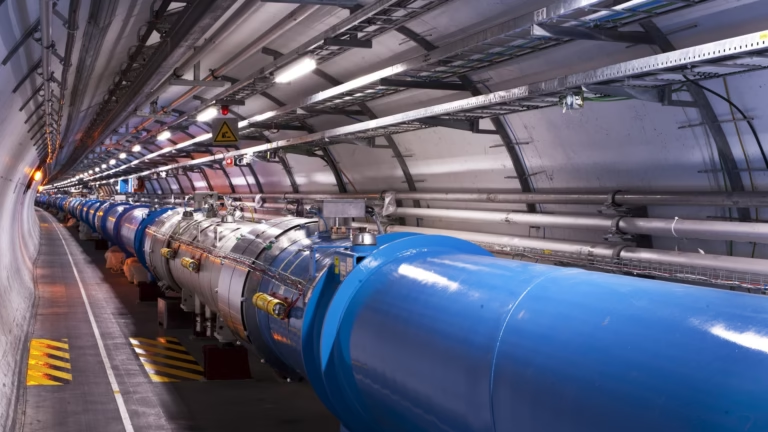
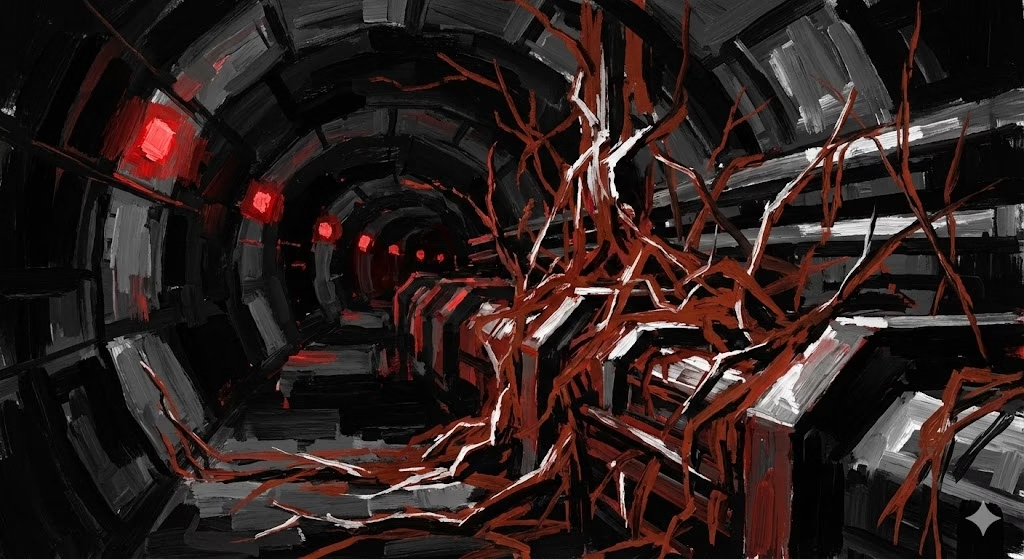
Deep beneath the pastoral border between France and Switzerland, in a tunnel so vast it bends with the curvature of the Earth, a machine is screaming. It is the Large Hadron Collider (LHC), the most complex device ever built by human hands. Every second, it steers beams of protons at 99.999999% of the speed of light and smashes them together, recreating conditions from a fraction of a second after the Big Bang. Superconducting magnets, chilled to temperatures colder than deep space, hum with a lethal electrical precision. Thousands of scientists monitor the readouts, waiting for a signal that breaks the pattern, a blip in the data that rewrites the laws of physics.
But for thirteen years, the machine has offered only silence.
In 2012, this tunnel was the center of the universe. The discovery of the Higgs boson was the scientific high-water mark of the 21st century, a triumph of theory and engineering that completed the Standard Model of particle physics. Champagne flowed in the cafeterias of Geneva; a Nobel Prize followed the next year; humanity patted itself on the back for unlocking the code of reality. But in the decade that followed, the champagne has gone flat, and a quiet panic has begun to settle over the European Organization for Nuclear Research (CERN). The Cathedral of Science is facing an existential crisis. It is fighting a three-front war against nature, geopolitics and economics, and in my view, for the first time in its seventy-year history, it is losing.
The Empty Zoo
The crisis begins with the physics itself. When the LHC was designed in the 1990s, many physicists saw the Higgs boson as the appetizer. The main course was supposed to be supersymmetry (SUSY), a theoretical framework predicting that every known particle has a heavier “superpartner.” Many theorists expected these particles (selectrons, squarks, gluinos) to show up soon after the machine was turned on. They were the mathematical glue that would fix the hierarchy problem, explaining why gravity is so weak and why the Higgs is so light. They were also leading candidates for dark matter.
The physicists prepared for a zoo; they found a desert.
As the LHC raised its collision energy from 7 TeV to 13 TeV, and then to 13.6 TeV, no superpartner appeared. The Standard Model held firm, maddeningly perfect, with no cracks to let the light of new physics shine through. So far the data fit what physicists call the “nightmare scenario”: a universe in which the Standard Model is all there is up to energy scales far beyond the reach of any machine we can build. Nothing has proved that scenario true, but nothing has ruled it out either.
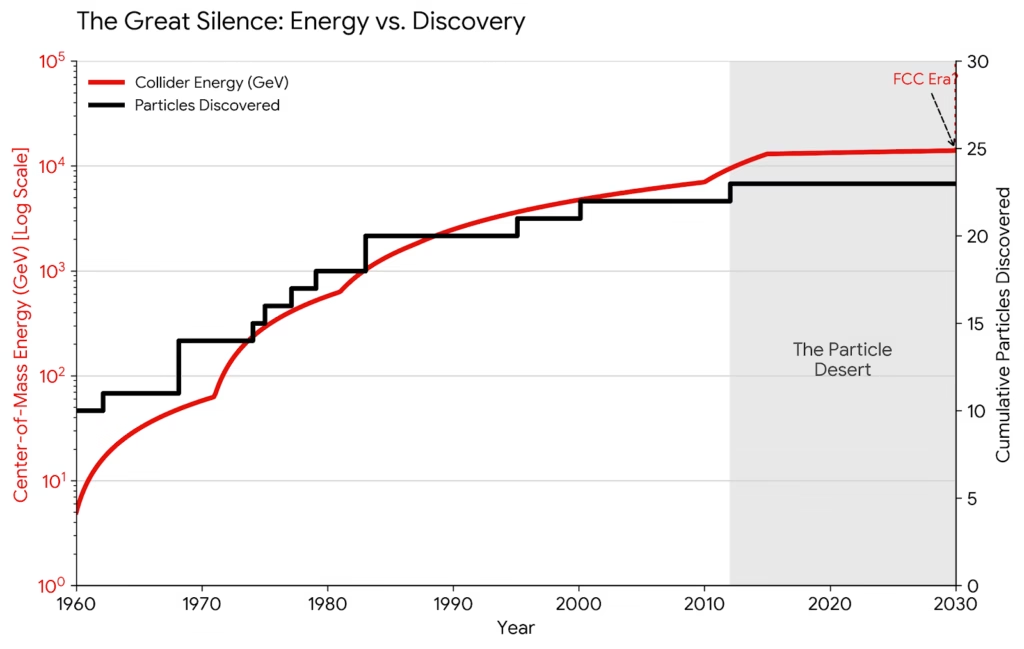
This “Great Silence” has fundamentally altered the atmosphere at CERN. The thrill of imminent discovery has been replaced by the grind of precision measurement. It is the difference between exploring a new continent and surveying a well-known parking lot. And as the data accumulates without a decisive anomaly, the question lurking in the back of every grant application becomes harder to ignore: if nature is hiding nothing accessible, why are we still digging?
The Dragon Rises in the East
Nature’s silence would be bad enough on its own, but CERN is no longer the only game in town. For a generation, if you wanted to work at the energy frontier, you moved to Geneva. The United States gave up its bid for the crown in 1993 when it cancelled the Superconducting Super Collider in Texas, and once the Tevatron at Fermilab shut down in 2011, Europe became the undisputed Vatican of high-energy physics. But vacuums do not last forever. While European diplomats argue over budgets, the People’s Republic of China has been preparing to pour concrete.
In Beijing, the Institute of High Energy Physics (IHEP) has finished the blueprints for the Circular Electron Positron Collider (CEPC), with an accelerator technical design report in 2023. It is a machine designed to exploit CERN’s hesitation. CERN’s two-stage project would not begin hunting particles until the mid-2040s. IHEP wanted to break ground within a few years, which could have brought its collider online years before Europe’s.
The contrast in political will is stark. CERN is a diplomatic miracle, an organization of 25 Member States whose Council takes most decisions by simple majority but in practice seeks a consensus as close to unanimity as possible on multi-billion-franc commitments. It is a slow, deliberative, democratic beast. The Chinese project needs the assent of the central government. If Beijing decides that high-energy physics is a strategic priority, a way to claim the “Sputnik moment” of the 21st century, it can mobilize capital and labor at a speed the West cannot match.
The CEPC is designed as a “Higgs factory,” a specialized machine optimized to study the one particle we know exists. It is a pragmatic, lower-cost bet compared to CERN’s grand ambitions. If built, it would shift the center of gravity in physics. The next generation of brilliant experimentalists would not look to the Alps for their future; they would look to Qinhuangdao, the port city chosen as the reference site. CERN risks becoming a legacy institution, a prestigious museum running an old machine while the frontier moves East.
The Price of Truth
Yet the most dangerous threat to CERN may come from the American hedge fund rather than the Chinese government.
In the golden age of the 20th century, the smartest twenty-somethings on Earth flocked to physics. They were drawn by the romance of the unknown, willing to endure low pay, temporary contracts and grueling hours for the chance to touch the fabric of reality. The “cool factor” of being a CERN physicist was payment enough. But the Great Silence has eroded that currency. A young PhD student starting today looks at the timeline and realizes that even if the next great machine is approved, it won’t be operational until they are in their forties or fifties. They are being asked to dedicate their careers to building a machine that might not find anything.
Meanwhile, the intellectual marketplace has shifted. The mathematical tools used to hunt bosons (Bayesian inference, Monte Carlo simulation, high-dimensional data analysis) are the same tools used to train large language models and predict stock market volatility.
We are witnessing the privatization of intelligence. A senior research fellow at CERN is paid a stipend of roughly CHF 7,000 to 8,000 a month, net of internal tax, in one of the world’s most expensive regions. That same researcher can walk into a quantitative finance firm in London or an AI lab in San Francisco, where offers at the top firms can be several times higher. The “smartest kids in the room” are no longer calculating scattering cross-sections; they are optimizing ad algorithms for Google or building trading bots for Citadel. In my view the brain drain is severe, and it costs CERN the visionary spark that defined its past.
Get the next one by email
Power, cooling, chips and the rules that shape them. No spam, unsubscribe any time.
The 15 Billion Franc Gamble
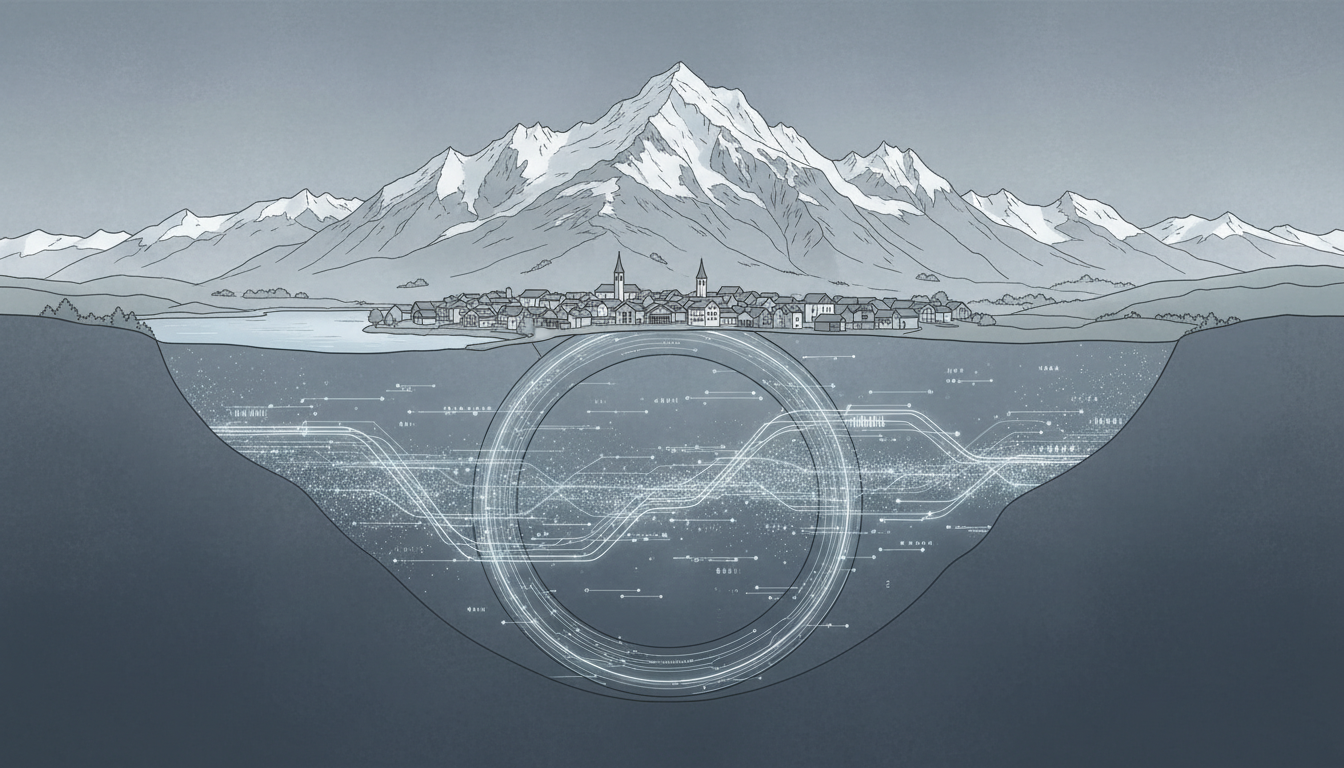
Cornered by these pressures, CERN has placed a massive bet on the table: the Future Circular Collider (FCC). It is a plan of pharaonic ambition, a 90.7-kilometre tunnel that would encircle Geneva and the surrounding countryside, dwarfing the current 27-kilometre ring. It would operate in two stages, first from the mid-2040s as an electron-positron Higgs factory and later, from the 2070s, as a proton collider of about 85 TeV, running well into the late 21st century.
The 2025 feasibility study puts the price of the first stage at CHF 15.3 billion, and critics expect it to rise. This is where the civil war begins.
A growing chorus of critics, led by voices like theoretical physicist Sabine Hossenfelder, argues that the FCC is a monument to the sunk cost fallacy. They contend that without a clear theoretical target, without a specific particle like the Higgs to hunt, building a bigger machine is just blind hope. They ask a brutal question: is measuring the properties of the Higgs to a few more decimal places worth CHF 15 billion?
That money could fund a dozen “moonshot” projects in quantum computing, fusion energy or climate engineering. It could revolutionize virology or room-temperature superconductivity. Critics argue that particle physics has become “too big to fail,” devouring science budgets simply to keep the institution alive.
Proponents, however, argue that you cannot put a price on knowledge. They point out that the World Wide Web was invented at CERN as a side project to manage information. They argue that the industry that learned to make superconducting wire for colliders such as Fermilab’s Tevatron helped make MRI scanners practical. They insist that if we stop looking, we accept that our understanding of the universe is finished, a stance that history has punished every time it was adopted.
Adapt or Die
The story of CERN is not over, but the chapter of “building bigger rings” may be closing. If the FCC stalls in bureaucratic purgatory, or if the Chinese beat them to the punch, the laboratory will need to reinvent itself to survive.
The path forward might lie in radical, high-risk innovation rather than sheer size. Experiments like AWAKE are testing plasma wakefield acceleration, a technology that surfs on waves in ionized gas to accelerate particles over meters rather than kilometers. If perfected, it could shrink a collider from the size of a city to something far smaller. Others look to the “muon shot,” a technologically daunting but compact collider that uses unstable particles to reach high energies without the massive footprint.
For now, the tunnel beneath Geneva remains cold and loud. The protons continue to circle, the magnets continue to hum, and the scientists continue to watch the screens, hoping for a ghost that hasn’t shown itself in thirteen years. CERN is racing against time, and the race is no longer only to find a particle. It is racing to justify its own existence in a world that is rapidly moving on.
Update, October 2026
Several things in this story have moved since January. The LHC’s Run 3 ended on 29 June 2026, and the machine is now in its third long shutdown, which installs the High-Luminosity LHC; collisions are scheduled to resume around June 2030. Mark Thomson became CERN’s Director-General in January 2026.
On 22 May 2026, in Budapest, the CERN Council adopted the updated European Strategy for Particle Physics. It makes completing the High-Luminosity LHC the top medium-term priority and names the FCC-ee as the preferred next flagship collider. The decision on whether to build it is expected around 2028, and CERN’s management must first produce a funding plan that Member States can afford.
In China, the CEPC was not included in the 2026 to 2030 five-year plan. IHEP’s director, Wang Yifang, said the team will resubmit in 2030 unless the FCC is approved first, in which case China would seek to join the FCC instead. For now, the race described above has one runner.
Cite this article
Turner, A. (2026, January 23). The Long Silence: CERN's Struggle to Avoid Obsolescence. ScienceShot. https://scienceshot.com/post/the-long-silence-inside-cerns-struggle-to-avoid-obsolescence
Turner, Alex. “The Long Silence: CERN's Struggle to Avoid Obsolescence.” ScienceShot, 23 Jan. 2026, scienceshot.com/post/the-long-silence-inside-cerns-struggle-to-avoid-obsolescence.
Turner, Alex. “The Long Silence: CERN's Struggle to Avoid Obsolescence.” ScienceShot, January 23, 2026. https://scienceshot.com/post/the-long-silence-inside-cerns-struggle-to-avoid-obsolescence.
@online{scienceshot-the-long-silence-inside-2026,
  author       = {Turner, Alex},
  title        = {{The Long Silence: CERN's Struggle to Avoid Obsolescence}},
  organization = {ScienceShot},
  date         = {2026-01-23},
  year         = {2026},
  url          = {https://scienceshot.com/post/the-long-silence-inside-cerns-struggle-to-avoid-obsolescence}
}
https://scienceshot.com/post/the-long-silence-inside-cerns-struggle-to-avoid-obsolescence
Get the weekly brief
Sourced analysis of data-centre engineering and regulation, every Monday. No spam, unsubscribe any time.