Update, October 2026: FCC Week 2026 took place in Helsinki from 8 to 12 June, and on 22 May the CERN Council named the FCC-ee its preferred next collider. A note at the end covers what changed.
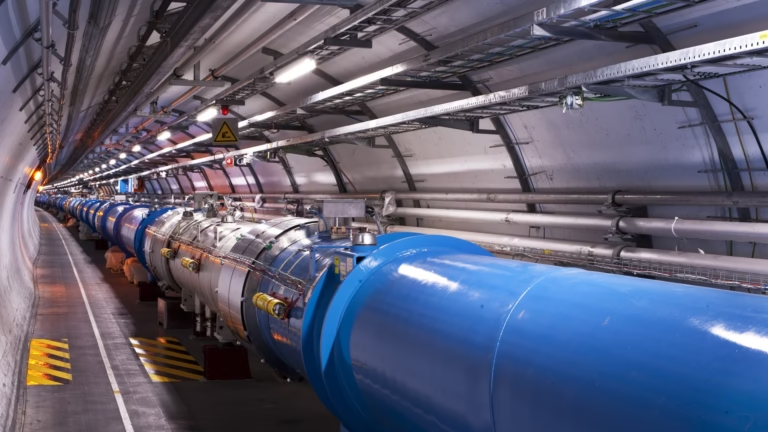
Physics, like theology, is a discipline obsessed with creation myths. For the past two decades, the high priests of the particle world have congregated at a 27-kilometre altar buried beneath the French-Swiss border, smashing protons together in hopes of glimpsing the universe’s divine architecture. The Large Hadron Collider (LHC) has been a triumph of human engineering, delivering the Higgs boson in 2012 and completing the Standard Model of particle physics. Yet, for all its glory, the LHC has been frustratingly silent on the heretical questions. Dark matter remains dark; gravity refuses to fit into quantum boxes; and the universe’s matter-antimatter asymmetry remains an embarrassing accounting error.
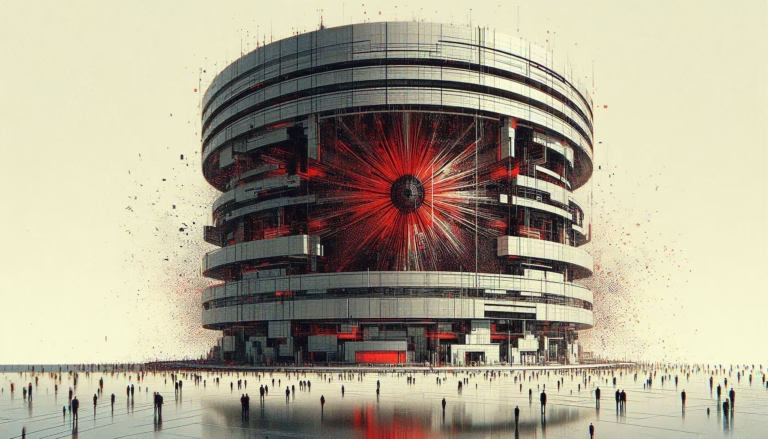
Now the faithful are growing restless. They want a bigger cathedral. CERN has chosen Helsinki to host the next grand conclave, FCC Week 2026, which will chart the course for the Future Circular Collider. The choice comes at a turning point in the project’s life. Having delivered a feasibility study in 2025 that essentially declared “Yes, we can build it,” the organisation now faces the far more precarious question: “Will you pay for it?”
The Ninety-Kilometre Gamble
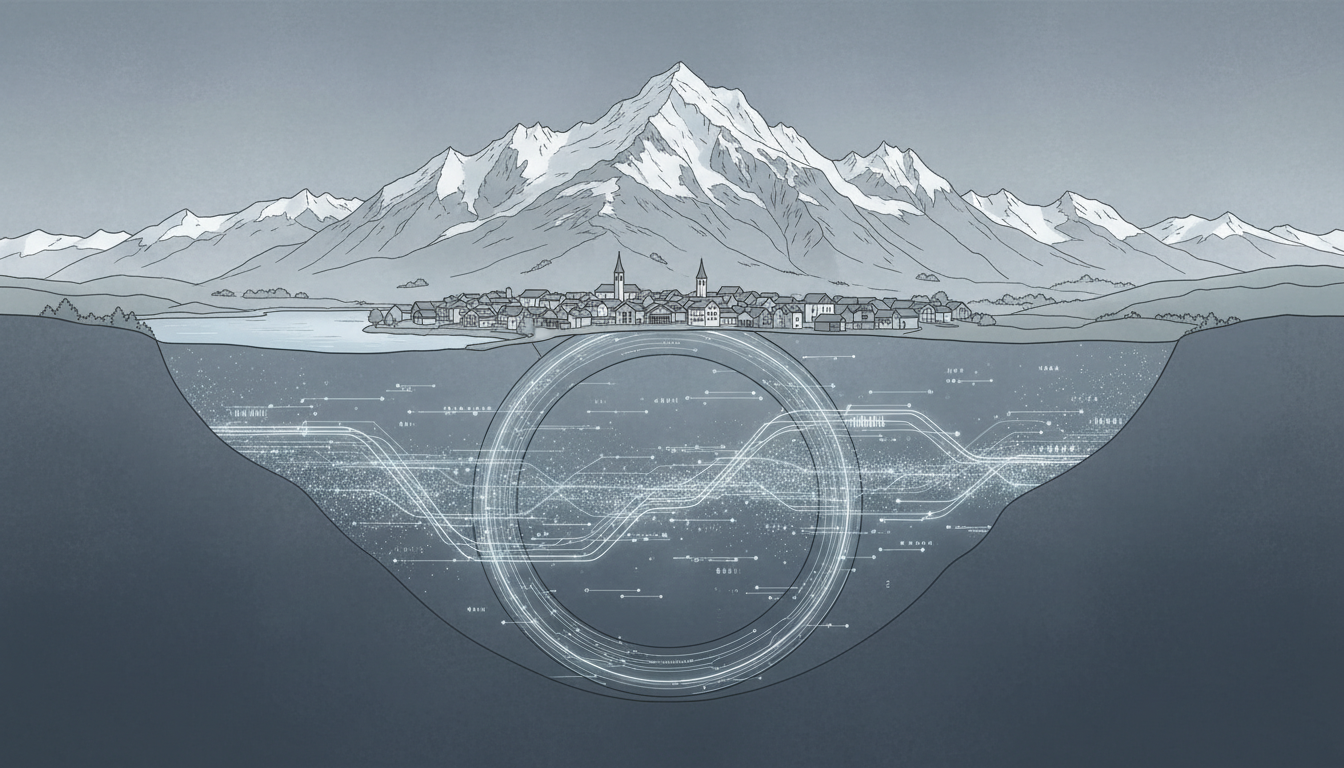
The numbers attached to the Future Circular Collider are the sort that make finance ministers weep. The plan is a 90.7-kilometre tunnel, more than three times the length of the LHC, that would encircle Geneva and pass beneath the lake, mostly through the soft molasse rock of the Geneva basin. The feasibility study puts the first stage at CHF 15.3 billion, a figure that history suggests is merely a polite opening bid. The project is split into two acts: an electron-positron collider (FCC-ee) that would operate as a “Higgs factory” from the mid-2040s, followed in the 2070s by a proton-proton machine (FCC-hh) that would reach about 85 tera-electronvolts (TeV) with 14-tesla magnets.
| Circumference | 90.7 km, more than three times the LHC’s 26.7 km |
|---|---|
| Depth | 180 to 400 m, about 200 m on average |
| Cost of the first stage (FCC-ee) | CHF 15.3 billion, including four detectors |
| Collision energy, proton stage | About 85 TeV with 14 T niobium-tin magnets |
| Construction | Early 2030s, if approved around 2028 |
| Operation | FCC-ee from the mid-2040s; FCC-hh from the 2070s |
The Helsinki meeting will be the first major gathering since the feasibility study went through the CERN Council and its committees. The mood is expected to be one of determined optimism, bordering on evangelical zeal. Outside the lecture halls, the atmosphere is cooler. Few critics doubt that the machine would work; their fear is that it would work very well at doing very little. The LHC has been a victim of its own success, ruling out the simplest versions of exotic theories, such as supersymmetry, that physicists had hoped to find. There is a real fear that the Future Circular Collider could be a 91-kilometre tunnel to nowhere, confirming the Standard Model with ever-higher precision but failing to break it.
Supporters argue that precision is the point. Over fifteen years the Higgs factory would produce almost three million Higgs bosons and about six trillion Z bosons, allowing researchers to measure their properties so precisely that any deviation from theory would shine like a beacon. It is a strategy of attrition rather than shock and awe: grinding down the decimal places until the universe confesses its secrets.
A Game of Subatomic Risk
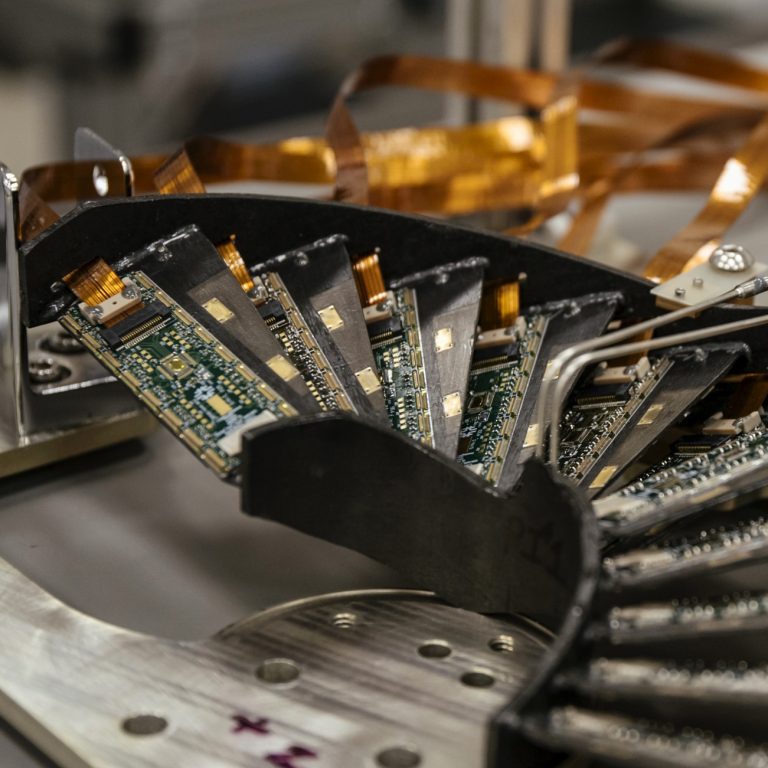
While the politicians sharpen their red pencils, the science continues. In January, the ALICE collaboration, one of the four main experiments at the LHC, reported a new measurement of the space-time evolution of particle emission in proton-lead collisions. Using a technique called femtoscopy, which exploits quantum correlations between pairs of identical charged kaons, the team measured the size of the emitting region in three dimensions and how long emission lasts. The sizes match proton-proton collisions of similar multiplicity, and the emission time is comparable to that in highly peripheral lead-lead collisions at the same energy (5.02 TeV).
These results, though esoteric to the layman, are a reminder of what these machines actually do. They are microscopes of time as much as space. The current LHC runs are squeezing the last drops of insight from the 27-kilometre ring. The High-Luminosity upgrade, due to start around 2030, will extend the facility’s life, but the energy ceiling has been reached. To go higher, one must go wider.
The geopolitical dimension cannot be ignored. China has its own plans for a Circular Electron Positron Collider (CEPC), a machine remarkably similar to the first phase of the FCC. The proposal, championed by the Institute of High Energy Physics in Beijing, is cheaper and was pitched as faster to build. For Europe, the Future Circular Collider is also an assertion of continental standing in fundamental research. Losing the centre of gravity in particle physics to East Asia would be a symbolic blow to a Europe already fretting over its technological competitiveness.
| LHC Run 3 | Ran from 2022 to 29 June 2026 at 13.6 TeV |
|---|---|
| Recent highlight | Observation of quantum entanglement between top quarks, published by ATLAS in Nature in September 2024 |
| ALICE, January 2026 | Three-dimensional kaon femtoscopy in proton-lead collisions |
| FCC-ee yield over 15 years | Almost 3 million Higgs bosons and about 6 trillion Z bosons |
Get the next one by email
Power, cooling, chips and the rules that shape them. No spam, unsubscribe any time.
The Cost of Curiosity
The debate over the Future Circular Collider ultimately boils down to the value of knowledge in a resource-constrained world. Critics, including some theoretically minded physicists, argue that the funds would be better spent on a wide range of smaller, riskier experiments, such as telescopes, neutrino detectors or tabletop quantum gravity tests, rather than putting all the eggs in one gigantic, subterranean basket. Sabine Hossenfelder, a vocal critic of the project, has long argued that building larger colliders without a clear theoretical prediction of what they might find is a strategy based on hope rather than evidence.
Yet the history of physics is littered with discoveries that no one ordered. The muon, the tau lepton and the atomic nucleus itself were found because someone looked, before any theory demanded them. The proponents of the Future Circular Collider argue that exploration is its own justification. If we stop looking, we guarantee that we will find nothing. The Helsinki meeting will likely reinforce this narrative: that the FCC is the only viable path to the next frontier of high-energy physics.
There is also the matter of engineering spinoffs. The superconducting magnets, vacuum systems and cryogenics required for the FCC would demand leaps in industrial technology. CERN is quick to point out that the World Wide Web was invented there, a serendipitous byproduct of the need to share information. Who is to say what the Future Circular Collider might spawn? Efficient power transmission? Advanced medical imaging? Or perhaps just a very expensive hole in the ground?
The road to approval is long. The CERN Council is expected to make a final decision around 2028. Between now and then, the project’s managers must convince the treasuries of Europe that 15 billion francs is a reasonable price for a machine that produces nothing but data. In an era of austerity, climate crisis and war, that is a hard sell. But as the delegates in Helsinki will doubtless remind us, the cost of ignorance is arguably higher.
For now, the particle physicists are like mapmakers at the edge of the known world. The LHC has filled in the dragon-infested waters of the Standard Model, and the map looks complete. But the mapmakers know that the edges don’t match reality. Galaxies spin too fast (dark matter); the universe is expanding ever faster (dark energy). Somewhere, the map is wrong. The Future Circular Collider is the ship they want to build to sail off the edge. Whether the taxpayers of Europe will agree to fund the voyage remains the greatest uncertainty of all.
Update, October 2026
FCC Week 2026 took place at the University of Helsinki from 8 to 12 June. Less than three weeks earlier, on 22 May, the CERN Council meeting in Budapest adopted the updated European Strategy for Particle Physics, which names the FCC-ee as the preferred next flagship collider and keeps completing the High-Luminosity LHC as the top medium-term priority. The construction decision is still expected around 2028, once CERN’s management has a funding plan the Member States accept.
The LHC’s Run 3 ended on 29 June 2026, and the High-Luminosity LHC is being installed during a shutdown that runs to about mid-2030. In China, the CEPC was left out of the 2026 to 2030 five-year plan; IHEP says it will try again in 2030 unless the FCC is approved first, in which case it would seek to join the FCC.
Cite this article
Piro, V. (2026, February 15). The Lord of the Rings: CERN's FCC Enters the Political Fray. ScienceShot. https://scienceshot.com/post/the-lord-of-the-rings-cerns-future-circular-collider-enters-the-political-fray
Piro, Viros. “The Lord of the Rings: CERN's FCC Enters the Political Fray.” ScienceShot, 15 Feb. 2026, scienceshot.com/post/the-lord-of-the-rings-cerns-future-circular-collider-enters-the-political-fray.
Piro, Viros. “The Lord of the Rings: CERN's FCC Enters the Political Fray.” ScienceShot, February 15, 2026. https://scienceshot.com/post/the-lord-of-the-rings-cerns-future-circular-collider-enters-the-political-fray.
@online{scienceshot-the-lord-of-the-2026,
  author       = {Piro, Viros},
  title        = {{The Lord of the Rings: CERN's FCC Enters the Political Fray}},
  organization = {ScienceShot},
  date         = {2026-02-15},
  year         = {2026},
  url          = {https://scienceshot.com/post/the-lord-of-the-rings-cerns-future-circular-collider-enters-the-political-fray}
}
https://scienceshot.com/post/the-lord-of-the-rings-cerns-future-circular-collider-enters-the-political-fray
Get the weekly brief
Sourced analysis of data-centre engineering and regulation, every Monday. No spam, unsubscribe any time.