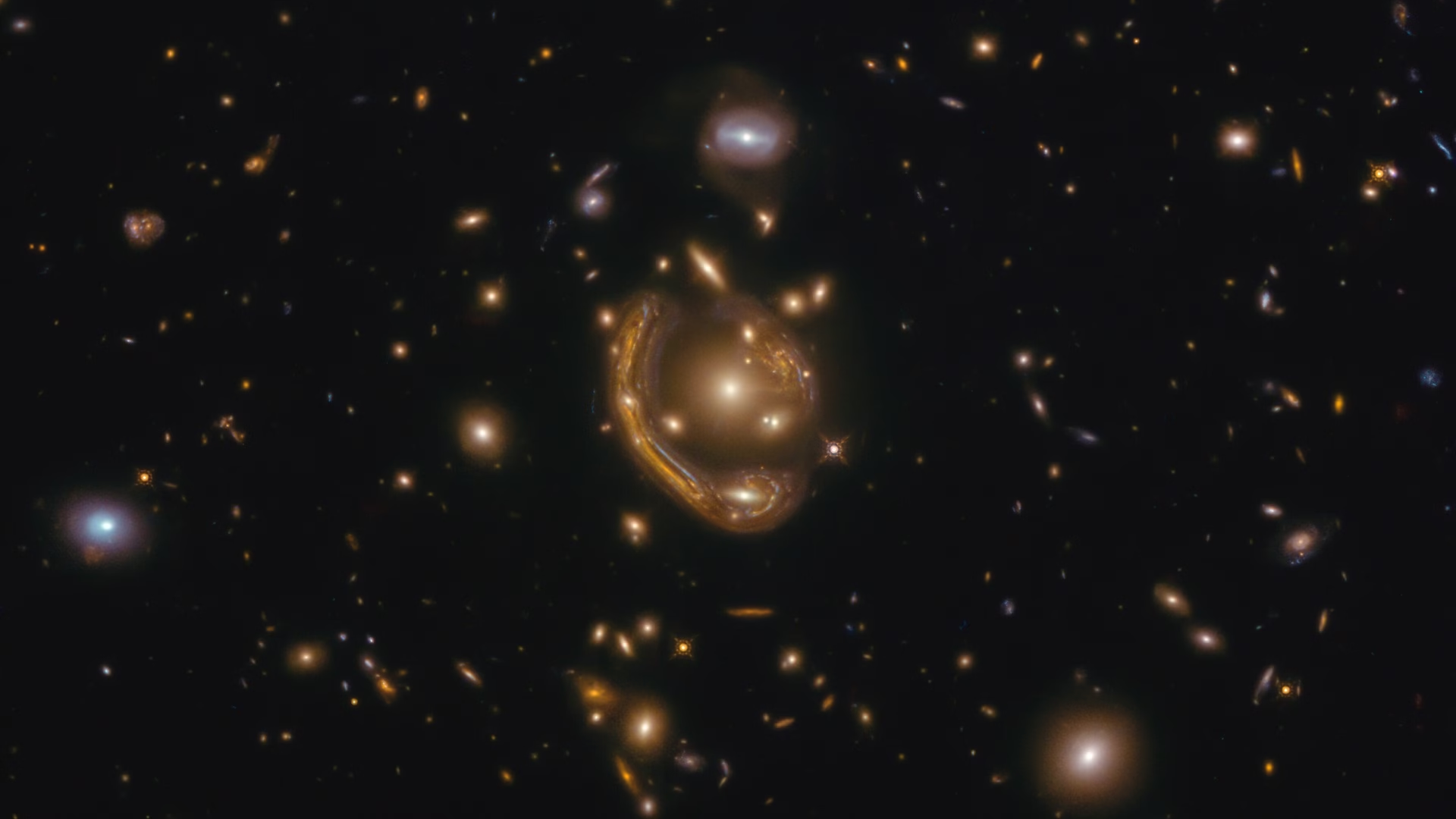
In Newton’s physics, space and time were independent: space was where things happened, and time was when they happened, the same for everyone. Relativity, developed in the early twentieth century, merged them into a single four-dimensional framework, space-time, in which observers moving relative to each other can disagree about lengths and durations but agree about the laws of physics.
The idea runs against everyday intuition, so this guide builds it up in steps, with two thought experiments that make it easier to picture.
The Shift From Space and Time to Space-Time
Our daily experience teaches us that space and time are distinct. Objects occupy a location in space and events occur at moments in time. For most practical purposes this separation works well, because we move far more slowly than light. As speeds approach the speed of light, about 300,000 km/s (exactly 299,792.458 km/s), the separation breaks down.
Albert Einstein’s theory of relativity provided the basis for this shift. He required that the laws of physics be the same for all observers moving at constant velocity, and showed that this forces measurements of time and distance to depend on the observer’s motion. In general relativity space-time goes further: it is shaped by the matter and energy it contains, and it in turn tells that matter how to move.
The Role of Light and the End of the Ether
In the 1860s James Clerk Maxwell unified electricity and magnetism into a single theory of electromagnetism. His equations showed that light is a wave in electric and magnetic fields, travelling at a fixed speed. That raised a question: fixed relative to what, and travelling through which medium?
Physicists proposed a medium called the luminiferous ether, but experiments failed to detect Earth’s motion through it, most famously the Michelson and Morley experiment of 1887. In 1905 Einstein made the ether unnecessary. He took as a principle that the speed of light is the same for all observers, regardless of their motion, and worked out what that implies for space and time.
Get the next one by email
One new article a week on radiation, particles and the instruments that measure them, with its sources. No spam, unsubscribe any time.
Special and General Relativity: A New Perspective
In special relativity the speed of light is absolute and measurements of space and time are relative. Imagine two events, one at 1 pm at home and the other at 2 pm at a school. For someone who stays at rest, an hour separates them. For a traveller moving between them at high speed, less time passes on their own clock. This effect, time dilation, is one of the theory’s best-known predictions.

Einstein’s 1905 papers did not describe relativity as geometry. That step came from his former mathematics teacher Hermann Minkowski, who in a lecture in Cologne in September 1908 showed that special relativity is most naturally written in a single four-dimensional space-time, with time as the fourth dimension. Minkowski space-time is flat, meaning it contains no gravity, and it is the stage on which the events of special relativity are linked in both space and time.
From 1907 to 1915 Einstein worked on general relativity, which extended these ideas to gravity. He proposed that mass and energy curve space-time, and that this curvature determines how objects move. What we perceive as gravity is the effect of that geometry, and the geometry itself can change, ripple and bend.


For example, the Earth orbits the Sun because it follows the straightest possible path through the space-time curved by the Sun’s mass. Newton’s law of gravitation remains an excellent approximation for the Solar System, and general relativity contains it as a limit while explaining effects Newton’s theory cannot, such as the slow turning of Mercury’s orbit.
The Geometry of Space-Time
In ordinary geometry the shortest path between two points is a straight line. In space-time the equivalent rule has a twist. The straightest path between two events, the one followed by a freely moving clock, is the one along which that clock records the longest proper time. The twist comes from the way time enters the space-time distance with the opposite sign to space.
Consider two events: A, “at home at 1 pm”, and B, “at the school at 2 pm”. A traveller moving in a straight line at constant velocity between them records the maximum elapsed time. A traveller who takes a zigzag path, speeding up and slowing down, records less. This is not merely theoretical. In 1971 Joseph Hafele and Richard Keating flew caesium atomic clocks around the world on commercial airliners and found time differences against clocks left on the ground that matched the predictions of relativity.
Space-Time in Everyday Life
Satellite navigation depends on these effects. GPS satellites orbit at about 20,200 km altitude and move at about 3.9 km/s. Their speed makes their clocks run slow by about 7 microseconds a day, as special relativity predicts. Because they sit higher in Earth’s gravitational field, general relativity makes their clocks run fast by about 45 microseconds a day. The net effect is a gain of about 38 microseconds a day, and the satellite clocks are deliberately tuned before launch to compensate. Left uncorrected, an error of 38 microseconds a day corresponds to roughly 11 kilometres of ranging error accumulating every day.
The same framework is used every day in particle accelerators, where particles travel close to the speed of light, and in cosmology. Relativity provides the framework for understanding black holes, gravitational lensing, the expansion of the universe and the Big Bang.

Cite this article
Turner, A. (2025, January 2). Space-Time and Relativity: How to Imagine It. ScienceShot. https://scienceshot.com/post/space-time-and-relativity-how-to-imagine-it
Turner, Alex. “Space-Time and Relativity: How to Imagine It.” ScienceShot, 2 Jan. 2025, scienceshot.com/post/space-time-and-relativity-how-to-imagine-it.
Turner, Alex. “Space-Time and Relativity: How to Imagine It.” ScienceShot, January 2, 2025. https://scienceshot.com/post/space-time-and-relativity-how-to-imagine-it.
@online{scienceshot-space-time-and-relativity-2025,
  author       = {Turner, Alex},
  title        = {{Space-Time and Relativity: How to Imagine It}},
  organization = {ScienceShot},
  date         = {2025-01-02},
  year         = {2025},
  url          = {https://scienceshot.com/post/space-time-and-relativity-how-to-imagine-it}
}
https://scienceshot.com/post/space-time-and-relativity-how-to-imagine-it
Get one article a week
One new article a week on radiation, particles and the instruments that measure them, with its sources. No spam, unsubscribe any time.