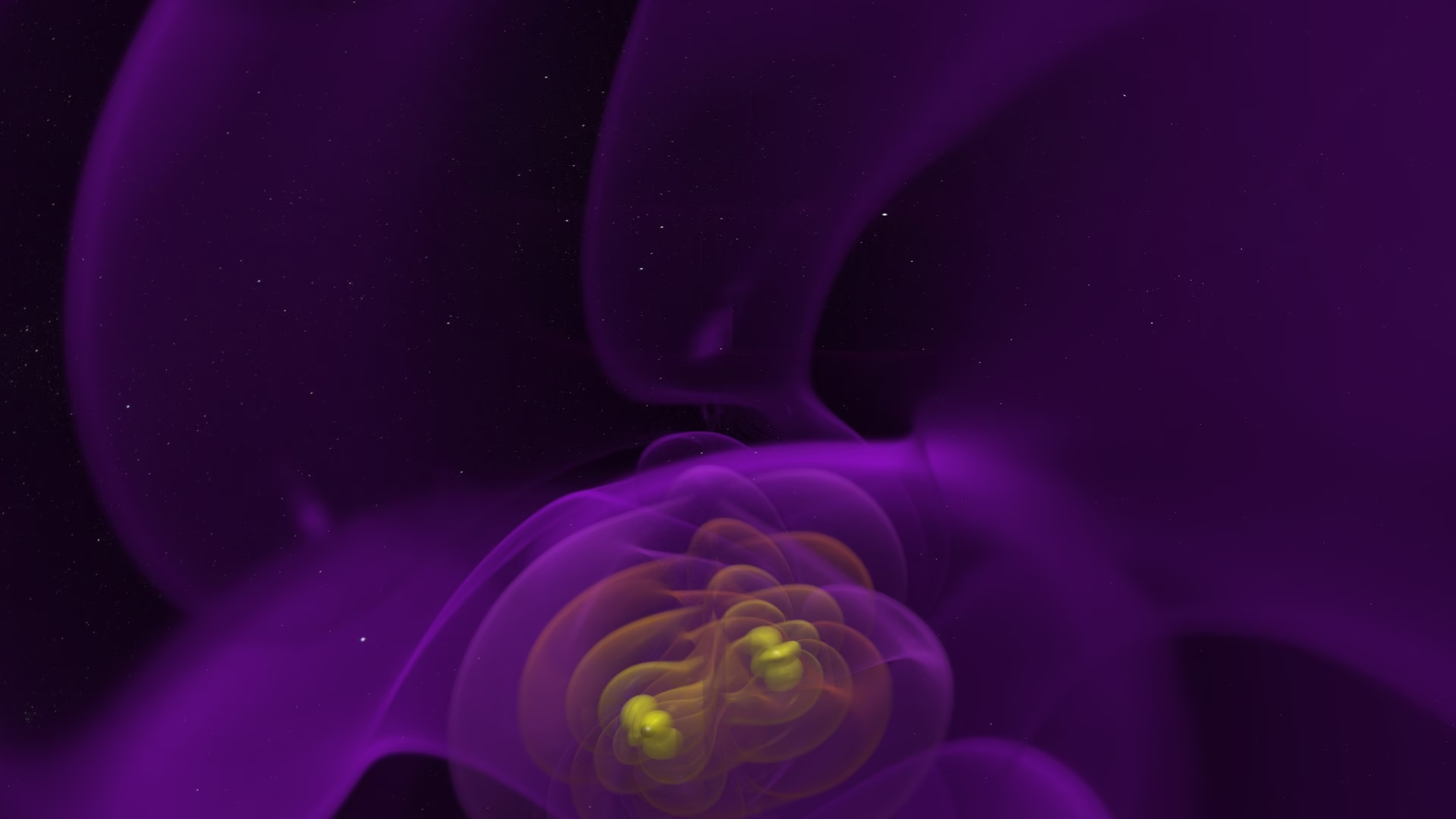

A signal LIGO caught on November 12, 2025, might be the first confirmed primordial black hole gravitational wave candidate in history — a black hole built not from a dying star, but from density fluctuations in the first second after the Big Bang. The event, cataloged S251112cm, has a chirp mass estimated between 0.1 and 0.87 solar masses. The LIGO-Virgo-KAGRA (LVK) collaboration’s own analysis puts better than 99% odds that at least one of the two merging objects weighed in below one solar mass — light enough that no known star could have made it.
Here’s my thesis, and it’s going to annoy people on both sides of this argument: the real story isn’t whether S251112cm is a primordial black hole — it’s how thin the line is between “maybe the first one ever seen” and “noise that happened to look right.” The refined false alarm rate on this event sits at roughly one per four years. That is nowhere near the certainty a discovery headline implies, and it’s the same tier of ambiguity that has swallowed every subsolar and edge-case merger candidate LIGO has flagged since 2019. I’ve spent enough time around detector control rooms — CERN’s included — to know that “consistent with theory” and “consistent with a glitch” can describe the identical blip on a screen.
A Subsolar Black Hole Shouldn’t Exist
Standard stellar collapse has a floor. When a massive star runs out of fuel and its core collapses, physics sets a hard boundary — the Tolman-Oppenheimer-Volkoff limit — below which the wreckage stops at a neutron star rather than continuing on to a black hole. That floor sits around 2 to 3 solar masses, creating a well-documented “mass gap” where no known astrophysical channel builds a black hole lighter than that from a dying star. A confirmed compact object under one solar mass, merging with another, breaks that playbook entirely.
That’s exactly why a primordial black hole is the leading alternative explanation on the table. These objects wouldn’t come from stellar death at all — they’d form when extreme density fluctuations in the infant universe collapsed directly into black holes, potentially within the first second after the Big Bang. Theorists particularly favor the QCD epoch, a window roughly a few microseconds in, when the equation of state governing matter briefly softened and made gravitational collapse easier. If that population exists, it would show up as a dark matter candidate that also occasionally merges and rings LIGO’s detectors — which is precisely the shape of signal S251112cm produced.
The Primordial Black Hole Gravitational Wave Candidate Timeline
S251112cm isn’t the first time gravitational-wave data has tempted physicists toward a primordial origin story. Theorists Sebastien Clesse and Juan Garcia-Bellido proposed GW190425, GW190521, and GW190814 as possible QCD-epoch PBH mergers, and Sai Wang and Zhi-Chao Zhao later argued GW200105 and GW200115 were compatible with a primordial black hole binary scenario. None of those five claims became consensus science — every one of them also has a perfectly ordinary astrophysical explanation that the field ultimately preferred. That pattern matters more than any individual candidate, and it’s the same pattern the field’s detector-side instrumentation keeps running into: signal shapes at the edge of sensitivity get reinterpreted as understanding improves.
Source: LVK event IDs (GW/S naming encodes detection date); Clesse & Garcia-Bellido; Wang & Zhao; arXiv 2603.25795
Lay those five candidates next to S251112cm and the pattern is obvious: LIGO’s entire operating history, from September 2015 to today, has produced roughly one merger every two years that someone was willing to argue might be primordial. Every single one of those earlier claims was eventually explained away, reinterpreted, or simply never confirmed. S251112cm is the newest entry on that list, not a break from it. What’s different this time is that a specific theoretical prediction was waiting for it before it arrived.
Get the next one by email
Physics, engineering and the people behind them. No spam, unsubscribe any time.
Inside the False Alarm Rate Math
Here’s the number that should temper every headline: S251112cm’s false alarm rate (FAR) — a measure of how often a detector’s own noise is expected to produce a signal that mimics a real astrophysical merger — was initially estimated at about one per six years. After the MBTA SSM pipeline (Multi-Band Template Analysis, Sub-Solar Mass), a specialized search tuned to hunt for exactly this kind of low-mass signal, reanalyzed the data, that number tightened to roughly one per four years, according to the arXiv preprint modeling S251112cm as a PBH interpretation. That’s a real, quantified result — and it’s also nowhere near what gravitational-wave astronomers demand before calling something a confident detection.
Public LVK alerts go out at FAR thresholds that are deliberately loose, because the point of an alert is to get astronomers pointing telescopes fast, not to certify a discovery. Catalog-grade detections — the ones that make it into LIGO’s confirmed merger catalog without an asterisk — are typically demanded at far, far tighter significance, orders of magnitude beyond one-in-four-years. A FAR of 1-in-4-years means that if you ran LIGO’s detectors for four more years generating nothing but instrumental noise, you’d expect a false candidate that looks just like this one roughly once. That’s a real possibility sitting inside the number, not a rounding error to wave away.
Source: arXiv 2603.25795, “Primordial Black Hole interpretation of the sub-solar merger event S251112cm”
The refinement from 1-in-6 to 1-in-4 years cut both ways. A tighter FAR is technically a more significant result, but going from “roughly a coin flip’s worth of confidence” to “a slightly-better-than-coin-flip’s worth of confidence” isn’t the leap a “first primordial black hole” headline implies. It’s the kind of incremental tightening that’s normal, expected, and still leaves plenty of room for this to be noise.
One Hit, Exactly Where the Model Predicted
Here’s the part of this story I find genuinely fascinating, and also the part that should make you more suspicious, not less. Researchers modeling a QCD-epoch primordial black hole dark matter population found the predicted merger rate is consistent with detecting exactly one such event across LIGO’s entire operating history to date — the model said “you should see about one,” and the data handed them one. On its face that’s a beautiful confirmation. But a single hit landing precisely where a model predicted is statistically indistinguishable from a single noise glitch landing where confirmation bias would most want it.
The electromagnetic follow-up campaign didn’t help settle it either. Telescopes searching the sky localization found no kilonova counterpart — the optical flash you’d expect from merging neutron stars — which is at least consistent with a black hole merger rather than ruling anything out. They did catch a coincidental Type IIb supernova sitting in the same patch of sky, almost certainly unrelated, a reminder of how crowded and noisy real astronomical data actually is. The ApJ paper analyzing S251112cm is careful to frame this as evidence worth taking seriously, not evidence that closes the case.
⚡ PHOTON’S TAKE
I want S251112cm to be real. A primordial black hole detection would rewrite how we think about dark matter and the first second of the universe. But I’ve watched too many “this fits the model perfectly” results evaporate under scrutiny to call a one-in-four-years false alarm rate a discovery. This is a genuinely exciting hint, not a confirmed primordial black hole. Treat it as a promising trigger for follow-up, not a headline you’d bet your physics career on — that difference is the entire point of doing science carefully.
What Would Actually Confirm a Primordial Black Hole Gravitational Wave Candidate
Confirming this claim doesn’t require a philosophical argument — it requires more data. LVK’s next observing run will either produce a second subsolar-mass event with a tight FAR, which would make the QCD-epoch PBH population model look extremely good, or it will go quiet, which would make S251112cm look a lot more like a beautifully-timed statistical accident. The precision this hunt demands isn’t so different from chasing coherence in a magnon qubit — both fields are trying to pull a real signal out of a system where noise and signal can look identical at the margins. That’s not a knock on this result; it’s just an honest description of where the goalposts sit.
My honest prediction: within two or three observing runs, we’ll know whether S251112cm was the first sighting of a primordial black hole population or a well-timed ghost in the data. Big-science claims that hinge on a single low-significance event have a rough track record — ask anyone who’s watched a promising anomaly quietly disappear once the exposure or statistics doubled, the same slow-grinding uncertainty that delays missions when a program bets everything on one thin resource. Until then, S251112cm deserves attention, funding for follow-up, and a healthy dose of skepticism — in that order.
One story like this, most days
Written by a CERN physicist. No spam, unsubscribe any time.