
Search “magnon qubit quantum computing” and you’ll land on a stack of headlines crowning magnons — the quantum particles of spin waves — as quantum computing’s newest qubit contender. It’s a tidy story: a new material, a new particle, a new race to build hardware. It’s also not what the underlying physics papers actually show, and the gap matters. That framing sells clicks, but it sets readers up to misjudge what problem quantum magnonics is actually solving.
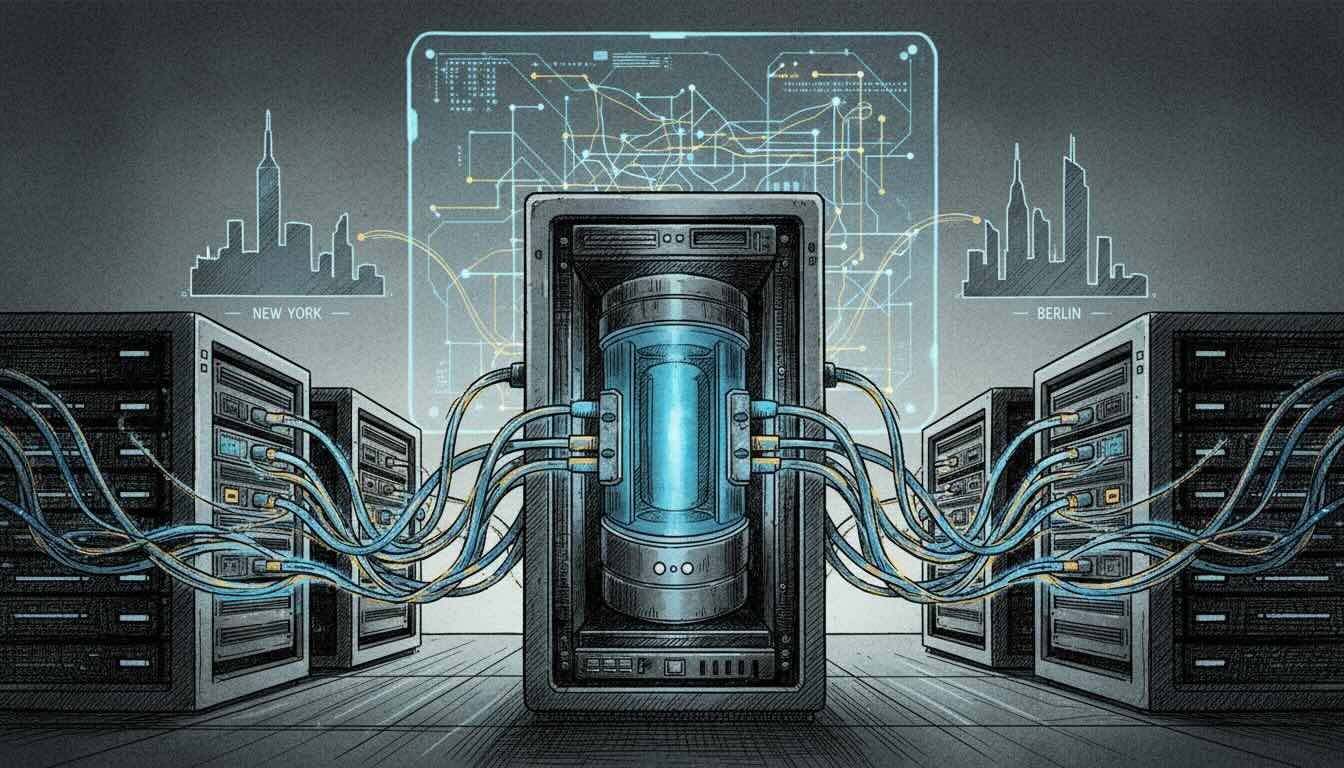
Read the record closely — the 2020 Science paper on single-magnon detection, a March 2026 Applied Physics Reviews Perspective surveying the field, and 2024 work in PNAS — and a different picture forms. In essentially every landmark experiment, the magnon is not the qubit. It’s a long-coherence bosonic mode acting as quantum memory and transducer, wired to a real two-level qubit: a superconducting transmon. Calling that setup “the newest qubit” is like calling the fiber-optic cable the newest logic gate.
The Magnon Qubit Headline Gets the Job Title Wrong
A magnon is the quantized unit of a spin wave — picture a wave of electron spins tipping over in sequence through a magnetic material, the way a stadium wave ripples through a crowd of seated fans. In yttrium iron garnet (YIG), an insulating ferrimagnet prized for astonishingly low magnetic damping, the simplest version of this — the uniform “Kittel mode” of a millimeter-sized sphere — behaves like a single harmonic oscillator, mathematically identical in structure to a photon bouncing in a microwave cavity or a phonon ringing in a mechanical resonator. That family resemblance is the whole reason magnons ended up in a quantum computing story at all: physicists already knew how to talk to harmonic bosonic modes using circuit-QED tricks built for superconducting qubits. That’s not a coincidence — it’s the same reason optical physicists spent decades perfecting single-photon detection before anyone seriously tried to compute with photons directly.
Inside the Experiments: Magnons Meet Superconducting Qubits
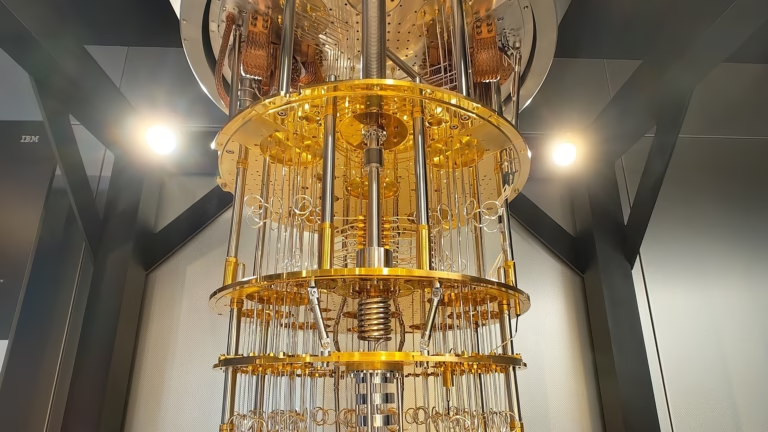
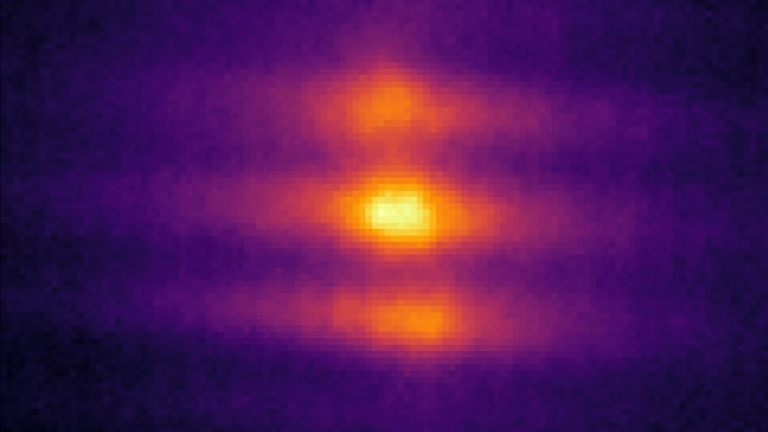
The landmark demonstration placed a millimeter-scale YIG sphere inside a 3D microwave cavity that was itself dispersively coupled to a superconducting transmon qubit — the same circuit-QED trick used for photon-number-resolved readout, just aimed at spin waves instead of light. By entangling the sphere’s Kittel mode with the transmon, researchers achieved single-shot detection of a single magnon, reporting a quantum detection efficiency of roughly 70% (Science, 2020). That’s a genuinely hard measurement — magnons live in a macroscopic crystal, not free space, and pulling a single quantum excitation’s signature out of that environment is closer to finding one flipped coin in a stadium wave than reading a qubit directly.
A March 2026 Perspective in Applied Physics Reviews lines up the field’s milestones so far: coherent coupling of magnon modes to superconducting resonators, qubit-based quantum sensing of magnons, that single-magnon detection, full Wigner-function tomography of a single magnon, and a macroscopic Bell state between a spin system and a superconducting qubit (APR Perspective, DOI 10.1063/5.0306423). None of those experiments built a magnon that computes on its own. A separate 2024 study pushed the same logic further, using magnons to mediate coupling between two separate superconducting qubits — measured through dissipation — which makes the magnon’s actual job description explicit: it’s the bus, not the processor (PNAS 120, e2313754120, 2024).
Source: reported figures — Science 367, 425 (2020), ~70% detection efficiency; arXiv:2106.09312 (2021), ~10µs coherence; PNAS 120, e2313754120 (2024); Applied Physics Reviews Perspective, DOI 10.1063/5.0306423 (2026)
Get the next one by email
Physics, engineering and the people behind them. No spam, unsubscribe any time.
Why a Magnon Isn’t a Qubit — Yet
Here’s the physics that the headlines skip: a qubit needs exactly two usable energy levels, and evenly spaced ladders don’t qualify. A magnon mode, like any harmonic oscillator, has energy levels spaced identically all the way up — 0 to 1 costs the same energy as 1 to 2, and so on forever. Address that mode with a microwave pulse tuned to the 0-to-1 transition and you’ll happily drive it into the 2, 3, and 4 states too, because nothing distinguishes one gap from the next. That’s the entire reason a plain LC oscillator can’t be a qubit either, and it’s why superconducting qubits aren’t just superconducting resonators.
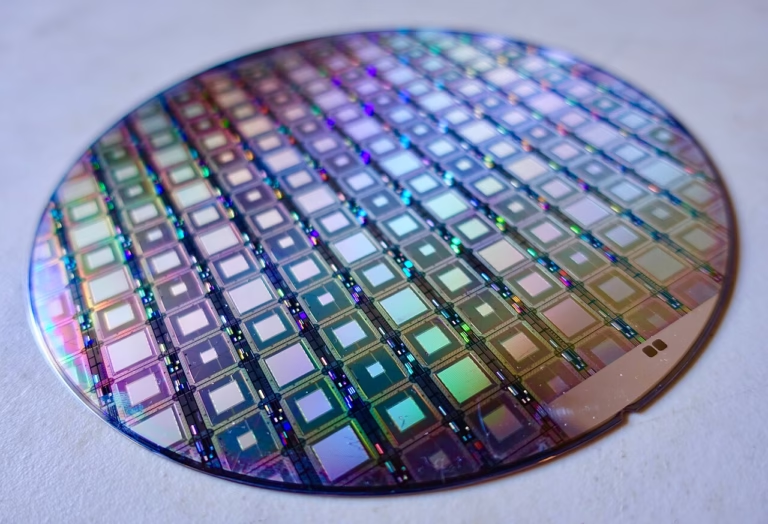
Transmons solve this with a Josephson junction, a superconducting circuit element whose nonlinearity unevenly spaces the energy ladder just enough to isolate one addressable transition. Magnonics has a theoretical equivalent: the magnon Kerr effect, arising from magnetocrystalline anisotropy or four-magnon scattering, which can in principle detune higher transitions out of resonance and leave a clean 0-to-1 gap to drive as a qubit. The catch is the word “in principle.” Engineering enough Kerr nonlinearity into a magnon mode to make it computationally useful as a stand-alone two-level system remains a theoretical proposal in the literature, not a device anyone has built and measured.
Every magnon-based result actually reported to date, including the reported ~10 microsecond coherence times cited for YIG-sphere quantum memories (cavity magnonics review, arXiv:2106.09312), uses the magnon as storage or a relay, with a transmon doing the computing. Nobody has published a working magnon qubit — the anharmonic version is still a proposal on paper, not a device on a chip.
Source: mechanism described in Applied Physics Reviews Perspective, DOI 10.1063/5.0306423 (2026); Kerr-effect qubit encoding remains a theoretical proposal, not a built device
⚡ PHOTON’S TAKE
I’ve spent enough time around dilution refrigerators to know the difference between the component doing the computing and the component carrying the signal between racks. A magnon is the second thing. It’s a gorgeous quantum memory — long coherence, tiny footprint, already talking fluently to transmons — and that’s a more useful job than “newest qubit” implies. Nobody has built a working magnon qubit. Someone might, once Kerr engineering catches up to the proposal stage. Until then, stop giving the wire a promotion it hasn’t earned.
The Real Payoff: Magnons as Quantum Computing’s Interconnect
The more consequential story here isn’t a new qubit species — it’s a candidate answer to quantum computing’s ugliest near-term bottleneck: wiring enough qubits together without losing the information in transit. Superconducting processors scale by packing more transmons onto a chip and more chips into a rack, and every hop between them costs coherence. A magnon mode with microsecond-scale coherence, sitting inside a cavity that already talks fluently to a transmon, is a plausible quantum wire for exactly that problem — a memory cell that holds a qubit’s state steady between operations, or a link that entangles processors sitting in different refrigerators.
That’s a familiar shape of problem if you’ve watched classical computing hit its own interconnect wall — the same reason 3D chip stacking keeps running into a thermal ceiling when engineers try to shorten the distance between cache and cores. Quantum hardware is heading toward the identical fork: the qubits themselves are improving steadily, but the wiring between them is what will decide how many you can usefully link. I’d bet the next five years of magnonics funding follows the interconnect story, not the qubit story, because that’s where the actual scaling pain lives.
There’s a sensing throughline here too. The same entanglement-based readout trick that let physicists detect a single magnon is a close cousin of the instrumentation logic behind next-generation particle detectors, including projects like PLATON, which is replacing millions of scintillating fibers with AI-driven readout instead of raw sensor count. Push single-quantum sensitivity far enough, in a magnetic crystal or a particle detector, and the interesting engineering shifts from “build more of the sensor” to “extract more information per event.” Magnonics is running the same play, aimed at storing and moving quantum bits instead of counting particles. That’s the unglamorous engineering work that actually moves a field forward, whether the quanta involved are spins or photons.
So no, magnons are not quantum computing’s newest qubit, and I don’t think they’re trying to be. They’re shaping up as the interconnect and memory layer that lets someone else’s qubits scale — a less flashy job title, but arguably the one this field needs filled first. Watch the Kerr-engineering proposals closely; if anyone actually builds an addressable magnon qubit, that’s the headline worth writing. Until then, believe the papers over the press.
One story like this, most days
Written by a CERN physicist. No spam, unsubscribe any time.