
Every physics student learns the boson/fermion rule like a commandment: swap two identical particles, and the wavefunction either stays put (a boson) or flips sign (a fermion) — full stop, two options, no exceptions. One-dimensional anyons just broke that commandment, and they did it the hard way: no braiding, no topology, just particles slamming into each other head-on.
Here’s my thesis, and it’s the part most anyon explainers skip: fractional statistics were never supposed to survive in 1D. Particles confined to a line can’t circle around one another — there’s no room to braid, no topological loophole to exploit. Yet a run of ultracold-atom experiments, from a 2023 Science paper through fresh 2026 confirmations, shows that a purely local, interaction-controlled collision can imprint the same kind of fractional exchange phase that 2D quantum-Hall anyons get from geometry. Statistics, it turns out, is not exclusively a topology story.
The Boson/Fermion Rule Isn’t as Ironclad as You Learned
Here’s why the two-option rule feels absolute. In three dimensions, the space of ways two identical particles can be arranged is “simply connected” — a fancy way of saying there’s only one topologically distinct way to swap them. Do the swap twice and you’re back where you started, so the wavefunction’s phase can only pick up a factor that squares to 1: either +1 (boson) or −1 (fermion). At CERN, every particle-identification algorithm I ever worked near assumes exactly one of those two statistics — there is no third setting on that dial, and nobody builds one, because in 3D there isn’t one to build.
Two dimensions changes the geometry entirely. Particle trajectories in a 2D plane can wind around each other in genuinely different topological ways — clockwise, counterclockwise, twice around — so the exchange phase is no longer locked to two values. It can be any value, e^(iθ) for any θ, and that continuum of possibilities is what physicists call true anyons. This is the anyon story most people have actually encountered: fractional-quantum-Hall edge states, the physics behind headline results like Nature’s 2024–2025 observations of anyon braiding and scaling dimensions, and the whole topological-quantum-computing narrative that Microsoft and others have built around exotic 2D platforms. It’s compelling physics, but it’s also the only anyon story that gets told.
One dimension was supposed to close that loophole entirely. Particles on a line cannot go around each other under any circumstances — think of two cars stuck on a single-lane road with no shoulder. They cannot pass; they can only meet bumper to bumper. Conventional wisdom said that without braiding, you’re stuck back with the plain 3D dichotomy: bosons or fermions, nothing in between. That assumption is exactly what the cold-atom results overturn.
Source: Mechanism as reported in Science 381, DOI 10.1126/science.adi3252 (2023)
Get the next one by email
Power, cooling, chips and the rules that shape them. No spam, unsubscribe any time.
Why One-Dimensional Anyons Shouldn’t Exist — But Do
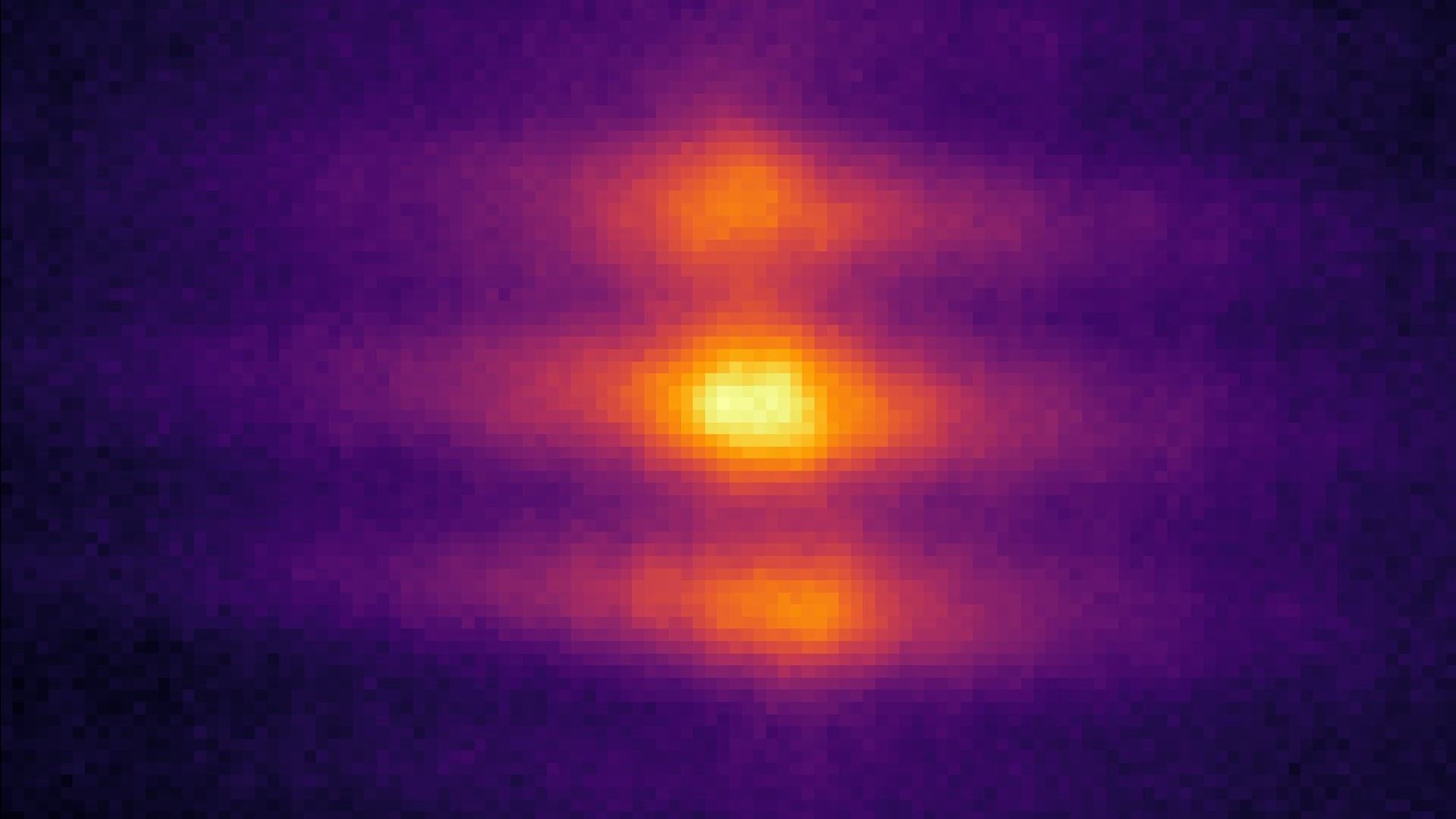
The mechanism is where this gets genuinely strange, and it has nothing to do with geometry. In these 1D systems, particles interact through a short-range contact interaction — they only “feel” each other at the instant they touch. What the cold-atom experiments show is that the strength of that contact interaction can be dialed continuously, and at the moment two particles scatter off each other, the collision itself imprints a tunable phase onto the many-body wavefunction. That scattering phase behaves exactly like an anyonic exchange phase, even though not a single particle has gone anywhere near “around” another one. It is tunable quantum statistics built entirely out of a two-body bounce.
The first clean demonstration came in 2023, when a Science paper (DOI 10.1126/science.adi3252) trapped ultracold 87Rb atoms in a 1D optical lattice and realized anyons with an arbitrary, continuously adjustable statistical phase — proof of principle that the effect is real and controllable. In May 2025, a University of Innsbruck team led by Hanns-Christoph Nägerl pushed it further with an actual dynamical readout: they injected a mobile impurity atom and accelerated it through a strongly interacting 1D Bose gas, then measured how its momentum distribution shifted as the interaction strength was tuned. Theory support came from Mikhail Zvonarev at Université Paris-Saclay and Nathan Goldman at ULB and Collège de France, and TU Berlin’s press office called it the first observation of emergent anyonic behavior in a 1D ultracold bosonic gas. OIST was still covering the result as a live, current finding in February 2026 — this is not a one-off, it is an active research thread.
What makes this a genuine surprise rather than a technicality is the contrast with everything else labeled “anyon” in popular coverage. Ask most people to explain anyons vs bosons vs fermions and they will reach for fractional-quantum-Hall edge states — the 2D world where particle trajectories braid and Nature has spent 2024 and 2025 publishing striking confirmations of exactly that behavior. That is genuinely great physics, and it is also, structurally, the easy answer: give particles room to circle each other and topology does the rest. Exclusion statistics in cold atoms is the harder, less-covered answer, because it says you do not need room to circle at all. A head-on collision, tuned correctly, is enough.
If you want a parallel from detector engineering: silicon photomultipliers still haven’t fully replaced photomultiplier tubes even though silicon should, on paper, have won by now — sometimes the “obvious” winning mechanism isn’t the only one that works, and the older or less flashy approach holds real ground. Topological braiding was assumed to be the only route to fractional statistics. Contact-interaction anyons are the 1D equivalent of the underdog mechanism that turned out to work anyway.
Source: Science 381, DOI 10.1126/science.adi3252 (2023); phys.org / TU Berlin press release (May 2025); OIST News (Feb 2026)
⚡ PHOTON’S TAKE
I’ve spent years around detectors built entirely on the boson/fermion binary — there’s no third setting on that dial. What excites me about one-dimensional anyons isn’t that they’re the “lesser” anyons, tucked away from the quantum-Hall spotlight; it’s that they prove fractional statistics is a physics principle, not a topology trick. Braiding gets the headlines, but a plain contact collision did the same job on a single line. That’s the real story: exotic quantum statistics is more universal, and more mundane to engineer, than we assumed.
What One-Dimensional Anyons Mean for Quantum Technology
Don’t expect 1D anyons to power a topological qubit the way 2D braiding-based platforms are being pitched to — without braiding, there is no topological protection to lean on, and protection from local noise is the whole reason topological qubits are interesting in the first place. That is a real limitation, and I’d rather say it plainly than oversell it. But these systems are becoming something arguably more useful in the near term: a clean, controllable laboratory for testing fractional-statistics physics without needing millikelvin fridges, exotic 2D heterostructures, or fragile quantum-Hall bars.
Tuning statistics with a single interaction-strength knob, in a 1D optical lattice that’s comparatively easy to build and probe, means more groups can run these experiments and push the parameter space further. Distinguishing a genuine tunable statistical phase from an ordinary interaction effect is exactly the kind of careful signal-versus-noise work that takes years to nail down — not unlike the ongoing effort to confirm whether something like primordial black hole candidate S251112cm is a real signal or an artifact. The 2023-through-2026 run of results suggests the 1D anyon signal has cleared that bar.
The bigger lesson, for me, is about where physicists look for exotic behavior. Fractional-quantum-Hall anyons taught a generation that “weird statistics” means “weird topology,” full stop. One-dimensional anyons say otherwise: give particles a tunable enough interaction, and even the most constrained geometry imaginable — a single line, one collision at a time — can host a continuum of quantum statistics. I expect the next few years to bring 1D and quasi-1D platforms built specifically to exploit that, purely because the physics is cheaper to access than the 2D route. Watch this space; the “boring” dimension just got interesting.
Get the weekly brief
Sourced analysis of data-centre engineering and regulation, every Monday. No spam, unsubscribe any time.