Two thousand grays. That is the reconstructed radiation dose at the entry wound in Anatoli Bugorski’s skull — the figure still cited for the instant a live proton beam bored through his head at the U-70 synchrotron on 13 July 1978. Set that beside the roughly 4.5 sievert that kills half of untreated people exposed across their whole body, and the Bugorski number looks like it belongs to a different universe. It does. That mismatch, not the size of the number, is the actual story.
Every retelling reaches for the same move: divide his dose by a lethal dose and marvel at the ratio. That ratio is the wrong tool, because a radiation dose without a stated volume and tissue means almost nothing. Correct for what was actually irradiated — a few cubic centimetres of brain and inner ear, not a human body — and the “miracle” stops looking miraculous. It starts looking like physics doing exactly what the numbers predict.
The Accident: Anatoli Bugorski and the U-70 Beam
In 1978, Bugorski was a researcher at the Institute for High Energy Physics in Protvino, home to the U-70 synchrotron, then the Soviet Union’s largest particle accelerator. On 13 July, he was checking a malfunctioning piece of beamline equipment when a safety interlock — the mechanism meant to signal that the beam was live — failed to do its job. It is the same category of failure that would doom the Space Shuttle Challenger eight years later: a known margin, ignored until a person was standing where the machine assumed no one would be.
Bugorski leaned in with his head in the beamline. A proton beam moving at 99.99% the speed of light, carrying an energy widely cited as 76 GeV (the U-70’s nominal design maximum was 70 GeV), passed through the back of his skull and out through his face in a fraction of a second. He later described the moment as a flash brighter than “a thousand suns” — a line repeated in nearly every account since, though no primary transcript has surfaced. There was no pain; the exposure was over before his nervous system could register it.
What followed over the next days was visible and frightening: the left side of his face swelled, and the skin along the beam’s exit track peeled where the tissue had been destroyed. Doctors who examined him expected him to die within days, the standard prognosis for anyone who had absorbed a dose anywhere near what the beam physics implied. He did not die, and understanding why requires throwing out the framing doctors reached for first.
Soviet Secrecy and a Story That Took Decades to Surface
Bugorski was transferred to Moscow specialists who studied him as a singular case — a living data point on what a beam of that energy does to a human head. Soviet authorities restricted his ability to seek treatment abroad or share details of his case with doctors outside the country, a common pattern for anything touching the USSR’s nuclear and accelerator programs. It sits alongside other closed chapters of Soviet big science, where unprecedented results stayed unpublished for reasons that had nothing to do with the science itself.
Despite the disfigurement, Bugorski showed no measurable loss of cognitive function, and he went on to complete his doctorate in the years following the accident (the exact year is not reliably documented in available sources). That fact alone — a functioning PhD candidate, post-beam — told Soviet physicians something important about how localized the damage really was.
Popular accounts often claim the story broke in the late 1980s, with the world supposedly oblivious for nearly fifteen years. That timeline does not hold up: the case reached Western press coverage later, sometime in the 1990s, and no single outlet or exact year is verifiable as the source of record. Once outside researchers did learn the details, Bugorski’s case became one of the only human data points anywhere for what a body does with an extreme, sharply localized dose from a high-energy proton beam.
The Numbers: Anatoli Bugorski’s Dose in Context
Radiation dose is usually reported in one of two units, and confusing them is how the “hundreds of thousands of times fatal” claim got started. A gray (Gy) measures energy absorbed per kilogram of the specific tissue actually irradiated — a local, small-volume number. A sievert (Sv) measures biologically weighted dose averaged across the entire body, the number that predicts whether someone develops radiation sickness. For protons the two units are numerically almost identical (relative biological effectiveness near 1.1), but the volumes they describe are not remotely the same thing.
The Bugorski entry and exit figures below are local Gy values through a few cubic centimetres of tissue. They come from a widely repeated reconstruction, not a primary dosimeter reading — no named calculating physicist or original dosimetry report has been independently verified. Everything else in the table is a whole-body Sv figure, drawn from sources such as the HHS Radiation Emergency Medical Management program and UNSCEAR. Reading down the table as one continuous scale is the mistake; reading it as two separate scales is the point.
| Measurement | Value | Type | Source |
|---|---|---|---|
| Bugorski, exit point (localized) | 3,000 Gy (300,000 rad) | Local tissue, Gy | Widely repeated estimate; no primary dosimetry |
| Bugorski, entry point (localized) | 2,000 Gy (200,000 rad) | Local tissue, Gy | Widely repeated estimate; no primary dosimetry |
| Full head/neck radiotherapy course | 60–70 Gy total | Local tissue, Gy | Standard external-beam oncology (ICRU guidance), ~30–35 fractions |
| Typical single radiotherapy fraction | ~2 Gy | Local tissue, Gy | Standard external-beam oncology |
| Hisashi Ouchi, Tokaimura criticality accident, 1999 | ~17 Sv (est. 8–20) | Whole-body, Sv | Published clinical case reports; died 83 days post-exposure |
| Human whole-body LD50/60, no medical care | ~4.5 Sv | Whole-body, Sv | REMM/HHS; NRC-cited (~6–7 Sv with aggressive supportive care) |
| Annual background radiation, global average | ~2.4 mSv (0.0024 Sv) | Whole-body, Sv | UNSCEAR |
Source: REMM/HHS, UNSCEAR, published Tokaimura case reports; Bugorski figures are a widely repeated estimate with no primary dosimetry.
Get the next one by email
Physics, engineering and the people behind them. No spam, unsubscribe any time.
The Bragg Peak: Why Proton Therapy Works, and Why This Beam Didn’t Stop
Here is the piece of physics that actually explains the survival, and it starts with how charged particles lose energy as they travel through matter. A proton slows as it plows through tissue, and it does not lose energy at a steady rate the whole way — it dumps the overwhelming majority of its energy in a sharp spike right near the end of its range, called the Bragg peak. Everywhere before that peak, the particle deposits a relatively low, flat dose; at the peak itself, the dose jumps dramatically before falling to almost nothing beyond it.
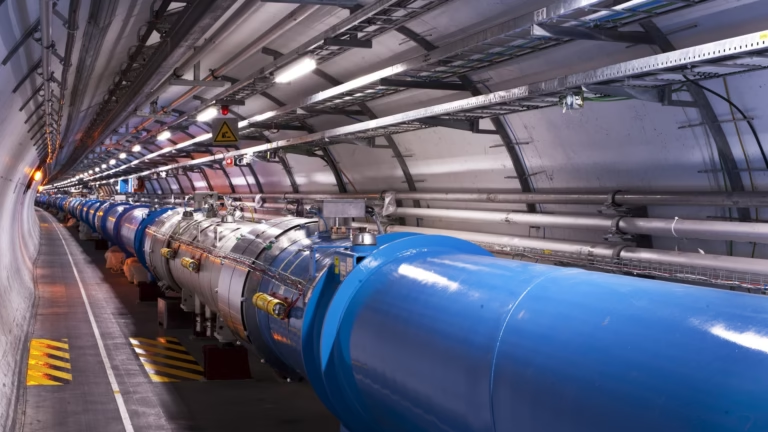
Proton therapy for cancer exploits this directly. Clinical beams run at roughly 70 to 250 MeV, tuned so the Bragg peak lands precisely inside the tumour, concentrating damage there while sparing healthy tissue in front of and behind it. It is a deliberately engineered version of what makes protons attractive for radiotherapy in the first place — a level of energy control that has pushed accelerator engineering in directions as extreme as keeping magnets colder than deep space at the LHC, in the same broad family of machines as the U-70.
A 76 GeV proton is roughly a thousand times more energetic than a clinical proton-therapy beam, with a range in dense matter measured in metres, not centimetres. A human head is roughly 15 to 20 centimetres across. The beam that hit Bugorski was so far past the range where a Bragg peak could form inside a human body that it never got the chance — it crossed his skull and brain on the flat, near-minimum-ionizing part of the energy-loss curve and kept going, exiting through his face still carrying most of its original energy. Proton therapy puts the peak inside the target; Bugorski’s accident is the exact inverse, a beam too energetic to stop inside a person at all.
Why Radiation Sickness Never Set In
The second half of the explanation is biological, not physical. Acute radiation syndrome — the classic radiation sickness that kills within days to weeks — is fundamentally a disease of the whole body, not of any one wound. It kills by wiping out tissues that depend on constant, rapid cell renewal: bone marrow, which produces blood cells (the hematopoietic syndrome, roughly 1 to 10 sievert whole-body), and the lining of the gut (the gastrointestinal syndrome, above roughly 10 sievert whole-body).
Bugorski’s beam was a channel only a few millimetres wide, passing through the back of his skull, through brain tissue, and through the inner ear. It never touched his femur, pelvis, sternum, or vertebrae — the bones that house the marrow acute radiation syndrome depends on destroying. It never touched his gut lining at all. Averaged across his entire body, the dose that actually governs survival from radiation sickness was small, even though the dose along that narrow track was, in local terms, catastrophic.
The damage that did occur maps precisely onto what the beam actually crossed. Injury to the facial nerve, cranial nerve VII, produced the lasting paralysis down the left side of his face. Injury to the cochlear-vestibular nerve, cranial nerve VIII, produced permanent hearing loss in his left ear. Focal scarring in the brain tissue the beam passed through created a seizure focus, which is why Bugorski has lived with recurring epilepsy ever since. None of it is mysterious once you know exactly where the beam went.
What Happened to Anatoli Bugorski After
Once the case became known outside the Soviet system, Bugorski was reported to have continued working in physics for decades, though the specific institutions and titles from that later career are not consistently documented. What is consistent is the outline: a scientist who kept working in the same field that had nearly killed him, in Protvino, the closed research town where the accident happened.
The most recent reporting, as of 2024–2025, describes Bugorski as alive and in his early eighties, still living in Protvino, still dealing with recurring seizures, left-ear deafness, and facial paralysis — the same injuries that mapped directly onto the beam’s path nearly five decades earlier. There is no reliable report of his death. The Anatoli Bugorski case reads, on paper, like it should have ended in 1978; the injury was real and permanent, but it was never the whole-body catastrophe the raw dose number implies.
Anatoli Bugorski: Frequently Asked Questions
Did Anatoli Bugorski survive the particle accelerator accident?
Yes. Despite taking a 76 GeV proton beam through his head at the U-70 synchrotron on 13 July 1978, Anatoli Bugorski survived, completed his doctorate afterward, and by most accounts continued working in physics for decades.
Why didn’t the proton beam kill him?
Two separate facts explain it. The beam was so energetic that it never formed a Bragg peak inside his head — it crossed his skull and brain on the flat part of its energy-loss curve and exited through his face rather than depositing a lethal concentrated dose and stopping. And acute radiation syndrome, the disease that normally kills after severe exposure, requires whole-body damage to bone marrow and gut lining; the beam’s narrow track missed both entirely.
Is it true he got hundreds of thousands of times the fatal radiation dose?
No — that figure, though widely repeated, does not hold up. The commonly cited comparison is closer to 200 to 600 times a conventional whole-body lethal dose, and even that comparison is misleading, because Bugorski’s reconstructed dose is a local Gy figure for a few cubic centimetres of tissue, while lethal-dose thresholds are whole-body Sv figures. See the numbers above for the full comparison.
What were the long-term effects of the accident?
The left side of his face was permanently paralysed, he lost hearing in his left ear, and he has experienced recurring seizures in the years since. A popular claim that the paralysed side of his face wrinkled more slowly with age is a plausible but clinically unverified anecdote, not a documented finding.
When did the world learn about the accident?
Not for a long time. Soviet authorities kept the case largely out of view for years after 1978, and it reached Western press coverage sometime in the 1990s — no specific outlet or year is reliably confirmed, and claims pinning it to the late 1980s are not well supported.
Where did the accident happen?
At the U-70 synchrotron at the Institute for High Energy Physics in Protvino, then the Soviet Union’s most powerful particle accelerator, when a safety interlock failed while Bugorski was examining equipment with the beam still live.
One story like this, most days
Written by a CERN physicist. No spam, unsubscribe any time.