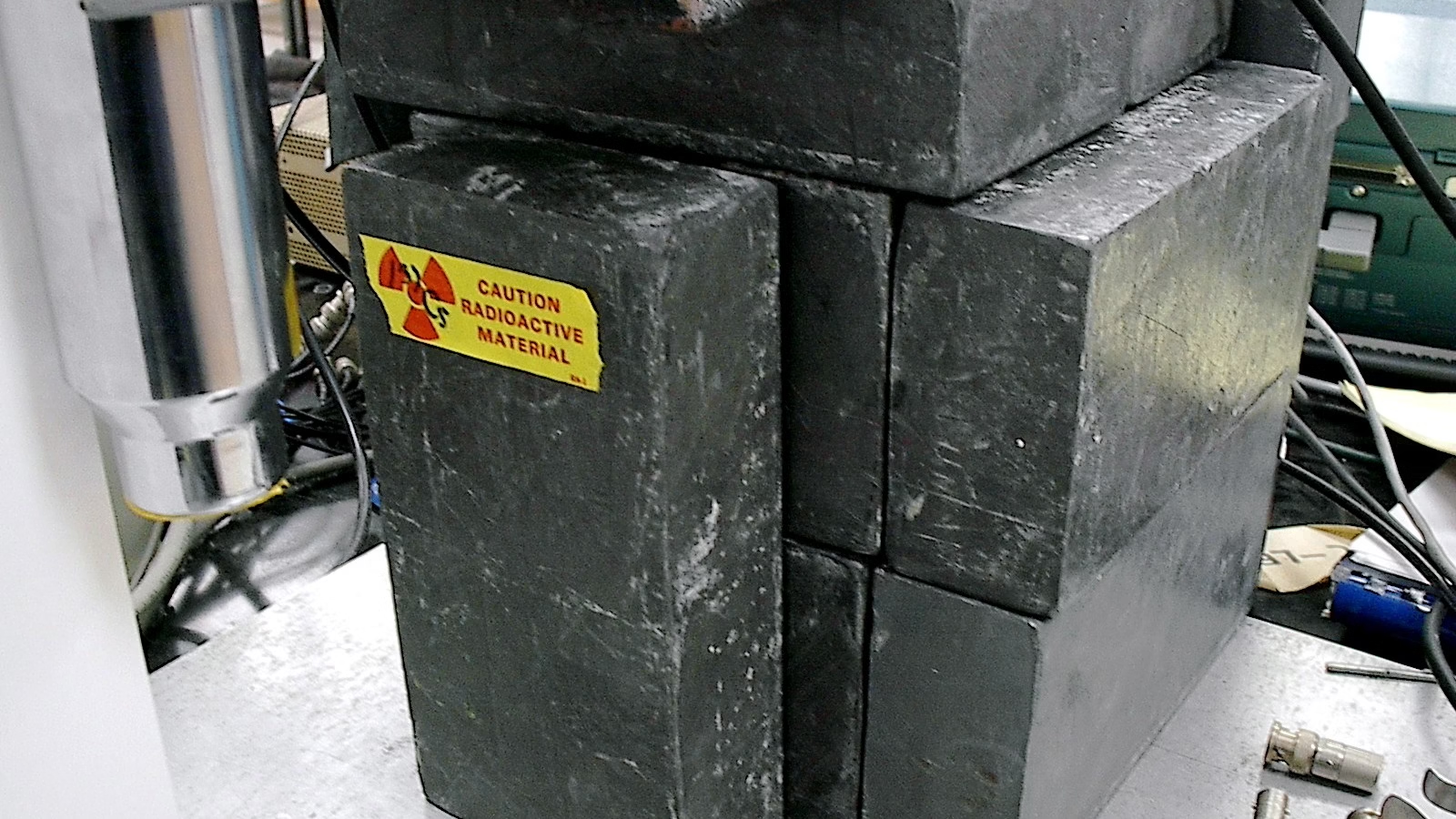
Key takeaways
- To cut a Cs-137 beam to a tenth you need 1.8 cm of lead, 4.0 cm of steel, 13 cm of concrete or 27 cm of water.
- Co-60 needs almost twice the lead of Cs-137: 3.4 cm against 1.8 cm for the same factor of ten.
- Lead’s edge over concrete falls from about 130 to 1 at 35 keV to 5 to 1 at 1.3 MeV.
- The table is narrow-beam physics. Real rooms need more material, and a qualified expert signs off the design.
A Cs-137 source is cut to a tenth by 1.8 cm of lead. Steel needs 4.0 cm, concrete 13 cm and water 27 cm. We ran the NIST XCOM photon cross-sections for the principal gamma line of 15 widely used isotopes through four shields. The table below gives the half-value layer (HVL) and tenth-value layer (TVL) of every pair.
The reference table
HVL is the thickness that halves a narrow beam. TVL cuts it to a tenth. Three TVLs give a factor of 1,000. Both come from the linear attenuation coefficient: HVL is ln 2 divided by it, TVL is ln 10 divided by it.
| Isotope | Gamma line, keV | Lead | Steel (iron) | Concrete | Water | ||||
|---|---|---|---|---|---|---|---|---|---|
| HVL | TVL | HVL | TVL | HVL | TVL | HVL | TVL | ||
| I-125 | 35.4925 | 0.0312 | 0.104 | 0.173 | 0.576 | 4.19 | 13.9 | 22.9 | 76.1 |
| Am-241 | 59.5409 | 0.119 | 0.396 | 0.716 | 2.38 | 10.7 | 35.5 | 33.5 | 111 |
| Ga-67 | 93.31 | 0.0923 | 0.307 | 2.06 | 6.85 | 16.4 | 54.6 | 39.7 | 132 |
| Co-57 | 122.061 | 0.182 | 0.603 | 3.36 | 11.1 | 19.2 | 63.7 | 43.2 | 143 |
| Tc-99m | 140.511 | 0.258 | 0.856 | 4.12 | 13.7 | 20.5 | 68.1 | 45.1 | 150 |
| Lu-177 | 208.366 | 0.674 | 2.24 | 6.24 | 20.7 | 24.1 | 80 | 51.3 | 170 |
| Se-75 | 264.658 | 1.16 | 3.85 | 7.42 | 24.6 | 26.4 | 87.8 | 55.8 | 185 |
| Ir-192 | 316.506 | 1.69 | 5.61 | 8.26 | 27.4 | 28.4 | 94.2 | 59.6 | 198 |
| Ba-133 | 356.013 | 2.13 | 7.06 | 8.81 | 29.3 | 29.7 | 98.8 | 62.4 | 207 |
| I-131 | 364.489 | 2.22 | 7.38 | 8.92 | 29.6 | 30 | 99.7 | 63 | 209 |
| F-18 | 511 | 3.91 | 13 | 10.6 | 35.1 | 34.5 | 115 | 72.2 | 240 |
| Cs-137 | 661.657 | 5.54 | 18.4 | 12 | 39.8 | 38.7 | 129 | 80.8 | 268 |
| Mo-99 | 739.5 | 6.31 | 21 | 12.6 | 42 | 40.7 | 135 | 85 | 282 |
| Co-60 | 1173.23 and 1332.49 | 10.4 | 34.4 | 16.4 | 54.6 | 52.6 | 175 | 110 | 364 |
| Na-22 | 1274.54 | 10.5 | 35 | 16.6 | 55.2 | 53.1 | 176 | 111 | 368 |

Get the next one by email
One new article a week on radiation, particles and the instruments that measure them, with its sources. No spam, unsubscribe any time.
What the numbers show
Energy sets everything. A 59.5 keV photon from Am-241 is cut to a tenth by 0.4 mm of lead. The 1.3 MeV photons of Co-60 need 34 mm, so almost twice the lead that Cs-137 needs. In water, concrete and steel the Compton effect dominates above about 150 keV, and it depends on the electron density, not on the atomic number. In lead the photoelectric effect holds on until about 550 keV. Above that, lead loses most of its edge: at 1.3 MeV it beats concrete by only 5 to 1 in thickness.
Low energies carry a surprise. Lead has a K absorption edge at 88.0 keV, where its mass attenuation coefficient jumps from 1.91 to 7.68 cm²/g in the XCOM data. The 93.3 keV line of Ga-67 sits just above it. Lead therefore stops Ga-67 photons better than the softer 59.5 keV photons of Am-241. Its TVL is 0.31 mm, against 0.40 mm.
Steel is the compact structural choice. At 662 keV it needs about a third of the thickness of concrete. Water is the thickest shield, but it is cheap and easy to move. This table covers photons only.
How we computed it
Every value comes from our photon engine, which reads NIST XCOM mass attenuation coefficients, interpolates them on a log-log grid and multiplies by density. Lead is 11.35 g/cm³, steel is modelled as pure iron at 7.874 g/cm³, concrete is ordinary Portland concrete at 2.3 g/cm³, and water is 1.0 g/cm³. Gamma-line energies come from the evaluated nuclear structure data file (ENSDF), served by the NNDC NuDat database. The line is the most intense gamma ray of each isotope, X-rays excluded. For F-18 it is the 511 keV annihilation photon. For Co-60 we average the linear coefficients of its 1173.2 and 1332.5 keV lines.
Limits
These are narrow-beam values. They ignore scattered photons that build up behind a thick shield, so a real wall must be thicker. Concrete varies by site and mix, and alloy steels differ slightly from iron. I-125 and Am-241 also emit X-rays that a thin shield absorbs more easily than the gamma line. Dose limits, workload and geometry belong to a qualified radiation protection expert, who will use broad-beam data.
To try your own isotope, energy or material, use the photon attenuation calculator. For beta particles and heavy charged particles, the energy loss calculator applies instead. Our explainer on how photons interact with matter covers the physics behind the three processes.
Cite this: ScienceShot, Europe’s shielding reference, November 2026, scienceshot.com, scienceshot.com/post/shielding-reference-15-isotopes-lead-concrete-steel-water.
Sources: NIST XCOM, Photon Cross Sections Database (SRD 8), a US government work; ENSDF evaluated decay data, National Nuclear Data Center NuDat, retrieved 30 Oct 2026.
Cite this article
Turner, A. (2026, November 3). Shielding for 15 isotopes: lead, steel, concrete, water. ScienceShot. https://scienceshot.com/post/shielding-reference-15-isotopes-lead-concrete-steel-water
Turner, Alex. “Shielding for 15 isotopes: lead, steel, concrete, water.” ScienceShot, 3 Nov. 2026, scienceshot.com/post/shielding-reference-15-isotopes-lead-concrete-steel-water.
Turner, Alex. “Shielding for 15 isotopes: lead, steel, concrete, water.” ScienceShot, November 3, 2026. https://scienceshot.com/post/shielding-reference-15-isotopes-lead-concrete-steel-water.
@online{scienceshot-shielding-reference-15-isotopes-2026,
  author       = {Turner, Alex},
  title        = {{Shielding for 15 isotopes: lead, steel, concrete, water}},
  organization = {ScienceShot},
  date         = {2026-11-03},
  year         = {2026},
  url          = {https://scienceshot.com/post/shielding-reference-15-isotopes-lead-concrete-steel-water}
}
https://scienceshot.com/post/shielding-reference-15-isotopes-lead-concrete-steel-water
Get one article a week
One new article a week on radiation, particles and the instruments that measure them, with its sources. No spam, unsubscribe any time.