
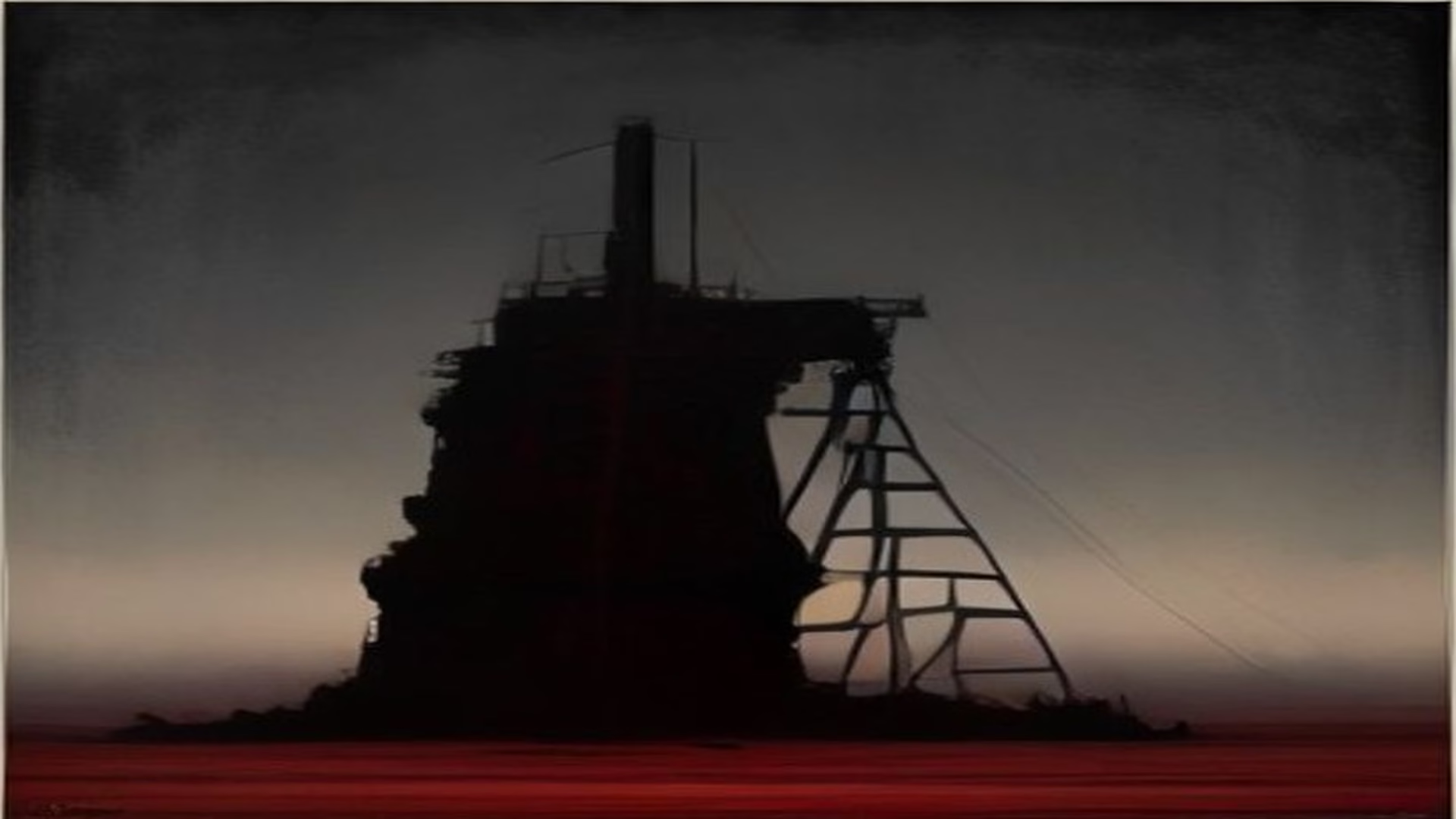
In 1989, a Soviet drilling crew pulled their bit up from 12,262 meters below the Kola Peninsula and quietly set a record nobody has broken since: the Kola Superdeep Borehole, the deepest hole ever cut into Earth’s crust. Thirty-seven years later it is still unbeaten, and the popular explanation is almost always the same one — the USSR ran out of money before it could go deeper.
That version skips the more interesting failure. Before the funding ever dried up, the crust itself had already started winning: granite heated past 180°C stopped fracturing under the drill and began creeping shut around it, like warm tar closing over a stick. Money finished the project. Physics had already started killing it.
The Kola Superdeep Borehole: A Cold War Bet on Rock
The project began in 1970, part scientific curiosity and part Cold War theater: the Soviets wanted to drill straight down through continental crust and see what was actually there, rather than infer it from seismic echoes. Nineteen years and one narrow borehole later, engineers hit 12,262 meters (40,230 feet) — a true vertical depth nothing drilled since has matched. A fourth branch of the same hole, restarted in the early 1990s, only reached 11,882 meters before crews stopped in 1992, shallower than the 1989 record, explicitly because of the heat they kept running into. That detail alone should end the funding-only narrative: the same hole, redrilled, hit the same wall for the same reason.
It was also a prestige project as much as a scientific one, the kind of numbers-driven flex that fit an era obsessed with reaching extremes first — a deepest hole to go with a first satellite and a first spacewalk. The Soviets were not drilling for oil at Kola; they wanted direct rock in hand from depths that had previously only been inferred from how seismic waves bounced back to the surface.
Put the number in perspective. Continental crust runs roughly 35 to 40 kilometers thick, so Kola crossed about a third of the crust and roughly 0.19% of the distance to Earth’s 6,371-kilometer-radius center. It never got near the mantle, let alone the core — it barely dented the outermost skin of the planet, yet that skin was already too hot and too soft to keep drilling through.
Source: HowStuffWorks / Kola SG-3 project data
The chart above tells the real story better than any political history can. The two curves sit close together for most of the descent, then split hard in the final stretch — which is exactly where the borehole started fighting back against the crew instead of yielding to the bit.
Where 12 Kilometers of Granite Stopped Acting Like Rock
Here’s the part most retellings skip: engineers didn’t plan for 180°C. Their geothermal models predicted around 100°C at 12,262 meters — ordinary for that depth, based on how heat was believed to move through old continental crust. What they actually measured was 180°C, nearly double the prediction, and that gap is the real story, not the ruble.
Rock has a personality change with depth and temperature called the brittle-ductile transition: the point where enough heat and confining pressure stop it from cracking cleanly and start letting it deform slowly, like a solid that flows. Cold wax snaps; warm wax bends and sags. Surface ice on a glacier shatters into crevasses, while ice deep inside the same glacier creeps and flows under its own weight without ever fracturing. Kola’s granite crossed that same line.
Above the transition, a drill bit chips rock away and the hole stays open behind it — that’s how the first ten-plus kilometers went. Below it, the borehole walls behave like glacier ice under pressure: they creep inward, squeezing the hole shut around the drill string faster than the crew could cut new rock out of the way. Heat made things worse a second way too, cooking the drilling mud meant to lubricate and cool the bit, which shortened bit life dramatically at depth. None of the popular myths — that they struck basalt, hit magma, or broke into some hidden cavity — actually happened; what stopped them was mechanical, not geological drama.
Every additional meter below that split had to fight the rock’s tendency to close back up behind the drill, which is a fundamentally different problem than simply breaking rock apart. A brittle formation gets out of the drill’s way once and stays out of the way; a ductile one keeps coming back. That distinction is why the fourth branch in the early 1990s stalled even earlier than the original hole — the crew already knew where the trouble started and still could not out-drill it.
This is a strikingly ordinary way for an ambitious engineering project to fail: not a dramatic blowout, but a model of the physical world that was wrong by a wide margin exactly where the margin mattered most. It’s the same shape of failure behind other famous engineering misjudgments — a 17-degree gap between predicted and real-world conditions undid the Challenger seals for related reasons, a design built around numbers the material only mostly agreed with.
Get the next one by email
Physics, engineering and the people behind them. No spam, unsubscribe any time.
Longest Well vs Deepest Hole: A Record Often Confused
Kola still holds the record most people think it holds, but not the one headlines sometimes hand to oil wells. In May 2008, Qatar’s Al Shaheen field drilled BD-04A to a measured length of 12,289 meters — technically longer than Kola’s borehole — but its true vertical depth was only about 1,387 meters, because it is an extended-reach well drilled almost horizontally through a reservoir. Sakhalin-I’s Chayvo Z-44 pushed that further in August 2012, reaching 12,376 meters of measured length, the longest well ever drilled, again by going sideways rather than down.
Neither well comes close to Kola’s true vertical depth. They are longer boreholes, engineered on purpose to travel far and stay shallow so a company can tap a wide oil and gas reservoir from a single platform. Kola went almost straight down and stayed there, which is a completely different, and much harder, problem: gravity does not fight a horizontal well the way heat and pressure fight a vertical one.
Source: oilandgasiq.com; Kola SG-3 project records
⚡ PHOTON’S TAKE
I find it almost funny that the Cold War’s most Cold-War-sounding record wasn’t broken by politics — it was broken by a bad thermal model. Everyone wants a story about money running out; the crust doesn’t care about five-year plans. Granite at 12 kilometers didn’t know it was supposed to hold 100°C, so it sat there at 180°C and did exactly what hot rock under real pressure always does: it flowed. That’s the line I’d put on a plaque. Moscow could have written a bigger check. It could not have written cooler rock.
The Kola Superdeep Borehole’s Real Lesson for Engineers
Deep drilling projects since Kola have quietly absorbed this lesson: modern ultra-deep wells budget explicitly for ductile rock and downhole temperatures that can outrun a simple linear model, rather than assuming the crust behaves the way a decades-old gradient chart says it should. I’ve spent enough time around extreme engineering environments — from data-center cooling loops to the LHC’s cryogenics, deliberately built colder than deep space — to recognize the pattern: the environments that break projects are rarely the ones anyone put in the original spec sheet.
Kola’s real legacy is not a hole in the Kola Peninsula; it’s a caution familiar from other misdiagnosed engineering stories, including cases where the true cause of a project’s failure got misread for decades. Nobody is racing to beat 12,262 meters of true vertical depth, and on current drilling technology nobody should expect to soon — the brittle-ductile transition does not move for better funding.
Materials science has moved on considerably since 1970, and modern bits, muds and downhole electronics are all better than what Kola’s crew had. None of that changes the underlying physics: the brittle-ductile transition is a property of rock, heat and pressure, not of drill-bit metallurgy. Beating Kola’s true vertical depth would mean solving that thermal problem outright, not simply building a tougher bit and trying again.
One story like this, most days
Written by a CERN physicist. No spam, unsubscribe any time.



Interesting. Old, vintage hardware