Key takeaways
- Nobody invented alternating current power. It is a system of generator, transformer, motor and line, assembled by many people between 1831 and 1891.
- The generator came first. Hippolyte Pixii’s hand-cranked machine of 1832 already produced alternating current, which an Ampère commutator then rectified.
- The transformer made it practical, and it was invented three times in five years: Gaulard and Gibbs (patent 1882), Zipernowsky, Bláthy and Déri (applications of early 1885), and William Stanley, who lit Great Barrington on 20 March 1886.
- Tesla’s polyphase patents date from 1 May 1888. Galileo Ferraris reached the rotating magnetic field independently from 1885. In 1891 a three-phase line carried about 300 horsepower 175 km from Lauffen to Frankfurt at over 75 per cent efficiency.
- AC won on arithmetic. At the same power, ten times the voltage means a tenth of the current and a hundredth of the line loss.
On 20 March 1886, twenty shops and offices on Main Street in Great Barrington, Massachusetts, lit incandescent lamps from a power system with no direct current on the street. A Siemens steam-driven alternator in an old rubber mill near Cottage Street supplied 500 volts. William Stanley had built his own transformers. In a test he raised the 500 volts to 3,000 and brought it back down again; the mains along the street ran at 500 volts, on wires fastened to the elm trees. Six step-down transformers in building basements brought the voltage down to 100 volts for the lamps (IEEE milestone text).
The milestone page calls it the first installation with all the basic features of a large electric power system. Look at what Stanley had to hand. The alternator was an existing machine. The transformer idea had been patented four years earlier by Lucien Gaulard and John Dixon Gibbs, and a Hungarian team had filed a better version a year before. So who invented alternating current? No one person did. AC power is a system, and its parts have different parents. Below is the dated record, then the arithmetic that explains why the system won.
Who contributed what: the dated record
Dates come from the sources in the last column. Where sources disagree, the row says so. Each row marks a first documented step. It does not rank anyone.
| Date | Who | What | Record |
|---|---|---|---|
| 29 August 1831 | Michael Faraday | Wraps two coils on an iron ring. A current in one coil induces a brief current in the other. The Royal Institution calls the ring the first electric transformer. | Royal Institution |
| 1832 | Hippolyte Pixii, with André-Marie Ampère | Hand-cranked machine turns a magnet under a coil and induces alternating current. Ampère’s rocking commutator rectifies it. The museum calls it basically a laboratory apparatus. | Museo Galileo |
| 1876 to 1878 | Pavel Yablochkov | Arc-lamp candle fed with alternating current. In 1878, 64 lamps light the Avenue de l’Opéra in Paris. ETHW says the AC came from direct current dynamos fitted with an inverter. | ETHW |
| 1882 | Lucien Gaulard and John Dixon Gibbs | Patent for distributing current through “secondary generators”, early transformers. Series connection. | Grace’s Guide; Museo Galileo |
| 1884 | Gaulard and Gibbs; Galileo Ferraris | Turin exhibition shows an AC line from Lanzo to Turin, about 40 km. The Deutsches Museum record gives 20 kW at 2,000 V; the ETHW milestone page gives 2 kW at 20 kV. | ETHW; Deutsches Museum record |
| January to March 1885 | Károly Zipernowsky, Ottó Bláthy, Miksa Déri (Ganz, Budapest) | Patent applications for transformers with parallel connection, a freely chosen ratio and a closed iron core. First to use the word “transformer”. | Asztalos, 1986 |
| From 1885 | Galileo Ferraris | Conceives a rotating magnetic field from two alternating currents 90 degrees apart, and builds two-phase motors. | ETHW |
| 20 March 1886 | William Stanley | Great Barrington: 500 V generator, own transformers, six step-down transformers, twenty businesses lit. Parallel-wired transformers. | ETHW milestone; ETHW, Stanley |
| 1 May 1888 | Nikola Tesla | US patents 381,968 (filed 12 October 1887) and 382,280 for motors driven by alternating currents in independent circuits. | US 381,968; US 382,280 |
| 24 to 25 August 1891 | Oskar von Miller, Michael Dolivo-Dobrowolsky (AEG), Charles E. L. Brown (Oerlikon) | Three-phase line from Lauffen am Neckar to Frankfurt: 175 km, 15 kV, 25 Hz, about 300 horsepower, efficiency above 75 per cent. Sources give 24 or 25 August. | ETHW milestone; TU Darmstadt |
| 26 August 1895 | Adams station, Niagara Falls | First large-scale multiphase power station with commercial operation at Niagara Falls. Ten 5,000 horsepower generators by May 1900. | ETHW milestone |
The generator and the lamp: 1831 to 1878
Faraday’s ring of 1831 was the first transformer, though nobody would have called it that. It showed that a changing current in one coil can induce a current in another. Every transformer still uses that effect. A year later Pixii, a Paris instrument maker who built apparatus for Arago and Ampère, gave the effect a handle. He turned a horseshoe magnet under a coil and got alternating current out. The Museo Galileo, which holds an original, says the induced current is rectified by Ampère’s rocking commutator, worked by a cam on the armature axis. Our reading is that early users wanted direct current, so alternating current was rectified from birth.
Alternating current found its first public job in lighting. Yablochkov’s arc candle burned two carbon rods side by side. In 1878, ETHW records, he lit 64 of them along half a mile of the Avenue de l’Opéra and nearby squares. ETHW states that his system ran on direct current dynamos fitted with an inverter to supply alternating current. A second ETHW page, on arc lighting, says that the candles operated only on alternating current. We do not claim how the AC was generated. For this record it is enough that lamps in a Paris street were already being fed with it.
The transformer, invented three times
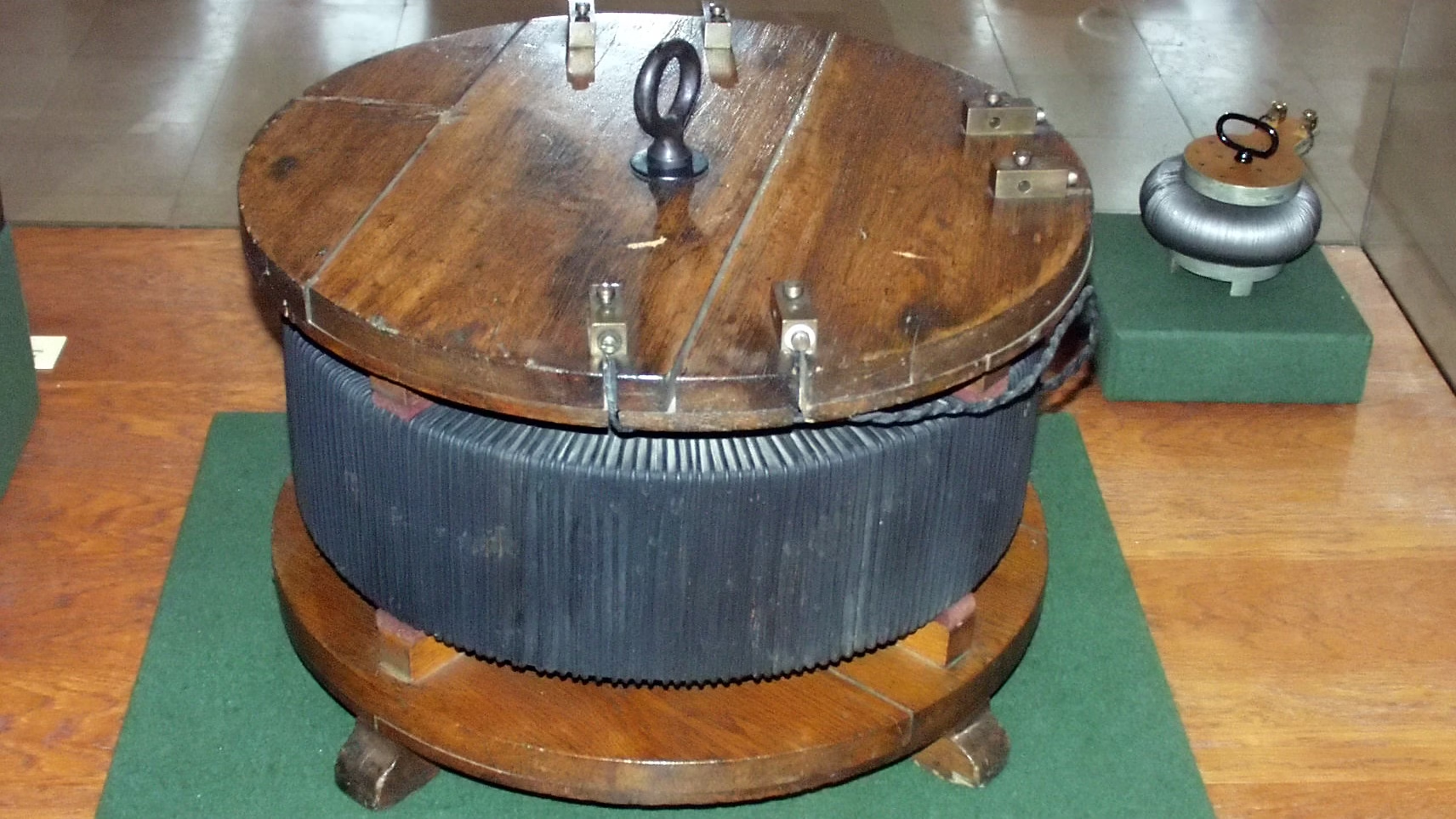
Alternating current could do one trick that direct current could not. Its voltage could be changed with coils of wire and no moving parts. The first people to build that into a distribution system were Gaulard and Gibbs. They patented their “secondary generator” in 1882, and the Museo Galileo describes the transformers sitting at intervals along a very long circuit, connected in series. In 1884 the Turin exhibition put the idea to a public test. Ferraris, who helped organise the electric section, ran an AC line from Lanzo to Turin of about 40 km (ETHW). The Deutsches Museum, which holds a Gaulard and Gibbs transformer, gives the figures as 20 kW at 2,000 V. The ETHW milestone page gives 2 kW at 20 kV, so the power and voltage of that line are uncertain.
Series connection had a flaw. Each transformer in the chain depended on all the others, so a change of load at one lamp upset the rest. Stanley’s biography at ETHW says that the Gaulard and Gibbs coils were wired in series, that the system was not self-regulating, and that Stanley saw the weakness. Parallel wiring, with each transformer fed from the same line, kept the voltage steady. ETHW cites a notebook entry of 18 September 1883 for his parallel-circuit discovery.
A Hungarian team reached the same fix. Zipernowsky, Bláthy and Déri, engineers at the Ganz works in Budapest, filed patent applications between January and March 1885. According to a paper by Péter Asztalos in Periodica Polytechnica, they covered transformers connected in parallel, a ratio that could be chosen freely, and a closed iron core. The three men were also the first to use the word “transformer” for the device, the same paper says. We have read its abstract and have not checked the patents themselves.
Westinghouse then took up the idea. The Edison Tech Center says that George Westinghouse bought the North American rights to the Gaulard and Gibbs system in 1885, for $50,000. ETHW’s Stanley biography says only that Westinghouse had taken an option on it. Either way, Stanley worked on the system for him. His Great Barrington installation of March 1886 combined the pieces: transformers wired in parallel, step-up and step-down stages, and a real load of lamps. ETHW credits him with grasping the closed magnetic core and the counter electromotive force that limits the current in the primary winding.
The motor: Ferraris and Tesla in brief
Lighting needs a generator and a transformer. Factories need a motor. In 1885 Galileo Ferraris, a professor in Turin, saw that two alternating currents 90 degrees out of step, fed to two coils at right angles, make a magnetic field that turns. A motor built on that idea needs no commutator. ETHW credits him with prototype two-phase motors, and the Edison Tech Center says he published in 1888. Nikola Tesla’s two patents, US 381,968 and US 382,280, were both granted on 1 May 1888. Our separate piece on what Nikola Tesla invented goes through his patents. Here it is enough to say that he did not invent alternating current or the transformer. His polyphase motor is one of the parts that completed the system.
Get the next one by email
One new article a week on radiation, particles and the instruments that measure them, with its sources. No spam, unsubscribe any time.
Lauffen to Frankfurt, 1891: the test that settled it
By 1891 the argument was about distance. Direct current systems of the day served customers within short reach of the generator. The International Electrotechnical Exhibition in Frankfurt let supporters of alternating current show what a long line could do. Oskar von Miller, a German-Bavarian consultant, organised a line from the hydroelectric plant at Lauffen am Neckar to the exhibition grounds. AEG, where Michael Dolivo-Dobrowolsky worked, and Maschinenfabrik Oerlikon, where Charles Brown designed the 300-horsepower generator, supplied the three-phase machinery.
The IEEE milestone page gives the figures: 175 km, 15 kV, 300 horsepower and an overall efficiency above 75 per cent, at 25 Hz. Lecture slides from the Technical University of Darmstadt date the first connection to 24 August 1891 and the demonstration to 25 August, and give the achieved efficiency as 75 per cent. The same slides say the 300-horsepower Oerlikon generator now stands in the Deutsches Museum in Munich. The Darmstadt slides and the Linda Hall Library credit Dolivo-Dobrowolsky with the three-phase system; he called it Drehstrom, rotating current. He joined AEG in 1887, and the Linda Hall Library notes that he asked whether three currents might improve on the two-current motors of Ferraris and Tesla.
Three-quarters sounds poor beside a modern grid. In 1891 it made the case. A sceptic quoted in the Darmstadt slides had feared that nothing of the current sent into the line would be left at the other end. The arithmetic below shows why a high voltage was the only way to try.
Niagara, 1895 to 1896
The Adams station at Niagara Falls began supplying local industry on 26 August 1895, and ETHW calls it a key victory for alternating current over direct current. The Edison Tech Center says the generators were 5,000 horsepower, two-phase machines at 25 Hz, supplied by Westinghouse, and that General Electric, which had lost the generator bid, won the contract for the transmission line. Power reached Buffalo on 15 November 1896, according to the same source, over a line of 25 miles at 11,000 volts. The Edison Tech Center is a secondary source, so treat the date and length as approximate.
This period is often told as a war between Edison and Westinghouse. The record we could open is thinner than the legend. The Edison Tech Center says that in 1886 Edison bought options on the Zipernowsky, Bláthy and Déri transformer, then decided alternating current was not worth the investment and dropped them. We found no source we could open that settles the wider quarrel, so we leave the legends out.
Why AC won: the arithmetic of a long wire
A wire heats in proportion to the square of the current in it. For a line of resistance R carrying current I, the power lost as heat is I²R. A line delivering power P at voltage V carries current I = P ÷ V. Put the two together and the loss falls as the square of the voltage. Raise the voltage tenfold and the same wire wastes a hundredth as much.
Here is a worked case. We want to deliver 100 kW through a line whose total resistance is 1 ohm (round numbers chosen for the sums, not a historic line).
| Receiving-end voltage | Current (P ÷ V) | Loss in line (I² × 1 ohm) | Share of the 100 kW lost |
|---|---|---|---|
| 100 V | 1,000 A | 1,000,000 W | Absurd: the loss is ten times the power delivered |
| 1,000 V | 100 A | 10,000 W | 10% |
| 10,000 V | 10 A | 100 W | 0.1% |
Going from 1,000 V to 10,000 V cut the current from 100 A to 10 A and the loss from 10 kW to 100 W, a factor of 100. Direct current had no easy equivalent in the 1880s, because raising or lowering a direct voltage needed rotating machinery. A transformer needs only a changing current. That is why the transformer sits at the centre of this story.
Stanley’s numbers fit the pattern. His street mains ran at 500 V and the basement transformers lowered it to 100 V for the lamps (ETHW). Had the street run at 100 V, the same power would have needed five times the current and caused twenty-five times the heating in the same wire. That is our calculation, because the pages give no loss figure. Lauffen is harder to check. Take 300 horsepower as about 224 kW (746 W per horsepower, our conversion) and the three-phase formula I = P ÷ (√3 × V) at unity power factor. Each wire then carried about 8.6 A at 15 kV. That is our estimate and ignores the real power factor. It shows how little current a 15 kV three-phase line needs to move that much power.
⚡ PHOTON’S TAKE
If one invention decided the contest, I would pick the transformer, and it had at least three fathers between 1882 and 1886. Tesla’s motor and Ferraris’s rotating field matter, and the 1888 patents are the best-known date in the story. By then Stanley had already lit a town. The record gives credit to a chain of people, each of whom fixed the flaw of the one before. Gaulard and Gibbs had series wiring, Stanley and the Ganz engineers fixed it with parallel wiring, and Dolivo-Dobrowolsky took the motor to three phases. That is a less tidy story than a single name, and I think it is the better one.
From the grid to the rack: AC meets DC again
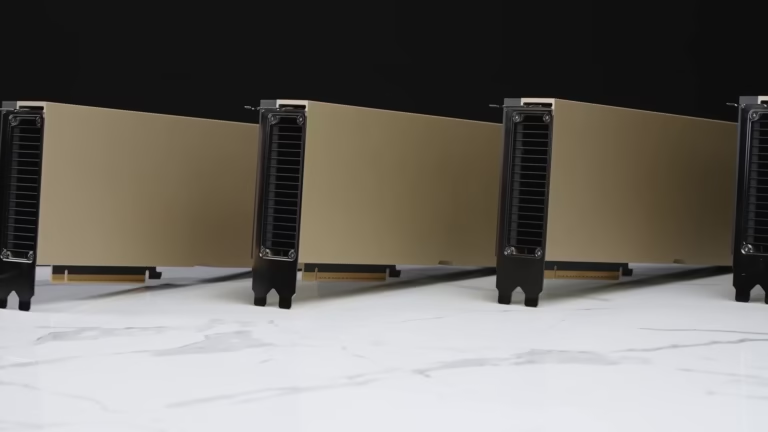
The grid still delivers alternating current, and the same I²R rule has returned inside the data centre. Our piece on 800 V DC power for 1 MW server racks works through it. At the 54 V busbar voltage that today’s racks use, a 1 MW rack would draw about 18,500 A. At 800 V DC the current falls to 1,250 A, and the resistive loss in a given conductor falls about 219 times. NVIDIA’s May 2025 description, as that article reports it, converts 13.8 kV AC grid power to 800 V DC at the edge of the data centre with rectifiers, then distributes DC along the rows. The article also covers the catch: DC is harder to switch off, so protection equipment has to change. Each AC to DC conversion step matters because it is a place where heat and cost enter, and where the voltage chosen decides how much copper the rack needs.
Sources
- IEEE Milestone, Alternating Current Electrification, 1886 (Great Barrington), ETHW
- William Stanley, ETHW biography
- IEEE Milestone, Rotating Fields and Early Induction Motors, 1885-1888, ETHW
- IEEE Milestone, Long Distance Electric Power Transmission Using Three-Phase Alternating Current, 1891, ETHW
- IEEE Milestone, Adams Hydroelectric Generating Plant, 1895, ETHW
- Jablochkoff Candles in Paris, ETHW
- Arc Lighting, ETHW
- Royal Institution, Michael Faraday’s ring-coil apparatus
- Museo Galileo, Magnetoelectric machine by Pixii
- Museo Galileo, Gaulard and Gibbs secondary generator
- Grace’s Guide, Gaulard-Gibbs
- Deutsches Museum, Gaulard and Gibbs distribution transformer (object record, via Wikimedia Commons)
- Péter Asztalos, Centenary of the transformer, Periodica Polytechnica Electrical Engineering 30 (1986)
- Nikola Tesla, US patent 381,968, Electro-magnetic motor (1888)
- Nikola Tesla, US patent 382,280, Electrical transmission of power (1888)
- Technische Universität Darmstadt, lecture slides on the history of electrical engineering (Lauffen-Frankfurt, slides 12 to 14)
- Linda Hall Library, Scientist of the Day: Mikhail Dolivo-Dobrovolsky
- Edison Tech Center, The History of Alternating Current
- Edison Tech Center, Harnessing Niagara Falls
Cite this article
Turner, A. (2026, November 1). Who Invented Alternating Current? The Dated Record. ScienceShot. https://scienceshot.com/post/who-invented-alternating-current
Turner, Alex. “Who Invented Alternating Current? The Dated Record.” ScienceShot, 1 Nov. 2026, scienceshot.com/post/who-invented-alternating-current.
Turner, Alex. “Who Invented Alternating Current? The Dated Record.” ScienceShot, November 1, 2026. https://scienceshot.com/post/who-invented-alternating-current.
@online{scienceshot-who-invented-alternating-current-2026,
  author       = {Turner, Alex},
  title        = {{Who Invented Alternating Current? The Dated Record}},
  organization = {ScienceShot},
  date         = {2026-11-01},
  year         = {2026},
  url          = {https://scienceshot.com/post/who-invented-alternating-current}
}
https://scienceshot.com/post/who-invented-alternating-current
Get one article a week
One new article a week on radiation, particles and the instruments that measure them, with its sources. No spam, unsubscribe any time.