Key takeaways
- Tesla’s best documented invention is the polyphase alternating current (AC) induction motor and the system built around it. US patents 381,968 and 382,280 were granted on 1 May 1888.
- Galileo Ferraris reached the rotating magnetic field independently in Turin from 1885, presented it in March 1888 and never patented it.
- Tesla did not invent alternating current, the transformer, the incandescent lamp or X-rays. William Stanley lit shops in Great Barrington with AC and transformers on 20 March 1886.
- On 21 June 1943, five and a half months after Tesla died, the US Supreme Court struck down the broad claims of a Marconi radio patent. It relied mainly on a patent by John Stone Stone and did not rule that Tesla invented radio.
- The Nikola Tesla Museum in Belgrade counts 112 US patents and at least 311 patents in 27 countries, many of them copies of the same invention filed abroad.
On 16 May 1888 Nikola Tesla, then 31, stood up before the American Institute of Electrical Engineers in New York. He thanked Professor Anthony for his help and then apologised. The notice had been short, he said, and he had not covered the subject as fully as he wished, “my health not being in the best condition at present” (the lecture text).
Then he went after the part of the direct current machine that engineers of the day fought with. That machine needs a commutator, a rotating switch that keeps reversing the current in its coils as it turns. Tesla called it “a complicated device” and “the source of most of the troubles” in electrical machines. He had come to show a motor that ran on alternating current and needed no commutator at all.
Fifteen days earlier, the US Patent Office had granted him the patents that covered it. One of them, US 381,968 for an “electro-magnetic motor”, records in its heading that half of it belonged to Charles F. Peck of Englewood, New Jersey.
That motor, and the system around it, is the firmest answer to the question of what Tesla invented. The rest of the list is longer and messier than most accounts admit. He patented the resonant transformer now called the Tesla coil, a radio-controlled boat, a bladeless turbine, a one-way valve with no moving parts and a vertical take-off aircraft. He did not invent alternating current, the transformer, the light bulb or X-rays. Radio is the hard case, and the 1943 Supreme Court decision often quoted in his favour says less than its reputation. His forecasts about the future are covered in our piece on Tesla’s predictions, and the commercial fight in Tesla vs Edison.
How a rotating magnetic field turns a motor without brushes
Power for motors in 1888 was “almost entirely confined” to direct current, Tesla told his audience. Direct current flows one way. To keep the rotor turning, the current in its coils had to be reversed at the right moment, and the commutator did that through sliding contacts called brushes. Sparking at sliding contacts wastes energy and shortens a motor’s life, as HyperPhysics notes.
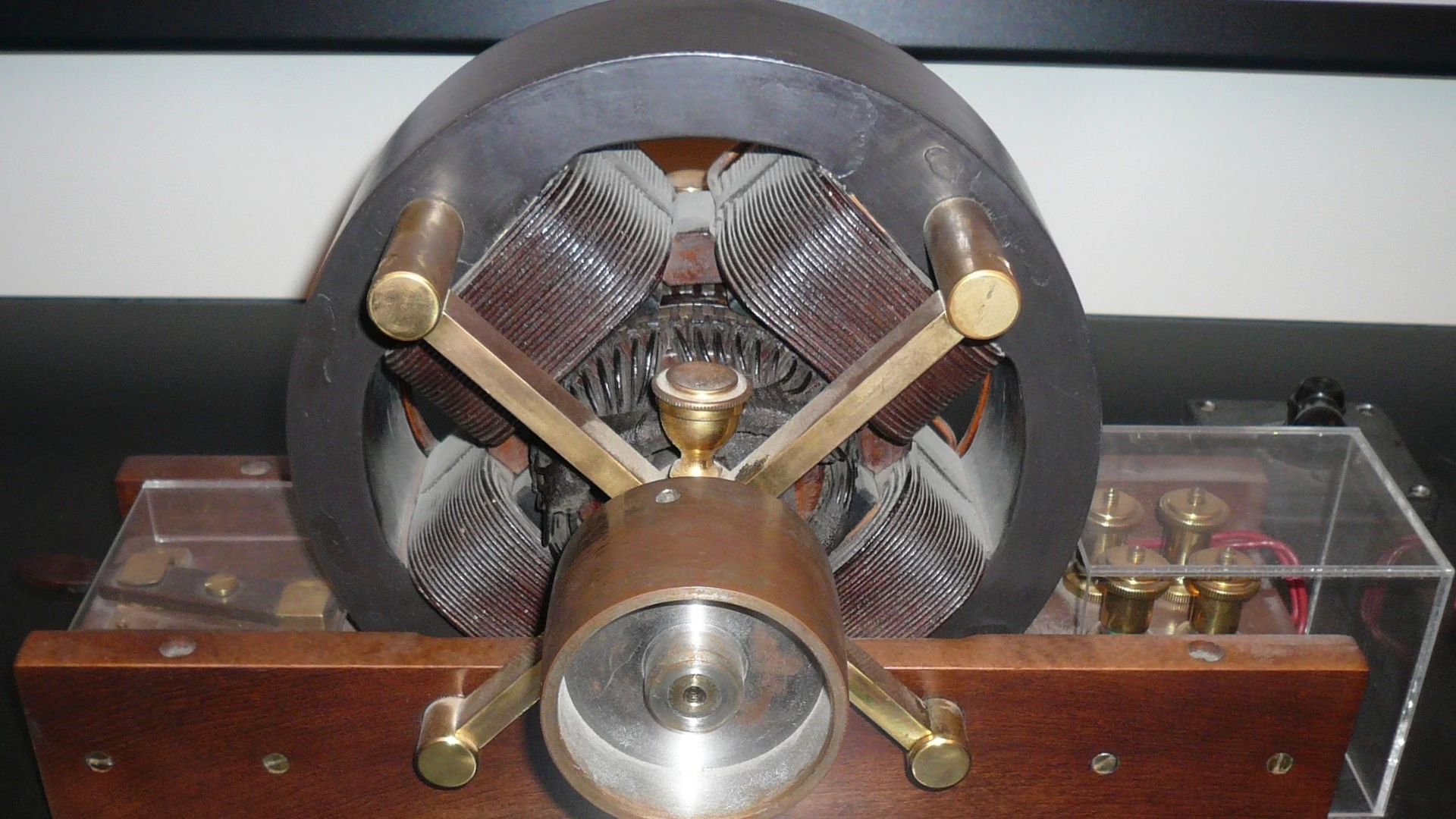
Tesla’s answer works in two steps. First, make the magnetic field itself turn. Take two coils at right angles and feed each with an alternating current, timed a quarter of a cycle apart. When the current in the first coil peaks, the current in the second is zero, so the field points along the first coil. A quarter of a cycle later the roles swap and the field points along the second. Then the first current peaks again, in the opposite direction. The field direction swings round the circle, one full turn per cycle, while nothing moves. Tesla’s patent calls this “a progressive shifting of the magnetism”. In the three-phase version that Britannica describes, three coils and three currents make a field that turns at constant strength.
Second, put a rotor inside that field made of metal bars joined into closed loops, with no wire running to it from outside. As the field sweeps past the bars, it induces a voltage in them. Because the loops are closed, current flows. A current inside a magnetic field feels a force, and that force drags the rotor round in the direction the field is turning. The rotor takes no current from the supply, which is why this motor needs no commutator (HyperPhysics).
The rotor can never quite catch the field. If it turned at exactly the same speed, the field would stand still relative to the bars. No voltage would be induced, and the push would vanish. So the rotor runs a little slower, and engineers call the difference slip. Britannica puts it at 0.5 to 5 percent at full load. On a 50 Hz European supply the field of a two-pole motor turns 3,000 times a minute, so its rotor turns at roughly 2,850 to 2,985.
Who got there first: Tesla or Ferraris?
The idea had a second inventor. In Turin, Galileo Ferraris had been working on the rotating magnetic field since 1885 and built laboratory prototype motors to test it. He presented the principle to the Turin Academy of Science in March 1888, two months before the New York lecture (IEEE Milestone). He chose not to patent it. Britannica says others reached the same principle independently, “among them Nikola Tesla, who applied and patented it.”
Tesla’s own account puts his idea earlier. The Belgrade museum, repeating it, says he conceived the rotating field in Budapest in February 1882 and built a first motor in Strasbourg in 1883 (Tesla Museum). The same museum notes that there is no record of him seeking a patent while he worked in Budapest in 1881 and 1882. His first application was filed on 30 March 1885 (Tesla Museum). The fair verdict is a shared discovery, with Tesla the one who turned it into a patented, saleable system.
His patents covered that system, which was the commercial point. US 382,280 claims a way of sending power over a line by feeding alternating currents into separate circuits, so that the motor’s magnetic poles keep shifting round. George Westinghouse licensed these inventions, and they helped AC win the contest with direct current (Physics Today). At Niagara Falls the Adams plant began supplying local industry on 26 August 1895. The IEEE calls it the first large-scale multiphase power station, and by May 1900 it had ten generators of 5,000 horsepower (IEEE Milestone). They were two-phase machines running at 25 Hz (Tesla Museum).
The motor is still everywhere. Britannica calls the induction motor “the principal device for the conversion of electrical power to mechanical power.” Electric motor systems of all kinds used 53% of the world’s electricity in 2023, or 13,462 TWh, according to the IEA 4E motor systems programme.
Tesla’s major US patents, with numbers and dates
The dates below come from the patent documents. Where an application was split from an earlier one, or renewed, the table says so. The last column records what happened to each idea, as far as the record shows.
| US patent | Filed | Granted | Title on the patent | What it does | What became of it |
|---|---|---|---|---|---|
| 334,823 | 6 May 1885 | 26 Jan 1886 | Commutator for dynamo-electric machines | Stops sparking where brushes leave the commutator bars of a direct current dynamo | His first granted US patent (Tesla Museum) |
| 381,968 | 12 Oct 1887 | 1 May 1888 | Electro-magnetic motor | AC motor turned by a “progressive shifting” of the magnetic field, with no commutator on the motor | Basis of the polyphase induction motor; half assigned to Charles F. Peck |
| 382,280 | 9 Mar 1888 (split from the 12 Oct 1887 application) | 1 May 1888 | Electrical transmission of power | Sends power by feeding alternating currents into separate circuits so the motor’s poles keep shifting | Licensed by Westinghouse (Physics Today); multiphase AC ran the Adams plant at Niagara from 1895 |
| 454,622 | 25 Apr 1891 | 23 Jun 1891 | System of electric lighting | A capacitor discharges through a primary coil; the secondary gives very high voltage at very high frequency | The Tesla coil; he used it in his lighting and wireless research (Tesla Museum) |
| 645,576 | 2 Sep 1897 | 20 Mar 1900 | System of transmission of electrical energy | Sends power through thin upper air, with four circuits tuned to one frequency | The Supreme Court found in 1943 that it anticipated features of Marconi’s tuning patent |
| 649,621 | 19 Feb 1900 (split from the 1897 application) | 15 May 1900 | Apparatus for transmission of electrical energy | Transmitting and receiving coils tuned to each other | The Patent Office rejected Marconi’s tuning claims on it before his patent was granted, amended, in 1904 (Rutledge dissent, 1943) |
| 613,809 | 1 Jul 1898 | 8 Nov 1898 | Method of and apparatus for controlling mechanism of moving vessels or vehicles | Steers a boat from a distance by radio signals | Shown at Madison Square Garden in 1898; called the first public demonstration of wireless command (Tesla Museum) |
| 1,119,732 | 18 Jan 1902 (renewed 4 May 1907) | 1 Dec 1914 | Apparatus for transmitting electrical energy | Grounded transmitter with a high terminal of large, smooth curves to stop charge leaking into the air | Filed while Wardenclyffe was being built; the tower was demolished for scrap in 1917 to satisfy his debts |
| 1,061,206 | 17 Jan 1911 (split from a 1909 application) | 6 May 1913 | Turbine | Steam or gas drags a stack of flat discs round by adhesion and viscosity, with no blades | 200 hp test at Edison’s Waterside station (1911); patents in 22 countries; still studied for small machines |
| 1,329,559 | 21 Feb 1916 (renewed 8 Jul 1919) | 3 Feb 1920 | Valvular conduit | A channel with side loops that lets fluid pass one way and turns it back the other, with no moving parts | Lab tests at NYU in 2021 found the one-way effect switches on near Reynolds number 200 |
| 1,655,114 | 4 Oct 1927 | 3 Jan 1928 | Apparatus for aerial transportation | A “helicopter-plane” that rises vertically and tilts to fly forward | His last US patent; an aerospace professor told Air & Space it could never be practical |
Get the next one by email
Power, cooling, chips and the rules that shape them. No spam, unsubscribe any time.
What Tesla patented after the motor
The coil came three years after the motor. Patent US 454,622 describes charging a capacitor, letting it discharge again and again through a primary coil, and drawing very high voltage from a secondary coil wound around it. It has no iron core, and it uses a spark gap. Tesla used it to make artificial lightning, and it drove his research on lighting and on wireless transmission (Tesla Museum).
The boat was his showpiece. In 1898, at an electrical exhibition in the new Madison Square Garden, he sent an iron-hulled model round an indoor pond by radio. Visitors asked it questions; asked for the cube root of 64, it flashed its lights four times. Tesla said it carried “a borrowed mind” (PBS). He was working levers on a control box. His patent, US 613,809, was filed on 1 July and granted on 8 November that year. The Belgrade museum calls the show the first public demonstration of commands sent wirelessly over a distance (Tesla Museum).
The turbine is the late invention he pushed hardest. A stack of flat discs replaces the blades. Steam enters at the rim and spirals inward to exhaust ports at the centre, dragging the discs round by adhesion and viscosity (the stickiness of the fluid). In 1911 Scientific American reported 200 horsepower from a single-stage test machine at Edison’s Waterside station in New York. The museum counts 23 patents for the turbine and its matching pump in 22 countries, more than for any other Tesla invention. Today the idea lives on in research on small machines. In a 2021 test, a rotor of five 160 mm discs gave at most 126 W. Its authors estimated that efficiency could pass 20% if the side gaps between discs and casing were closed. They blame the nozzle system that feeds the discs for most of the low efficiency of Tesla turbines.
The valvular conduit of 1920 had a quieter second life. Its side pockets reverse fluid pushed the wrong way, so that it collides with the oncoming flow, while forward flow passes almost straight through. A 2021 study in Nature Communications measured the effect and found that it switches on sharply near a Reynolds number of 200. The Reynolds number compares the momentum of a flow, set by its speed and the width of the channel, with the fluid’s stickiness; high values favour turbulence, and here the effect appeared at unusually low values. The authors also confirmed Tesla’s guess that the valve works better when the flow pulses.
His last US patent, the 1928 “helicopter-plane”, was meant to rise like a helicopter and fly like an aeroplane. J. Gordon Leishman of the University of Maryland told Air & Space that it lacked any way to cancel the twisting force of its propeller, “which means it could never be practical.” The magazine adds that the design was not the inspiration for later vertical take-off aircraft.
What Tesla did not invent
Alternating current was in use before his motor. Tesla said so himself in the 1888 lecture: transformers, he told the room, had already “afforded us a relatively perfect system of distribution.” What was missing was a good AC motor. In 1884 Lucien Gaulard and John Gibbs showed their “secondary generators”, later called transformers, in Turin, and Ferraris used them to send AC power 40 km from Lanzo to Turin (IEEE Milestone). On 20 March 1886 William Stanley lit offices and stores in Great Barrington, Massachusetts, with alternating current and transformers (IEEE Milestone). Tesla filed the application behind US 381,968 on 12 October 1887.
The light bulb predates him too. Thomas Edison’s patent for an electric lamp, US 223,898, was filed on 4 November 1879 and granted on 27 January 1880. Tesla arrived in New York in 1884 (ETHW). He did patent lamps later, such as US 514,170 of 1894, but they were special lamps for his high-frequency lighting system.
X-rays belong to Wilhelm Röntgen, who found them in 1895. He received the first Nobel Prize in Physics in 1901 for “the discovery of the remarkable rays” later named after him (Nobel Prize). Tesla used his coil to generate them in his own research (Tesla Museum).
Radio and the 1943 Supreme Court case
The radio claim rests on a case Tesla did not live to see. He died on 7 January 1943 in room 3327 of the New Yorker Hotel (Physics Today). On 21 June 1943 the US Supreme Court decided Marconi Wireless Telegraph Co. of America v. United States, 320 U.S. 1. The Marconi company had sued the government in 1916 for damages over four patents. At the centre was Marconi’s tuning patent, US 763,772, granted in 1904.
Chief Justice Stone’s opinion upheld a lower court ruling that its broad claims were invalid. It said Tesla’s US 645,576, filed on 2 September 1897, had disclosed four circuits all tuned to the same frequency. “Tesla thus anticipated” several features of Marconi’s design, the Court wrote, though Oliver Lodge supplied the adjustable tuning coil that Tesla lacked. The decision itself rested mainly on a patent by John Stone Stone, applied for in February 1900, which the Court found had anticipated Marconi.
The opinion also limited what it decided. “Marconi’s reputation as the man who first achieved successful radio transmission rests on his original patent,” it said, and that patent was “not here in question.” That earlier patent, US 586,193, was granted on 13 July 1897, seven weeks before Tesla filed US 645,576. Justice Rutledge, dissenting in part, added a footnote: “Tesla in fact did not use Hertzian waves.” The note explains that Tesla meant to make the upper air carry power. That meant he never faced selectivity, the problem of keeping one station’s signal apart from another’s, which Marconi and his rivals were working on.
So the case shows that Tesla described tuned transmitting and receiving circuits early, and that this undercut one Marconi patent. It does not make Tesla the inventor of radio, and the Court never said it did. Marconi shared the 1909 Nobel Prize in Physics with Ferdinand Braun “in recognition of their contributions to the development of wireless telegraphy” (Nobel Prize). The longer contest between the two men is in Tesla vs Marconi.
How many patents did Tesla have?
The figure of “about 300” is real but needs a footnote. The Nikola Tesla Museum in Belgrade, which holds his archive, counts 112 registered US patents, from 334,823 in 1886 to 1,655,114 in 1928. It has found 199 more in 26 other countries so far, which makes at least 311 patents in 27 countries. Many of these protect the same invention in different countries. The museum says the foreign total is still not final, and its archive also holds about 33 American applications that failed.
Patents also measure something narrow. A single patent, US 613,809, carries the whole idea of radio remote control. The motor system is spread across dozens of filings: 1889 was his busiest year, with a total of 37 applications relating to the polyphase system.
⚡ PHOTON’S TAKE
Tesla does not need the radio story. The motor is enough. A magnetic field that turns while nothing moves drives a rotor with no wires to it, and Britannica still calls that machine the principal device for turning electrical power into mechanical power. Crediting him with radio on a 1943 opinion that turned mainly on John Stone Stone’s patent puts his weakest claim in front of his strongest.
In Belgrade the museum runs a motor like the one Westinghouse engineer Charles Scott built to Tesla’s design for the 1893 Chicago World’s Fair. Its rotating field stands an egg-shaped rotor on its end (Tesla Museum). Visitors start it by pressing a green button.
Cite this article
Turner, A. (2026, October 24). What did Nikola Tesla invent? His patents, and what he did not. ScienceShot. https://scienceshot.com/post/what-did-nikola-tesla-invent
Turner, Alex. “What did Nikola Tesla invent? His patents, and what he did not.” ScienceShot, 24 Oct. 2026, scienceshot.com/post/what-did-nikola-tesla-invent.
Turner, Alex. “What did Nikola Tesla invent? His patents, and what he did not.” ScienceShot, October 24, 2026. https://scienceshot.com/post/what-did-nikola-tesla-invent.
@online{scienceshot-what-did-nikola-tesla-2026,
  author       = {Turner, Alex},
  title        = {{What did Nikola Tesla invent? His patents, and what he did not}},
  organization = {ScienceShot},
  date         = {2026-10-24},
  year         = {2026},
  url          = {https://scienceshot.com/post/what-did-nikola-tesla-invent}
}
https://scienceshot.com/post/what-did-nikola-tesla-invent
Get the weekly brief
Sourced analysis of data-centre engineering and regulation, every Monday. No spam, unsubscribe any time.