
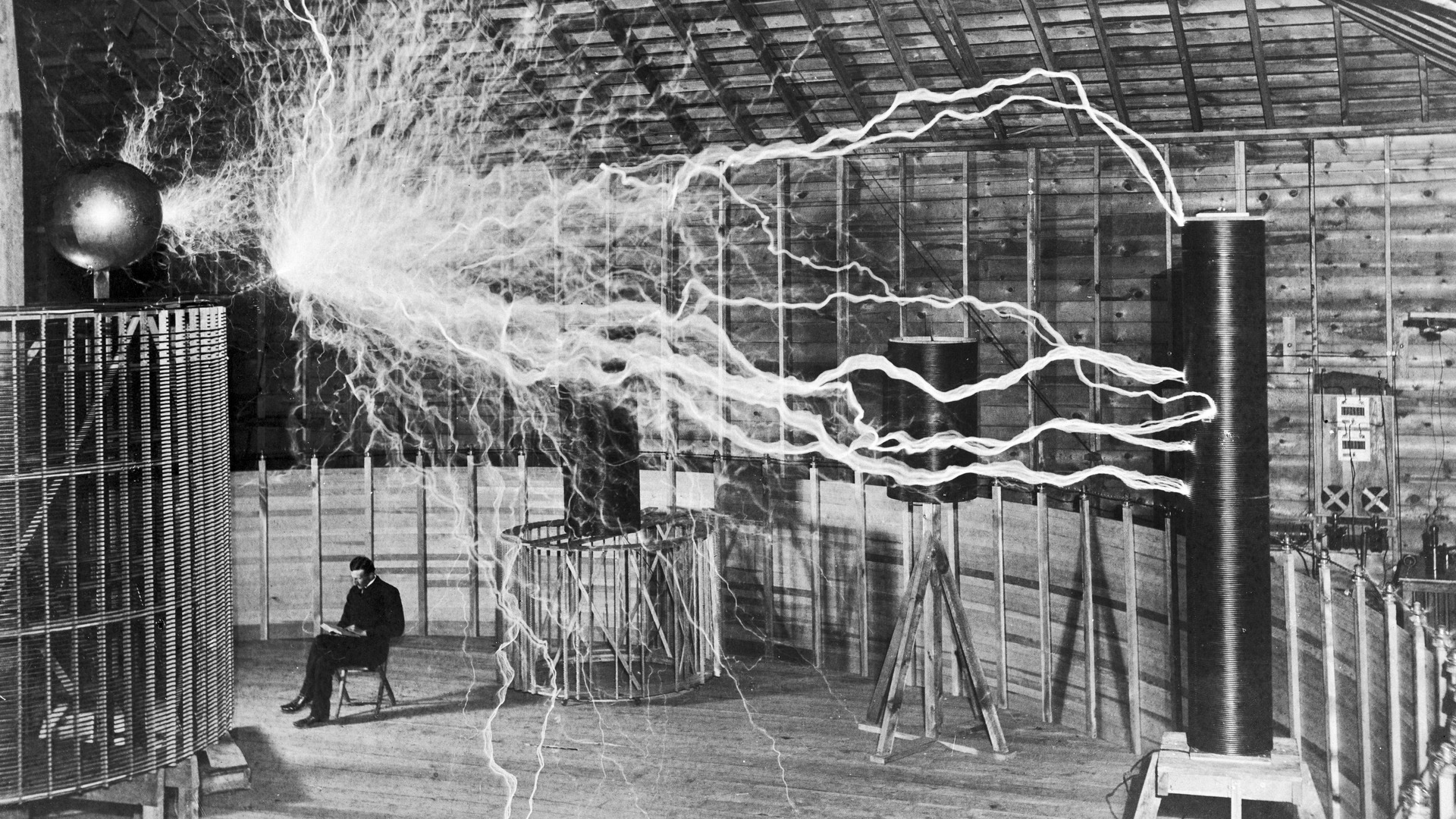
The rivalry between Nikola Tesla and Thomas Edison is one of the most retold stories in the history of technology, and one of the most distorted. The real contest of the late 1880s, the “War of the Currents”, was mainly fought between Edison’s companies and George Westinghouse, with Tesla’s patents on Westinghouse’s side. This page sets out what happened, when, and which popular episodes never happened at all.
Tesla and Edison: a timeline
| Year | Event |
|---|---|
| 1879 | Edison demonstrates a practical incandescent lamp |
| 1882 | Edison’s Pearl Street station in New York begins supplying direct current (DC) |
| 1884 | Tesla arrives in New York and works for the Edison Machine Works for about six months |
| 1888 | Tesla’s induction motor patents are granted; Westinghouse licenses them; Harold P. Brown begins public animal electrocutions to discredit AC |
| 1890 | First execution by electric chair, using AC, in New York State |
| 1892 | Edison General Electric merges with Thomson-Houston to form General Electric; Edison loses control |
| 1893 | Westinghouse lights the World’s Columbian Exposition in Chicago with AC |
| 1896 | AC power from the Adams plant at Niagara Falls reaches Buffalo |
| 1931 | Edison dies on 18 October |
| 1943 | Tesla dies on 7 January |
Two inventors with different methods
Thomas Edison (1847 to 1931) was the most famous inventor in the world by the 1880s, with the phonograph, an improved telephone transmitter and a practical incandescent lamp to his name. His real innovation was the industrial research laboratory at Menlo Park, where teams tested idea after idea, and a complete electric lighting system with generators, cables, meters and lamps. His system ran on direct current at low voltage.
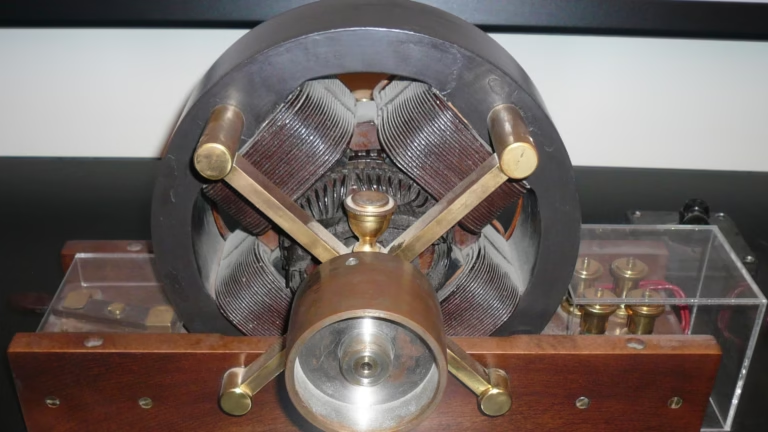
Nikola Tesla (1856 to 1943) was born in Smiljan, then in the Austrian Empire and now in Croatia, to a Serbian family. He was a theorist who worked out designs in his head before building them. His great contribution was the induction motor and the polyphase alternating current (AC) system it belonged to, described in our guide to Tesla’s inventions.
Tesla at the Edison Machine Works
Tesla first worked for Edison’s companies in Paris, at the Continental Edison Company, and in June 1884 he moved to New York to work at the Edison Machine Works, which made dynamos. He stayed about six months and left in early 1885. By Tesla’s own account he quit after being refused a large bonus he believed he had been promised for redesigning the company’s dynamos; Edison’s side never confirmed the story. The two men had little direct contact afterwards.
Get the next one by email
One new article a week on radiation, particles and the instruments that measure them, with its sources. No spam, unsubscribe any time.
The War of the Currents
Direct current had a basic limit. At the low voltages that were safe in homes, large currents were needed, and resistance losses in the cables grew with the square of the current, so DC power stations had to be within about a mile of their customers. Alternating current could be stepped up by transformers to high voltage for transmission, which cuts the current and the losses, then stepped down again for use. AC lighting systems spread quickly from 1886, and from 1888 Tesla’s induction motor gave AC a practical motor as well.
Edison argued that high-voltage AC was deadly, which was partly true, and his company campaigned against it. In 1888 the electrical engineer Harold P. Brown, with help from Edison’s laboratory, electrocuted dogs and other animals in public demonstrations to show the danger of AC, and he promoted AC for the new electric chair. The first execution by electric chair took place in 1890. The famous electrocution of the elephant Topsy at Coney Island in 1903 came years after the War of the Currents ended and was not organised by Edison, although a film company he owned recorded it.
The economics won. In 1892 Edison General Electric merged with its AC rival Thomson-Houston to form General Electric, and Edison lost control of the company that carried his name. In 1893 Westinghouse won the contract to light the World’s Columbian Exposition in Chicago with AC, and Westinghouse generators built on Tesla’s polyphase system powered the Adams plant at Niagara Falls, which began sending power to Buffalo in November 1896. AC became the standard for power networks worldwide.

Myths about Tesla and Edison
- Edison did not electrocute animals himself in public, and he had nothing to do with organising Topsy’s death in 1903.
- Tesla did not hold a public demonstration in which he lit lamps with “his AC motor powered by Niagara Falls” to prove AC safe. The Niagara plant opened years after the War of the Currents had been decided.
- AC did not let electricity travel “without losing its energy”. All transmission loses some energy; high voltage simply makes the losses much smaller.
- The quotations in which Edison admits that “Tesla has solved an extremely difficult problem”, or calls Tesla one of the greatest electrical geniuses, have no known source.
What they thought of each other
The best documented verdict is Tesla’s. When Edison died in October 1931, Tesla told The New York Times that Edison’s trial-and-error method had been extremely inefficient and that a little theory and calculation would have saved him most of his labour. In the same interview he called Edison’s actual accomplishments little short of a miracle. Both judgements fit the record: Edison’s genius was organisation and persistence, Tesla’s was theory, and the electric grid needed both. A second contest of the same years, over who made radio possible, is told in Tesla vs Marconi, and more history of power and communication is in the semiconductors and electronics section.
The Rematch: AI Data Centers Are Quietly Reopening the War of Currents
The argument is not over. Every server in a modern data center runs internally on DC, while the electricity spends most of its trip as AC and is converted back and forth several times before it reaches a GPU. Each conversion turns some power into heat, and at gigawatt scale that waste stops being a rounding error.
That is why the industry is now pushing high-voltage DC distribution into the data center: converting once, at the building’s edge, from medium-voltage AC to about 800 V DC, then routing DC the rest of the way to the rack. The case is familiar from the 1880s, with fewer conversions, less heat and less copper. Industry estimates put the reduction in energy loss at 7 to 20 percent compared with typical power flows, and on a 1-gigawatt AI campus a single percentage point of efficiency is worth roughly 10 megawatts.
AC won the War of the Currents because it transmits power efficiently over long distances. Inside an AI data center the distances are short and the load is relentless and natively DC, which shifts the calculation back the other way. More than a century later, the argument that defined their rivalry has moved from the transmission line to the server rack.
Cite this article
Turner, A. (2024, March 27). Tesla vs Edison: The Rivalry of the Ages. ScienceShot. https://scienceshot.com/post/tesla-vs-edison-the-rivalry-of-the-ages
Turner, Alex. “Tesla vs Edison: The Rivalry of the Ages.” ScienceShot, 27 Mar. 2024, scienceshot.com/post/tesla-vs-edison-the-rivalry-of-the-ages.
Turner, Alex. “Tesla vs Edison: The Rivalry of the Ages.” ScienceShot, March 27, 2024. https://scienceshot.com/post/tesla-vs-edison-the-rivalry-of-the-ages.
@online{scienceshot-tesla-vs-edison-the-2024,
  author       = {Turner, Alex},
  title        = {{Tesla vs Edison: The Rivalry of the Ages}},
  organization = {ScienceShot},
  date         = {2024-03-27},
  year         = {2024},
  url          = {https://scienceshot.com/post/tesla-vs-edison-the-rivalry-of-the-ages}
}
https://scienceshot.com/post/tesla-vs-edison-the-rivalry-of-the-ages
Get one article a week
One new article a week on radiation, particles and the instruments that measure them, with its sources. No spam, unsubscribe any time.

I think if the United States would have embraced the genius not left alone into the hands of the marketing but opened to wide spread availability, Tesla invented a hundreds more inventions but came short to sell many of them, if genius break through worked into a place not of patent industry but of innovations and creation possibility, they could have used ideas to make a better future, and unlike the leve of crunch that today places on million dollar ideas compared to the past, if an inventor cannot create his idea that design mean the idea doesn’t work but the rest of the ungenius people, had no rightful enough part for their greatest minds.