Key takeaways
- No. Thomas Newcomen’s steam engine was pumping water near Dudley Castle in 1712, 24 years before James Watt was born. Thomas Savery had patented a steam pump in 1698.
- Watt’s great invention was the separate condenser, worked out in 1765. His patent of 5 January 1769, No. 913, protects a “new invented method of lessening the consumption of steam and fuel in fire engines”.
- It cut the coal bill by about two thirds. Newcastle engines measured in 1769 averaged 5.59 million foot-pounds of work per bushel of coal, and a Watt engine tested about 1778 gave about 18 million.
- An Act of Parliament of 1775 extended his patent to 1800. Later patents turned the pumping engine into a machine that could drive mills, with the sun-and-planet gear (1781) and parallel motion (1784).
- Watt did not invent the crank or the centrifugal governor. The kettle story’s best-known source is a eulogy read in Paris in 1834, and its boy is watching steam condense on a spoon.
In the winter of 1763 to 1764, a small model engine was waiting for repair at the University of Glasgow. It belonged to the university and copied the steam engines that pumped water out of British mines. It had never worked properly, even after a trip to London to be put in order by the instrument maker Sisson. The job went to the university’s own instrument maker, James Watt, then 27 (University of Glasgow).
“The poor performance of this model fixed Watt’s thoughts on the question of the economy of steam,” the engineer Frederick Bramwell wrote in the Dictionary of National Biography in 1899. Decades later Watt told Robert Hart and his brother where the answer came to him. It was not in the college, he said: “I believe the Faculty would very willingly connect the invention with the College, now that it had been of some use to the world.” He had gone for a walk on Glasgow Green “on a fine Sabbath afternoon”, thinking about the engine. Then, he said, “the idea came into my mind, that as steam was an elastic body it would rush into a vacuum” (Hart, 1859).
The model he was fixing is the short answer to the question in the title. Watt did not invent the steam engine. The working steam engine was half a century old when it reached his bench, and the man usually credited with it is Thomas Newcomen. What Watt invented was a way to make that engine burn far less coal: he condensed the steam in a separate vessel, so the cylinder could stay hot. Later he gave it the gears that let it turn a wheel. Below, each step is dated against the patents and the early records.
Who invented the steam engine, then?
Steam had moved things long before anyone used it for work. Hero of Alexandria, writing in Greek, described a hollow ball on a pivot, fed with steam from a boiling cauldron. Steam escaping from two bent pipes makes the ball spin. The English edition of Hero’s Pneumatics that Bennet Woodcroft commissioned and edited in 1851 heads the passage “The Steam-Engine” (Woodcroft’s edition, section 50). It was a toy that did no useful work, and its translator’s preface shows that scholars could not agree on the century Hero lived in.
The first practical use of steam power was Thomas Savery’s pump. His patent, No. 356, was granted in the summer of 1698 for fourteen years. An Act of Parliament of 1699 added twenty-one more, so it lasted until 1733 (the American Physical Society gives 2 July; the DNB gives 25 July in its Savery entry and 25 June in its Newcomen entry). The grant covered “a new invention for raising of water, and occasional motion to all sorts of mill works”. Savery’s pump had no heavy moving parts. Condensing steam made a vacuum that drew water up into a vessel, and steam pressure then pushed it higher. The APS notes that its imperfect seals made it prone to explode, and that it used too much fuel to pay its way in mines.
Newcomen, described by a contemporary as an ironmonger of Dartmouth, built the machine that worked. His partner was John Calley. The earliest known record is an engraving by Thomas Barney, dated 1719, titled “The Steam Engine near Dudley Castle” and inscribed as erected in 1712. According to the Dictionary of National Biography, it had a 21-inch cylinder, made twelve strokes a minute and raised water from a depth of 156 feet. The Science Museum Group calls Newcomen the first to design a practical steam engine.
His engine was atmospheric. Steam filled a cylinder under a piston, and a jet of cold water sprayed inside condensed it. That left a partial vacuum, so the weight of the air above pushed the piston down. The piston pulled one end of a rocking beam, and the other end worked the pump rods in the mine. Newcomen never took out a patent of his own. Savery’s patent was seen as broad enough to cover Newcomen’s engine too, and Newcomen joined him as a partner instead.
From Savery to the watt: the dates, checked
Patent numbers are the official numbers of the English patent series. Dates come from the patent texts where we could read them, and otherwise from the sources named in each row. Where two good sources disagree, the row says so.
| Date | Who | What happened | Record |
|---|---|---|---|
| Century disputed | Hero of Alexandria | Describes a ball spun by jets of steam | Pneumatics, section 50 (Woodcroft, 1851) |
| July 1698 | Thomas Savery | Patent No. 356 for raising water by fire; extended in 1699 to 1733 | APS gives 2 July; DNB gives 25 July (25 June in its Newcomen entry) |
| 1712 | Thomas Newcomen and John Calley | Atmospheric engine near Dudley Castle: 21-inch cylinder, twelve strokes a minute, water raised from 156 feet | Barney engraving of 1719, via DNB |
| Winter 1763 to 1764 | James Watt | Repairs the University of Glasgow’s model Newcomen engine | University of Glasgow; DNB gives 1764 |
| 1765 | Watt | Separate condenser worked out and tried on a model | Science Museum; DNB |
| 5 January 1769 | Watt | Patent No. 913, “new invented method of lessening the consumption of steam and fuel in fire engines”; specification enrolled 29 April 1769 | Patent text (1855 printing) |
| 1775 | Parliament; Matthew Boulton | Act extends the 1769 patent to 1800; partnership with Boulton at Soho, Birmingham | DNB; the Science Museum Group dates the partnership to 1776 |
| 1780 | Pickard, a workman | Patent No. 1263 for using the crank on a steam engine | DNB |
| 1781 | Watt | Patent No. 1306: five ways to get rotary motion, including the sun-and-planet gear | DNB |
| 1782 | Watt | Patent No. 1321, including the double-acting engine | DNB |
| 1784 | Watt | Patent No. 1432, including parallel motion | DNB |
| 1785 | Boulton and Watt | Rotative engine built for Samuel Whitbread’s London brewery; now in Sydney | ASME landmark |
| 1787 | Thomas Mead | Patent No. 1628, “Regulator for Wind and other Mills”, the earliest printed governor Bramwell could find | DNB |
| 1800 | Watt and Boulton | Patent extension ends; both retire from Boulton & Watt in favour of their sons | DNB |
| 25 August 1819 | Watt | Dies at Heathfield, near Birmingham | DNB |
| August 1882 | William Siemens | Proposes calling the unit of electrical power a Watt | British Association Report 1882, pp. 5 to 6 |
| 1960 | 11th General Conference on Weights and Measures | The watt (W, one joule per second) becomes the unit of power in the new International System of Units | BIPM, Resolution 12 |
What the separate condenser changed
Newcomen’s engine wasted heat on every stroke. The cold spray that condensed the steam also chilled the cylinder walls. On the next stroke, fresh steam had to warm the metal up again before it could fill the cylinder, and much of it turned to water on the cold walls. Watt saw that one vessel was being asked to be hot and cold in turn.
His patent splits the two jobs. The first principle of the 1769 specification says the cylinder, which Watt calls the steam vessel, must be “kept as hot as the steam that enters it”. He would wrap it in wood, surround it with steam and let nothing colder touch it. The second principle moves the cold work elsewhere: the steam “is to be condensed in vessells distinct from the steam vessells or cylinders”. He named these vessels condensers. The third principle adds a pump, worked by the engine itself, to draw out air and water that the condenser could not get rid of.
The rest of the specification shows how far ahead he was thinking. The fourth principle proposes pushing the piston with the pressure of the steam itself, and lets the steam escape into the open air where cooling water is scarce. The fifth describes a steam wheel for “motions round an axis”, with weights that steam drives round a hollow ring. Bramwell notes that no workman could have built the wheel from that description, and that it would not have worked, “as Watt found out after repeated trials.” Watt drafted the specification with plenty of friendly scientific advice and, as far as Bramwell could tell, no lawyer. Bramwell judged it “so clumsily drawn” that the patent’s validity was seriously contested many years later.
The patent also limited where the method was protected. It covered “that part of His Majesty’s Kingdom of Great Britain called England, the Dominion of Wales, and Town of Berwick upon Tweed”, plus the colonies. Watt signed the specification on 25 April 1769. One of the witnesses was John Roebuck, the founder of the Carron ironworks, who had taken a share in the invention. Watt built a trial engine with an 18-inch cylinder at Kinneil, near Linlithgow. It was tried several times “with no thoroughly definite result” before Roebuck ran into debt (DNB).
Newcomen against Watt: the coal bill, recalculated
Mine owners judged engines by a number Watt himself introduced, the duty. Duty is the number of pounds an engine lifts one foot for each bushel of coal it burns. A foot-pound, the work of lifting one pound by one foot, is about 1.36 joules. The bushel was a measure of volume, so its weight varied. William Pole, in his 1844 Treatise on the Cornish Pumping Engine, says the duty figures of his day referred to a bushel of Welsh coal weighing about 94 pounds.
The best early measurements come from the civil engineer John Smeaton, who improved atmospheric engines himself. In 1769 he worked out the performance of fifteen engines at work around Newcastle. Expressed as duty in Pole’s treatise, they averaged 5,590,000 foot-pounds per bushel, between 3,220,000 for the worst and 7,440,000 for the best. Pole credits Smeaton’s own changes with raising the average of the atmospheric engine “from 7 to about 10 millions”. Then, about 1778, Smeaton tested two of Watt’s engines. One at Birmingham gave “about eighteen millions”, and one at Hull about half a million more. He concluded that Watt’s engines did on average double the duty “of the atmospheric engine as improved by himself” (Pole, p. 27).
Those figures can be turned into coal per unit of work. Watt defined his horsepower as 33,000 foot-pounds a minute, which makes 1,980,000 foot-pounds an hour. Divide that by the duty and you get bushels of coal per horsepower-hour. Multiply by 94 pounds and you get the weight of coal. For the Newcastle average: 1,980,000 divided by 5,590,000 is 0.354 bushel, or 33.3 pounds (15.1 kg) of coal for every horsepower-hour of pumping. For the Birmingham Watt engine: 1,980,000 divided by 18,000,000 is 0.110 bushel, or 10.3 pounds (4.7 kg).
| Engine | Duty (million foot-pounds per bushel) | Coal per horsepower-hour | Coal per kWh of work | Share of the coal’s heat turned into work (estimate) |
|---|---|---|---|---|
| Newcastle atmospheric engines, 1769, worst | 3.22 | 57.8 lb (26.2 kg) | 35.2 kg | 0.4% |
| Newcastle atmospheric engines, 1769, average | 5.59 | 33.3 lb (15.1 kg) | 20.3 kg | 0.7% |
| Newcastle atmospheric engines, 1769, best | 7.44 | 25.0 lb (11.4 kg) | 15.2 kg | 0.9% |
| Atmospheric engine after Smeaton’s improvements | about 10 | 18.6 lb (8.4 kg) | 11.3 kg | 1.2% |
| Watt engine, Birmingham, tested about 1778 | about 18 | 10.3 lb (4.7 kg) | 6.3 kg | 2.2% |
| Watt engine, Hull, tested about 1778 | about 18.5 | 10.1 lb (4.6 kg) | 6.1 kg | 2.3% |
The ratio of the two duties is 18 to 5.59, or 3.2. A Watt engine needed about 31% of the coal that the average Newcastle engine burned for the same pumping, a saving of 69%. That matches the Science Museum’s summary that engines with Watt’s condenser “burned 2/3rds less coal”. Against an engine already improved by Smeaton, the saving was smaller, at 44%. The ratios do not depend on the bushel weight, as long as the same bushel is used throughout. The weights of coal do: if Smeaton’s bushel was lighter than 94 pounds, every weight in the table falls in proportion.
The last column is our estimate, and it rests on one more assumption. Coal of the kind burned in these engines releases about 25.8 megajoules per kilogram, the default net calorific value for other bituminous coal in the IPCC’s 2006 inventory guidelines (Table 1.2). A 42.6 kg bushel therefore holds about 1,100 megajoules. The Newcastle average turned 7.6 megajoules of it into lifted water, about 0.7%. The Birmingham Watt engine turned 24.4 megajoules into work, about 2.2%. Across the IPCC’s range for this coal, 19.9 to 30.5 MJ/kg, the Newcomen figure stays below 1% and the Watt figure lies between 1.9% and 2.9%, on a 94-pound bushel. A lighter bushel would raise both shares in proportion: at 84 pounds the Newcomen upper bound reaches about 1%. Both shares are small, and the second is three times the first.
Roebuck’s debts, Boulton’s money and the 1775 Act
The invention earned Watt nothing for years. He made a living as a surveyor of canals and harbours. In 1768 he was introduced to Matthew Boulton, who owned the Soho works near Birmingham. When Roebuck failed in 1772, Boulton offered to take a two-thirds share in the engine patent in place of a debt of £1,200. In May 1774 Watt moved to Birmingham. Early in 1775 he went into partnership with Boulton (DNB; the Science Museum Group gives 1776).
A patent then lasted fourteen years, so Watt’s would have run out in January 1783. Much of that time had passed with no income, and Boulton and Watt asked Parliament for more. The result was an Act of Parliament in 1775. Its printed title begins “An Act for vesting in James Watt, Engineer” and speaks of “certain Steam Engines, commonly called Fire Engines, of his invention” (as recorded in a Christie’s catalogue of an original copy). It extended the patent until 1800, seventeen years beyond its original end. The trial engine from Kinneil went to Soho to show buyers what it could do.
Get the next one by email
One new article a week on radiation, particles and the instruments that measure them, with its sources. No spam, unsubscribe any time.
The crank he could not patent
A pumping engine only needs to go up and down. Mills need a turning shaft, and by the late 1770s Watt wanted that market. The obvious way to turn a rocking beam into rotation was a crank. Bramwell repeats the story that Watt meant to patent its use, but a workman named Pickard passed the idea to a Bristol rival called Wasbrough. Pickard took out patent No. 1263 for the crank on a steam engine in 1780.
Watt complained that his idea had been stolen. He also wrote, of Pickard’s patent, that “the true inventor of the crank rotative motion was the man who first contrived the common foot-lathe”. Applying it to the engine, he added, “was like taking a knife to cut cheese which had been made to cut bread.” Bramwell’s reading is that Watt knew the crank could not be validly patented by anyone.
So Watt went round it. His patent of 1781, No. 1306, describes five ways to make rotary motion that, in his view, avoided the crank, although Bramwell thought two of them were cranks all the same. The one he used was the sun-and-planet gear. A toothed wheel fixed to the end of the connecting rod, the planet, travels round a second toothed wheel on the output shaft, the sun, and turns it. His patent of 1782, No. 1321, made the engine double-acting: steam and vacuum worked on both sides of the piston, so it pushed on the upstroke as well as the downstroke. That gave a more even turning force and, Bramwell notes, doubled the work from a cylinder of a given size.
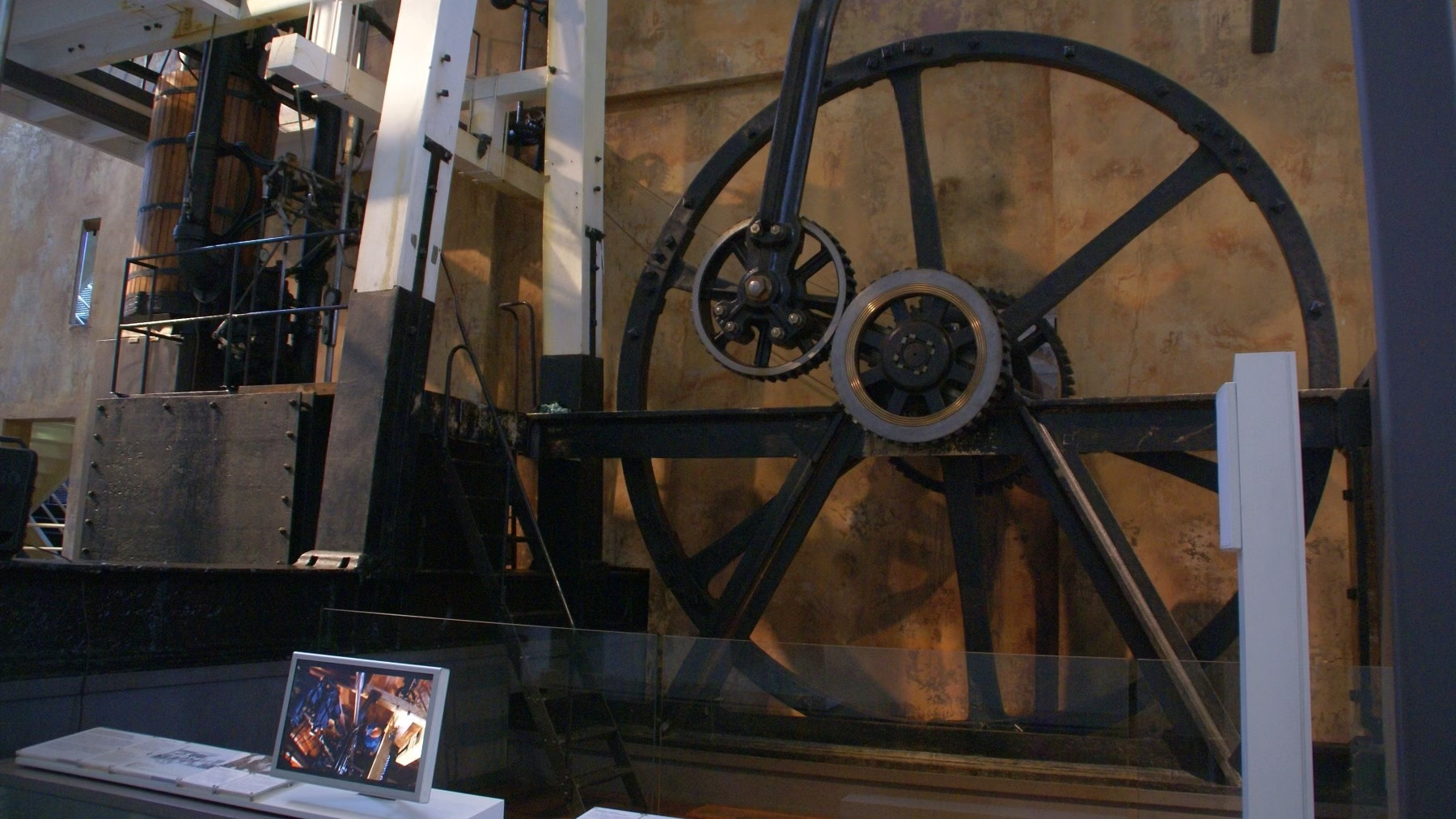
A double-acting engine has to push the beam as well as pull it, and the chain that linked piston and beam in older engines could only pull. Watt’s answer, in patent No. 1432 of 1784, was parallel motion. Linked levers pivoted in opposite directions guide the top of the piston rod along an almost straight line while the beam end swings in an arc. Bramwell says Watt “prided himself more than on any of his other inventions” on it. The engine in the photograph above has both devices. Boulton and Watt built it in 1785 for Samuel Whitbread’s brewery in London, where it drove a malt mill until 1887. It was then presented to Archibald Liversidge and shipped to Sydney in 1888, where the Powerhouse Museum restored it to working order (ASME).
Things Watt is credited with but did not invent
The steam engine heads the list, and the crank comes second. The centrifugal governor is the third: two weighted balls spin with the engine, fly outward as it speeds up and close the steam valve through a linkage. Bramwell, writing in 1899, called Watt’s authorship “by no means certain”. The earliest publication he could find was Thomas Mead’s patent of 1787, No. 1628, “Regulator for Wind and other Mills”, and he could not find when Watt first fitted one.
John Farey, writing in 1827, said Boulton and Watt engines built in 1784 and 1785, including Whitbread’s, had a governor. He also said it worked “on the principle which had been previously used in wind and water mills.” Bramwell pointed out that Farey wrote forty to fifty years after the event. The ASME landmark record for the Whitbread engine now lists its flyball governor among later modifications. Watt never patented the governor, or its use on a steam engine. On this evidence, the fair credit is that his firm adapted a device from the mills to steam. Tesla and Einstein collect credit for inventions in much the same way, as our checks of what Tesla invented and what Einstein invented show.
Did Watt really get the idea from a kettle?
The popular version has a boy watching a kettle lid rattle and dreaming up the steam engine. Its best-known source is a eulogy by François Arago, perpetual secretary of the French Academy of Sciences, read at a public meeting in Paris on 8 December 1834. James Patrick Muirhead published an English translation in 1839.
Arago’s scene is different from the legend. Watt’s aunt, Mrs Muirheid in the translation’s spelling, scolds him at the tea table: “I never saw such an idle boy”. For an hour he has taken the lid off the kettle and put it back, held a cup or a silver spoon over the steam and caught the drops that form. Nothing in it lifts a lid or drives a machine. The boy is watching steam turn back into water. Arago placed the scene in 1750, when Watt was 14, fifteen years before the separate condenser.
Arago also wrote in the meaning himself. To his listeners, he said, the aunt’s complaint showed “the mighty engineer preluding to the discoveries which were to immortalise him”. For Watt’s childhood he had a memorandum written in 1798 by Marion Campbell, Watt’s cousin and childhood companion, which Watt’s son supplied. Arago does not say which source gave him the kettle. Nothing rules the scene out. The step from it to the invention is Arago’s own. Watt’s own account, given to the Hart brothers, ties the idea to the broken model and the walk on Glasgow Green.
The horsepower and the watt
Watt needed a way to sell engines to people who used horses, so he rated them against a horse. By Bramwell’s account, he estimated that a horse working for several hours could raise 22,000 pounds one foot a minute. So that no buyer could complain, he sized each of his horsepowers to do half as much again: 33,000 foot-pounds a minute, or about 746 watts in modern units.
The unit that carries his name came 63 years after his death. In August 1882 William Siemens, the president of the British Association for the Advancement of Science, proposed a name for the power carried by a current of one ampere at one volt. “It might be appropriately called a Watt,” he said, “in honour of that master mind in mechanical science, James Watt” (Report of the British Association, 1882, pages 5 to 6). In the same address he put a horsepower at 746 watts. In 1960 the General Conference on Weights and Measures wrote the watt, one joule per second, into the International System of Units. Every power rating on this site, from a single server to a rack of AI accelerators, is counted in his unit.
⚡ PHOTON’S TAKE
Newcomen invented the steam engine, and he deserves the title more than Watt does. Watt’s claim is better than invention, because it can be measured. Smeaton put a Watt engine at about 18 million foot-pounds per bushel against 5.59 million for the average Newcastle engine, a threefold cut in coal for the same work. The kettle story turns that into a moment of genius. The records show a man who fixed a broken model, found where the heat went, and spent the next ten years finding the money and the partner to make the fix pay.
For what the engine did to British industry once Boulton and Watt began selling it, read our essay on how James Watt’s steam engine sparked the Industrial Revolution.
Sources
- James Watt, Specification of Patent No. 913 (1769), printed by Eyre and Spottiswoode, 1855
- Frederick Bramwell, “Watt, James (1736 to 1819)”, Dictionary of National Biography, vol. 60 (1899)
- Richard Bissell Prosser, “Newcomen, Thomas”, Dictionary of National Biography, vol. 40 (1894)
- “Savery, Thomas”, Dictionary of National Biography
- William Pole, A Treatise on the Cornish Pumping Engine (1844), pp. 17 to 27
- Robert Hart, “Reminiscences of James Watt”, Transactions of the Glasgow Archaeological Society 1 (1859)
- François Arago, Historical Eloge of James Watt, translated by J. P. Muirhead (1839)
- C. William Siemens, Presidential Address, Report of the British Association for the Advancement of Science, 1882
- BIPM, Resolution 12 of the 11th CGPM (1960)
- The Pneumatics of Hero of Alexandria, translated by J. G. Greenwood, edited by Bennet Woodcroft (1851)
- APS News, July 2, 1698: Thomas Savery patents an early steam engine (2018)
- Science Museum Group, Newcomen atmospheric engine, object 1920-124/1
- Science Museum Group, James Watt 1736 to 1819
- Ben Russell, James Watt and the separate condenser, Science Museum blog (5 January 2019)
- University of Glasgow, Model steam engine which inspired James Watt receives Engineering Heritage Award (20 August 2019)
- ASME, Landmark 111: Boulton & Watt rotative steam engine
- Christie’s, lot record for the 1775 Act vesting the steam engine patent in James Watt
- IPCC, 2006 Guidelines for National Greenhouse Gas Inventories, vol. 2, ch. 1, Table 1.2
Cite this article
Turner, A. (2026, October 31). Did James Watt Invent the Steam Engine? The Dates, Checked Against the Patents. ScienceShot. https://scienceshot.com/post/did-james-watt-invent-the-steam-engine
Turner, Alex. “Did James Watt Invent the Steam Engine? The Dates, Checked Against the Patents.” ScienceShot, 31 Oct. 2026, scienceshot.com/post/did-james-watt-invent-the-steam-engine.
Turner, Alex. “Did James Watt Invent the Steam Engine? The Dates, Checked Against the Patents.” ScienceShot, October 31, 2026. https://scienceshot.com/post/did-james-watt-invent-the-steam-engine.
@online{scienceshot-did-james-watt-invent-2026,
  author       = {Turner, Alex},
  title        = {{Did James Watt Invent the Steam Engine? The Dates, Checked Against the Patents}},
  organization = {ScienceShot},
  date         = {2026-10-31},
  year         = {2026},
  url          = {https://scienceshot.com/post/did-james-watt-invent-the-steam-engine}
}
https://scienceshot.com/post/did-james-watt-invent-the-steam-engine
Get one article a week
One new article a week on radiation, particles and the instruments that measure them, with its sources. No spam, unsubscribe any time.