Key takeaways
- Every Einstein patent was shared with a partner. With Leo Szilárd he patented refrigerators and a liquid-metal pump, with Rudolf Goldschmidt a magnetostriction sound device meant for a hearing aid, and with Gustav Bucky a camera that set its own exposure.
- The German patent office counts 22 refrigeration patents granted to Einstein and Szilárd, ten German and twelve foreign. The historian Gene Dannen counts more than 45 applications, and patents were granted in at least seven countries.
- None of his inventions became a consumer product. Electrolux paid 3,150 Reichsmark for one refrigerator application in 1927 and never used the two patents it bought.
- Relativity, E = mc² and the law of the photoelectric effect are discoveries about nature. His Nobel Prize citation calls the photoelectric law a discovery.
- The 1936 US design patent for a blouse names an Albert Einstein of Manhattan with German citizenship. On the same day, the physicist was granted a camera patent as a resident of Princeton, so the blouse very likely belongs to a namesake.
In the winter of 1925 to 1926, Albert Einstein read a newspaper report about a family found dead in their beds. The parents and several children had been killed by poisonous gas that leaked from the pump of their refrigerator. Home refrigerators of the time ran on methyl chloride, ammonia or sulphur dioxide. All three are toxic, and the amount inside one machine could kill its owner.
“There must be a better way,” Einstein said to Leo Szilárd, a Hungarian physicist who also lived in Berlin. That is how the historian Gene Dannen tells it. The story comes from Szilárd, and the editors of Einstein’s collected papers are careful with it: they write that Szilárd “claimed” Einstein started the project in 1926 after reading the report. None of the accounts names the newspaper.
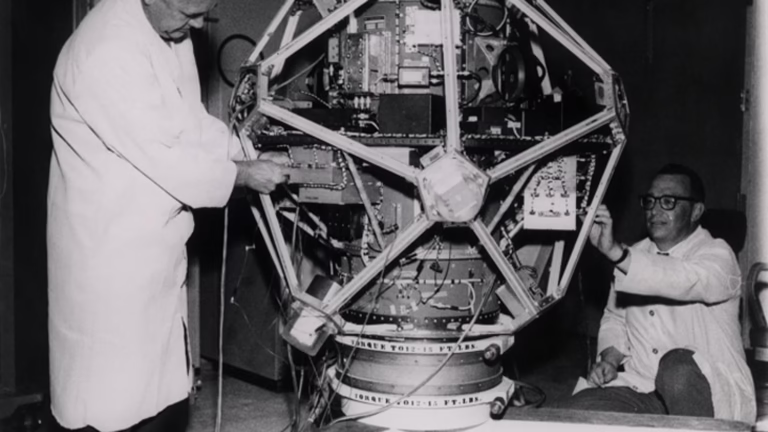
What the two men did next is most of the answer to the question in the title. Every patent Einstein held was shared with a partner. With Szilárd he patented refrigerators, and a pump that moves liquid metal with magnetism, in at least seven countries. With the engineer Rudolf Goldschmidt he patented a sound device meant to become a hearing aid. With the radiologist Gustav Bucky he patented a camera that set its own exposure. He also helped improve a ship’s gyrocompass, though his name is missing from that patent. Earlier, he had designed a small instrument for measuring tiny voltages, which two friends built. None of the devices he patented became a product you could buy.
For his physics, from relativity to E = mc², read Einstein’s nine major discoveries. Here we stay with the machines, and each patent number below is checked against the original record.
Einstein’s patents and inventions, row by row
Every patent row below, except the Hungarian one, was checked against the document itself. German records come from DEPATISnet, the database of the German patent office. The others come from the scanned originals on Google Patents. Dates are the filing and publication dates printed on each record. The last row is the blouse, kept here because so many lists include it.
| Invention | Patent | Filed | Granted or published | With | What it does | What became of it |
|---|---|---|---|---|---|---|
| Absorption refrigerator | US 1,781,541 (United States) | 16 Dec 1927 (German priority 16 Dec 1926) | 11 Nov 1930 | Leo Szilárd | Cools with heat from a flame: butane boils into ammonia gas, water absorbs the ammonia, no compressor | Assigned to Electrolux Servel; never sold as a product |
| Same design, British filing | GB 282,428 (United Kingdom) | 16 Dec 1927 (priority 16 Dec 1926) | 15 Nov 1928 | Leo Szilárd | Absorption cooling with butane or methyl bromide, ammonia and water | As above |
| Early absorption applications | DE 499,830 and DE 525,833 (Germany) | 26 Oct 1926 and 17 Dec 1926 | 18 Jun 1930 and 29 May 1931 | Leo Szilárd | Methods for producing cold | Granted in the name of Platen-Munters, the Electrolux division that bought their work |
| Vapour-pressure refrigerator | FR 647,838 (France) | 29 Dec 1927 (priority 29 Dec 1926) | 1 Dec 1928 | Leo Szilárd | Moves the liquid by raising the vapour pressure in pulses | Not produced |
| Electromagnetic liquid-metal pump | GB 303,065, FR 670,428, CH 140,217, DE 554,959 | DE 28 Dec 1927; GB, FR and CH Dec 1928 (priority 27 Dec 1927) | FR 28 Nov 1929; GB 26 May 1930; CH 31 May 1930; DE 27 Jul 1933 | Leo Szilárd | AC coils push mercury or another liquid metal through a ring-shaped gap; the metal acts as the piston | AEG built prototypes until August 1932 |
| Sodium-potassium pump and compressor | GB 344,881, AT 133,386 | AT 22 Dec 1928; GB 3 Dec 1929 (priority 3 Dec 1928) | GB 3 Mar 1931; AT 26 May 1933 | Leo Szilárd | Uses a sodium-potassium alloy that stays liquid at −12°C | As above |
| Later German refrigeration patents | DE 561,904, 562,300, 563,403 (refrigerating machine); 565,614 (compressor); 556,535 (pump); 562,040 (oscillating electromagnetic drive) | 13 Nov 1927 to 15 Apr 1930 | 8 Apr to 20 Sep 1933 | Leo Szilárd | Refrigerating machines and their pumps and drives | Published after Einstein had left Germany |
| Hungarian refrigerator patent | HU 102,079 (Hungary) | Not verified | Not verified | Leo Szilárd | Refrigerator | Shown by Dannen; record not opened for this table |
| Magnetostriction sound device | DE 590,783 (Germany) | 25 Apr 1929 | 10 Jan 1934 | Rudolf Goldschmidt | A prestressed magnetic body changes length with the current, for loudspeakers and a planned hearing aid | Abandoned when both men left Germany |
| Light intensity self-adjusting camera | US 2,058,562 (United States) | 11 Dec 1935 | 27 Oct 1936 | Gustav Bucky | A self-powered photoelectric cell swings a screen of graded transparency into the light path | Not manufactured |
| Gyrocompass contribution | DE 394,667, filed by Anschütz & Co | 18 Feb 1922 | 8 May 1924 | Hermann Anschütz-Kaempfe | Gyro sphere floating in liquid, centred by ring-shaped AC coils | Einstein not named; royalties paid to him until 1938 |
| Maschinchen (voltage multiplier) | No patent | Designed 1907 | Paper 1908; Habicht description 1910 | Conrad and Paul Habicht | Multiplies a voltage of about half a millivolt until an electroscope can read it | A few sold from Paul Habicht’s workshop; one survives at Tübingen |
| Katzbuckel (“cat’s back”) wing profile | No patent | Flight paper Aug 1916 | Test date not given by DPMA | None named | A new wing profile, named for its arched shape | Failed a practical test |
| Ice machine | No patent known | Under way by Dec 1919 | Application considered March 1922 | Walther Nernst | Refrigerating machine; details unknown | No record of a grant |
| Blouse (misattributed) | US D101,756 (design patent) | 2 Jul 1936 | 27 Oct 1936 | None | Ornamental blouse with side openings that double as armholes | Names an Albert Einstein of Manhattan, “a citizen of the German Republic” |
How many patents did Einstein have?
The figure you will read most often is “more than 50”, as in a 2017 paper by the physicist Asis Kumar Chaudhuri. The firmer numbers are smaller. The German Patent and Trade Mark Office (DPMA) counts 22 refrigeration patents granted to Einstein and Szilárd on applications filed between 1926 and 1932: ten German and twelve foreign. Dannen counts more than 45 applications for the same work, in at least six countries.
Add the Goldschmidt and Bucky patents and the granted total is about two dozen. Most of them name Einstein as an inventor or owner. Two German grants went out in the name of Platen-Munters, the Electrolux division that bought the work, and the gyrocompass patent that paid him royalties names only Anschütz & Co.
Lists that circulate online need checking. Chaudhuri’s own table gives the American refrigerator patent the number of the Hungarian one (102,079), while the American record is US 1,781,541. Most of the German grants also came late. Seven Einstein and Szilárd patents were published between April and September 1933. By then Einstein had already renounced his German citizenship, handing in his passport at the German consulate in Brussels on 28 March 1933.
Seven years judging other people’s inventions
Einstein knew patents from the examiner’s side first. According to the Swiss Federal Institute of Intellectual Property, he started at the patent office in Bern on 23 June 1902 as a “level III technical expert”, paid 3,500 Swiss francs a year. He was promoted to level II in 1906. On 16 July 1909 he resigned to become associate professor of theoretical physics at the University of Zurich.
The office believes it can name a few applications he examined, but it adds that “more exact details aren’t available.” Patents also ran in the family. Chaudhuri lists seven German and Swiss patents held by his uncle Jakob between 1886 and 1893, mostly for arc lamps and electrical measuring instruments. The years in Bern were also the years of the 1905 papers that made his name.
What was Einstein’s first invention?
His first device was the Maschinchen, the “little machine” for measuring tiny voltages, which he designed in 1907 (more on it below). It was never patented.
His first patent plans came later, and they were already about cold. In December 1919 he worked with Walther Nernst on a “funny technical thing, an ice machine”, in the words of a letter quoted by the Einstein Papers Project. By March 1922 the two were considering a patent application. The first joint application the editors name was filed in Germany on 13 September 1926, “on a cooler with capillary pump”, and only its title survives. The editors also list a Szilárd application from March 1926, and Dannen says the filings began in early 1926.
The refrigerator with no moving parts (1926 to 1932)
An absorption refrigerator runs on heat, which in the 1920s meant a gas flame. It needs no electric compressor. The idea rests on a simple fact: a liquid boils at a lower temperature when less of the pressure around it comes from its own vapour. In the design patented as US 1,781,541, liquid butane sits in the evaporator, the cold part of the machine. Ammonia gas is fed in on top of it. The butane’s share of the pressure drops, so the butane boils and takes heat from the box.
The gas mixture then meets water. Ammonia dissolves in water and butane does not. The butane turns back into liquid, floats on top of the solution and runs back to the evaporator. Heat from the flame drives the ammonia out of the water again, and the cycle repeats. Gravity and the heat move every fluid, so nothing turns or slides.
This improved an earlier design by the Swedish inventors Baltzar von Platen and Carl Munters, which Electrolux sold. On 2 December 1927 Einstein and Szilárd sold a patent application to Platen-Munters Refrigerating System, an Electrolux division, for 3,150 Reichsmark, then 750 US dollars. Electrolux thought the price “very cheap”, Dannen reports. The American patent followed on 11 November 1930, assigned to Electrolux Servel of New York. The DPMA says Electrolux bought two patents and used neither.
How much of this was Einstein’s own work is hard to say. The editors of his papers note Szilárd’s “intense activity” and Einstein’s few letters. The capillary pump seems to have been his idea. “I am happy […] about the capillary pump”, he wrote to Szilárd on 15 September 1928, “for which I have not yet succeeded in arousing your enthusiasm.” Szilárd, for his part, had warned him that “soon you will be getting sick enough of ice machines”.
What killed the project was chemistry. Freon, a refrigerant that is not toxic, was first demonstrated in 1930, and it removed the danger Einstein had read about (American Physical Society). In 1930 that looked like the end of the problem. By 2008 freons were counted among greenhouse gases, and a team under Malcolm McCulloch at Oxford built a prototype of the Einstein and Szilárd design for places without electricity. McCulloch predicted that new gases could make it four times as efficient. It stayed a prototype.
The 1930 patent is still cited as prior art, the earlier work a patent examiner compares new claims against. Google Patents lists 40 later patent documents, granted patents and published applications, that cite US 1,781,541. One of them is a Hamilton Sundstrand application, published in 2024, for absorption cooling of electric systems with waste heat.
The pump that “howled like a jackal”
The pump was the boldest idea of the partnership. A normal compressor has moving parts and seals, and seals leak. The Einstein and Szilárd pump had no mechanical moving parts and no seals. In GB 303,065, coils wound round an iron cylinder carry alternating current, and each coil is a quarter of a cycle behind its neighbour. Together they make a magnetic field that travels along the cylinder. That field drives a current through a liquid metal in a ring-shaped gap, and the metal is pushed along. In this patent the moving mercury drives a jet pump that draws in the refrigerant vapour and compresses it. In the Swiss patent CH 140,217 the liquid metal itself works as a piston.
Mercury did not conduct well enough. A later patent, GB 344,881, switched to an alloy of sodium and potassium that stays liquid at minus 12°C. The electrical company AEG agreed in the autumn of 1928 to develop the pump. Albert Korodi, the engineer on the project, built prototypes at the AEG research institute until August 1932, when the Depression cut the institute in half.
The prototypes were loud. The physicist Dennis Gabor said the pump “howled like a jackal”, while Korodi remembered a sound like rushing water. The cause was cavitation, small bubbles that form and collapse inside the moving metal. Dannen writes that the team brought the noise down to acceptable levels before the work stopped.
The American Physical Society says the pump later “proved useful for cooling breeder reactors”, nuclear reactors designed to make more fuel than they burn. The patent record holds a smaller trace. In 1944 Harrison Brown and Henry Hubble applied for a US patent on pumping fluorine gas with a liquid piston, later assigned to the Atomic Energy Commission. The examiner listed the Einstein and Szilárd French patent FR 670,428 as prior art.
A sound device for a singer losing her hearing (1928 to 1934)
In 1928 Einstein asked the engineer Rudolf Goldschmidt to help him build a hearing aid for Olga Eisner, a singer he knew who had become hard of hearing (IEEE Spectrum). Goldschmidt had built radio transmitters, including one used on the first radio telegraph link between Germany and the United States in 1914 (Chaudhuri).
Their idea used magnetostriction. A magnetic material changes its length very slightly when the magnetic field around it changes. The change is small because the material is stiff and resists it. In DE 590,783, filed on 25 April 1929, the inventors reduce that resistance by putting the magnetic body, or a part attached to it, under strong mechanical tension. Its length then follows the current in the coil more freely. The vibration can drive a loudspeaker or, as planned, a hearing aid.
The patent was granted on 21 December 1933 and published on 10 January 1934. By then both men had left Germany. The DPMA notes that the patent office named him “Dr. Albert Einstein formerly in Berlin, current residence unknown”. The hearing aid was never built. Chaudhuri notes that electronic hearing aids, which amplify the signal, overshadowed the approach.
Get the next one by email
Power, cooling, chips and the rules that shape them. No spam, unsubscribe any time.
The camera that set its own exposure (1935 to 1936)
Gustav Bucky was a radiologist who had left Germany in 1933. He was known for the Bucky grid, which cut the blur in X-ray images. He and Einstein filed US patent 2,058,562 on 11 December 1935, and it was granted on 27 October 1936 as a “light intensity self-adjusting camera”. The record gives Bucky’s address as New York and Einstein’s as Princeton.
A photoelectric cell, of the kind used in exposure meters, sits behind its own small window in the front of the camera. Light falling on the cell makes a small current. The current turns a shaft through an angle that grows with the brightness. The shaft swings a curved screen into the light path between the lenses, clear at one end and darker towards the other. A bright scene gets the darker part of the screen. The cell powers the mechanism itself, so the camera needs no battery.
Chaudhuri points out that this is the only Einstein invention built on the photoelectric effect, which he had explained in 1905. Science News reported the patent in December 1936. In the words of IEEE Spectrum, “the invention went nowhere.”
The gyrocompass that paid him but does not name him
A gyrocompass points north with a fast-spinning wheel instead of a magnetised needle. In December 1914 Hermann Anschütz-Kaempfe of Kiel took legal action against a competing compass from the American Sperry company. In 1915 Einstein examined both instruments as an independent expert, and Anschütz won (heise, Anschütz museum).
Einstein then stayed to help. In 1918 he asked to be released as an expert so that he could work with Anschütz-Kaempfe on a new compass. The result had two gyroscopes sealed in a sphere that floats in a liquid. By heise’s account, Einstein’s most important idea was a ring of coils that keeps the sphere centred without touching it. The patent, DE 394,667, was filed by Anschütz & Co on 18 February 1922 and published on 8 May 1924. Its claim 4 covers ring-shaped AC coils with a U-shaped cross-section. The DPMA believes Einstein’s contribution is “probably behind” that claim. His name is not on the document.
He was paid all the same: 1% of the sale price of each compass and 3% of licence fees abroad, transferred until 1938. He visited Kiel between 1915 and 1926. For a time he lived in a flat at the compass factory, which he called his “Diogenes barrel”, after the Greek philosopher said to have lived in one.
The Maschinchen: a machine for his own physics (1907 to 1910)
In 1907 Einstein predicted that a capacitor, a device that stores electric charge on two plates, keeps a tiny leftover voltage after it is discharged. The voltage comes from the random motion of electrons and is about half a millivolt. No voltmeter of the time could read it (Scientific American). He designed a machine that multiplies a voltage step by step until an ordinary electroscope can show it.
Two brothers built it: Conrad Habicht and Paul Habicht, an engineer and instrument maker. Einstein described the method in Physikalische Zeitschrift in 1908 (volume 9, pages 216 to 217). The brothers published their working version, the “electrostatic potential multiplier according to A. Einstein”, in 1910. No patent was filed. A few units were made and sold from Paul Habicht’s workshop in Schaffhausen until the 1930s, but users found it impractical (einstein-website.de). One, bought by the physicist Friedrich Paschen around 1920, is at the University of Tübingen.
In 2006 Danny Segers and Jos Uyttenhove of the Museum for the History of Sciences in Ghent built a replica. It worked, but its output fluctuated. Scientific American concluded that the rebuild confirmed Einstein “made the right choice in remaining a theorist.”
A wing that failed its test
Einstein also studied how air flows around aircraft wings. In August 1916 he published a two-page paper on the theory of water waves and of flight in Die Naturwissenschaften. He designed a new wing profile, called the “Katzbuckel” wing because its shape looks like a cat arching its back. The DPMA records that the wing failed a practical test. No patent was filed.
Why relativity is on a different list
An invention is a machine or a method that someone can build. Relativity, E = mc², Brownian motion and the law of the photoelectric effect describe how nature behaves. The Nobel committee used that word when it gave Einstein the 1921 prize “for his services to Theoretical Physics, and especially for his discovery of the law of the photoelectric effect”.
Some of those discoveries became the basis of machines that other people built. Satellite navigation corrects for relativity every day, as our article on GPS and Einstein explains (and this one on space-time explains why). Einstein’s 1917 paper on the quantum theory of radiation introduced stimulated emission, the process behind the laser. The first working laser was built by Theodore Maiman at Hughes Aircraft in 1960 (APS).
Things Einstein is credited with but did not invent
The most repeated is the blouse. US design patent D101,756, filed on 2 July 1936 and granted on 27 October 1936, protects an “ornamental design for a blouse” with side openings that double as armholes. Science News in 2011 and Chaudhuri’s 2017 paper both credit it to the physicist.
The patent itself says something else. It names “Albert Einstein, a citizen of the German Republic, residing in the Borough of Manhattan”. The camera patent granted to the physicist on that same day places him in Princeton. He had held Swiss citizenship since 1901 (AIP) and had renounced his German citizenship in March 1933. We found no historian who has settled the question. On the evidence of the two records, the blouse very likely belongs to another Albert Einstein.
The atomic bomb is the second. In 1939 Einstein signed the letter to President Roosevelt that warned of German nuclear research, written with Szilárd, his partner from the refrigerator years. The Atomic Heritage Foundation states that “Einstein played no role in the Manhattan Project”. He was refused a security clearance in July 1940. The people who built the bomb appear in our profile of J. Robert Oppenheimer.
The third is the refrigerator in the kitchen. An April 1997 article in Physics Today said an Einstein and Szilárd refrigerator became a common consumer item. Dannen replied in the same magazine that the Servel refrigerators in question were built on the Platen-Munters design under licence from Electrolux, and that none of the Einstein and Szilárd designs ever reached consumers.
⚡ PHOTON’S TAKE
The pump is the Einstein invention worth remembering, and most lists leave it out. The refrigerator lost to Freon within a few years of its patent. The pump’s idea, liquid metal pushed by a travelling magnetic field with no seal that can fail, outlived the kitchen it was designed for. Szilárd deserves at least half the credit. The surviving papers show him filing the patents and dealing with the companies, and even the editors of Einstein’s collected papers cannot say for sure which ideas were Einstein’s.
Sources
- Einstein Papers Project, Introduction to Volume 15 of The Collected Papers of Albert Einstein (section X, Refrigerators and Patents)
- Gene Dannen, Leo Szilard the Inventor: A Slideshow (Budapest, 9 February 1998)
- Gene Dannen, Story of Refrigerator Designed by Einstein and Szilard Gets Iced, Physics Today, December 1997
- APS News, November 11, 1930: Patent granted for Einstein-Szilard refrigerator
- German Patent and Trade Mark Office (DPMA), Great inventors: Albert Einstein
- Swiss Federal Institute of Intellectual Property, Einstein FAQ
- Asis Kumar Chaudhuri, Einstein’s Patents and Inventions (arXiv:1709.00666, 2017)
- IEEE Spectrum, Albert Einstein, refrigerator technician (24 October 2017)
- Scientific American, Einstein’s Only Known Experiment Rebuilt (3 October 2006)
- einstein-website.de, Maschinchen
- heise online, Shortest earth orbit in 84 minutes of the Schuler period (11 March 2025)
- Anschütz, Anschütz museum
- Phys.org, Einstein’s green refrigerator making a comeback (25 September 2008)
- Science News, Einstein invents automatic camera (1936, updated 2011)
- Nobel Prize, The Nobel Prize in Physics 1921
- Atomic Heritage Foundation, Albert Einstein
- APS News, Einstein predicts stimulated emission
- American Institute of Physics, Einstein chronology
- US Holocaust Memorial Museum, Albert Einstein quits Germany, renounces citizenship
- Einstein, Elementare Theorie der Wasserwellen und des Fluges, Die Naturwissenschaften 4 (1916), 509 to 510
Cite this article
Turner, A. (2026, October 17). What did Albert Einstein invent? His patents, checked against the records. ScienceShot. https://scienceshot.com/post/what-did-albert-einstein-invent
Turner, Alex. “What did Albert Einstein invent? His patents, checked against the records.” ScienceShot, 17 Oct. 2026, scienceshot.com/post/what-did-albert-einstein-invent.
Turner, Alex. “What did Albert Einstein invent? His patents, checked against the records.” ScienceShot, October 17, 2026. https://scienceshot.com/post/what-did-albert-einstein-invent.
@online{scienceshot-what-did-albert-einstein-2026,
  author       = {Turner, Alex},
  title        = {{What did Albert Einstein invent? His patents, checked against the records}},
  organization = {ScienceShot},
  date         = {2026-10-17},
  year         = {2026},
  url          = {https://scienceshot.com/post/what-did-albert-einstein-invent}
}
https://scienceshot.com/post/what-did-albert-einstein-invent
Get the weekly brief
Sourced analysis of data-centre engineering and regulation, every Monday. No spam, unsubscribe any time.