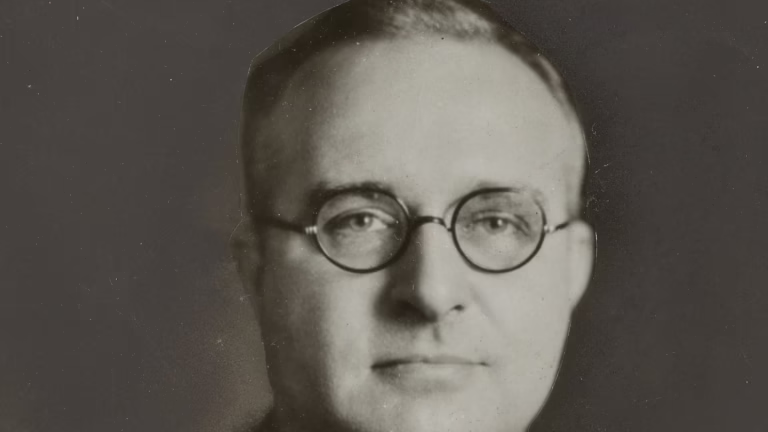
At 8:22 on the morning of 4 February 1912, Franz Reichelt stood on the ledge of the Eiffel Tower’s first platform, fifty-seven metres above the frozen Champ de Mars, and did nothing at all for about forty seconds. Two cameramen were waiting on him, one up on the platform, one down on the grass. The Franz Reichelt Eiffel Tower jump had been advertised for days. He was wearing the thing he had spent eighteen months sewing: rubberised fabric and silk, threaded through with rods and belts, cut so that the suit itself would open into a parachute the moment he left the rail.
He turned to the reporters. “À bientôt,” he said. See you soon.
The fall took a little over three seconds. Le Figaro’s man on the ground wrote that Reichelt had been calm and smiling right up to the moment he went over, and what came down was a loose bundle of trailing cloth with a man inside it. He hit hard enough to press a hollow about fifteen centimetres deep into ground that had been freezing all night.
The story is normally told as a joke with a body at the end of it: a tailor who thought he could fly, wrapped in a ridiculous amount of cloth. That reading is wrong, and the numbers are what make it wrong. Work out how much canopy a man of Reichelt’s weight actually needs and you land close to the area he had already built.
The suit that started in a dressmaking shop
Reichelt was Austrian by birth and had a dress business in Paris. He started work on the suit in July 1910, for a reason that was entirely sound: aviators were falling out of aircraft and dying, and they had nothing on them to stop it. His idea was a garment a pilot could simply wear, with no separate pack to fetch and no line to pull.
The first version was a monster. Accounts of its weight differ too widely for any one figure to be quoted as fact, but the redesign is consistent across all of them: he roughly doubled the canopy area and cut the weight hard, ending at about 30 square metres of surface. He gave his own body weight as seventy-two kilograms.
Then he tested it, and this is the part of the story that matters most.
Through 1911 he threw dummies wearing the suit out of windows into the courtyard of his own apartment building. The canopy did not inflate. He tried it himself over a pile of straw and broke his leg. Sources disagree on the exact drops and heights, but every account agrees on the outcome: repeated tests, repeated failures to open, across months.
Reichelt had an explanation ready. He is quoted as saying that if he had fifty or a hundred metres instead of twenty-five, the results would have been wonderful. He had read his own failures as a shortage of altitude. Every dummy that came down in that courtyard was telling him something about the mechanism, and he heard it as a complaint about the building.
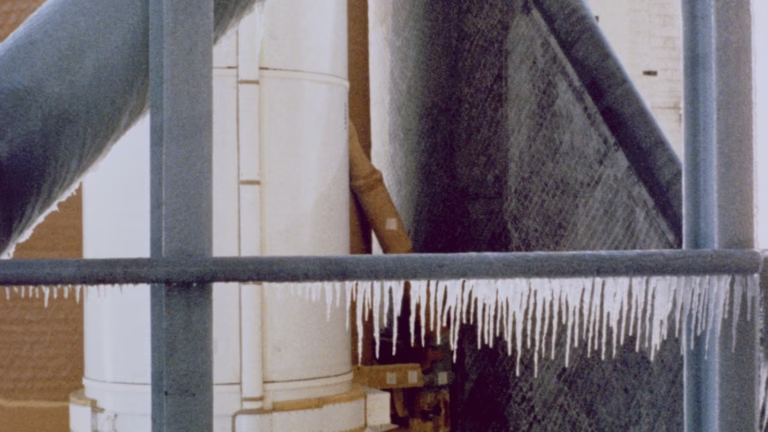
The data arrives, it is unwelcome, and it gets absorbed into a story that keeps the design alive. NASA’s managers did a version of this with cold weather and rubber seals, which is the seventeen-degree margin they had in hand before Challenger flew. Reichelt was going to be standing in his result.
The permit said a dummy
In early 1912 he petitioned the Paris Prefecture of Police for permission to test from the tower. The Prefect, Louis Lépine, granted it. The authorisation rested on the understanding that what went over the rail would be a mannequin.
Reichelt arrived around seven with two friends and the two cinematographers. Sources put the temperature somewhere between freezing and several degrees under it, with a wind coming across the open ground of the Champ de Mars. A guard named Gassion tried to stop him going up. Gaston Hervieu, who was experimenting with parachutes himself and knew what the design was asking the fabric to do, told him not to jump.
Reichelt had already told the press what he intended. “I want to try the experiment myself and without trickery,” he said, “as I intend to prove the worth of my invention.” To Hervieu and the others pushing back he offered his own mass as the argument: his seventy-two kilos and his parachute, he said, would give their objections the most decisive rebuttal.
He was right that the demonstration would settle it. Using your own body as the proof is a move with a poor record, and the man who did it most famously with leaded petrol spent the following year recovering from lead poisoning in bed.
Timeline of the Franz Reichelt Eiffel Tower jump
| Time | What happened | What was known then | Source |
|---|---|---|---|
| July 1910 | Reichelt begins designing a wearable parachute suit in his Paris shop | No self-deploying personal parachute existed; pilots flew with nothing | Wikipedia |
| 1911 | Dummy drops from his apartment courtyard fail to inflate the canopy | The canopy would not open at low height; he attributed this to the height | Wikipedia; All That’s Interesting |
| 1911 | He tests a version himself over straw and breaks his leg | Injury read as bad luck, not as evidence about the deployment mechanism | All That’s Interesting |
| Late 1911 | Canopy enlarged to roughly 30 m², suit weight cut substantially | More area assumed to fix a problem that was about opening, not size | Wikipedia; Amusing Planet |
| Early 1912 | Prefect Louis Lépine grants permission to test from the tower | Officials understood the test would drop a dummy, not a man | Wikipedia |
| 4 Feb 1912, ~07:00 | Arrives with two friends and two cinematographers; guard Gassion blocks him; Gaston Hervieu argues against a live jump | Hervieu, a working parachute experimenter, judged the design unsafe | Wikipedia |
| 4 Feb 1912, 08:22 | After about 40 seconds on the ledge he says “À bientôt” and jumps from 57 m | He had told reporters his 72 kg would settle the argument | Wikipedia; Amusing Planet |
| 08:22 plus ~3.4 s | Canopy never inflates; impact leaves a hollow ~15 cm deep in frozen ground | Press immediately questioned how a dummy permit became a live jump | Wikipedia; All That’s Interesting |
| 1 Mar 1912 | Albert Berry jumps from a Benoist aircraft over Jefferson Barracks, St Louis | Deployment into an aircraft’s forward airspeed worked on the first attempt | Wikipedia; military.com |
Get the next one by email
Physics, engineering and the people behind them. No spam, unsubscribe any time.
The Franz Reichelt parachute was close to the right size
A parachute works by drag. The canopy pushes air out of the way, the air pushes back, and the descent settles at the speed where that push equals the weight coming down. The relationship is the drag equation, and rearranged for the steady descent rate it says the terminal speed goes as the square root of weight divided by canopy area.
Put Reichelt’s numbers in. Take his stated seventy-two kilograms plus a suit somewhere in the region of twenty kilograms, so call it eighty-five all in. Take sea-level air at 1.2 kg per cubic metre and a drag coefficient around 1.4, which is the usual range for a round canopy. With 30 square metres of fabric, that gives a steady descent of roughly 5.8 metres per second.
Round military parachutes land people at about five to six metres per second. It is a hard landing and it breaks ankles, but people walk away from it every day.
So the fabric was not the joke. Reichelt, working with no wind tunnel and no aeronautical training, in a shop that mostly made dresses, had arrived by trial and error at a canopy area that a textbook calculation puts in the survivable band for his own body weight. That is the fact I want a reader who has watched the newsreel a dozen times to take away.
What every working parachute in 1912 had, and his did not
The calculation above assumes a canopy that is already open, inflated and stable. Getting to that state is the entire problem, and it is where the suit failed.
Inflation needs air moving through the canopy, and it needs time. A parachute does not snap open because the fabric wants to; it opens because air is forced into it fast enough to pressurise the shape. Reichelt stepped off a stationary iron ledge. His forward speed at the moment of release was zero, so the only airflow available to open thirty square metres of cloth was the airflow his own falling body generated, starting from nothing and building as he accelerated.
And he had fifty-seven metres of altitude to do it in. Ignoring drag, a body falls fifty-seven metres in about 3.4 seconds and arrives at roughly 33 metres per second, around 120 km/h. That is the whole budget. Inflate in under three seconds from a standing start, wearing the canopy instead of trailing it, with no pilot chute to drag the fabric out and no static line to pull it open, or hit the Champ de Mars at motorway speed.
His contemporaries were solving a different problem first. Gleb Kotelnikov had designed the RK-1 knapsack parachute in 1911, a folded silk canopy in a rigid pack that ejected clear of the body; Russian aviators were using it operationally by 1914. Grant Morton jumped from a Wright Model B over Venice Beach in 1911 by throwing his packed canopy clear of the aircraft before he went, letting the machine’s speed snap it open.
Every one of those designs had the same two things: a canopy stowed separately from the jumper, and an aircraft moving fast enough to inflate it immediately. Reichelt had neither. His suit needed the fabric to open around a man who was barely moving, and his own courtyard tests in 1911 had already demonstrated precisely that failure, over and over, in the only variable he refused to consider.
THE PHOTON’S TAKE
Reichelt was not a fool, and calling him one lets the interesting part of this go. He solved the sizing problem by hand and got it close. What killed him was that he never separated two questions the modern reader separates without thinking: how big does the canopy have to be, and how does it get open. He had failure data on the second question sitting in his own courtyard for a year, and he spent that year answering the first one better.
Twenty-five days later
On 1 March 1912, three and a half weeks after Reichelt came off the tower, Captain Albert Berry dropped from a Benoist pusher aircraft over Jefferson Barracks in Missouri with a canopy packed in a casing on his body. It worked. The idea Reichelt had been chasing, a parachute the jumper carries and deploys himself, was demonstrated within a month of his death, by a man who had a moving aeroplane to open it for him.
The footage of Reichelt was distributed to French cinemas within days. It is among the earliest fatal accidents recorded on film and shown to a paying audience, which is why it is still circulating, silently, on phones, a century later. The Paris papers spent the following week arguing about how a permit for a mannequin had ended with a man in the ground.
The popular version gets the physics backwards. Height was the thing Reichelt wanted more of, and at fifty-seven metres no quantity of it would have outrun his own mechanism. Given four hundred, though, thirty square metres of canopy inflating slowly against a rising airstream has a real chance of filling before the ground arrives.
His rationalisation was half right. It was nowhere near right enough for the tower he picked, and the tower was the point, because that is where the audience was.
Physical limits that refuse to move whatever the budget have their own literature, and the Kola borehole, where the rock beat the drill, is the cleaner case. Reichelt’s limit was deployment. He held the ledge for forty seconds in a freezing wind with two cameras running and a guard who had tried to send him home, and then he made the only test that could not be repeated.
The hollow he left in the frozen ground was about six inches deep. His parachute suit was sewn to a size that would have worked.
One story like this, most days
Written by a CERN physicist. No spam, unsubscribe any time.