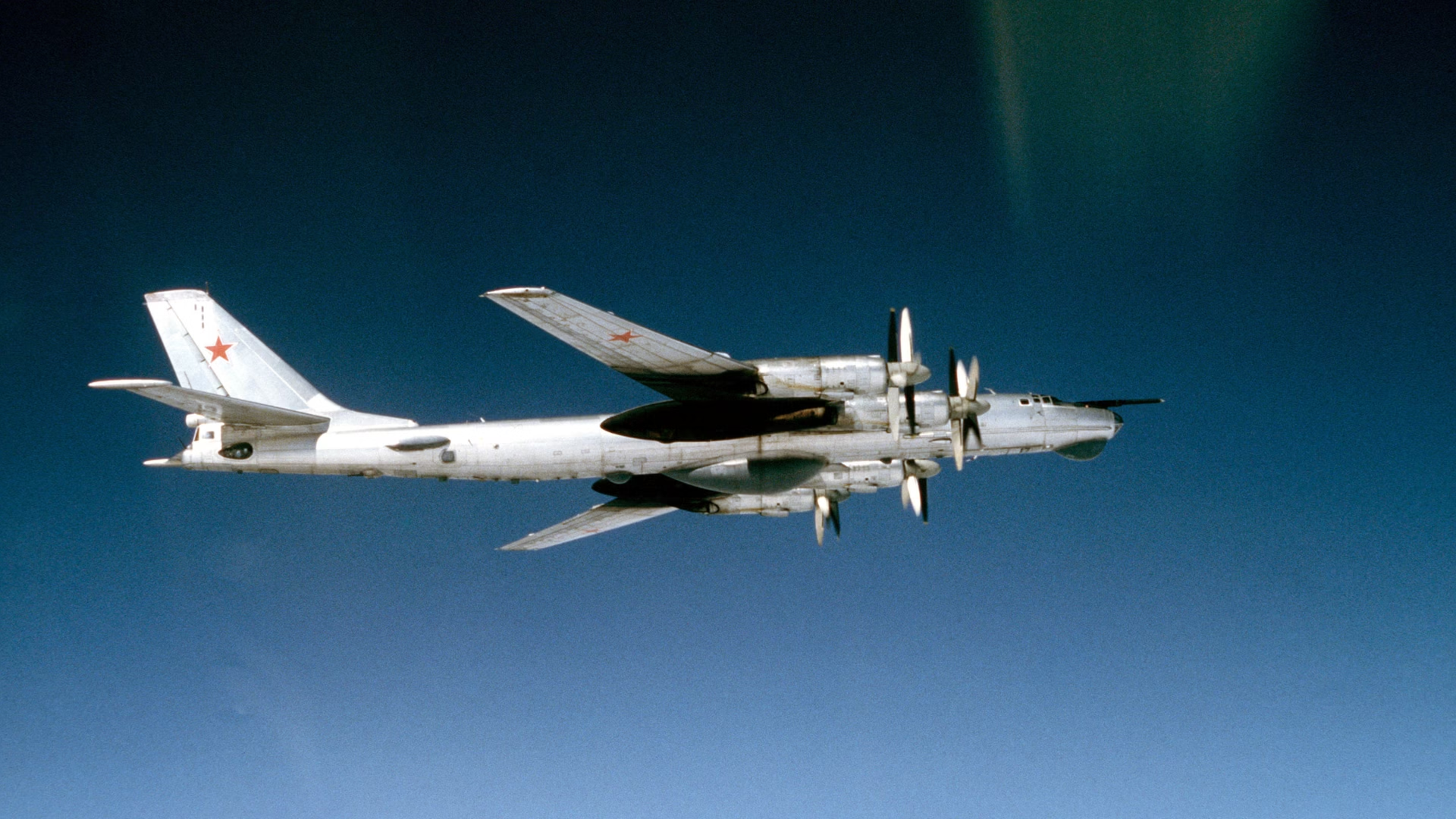

The bomber took off painted the wrong colour.
Every surface of the Tu-95 that would normally have worn Soviet grey had been sprayed a flat reflective white, and so had the Tu-16 camera aircraft flying behind it. The bomb bay doors were gone, cut away, because the weapon didn’t fit inside. It hung half out of the aircraft’s belly: twenty-seven tonnes, eight metres long, a little over two metres across. The Tsar Bomba yield that Major Andrei Durnovtsev carried off the runway at Olenya airfield on the Kola Peninsula that morning, Monday 30 October 1961, was about half the number history remembers.
100 megatons is the figure that stuck. The device that actually went off over Novaya Zemlya was roughly 50, and it threw out about a thirtieth as much radioactive fission product as the 100-megaton version would have. One metal separates those two bombs. I think the choice to swap it was the only decision in the whole programme that a physicist could defend in public afterwards, and it is almost never the part anybody mentions.
Three minutes and eight seconds
The white paint was for the flash. A detonation this size puts out enough thermal radiation to scorch an aircraft’s skin from tens of kilometres away, and reflective surfaces survive that better than dark ones.
Release came at about 10,500 metres over the Sukhoy Nos range, on a long Arctic island the Soviet Union had been detonating things on since 1955. The bomb fell under a parachute weighing most of a tonne. That parachute wasn’t for accuracy. It was for Durnovtsev.
The retarded fall lasted roughly 188 seconds — three minutes and eight seconds in which a turboprop bomber flew away from the spot it had just dropped a fifty-megaton device onto, as fast as a turboprop bomber can be made to go. Detonation was at about 4,000 metres. An air burst, not a ground burst, and that distinction does most of the work in the fallout story: a fireball that never touches the ground has no soil to lift, irradiate and drop again downwind.
Soviet accounts put the moment at 11:32 Moscow time. Some say 11:33. I can’t settle that from anything I’d call a primary document, and the honest version is that the minute is uncertain even though the morning isn’t.
The aircraft came home. Accounts usually say the shockwave caught it around 45 kilometres out and dropped it something like a kilometre before Durnovtsev got hold of it again, though that stand-off figure is one of the many numbers in this story that gets repeated with great confidence and cited with none.
The Tsar Bomba yield was ordered at 100 megatons
Nobody involved called it the Tsar Bomba. That name came later and from outside, borrowed from the Kremlin’s Tsar Cannon, which was never fired, and its Tsar Bell, which was never rung. Internally it was RDS-220, or izdeliye 602 — article 602. Western analysts watching it called it Big Ivan.
Khrushchev gave the order in July 1961, as part of the decision to break the test moratorium that had held since 1958, and what he wanted was a demonstration: the largest detonation anyone had ever staged, ready in time to go off while the 22nd Party Congress was still sitting in Moscow. Design went to KB-11 at Arzamas-16 under Yulii Khariton, with the theory handled by Andrei Sakharov, Viktor Adamsky, Yuri Babayev, Yuri Smirnov and Yuri Trutnev.
They had about fifteen weeks.
A crash programme with a political delivery date is the condition under which people talk themselves past a margin they should have respected. Readers who’ve followed how NASA argued its way around a 17-degree gap on Challenger know the shape of that situation. What happened at Arzamas-16 has the same shape and the opposite ending, which is the part I find worth explaining.
Where the tamper sits
A big thermonuclear weapon is built in stages, and the third one is optional in a way the first two aren’t.
The first stage is an ordinary fission bomb, ordinary by 1961 standards: plutonium or highly enriched uranium driven to a chain reaction. Its job is to flood the inside of the casing with X-rays fast enough to compress and light the second stage, where light nuclei are forced together and release energy. Fusion is clean in the way that matters here. Push hydrogen isotopes together and you get helium and neutrons, not the spray of medium-weight radioactive isotopes that fission leaves behind and that constitutes actual fallout.
Then there’s the tamper. Every stage needs one — a heavy jacket that holds the assembly together for the microseconds before it blows itself apart, and the longer it holds, the more of the fuel burns. The tamper has to be there. What it’s made of is a choice.
Fusion throws off neutrons at around 14 MeV, which is fast, and fast neutrons will split uranium-238. U-238 isn’t weapons material and won’t sustain a chain reaction on its own, so nobody builds a bomb out of it. Wrap it around a working fusion stage, though, and those 14 MeV neutrons fission it anyway. Build the jacket out of U-238 instead of something inert and it stops being structure and starts being fuel.
Roughly doubles the weapon. Also makes it filthy, because every one of those fissions leaves fission products behind, and fission products are the thing that falls out of the sky for the next thirty years.
Yield figures: Soviet-calculated, as reported in the Nuclear Weapon Archive.
Get the next one by email
Physics, engineering and the people behind them. No spam, unsubscribe any time.
Why halving the Tsar Bomba yield cut the fission by 97%
They built the third stage out of lead.
Lead doesn’t fission. It does the tamper’s mechanical job and contributes essentially nothing to yield, which is the entire point. The arithmetic, as reported in the standard technical accounts of the Soviet programme: the uranium version was calculated at around 100 megatons total, some 51.5 of them from fission. The lead version that actually flew came in near 50 megatons total, about 1.5 of them from fission. Fusion did as much as 97% of the work.
In absolute terms the swap removed about 50 megatons of yield and about 50 megatons of fission, and those are the same 50, because the fission in that jacket was the extra yield. As a fraction the two numbers behave completely differently. Total yield halves. Fission collapses by a factor of more than thirty. “Half as big” and “a thirtieth as dirty” describe one decision.
Source: The Nuclear Weapon Archive, “The Soviet Weapons Program — The Tsar Bomba”
The uranium version has been estimated to have produced on the order of 25% of all the fallout from every nuclear detonation since 1945. One device. One morning. That is the thing that didn’t happen, and it didn’t happen because a small group of physicists working to a deadline chose a metal.
The 97% figure deserves a caveat, and not a small one. It’s a Soviet calculation, published by the people who built the device, and I’m not aware of an independent Western fission-product analysis confirming the exact fraction. An air burst at 4,000 metres and a low fission yield are both consistent with the measured absence of heavy local contamination, so the claim fits what fell. It remains their number.
The number they got right
Here is what makes the lead swap an engineering decision rather than a lucky one: the team predicted the modified device at about 51.5 megatons and got about 50.
Set that against Castle Bravo. In March 1954 the United States detonated a device it expected to yield 4 to 6 megatons. It produced 15, because the designers had assumed the lithium-7 in the fuel would sit out the reaction, and instead it absorbed a neutron, threw off tritium and an extra neutron of its own, and fed the fusion it was supposed to ignore. The miss contaminated Rongelap and Rongerik, irradiated the crew of the Daigo Fukuryū Maru, and remains the worst radiological accident in the American testing programme. Those designers did not understand their own weapon.
Sources: Nuclear Weapon Archive; US Castle Bravo test record
Sakharov’s team removed half their own yield on purpose and hit their revised number within a few percent. Whatever else the Tsar Bomba was — and it was mostly theatre — the physics was under control in a way Bravo’s wasn’t.
Timeline: what was known on the day
| Date / time | What happened | What was known then |
|---|---|---|
| July 1961 | Khrushchev orders a maximum-yield demonstration device, ending the 1958 testing moratorium | That the target was the largest detonation ever attempted. No design existed yet. |
| July–Oct 1961 | KB-11 at Arzamas-16 designs RDS-220 in roughly fifteen weeks under Khariton, Sakharov, Adamsky, Babayev, Smirnov and Trutnev | Calculated three-stage yield near 100 Mt with a U-238 tamper; around 51.5 Mt of that from fission. |
| Before the test (exact date undocumented) | Third-stage U-238 tamper replaced with lead | Expected yield about 51.5 Mt. Who formally authorised the swap is not precisely documented. |
| 30 Oct 1961, ~09:30 Moscow | Tu-95V takes off from Olenya airfield, bomb bay doors removed, anti-flash white paint, Tu-16 camera ship in company | Crew survival depended on the parachute delay working as calculated. |
| 30 Oct 1961, midmorning | Release at ~10,500 m over Sukhoy Nos, Novaya Zemlya; ~188 s of retarded fall | Air burst planned at ~4,000 m to limit local fallout. |
| 30 Oct 1961, 11:32–11:33 Moscow | Detonation at ~4,000 m. Aircraft clears the area and returns | Measured yield roughly 50 Mt, close to the revised prediction. The West detected it seismically and by atmospheric debris. |
| Days later, 22nd Party Congress | Khrushchev publicly describes a bomb of about 100 megatons | The 100 Mt figure described the unbuilt design, not the tested device. |
| 20 Aug 2020 | Rosatom declassifies and releases documentary footage of the test | Now: the ~50 Mt consensus stands, with some post-2020 Russian commentary arguing for a modestly higher figure. Not independently settled. |
The number Khrushchev kept
Days after the test, Khrushchev stood in front of the 22nd Party Congress and talked about a hundred-megaton bomb.
He wasn’t quite lying. The Soviet Union had designed a 100-megaton device and could in principle have built one. It had detonated half of that, and the half left out was precisely the half that would have turned a spectacle into an atmospheric catastrophe. The politics kept the number the physicists had thrown away. Sixty-five years on, that’s still the number most people file it under.
Plenty of what surrounds this story has hardened into folklore. The claim that the blast broke windows in Norway and Finland gets repeated constantly and sourced thinly; Alex Wellerstein, who has done the most careful recent work on the test, treats that kind of detail sceptically in his 2021 account for the Bulletin of the Atomic Scientists. The Western measurement side is thinner than you’d expect too, which is a small irony given how much effort went into building instruments to read other people’s explosions from far away — the same difficulty that made the Vela incident so hard to settle two decades later.
What isn’t disputed is that the thing was never a weapon. At 27 tonnes it fit no operational bomber’s bay and no missile of the period, which is why the aircraft carrying it had to be cut open first. It could be dropped on Novaya Zemlya, an island the Soviet Union already owned and had been detonating things on for six years, a few hundred kilometres up the coast from the Kola Peninsula where Soviet engineers would later start drilling the deepest hole in the world. It could not be dropped on anyone.
So the swap cost the Soviet Union nothing. A weapon that can’t reach a target loses nothing by being smaller, and the team gave up fifty megatons that had no delivery system attached to them. That’s what makes the decision defensible rather than brave, and I’d keep the distinction. They weren’t choosing between a bomb and their consciences. They were choosing between two demonstrations, one of which would have salted the upper atmosphere with a quarter of the century’s fission products for no gain in capability whatsoever, and they took the other one.
Every megaton in a three-stage weapon that comes out of a uranium jacket arrives with its fission products attached. On 30 October 1961 that jacket was made of lead, and Durnovtsev flew home.
One story like this, most days
Written by a CERN physicist. No spam, unsubscribe any time.