It happens to everyone. You’re sitting at a café, discussing the merits of a specific brand of noise-canceling headphones with a friend. You haven’t searched for them. You haven’t texted about them. Yet, three hours later, as you doom-scroll through Instagram or TikTok, there it is: a glossy advertisement for that exact pair of headphones.
The sensation is visceral. You feel watched. The conclusion seems obvious: My phone is listening to me.
This anecdote has become the urban legend of the digital age, a shared ghost story for the 21st century. But the reality of how social networks predict your behavior is far more complex, scientifically fascinating, and ultimately, more unsettling than a rogue microphone. The truth isn’t that they are recording your conversations; it’s that they don’t need to.
Through the lens of advanced data science, we will dismantle the microphone myth and expose the real machinery of Social Network Behavior Prediction. We will dive into the Feedforward Neural Networks (FNNs) that model your future, the psychographic profiling that knows you better than your spouse, and the “surveillance capitalism” economic model that turns your human experience into a tradable futures market.
The Mathematics of “Telepathy”: How Prediction Works
To understand why an algorithm can anticipate your desires, we must look at the underlying architecture. Social networks do not function as mere bulletin boards; they are active prediction engines driven by deep learning.
The Data Points: A High-Dimensional Vector Space
Every interaction you have online creates a data point. But it’s not just what you “like.” The collection is granular and vast, forming what data scientists call a high-dimensional vector space of your personality.
- Dwell Time: How many milliseconds you hover over a post.
- Scroll Velocity: The speed at which you bypass content (indicating disinterest) vs. the micro-pauses that signal cognitive engagement.
- Graph Associations: Who you are standing near (digitally and physically) and what they are interested in.
When you discuss headphones with a friend, the system doesn’t need audio. It knows your friend recently bought those headphones. It knows your GPS data places you two at the same coffee shop for 45 minutes. The collaborative filtering algorithm deduces that the probability of you influencing each other is high. It serves you the ad not because it heard you, but because the statistical probability of you wanting that product spiked the moment your devices co-located.
Feedforward Neural Networks (FNN)
At the core of this predictive power are Feedforward Neural Networks. Unlike simple linear regressions, FNNs process data in a non-cyclical direction, from input nodes (your data) through hidden layers (processing) to output nodes (prediction).
Recent studies utilize these networks to classify user actions with frightening accuracy. By feeding the network historical interaction data—your past 10,000 clicks—the hidden layers identify non-linear patterns invisible to human analysts. For example, the network might learn that users who pause on “tech review” videos on Tuesday mornings and have a high affinity for “minimalist design” images are 88% likely to click on an ad for high-end audio equipment within 48 hours.
The “magic” is simply math. The algorithm is solving for the probability of your next action given the context and your history. When the variable crosses a certain threshold, the ad server fires.
The Microphone Controversy: Myth vs. Mechanism
The persistence of the “listening” theory is a testament to the Frequency Illusion (or Baader-Meinhof phenomenon), where a cognitive bias leads you to notice a newly learned concept more often. However, we must address the technical reality.
Why Constant Recording is Impractical
From a software engineering perspective, constant audio recording is a logistical nightmare.
- Data Volume: High-quality audio is data-heavy. Streaming 24/7 audio from billions of users would clog upstream bandwidth and require exabytes of server storage daily.
- Battery Drain: Constant microphone processing prevents the device’s CPU from entering low-power “sleep” states. Your battery would die in hours.
- Packet Inspection: Security researchers regularly inspect the data packets leaving phones. While they see vast amounts of metadata, they rarely, if ever, find unauthorized audio streams being uploaded to Facebook or Google servers.
The “Active Listening” Loophole
However, the story has a dark twist. While the social networks themselves (Meta, TikTok) adamantly deny listening, the marketing ecosystem is murkier.
In late 2024 and early 2025, leaked pitch decks from marketing partners (such as the CMG “Active Listening” scandal) suggested that third-party software could listen to conversations via smart devices to capture “intent data.” While major platforms like Google quickly distanced themselves and removed these partners, the technology exists. It usually relies on users granting microphone permissions to seemingly innocuous apps (flashlights, games, weather apps) that run background processes. These third-party data brokers then aggregate “voice intent” tags and sell them to the ad networks.
So, is Facebook listening? Likely not directly. Is someone in the ad-tech ecosystem trying to? Possibly. But the primary mechanism remains probabilistic modeling, not wiretapping.
Get the next one by email
Physics, engineering and the people behind them. No spam, unsubscribe any time.
Psychometrics: The Cambridge Analytica Legacy
The efficacy of behavior prediction relies on psychographics—the measurement of psychological attributes. This field gained notoriety during the Cambridge Analytica scandal, but the science remains the industry standard.
The Big Five Personality Traits
Algorithms classify users based on the OCEAN model:
- Openness to experience
- Conscientiousness
- Extraversion
- Agreeableness
- Neuroticism
A seminal study by researchers Kosinski, Stillwell, and Graepel showed that a computer could judge personality better than a work colleague based on just 10 Facebook “Likes.” With 70 Likes, it beat a roommate; with 150, a parent; and with 300 Likes, it could predict personality traits better than a spouse.
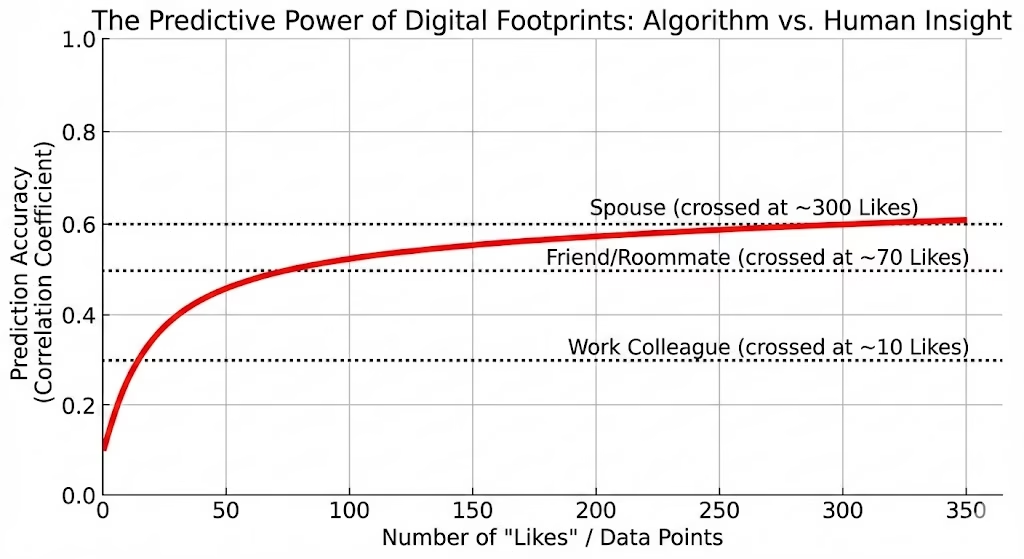
If an algorithm determines you score high on Neuroticism and Conscientiousness, it knows you are susceptible to fear-based messaging (e.g., cybersecurity ads or health supplements). If you score high on Openness, it targets you with travel and novelty experiences. This isn’t just advertising; it is behavioral modification at scale.
Surveillance Capitalism: The Economic Imperative
Harvard professor Shoshana Zuboff coined the term Surveillance Capitalism to describe this economic logic. In this system, human experience is the raw material. It is extracted, processed, and packaged into “prediction products” sold in behavioral futures markets.
- The Product: It is not the user. It is the certainty of the user’s future action.
- The Buyer: Advertisers, insurance companies, political campaigns.
- The Goal: To reduce the uncertainty of human behavior to zero.
This economic drive pushes platforms to not just predict behavior, but to guarantee it. This leads to the “nudge”—subtle UX choices designed to guide your hand. The notification that buzzes at the exact moment your engagement typically drops is not an accident; it is a calculated stimulus to ensure the prediction model remains accurate.
Conclusion: Regaining Agency in the Age of Algorithms
The realization that social networks predict our behavior without listening to our words is, in many ways, more disturbing than the conspiracy theory. It implies that our individuality is comprised of patterns so predictable that a matrix of vectors can simulate our next thought.
We are not being eavesdropped on; we are being modeled.
To maintain agency, we must understand the tools used against us. We can “poison the well” by obfuscating our data (randomizing clicks, using VPNs, disabling tracking IDs), but the most powerful tool is awareness. When you see that eerily accurate ad, remember: it’s not magic, and it’s not a microphone. It’s a mirror reflecting your digital shadow.
One story like this, most days
Written by a CERN physicist. No spam, unsubscribe any time.