Key takeaways
- A panoramic dental X-ray is 0.01 mSv and a chest X-ray 0.02 mSv. That is under two days and about three and a half days of UK background.
- A head CT, at 2 mSv, equals about a year of UK background. A chest CT of 8 mSv equals about four years.
- A return flight from Frankfurt to New York adds 0.12 mSv, under a third of a mammogram.
- Natural background is 2.4 mSv a year worldwide and 3.2 mSv in Europe, and radon supplies about 60 percent of the European figure.
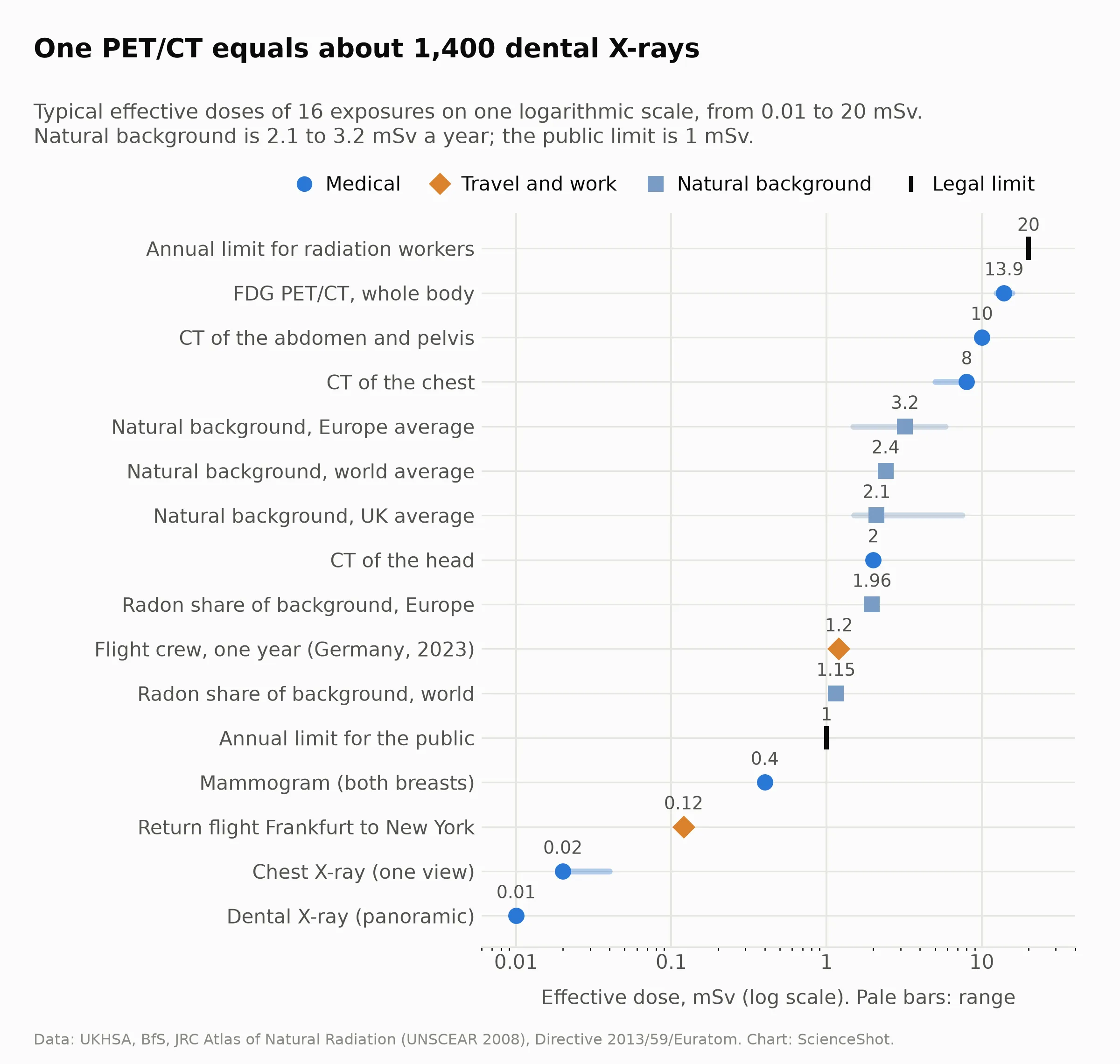
One head CT delivers about 2 mSv, close to a year of natural background in the UK, which averages 2.1 mSv. A panoramic dental X-ray is 0.01 mSv, a two-hundredth of that year. We put 16 exposures on one logarithmic scale, using typical effective doses from the UK Health Security Agency (UKHSA), Germany’s Federal Office for Radiation Protection (BfS) and the European Commission’s Joint Research Centre (JRC). Each value was checked at its source on 30 Oct 2026.
Your dose on one scale
The effective dose weights each organ by its radiosensitivity. That lets a chest X-ray, a flight and a year of radon share one unit, the millisievert (mSv).
| Exposure | Typical dose, mSv | Range, mSv | Days of UK background | Source |
|---|---|---|---|---|
| Dental X-ray (panoramic) | 0.01 | 1.7 | UKHSA, BfS | |
| Chest X-ray (one view) | 0.02 | 0.02 to 0.04 | 3.5 | UKHSA, BfS |
| Return flight Frankfurt to New York | 0.12 | 21 | BfS | |
| Mammogram (both breasts) | 0.4 | 70 | BfS | |
| Annual limit for the public | 1 | n/a | Directive 2013/59/Euratom | |
| Radon share of background, world | 1.15 | n/a | JRC, UNSCEAR 2008 | |
| Flight crew, one year (Germany, 2023) | 1.2 | 209 | BfS | |
| Radon share of background, Europe | 1.96 | n/a | JRC | |
| CT of the head | 2 | 348 | UKHSA, BfS | |
| Natural background, UK average | 2.1 | 1.5 to 7.5 | n/a | UKHSA |
| Natural background, world average | 2.4 | n/a | JRC, UNSCEAR 2008 | |
| Natural background, Europe average | 3.2 | 1.48 to 5.83 | n/a | JRC |
| CT of the chest | 8 | 5 to 8 | 1390 | UKHSA, BfS |
| CT of the abdomen and pelvis | 10 | 1738 | UKHSA, BfS | |
| FDG PET/CT, whole body | 13.9 | 12.4 to 15.7 | 2416 | Phys Eng Sci Med 2025 |
| Annual limit for radiation workers | 20 | n/a | Directive 2013/59/Euratom |
Get the next one by email
One new article a week on radiation, particles and the instruments that measure them, with its sources. No spam, unsubscribe any time.
What the scale shows
Medical imaging spans three orders of magnitude. A dental film is 0.01 mSv. A whole-body PET/CT has a median of 13.9 mSv in a 2025 study of 484 patients on a conventional scanner. A scan is a justified dose with a clinical benefit, and the dose limits below do not apply to it.
Flying is cheap by comparison. The BfS puts a return trip between Frankfurt and New York at about 120 microsieverts, or 0.12 mSv. One way it ranges from 0.032 to 0.075 mSv with the solar cycle and the flight altitude. In Germany in 2023 about 37,000 measurably exposed crew members shared a collective dose of 44.0 person-sieverts, which divides to about 1.2 mSv each.
Background is the largest steady dose, and it is not constant. The UKHSA reports regional averages from 1.5 to 7.5 mSv a year. Across Europe, country averages run from 1.48 mSv in the Netherlands to 5.83 mSv in the Czech Republic. Radon explains most of the spread. In the JRC tabulation it supplies 1.96 of the 3.2 mSv European average and 1.15 of the 2.4 mSv world average from UNSCEAR 2008.
The EU sets 1 mSv a year for the public and 20 mSv a year for radiation workers (Directive 2013/59/Euratom, Articles 12 and 9). Dose limits do not apply to medical exposures. The 20 mSv worker limit is a cap, not a typical dose.
How we compiled it
Where two authorities differ we show both as a range. The UKHSA gives 0.02 mSv for a chest X-ray and the BfS 0.04 mSv. For a chest CT the UKHSA gives 8 mSv and the BfS 5 mSv. The dot is the UKHSA value for the exposures it lists. Mammography, flights and crew doses come from the BfS, and background from the JRC Atlas. The PET/CT dot is the median, with its interquartile range of 12.4 to 15.7 mSv.
Limits
These are typical values for a standard adult of about 70 kg. Real doses depend on the scanner, the protocol and body size. The 2.4 mSv world figure dates from UNSCEAR 2008 as tabulated by the JRC in 2019, and national averages differ. Effective dose is a protection quantity, not a personal risk estimate. Whether to have a scan is a question for your doctor.
To convert between sieverts, millisieverts and rem, use the radiation units converter.
Cite this: ScienceShot, Your dose this year, November 2026, scienceshot.com, scienceshot.com/post/your-dose-this-year-dental-xray-ct-flight.
Sources: UKHSA, Medical radiation: patient doses (updated 28 Sep 2026); BfS, X-ray dose table (16 Feb 2023), cosmic radiation in flight (23 Sep 2026) and national dose register (2023 data); JRC, European Atlas of Natural Radiation, chapter 9 (2019), after UNSCEAR 2008; Directive 2013/59/Euratom; Physical and Engineering Sciences in Medicine 2025, 48(3). Retrieved 30 Oct 2026.
Cite this article
Turner, A. (2026, November 17). Your dose this year: dental X-ray, CT and a flight on one scale. ScienceShot. https://scienceshot.com/post/your-dose-this-year-dental-xray-ct-flight
Turner, Alex. “Your dose this year: dental X-ray, CT and a flight on one scale.” ScienceShot, 17 Nov. 2026, scienceshot.com/post/your-dose-this-year-dental-xray-ct-flight.
Turner, Alex. “Your dose this year: dental X-ray, CT and a flight on one scale.” ScienceShot, November 17, 2026. https://scienceshot.com/post/your-dose-this-year-dental-xray-ct-flight.
@online{scienceshot-your-dose-this-year-2026,
  author       = {Turner, Alex},
  title        = {{Your dose this year: dental X-ray, CT and a flight on one scale}},
  organization = {ScienceShot},
  date         = {2026-11-17},
  year         = {2026},
  url          = {https://scienceshot.com/post/your-dose-this-year-dental-xray-ct-flight}
}
https://scienceshot.com/post/your-dose-this-year-dental-xray-ct-flight
Get one article a week
One new article a week on radiation, particles and the instruments that measure them, with its sources. No spam, unsubscribe any time.