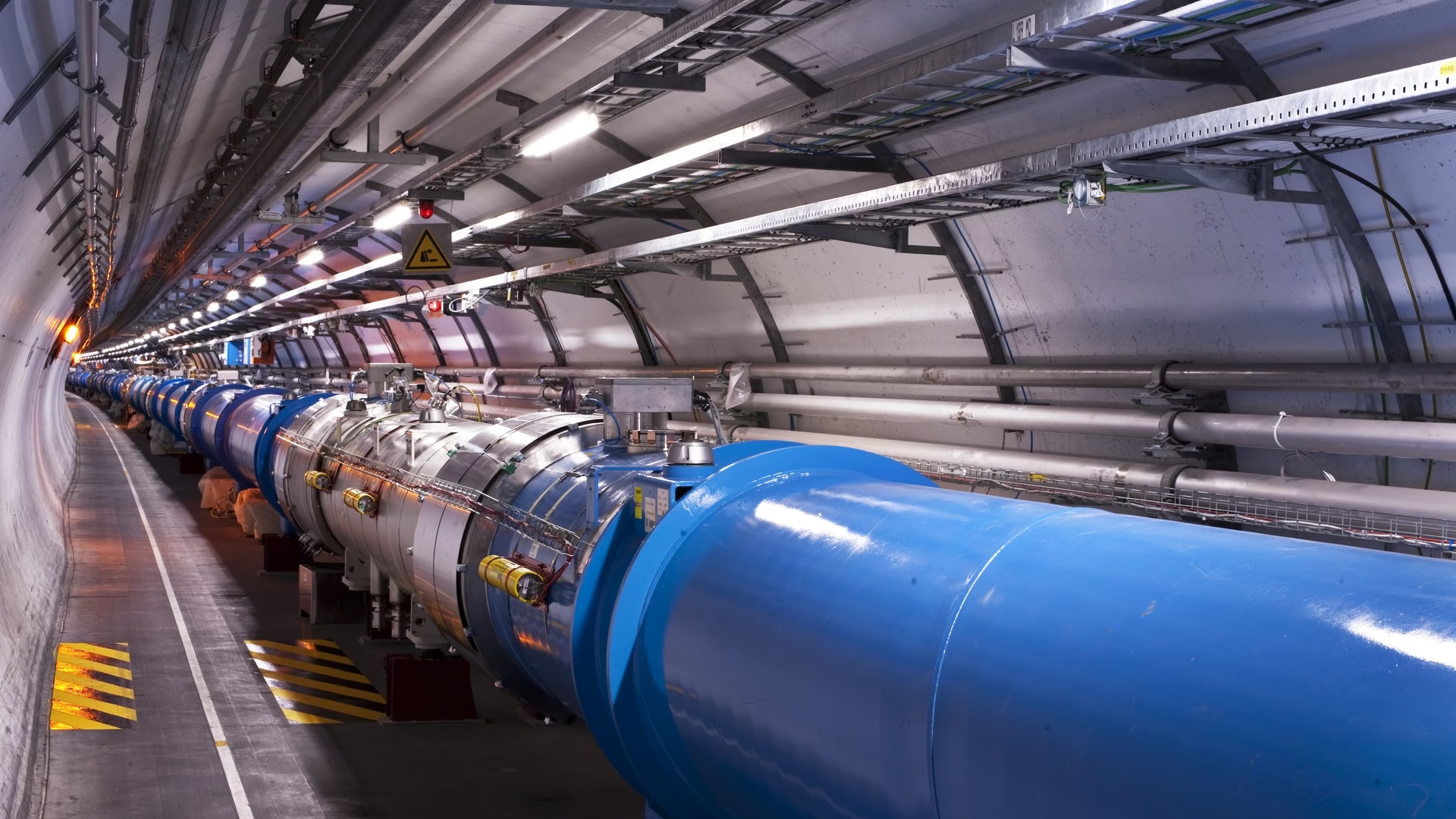
CERN, the European Organization for Nuclear Research, runs the world’s largest particle physics laboratory on the border between France and Switzerland, and its Large Hadron Collider (LHC) is the most powerful particle accelerator ever built. This page answers the questions people most often ask about it, from when it was founded and what it costs to whether it could make a black hole. If you want to work there, see how to get a job at CERN; for the physics behind the detectors, try the calculators hub.
CERN and the LHC in numbers
| Item | Figure |
|---|---|
| Founded | 29 September 1954, by 12 European states |
| Member States today | 25, plus 11 Associate Member States |
| LHC circumference | 26,659 m |
| LHC collision energy | 13.6 TeV (proton collisions) |
| LHC construction cost (CERN share) | 4,332 million Swiss francs |
| CERN electricity use | About 1.3 TWh a year, peaking near 200 MW |
| Worldwide LHC Computing Grid | More than 170 sites in 42 countries, about 1.4 million cores |
When was CERN founded?
The first official proposal for a European physics laboratory came from the French physicist Louis de Broglie at the European Cultural Conference in Lausanne, which opened on 9 December 1949. The aim was to rebuild European science after the war and to share the rising cost of large research facilities. In 1952 eleven governments set up a provisional council and chose Geneva as the site. The CERN Convention entered into force on 29 September 1954, the organization’s official founding date.
The 12 founding Member States were Belgium, Denmark, France, the Federal Republic of Germany, Greece, Italy, the Netherlands, Norway, Sweden, Switzerland, the United Kingdom and Yugoslavia, which left in 1961. Construction began on a new site at Meyrin, outside Geneva. CERN’s first accelerator, the 600 MeV Synchrocyclotron, started operating in 1957, and the 28 GeV Proton Synchrotron first accelerated protons in November 1959. The Proton Synchrotron still feeds particles to the rest of CERN’s accelerator complex today.
What has CERN discovered?
- 1973: neutral currents, a key prediction of the electroweak theory, seen in the Gargamelle bubble chamber.
- 1983: the W and Z bosons, carriers of the weak force; Carlo Rubbia and Simon van der Meer shared the 1984 Nobel Prize in Physics.
- 1989: Tim Berners-Lee proposed the World Wide Web while working at CERN, and developed it with Robert Cailliau and others from 1990.
- 1995: the first atoms of antihydrogen, made at the Low Energy Antiproton Ring.
- 2012: the Higgs boson, announced by the ATLAS and CMS experiments on 4 July.
The top quark, sometimes credited to CERN, was discovered in 1995 at Fermilab near Chicago by the CDF and DZero experiments.
Where are CERN and the LHC located?
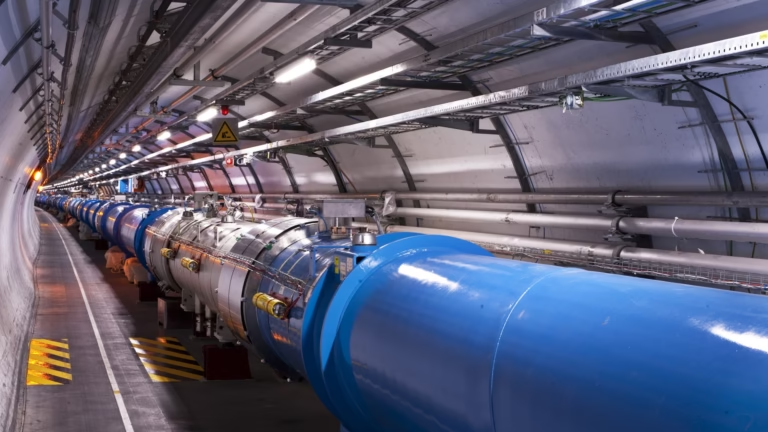
CERN’s main site is at Meyrin in the canton of Geneva, and the laboratory straddles the French and Swiss border. The LHC lies in a circular tunnel 26.7 kilometres long, on average about 100 metres underground, and the ring passes under both countries.
What does CERN stand for?
The acronym comes from the French name of the provisional body set up in 1952, the Conseil Européen pour la Recherche Nucléaire. When the permanent organization was created in 1954 it became the European Organization for Nuclear Research, but the original acronym stayed.
How many people work at CERN and the LHC?
CERN employs around 2,500 staff members (including the DG), mostly physicists, engineers, technicians and administrators who build and run the accelerators and infrastructure. Far more people use the laboratory than work for it: more than 12,000 scientists of about 110 nationalities, from institutes in more than 70 countries, take part in CERN experiments. The experiments themselves are run by these international collaborations, which are funded separately from CERN’s own budget.
How much did the LHC cost?
According to CERN, its share of the LHC construction cost was 4,332 million Swiss francs: 3,756 million for the machine and its underground areas, 493 million as CERN’s contribution to the detectors and their caverns, and 83 million for computing. The four big detectors cost about 1,500 million Swiss francs in total, most of it paid by the collaborations and their funding agencies. You would think, wow, this is a lot. Is it worth it? Given what the LHC has made it possible to discover, there are good reasons to think so.
How much electricity does CERN use?
CERN uses about 1.3 terawatt hours of electricity a year, roughly the annual consumption of 300,000 British homes. Demand peaks at about 200 megawatts from spring to December, when the accelerators run, and falls to about 80 megawatts in winter. At its peak, CERN draws about a third as much power as the nearby city of Geneva. The LHC itself accounts for around 600 gigawatt hours a year.
A large share of it goes into the LHC’s cryogenic system, which draws about 40 megawatts to keep the superconducting magnets at 1.9 kelvin, colder than outer space (see why the LHC is colder than outer space). CERN is supplied from the French grid, with a Swiss substation kept as a partial backup.

Get the next one by email
One new article a week on radiation, particles and the instruments that measure them, with its sources. No spam, unsubscribe any time.
What does CERN do?
CERN studies the basic constituents of matter and the forces between them. Its accelerators push protons and heavy ions to nearly the speed of light and smash them together, and detectors the size of buildings record the particles that fly out. Comparing those collisions with the predictions of the Standard Model of particle physics lets physicists test the theory, measure its parameters and look for signs of something new, such as dark matter particles or extra forces. Every lap around the ring costs the beams a little radiated energy, and the accelerator power calculator works out how much for a given beam energy and bending radius.
The LHC is the best-known machine, but CERN runs a chain of accelerators that also serve smaller experiments on antimatter, rare nuclei, neutrinos and cosmic-ray physics. Developing those machines and detectors has produced spin-off technologies in medical imaging, cancer therapy with particle beams and computing.
How much data do CERN and the LHC generate?
Inside the ATLAS and CMS detectors, bunches of protons cross so often that up to about a billion proton collisions can occur every second. Only a tiny fraction can be kept: fast electronic filters called triggers decide in microseconds which collisions look interesting and discard the rest.
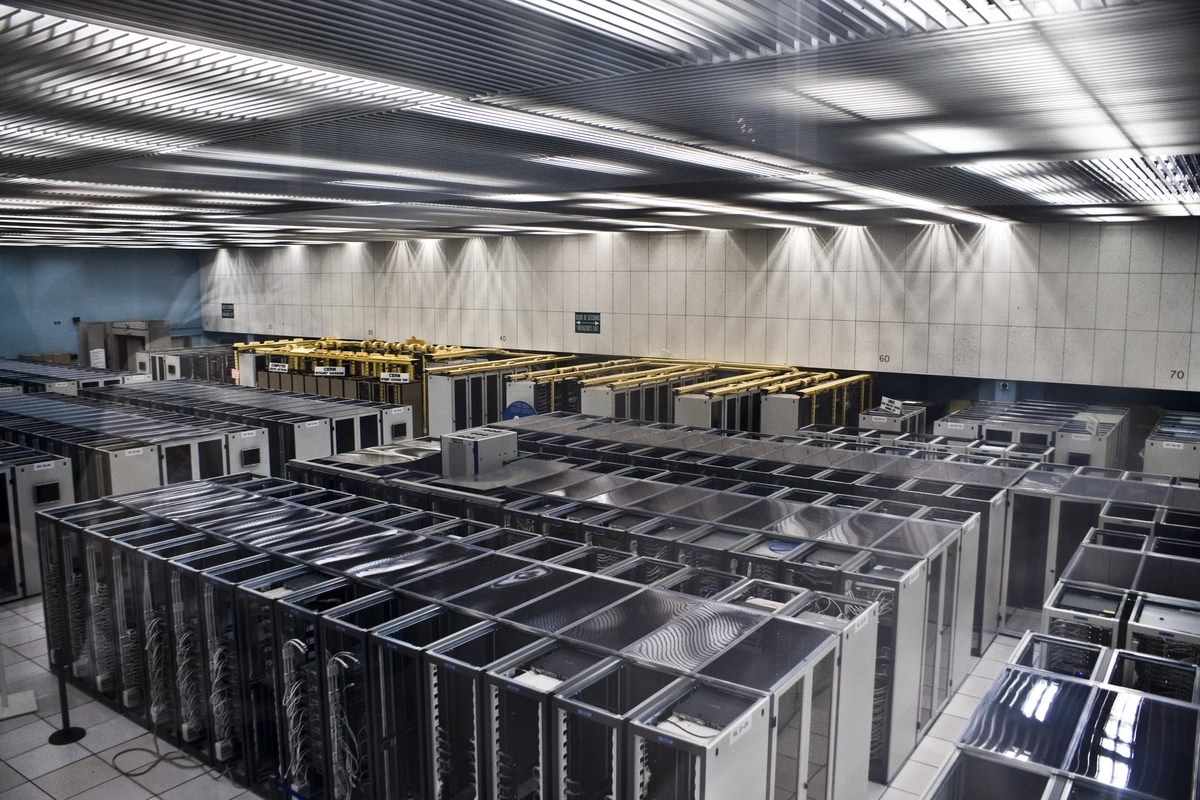
Even so, the volumes are enormous. During the LHC’s second run the CERN Data Centre handled about one petabyte, a million gigabytes, of data per day, and the experiments prepared for more than 600 petabytes of storage for the third run. The CERN Data Centre itself has about 450,000 processor cores in 10,000 servers. Analysis is shared through the Worldwide LHC Computing Grid, which links more than 170 computing sites in 42 countries, with about 1.4 million cores and 1.5 exabytes of storage, and runs more than two million tasks a day.
Can CERN cause earthquakes, end the world, open portals to other dimensions, or make gold?
No. The energy in an LHC collision is concentrated into a tiny space, but in absolute terms it is small: each colliding proton carries roughly the kinetic energy of a flying mosquito. Nature performs the same kind of collision all the time, at much higher energies, when cosmic rays strike the Earth, the Moon and every other body in the universe. CERN’s safety assessment group reviewed the risks in 2008 and concluded that LHC collisions present no danger.
As for gold, physicists can in principle change one element into another with nuclear reactions, and in 2025 the ALICE experiment reported that near-miss collisions of lead nuclei had knocked out three protons and briefly turned some lead into gold. Over the LHC’s second run that came to about 86 billion gold nuclei, or 29 trillionths of a gram, and each nucleus survived only a tiny fraction of a second.
Can the LHC create a black hole?
Not according to standard gravity, which is far too weak at these energies. Some speculative theories with extra dimensions allow microscopic black holes to form in LHC collisions. Even in those theories, such black holes would evaporate through Hawking radiation almost instantly, before reaching the detector walls. And if they could form and were stable, cosmic rays would have been making them for billions of years; the survival of the Earth, the Sun and dense stars such as neutron stars rules out any danger. No sign of microscopic black holes has been found in LHC data.
Why does CERN have a statue of Shiva?
The two-metre statue of Shiva Nataraja, the dancing form of the Hindu god, was unveiled at CERN on 18 June 2004. It was a gift from India, presented by the Department of Atomic Energy, to mark the country’s long association with CERN, which began in the 1960s. India became an Associate Member State of CERN on 16 January 2017.
In Hindu tradition Nataraja’s dance represents the cycle of creation and destruction. A plaque next to the statue quotes the physicist Fritjof Capra, who in the 1970s compared that cosmic dance with the constant creation and annihilation of subatomic particles.
How can you visit CERN?
CERN’s Science Gateway visitor centre, opened in 2023, has free exhibitions and workshops; admission is free but registration is required. Guided tours of CERN sites can be booked through the visitor website, and underground visits are rare: the LHC tunnel is never open to visitors, and the experiment caverns can be visited only while the LHC is stopped. From Geneva’s Cornavin station, tram 18 towards Meyrin, CERN reaches the stop in front of the laboratory in about 25 minutes. From the airport, take bus 23, 28 or 57 to Vernier, Blandonnet and change to tram 18.
References
Cite this article
Turner, A. (2023, August 4). What Is CERN? What the LHC Does, Costs and Has Discovered. ScienceShot. https://scienceshot.com/post/cern-and-lhc-discover-the-secrets-of-the-universe
Turner, Alex. “What Is CERN? What the LHC Does, Costs and Has Discovered.” ScienceShot, 4 Aug. 2023, scienceshot.com/post/cern-and-lhc-discover-the-secrets-of-the-universe.
Turner, Alex. “What Is CERN? What the LHC Does, Costs and Has Discovered.” ScienceShot, August 4, 2023. https://scienceshot.com/post/cern-and-lhc-discover-the-secrets-of-the-universe.
@online{scienceshot-cern-and-lhc-discover-2023,
  author       = {Turner, Alex},
  title        = {{What Is CERN? What the LHC Does, Costs and Has Discovered}},
  organization = {ScienceShot},
  date         = {2023-08-04},
  year         = {2023},
  url          = {https://scienceshot.com/post/cern-and-lhc-discover-the-secrets-of-the-universe}
}
https://scienceshot.com/post/cern-and-lhc-discover-the-secrets-of-the-universe
Get one article a week
One new article a week on radiation, particles and the instruments that measure them, with its sources. No spam, unsubscribe any time.