
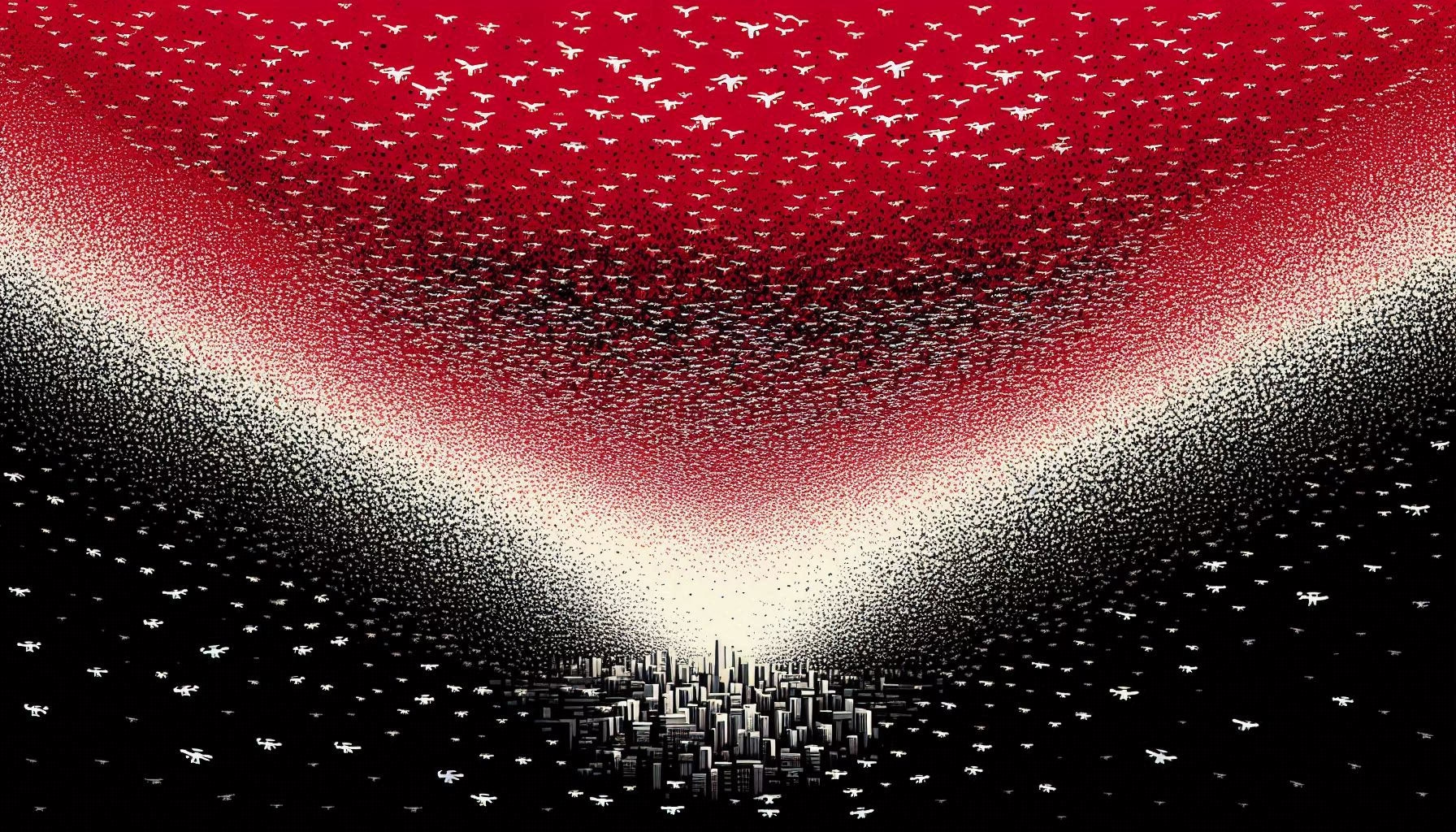
For seventy years, military planners have visualized the invasion of Taiwan as a supersized version of D-Day. They imagine thousands of landing craft storming the beaches of Taoyuan, paratroopers dropping over Taipei, and a cataclysmic clash of steel on the coastline. This is the “Normandy Paradigm” and it is likely obsolete. If the People’s Liberation Army (PLA) studies the lessons of Ukraine and the Nagorno-Karabakh conflict, they will realize that the most efficient way to take the island is not with soldiers, but with cheap, disposable circuitry.
The geography of Taiwan—often called a “porcupine”—is designed to shred an amphibious landing. Its beaches are few and fortified; its mountains are treacherous. A physical invasion is a gamble with a high probability of failure and massive casualties. However, a new doctrine is emerging in military science: Aerial Denial via Saturation. Instead of risking a single ship, Beijing could launch a campaign of pure industrial attrition, sending waves of thousands of low-cost drones across the Taiwan Strait every single day. The goal is not necessarily to blow up targets, but to force Taiwan to blow up the drones. It is a strategy of economic exhaustion, turning Taiwan’s advanced defense systems into their own liability.
The Taiwan Invasion: The Cost-Exchange Ratio
Modern air defense is built on a specific economic assumption: the interceptor is cheaper (or comparable in cost) to the target it is destroying. You fire a $2 million Patriot missile to stop a $50 million fighter jet. That is a good trade. But the equation flips catastrophically in the age of drone warfare.
Consider the economics of a “Shahed-style” drone or a converted civilian quadcopter. Mass-produced in Shenzhen—the electronics manufacturing capital of the world—a long-range suicide drone might cost roughly $20,000 to $50,000. In contrast, Taiwan’s primary air defense relies on US-made Patriot PAC-3 missiles (approx. $4 million each) and domestically produced Tien Kung III missiles (approx. $1 million each).
If China launches a wave of 500 drones, and Taiwan intercepts them all, the ledger looks like this:
- China’s Cost: $10 million (500 drones × $20k).
- Taiwan’s Cost: $500 million (assuming cheaper $1M interceptors).
This is a 50:1 cost asymmetry. But the money isn’t the real problem; the inventory is. Money can be printed; high-performance missile guidance chips cannot. Taiwan has a finite number of interceptors—estimated in the low thousands. China has a manufacturing base capable of churning out tens of thousands of drones per month. This is the “Cost-Exchange Trap.”
The Strategy: The “Empty Magazine” Phase
The hypothetical campaign would not begin with a bang, but with a swarm. It would proceed in three distinct phases designed to strip the island of its “shield” before the “sword” ever strikes.
Phase I: The Decoy Soak For the first week, the PLA would likely send waves of retrofitted, obsolete fighter jets (converted to unmanned drones) and thousands of cheap, radar-reflecting decoys. These objects don’t need to carry warheads; they just need to look like threats on a radar screen. Taiwan’s radar operators would face an impossible dilemma: ignore the blip and risk a bomb hitting a power plant, or fire a precious missile and destroy a piece of flying plywood. Under the pressure of war, defensive doctrines usually default to “shoot first.” This phase effectively “soaks up” the first layer of Taiwan’s ready-alert munitions.
Phase II: The Hunter-Killer Loitering Once the long-range surface-to-air missile (SAM) batteries are depleted or forced to conserve ammo, the PLA introduces “loitering munitions” (like the Harpy or massive swarms of smaller equivalents). These drones orbit for hours, waiting for a Taiwanese radar to turn on. The moment a radar emits a signal, the drone traces it back to the source and destroys the emitter. This blinds the island. Without radar, the remaining missile batteries are useless. The skies belong to the swarm.
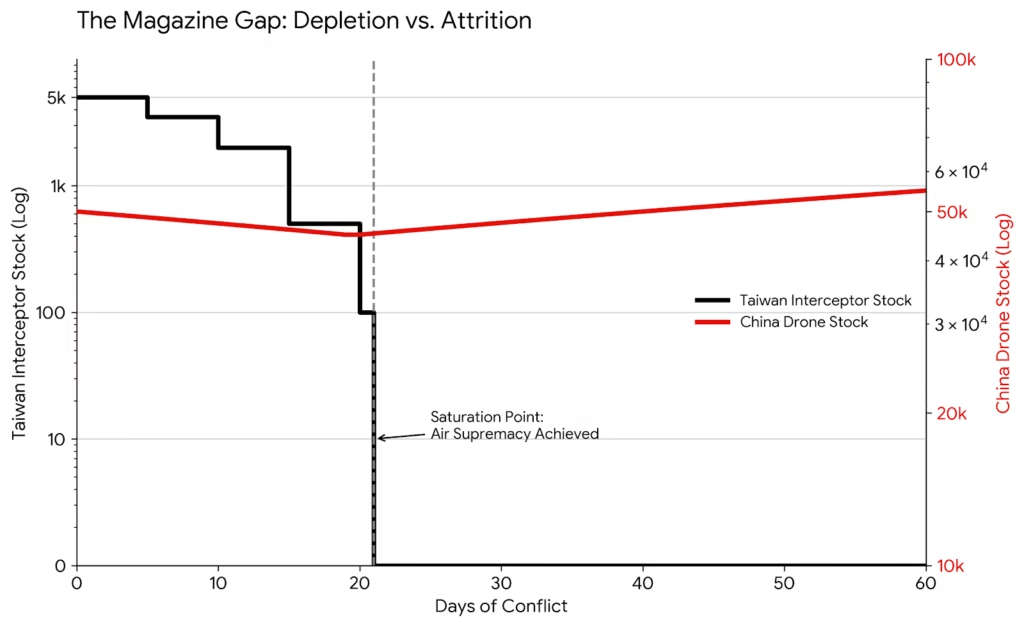
Phase III: The Blockade of Attrition With air defenses exhausted (the “Empty Magazine” scenario), China does not need to invade yet. They simply maintain a 24/7 “drone cap” over the island. Any ship trying to enter a Taiwanese port is swarmed. Any truck seen moving military supplies is struck. The economy freezes. The energy grid is systematically dismantled. The population is held hostage not by soldiers on the street, but by the buzzing overhead.
The Logistics of the Swarm: Can China Do It?
Skeptics often argue that coordinating thousands of drones is technically impossible. This underestimates both the current state of AI and China’s industrial capacity.
- Manufacturing Dominance: China produces over 70% of the world’s civilian drones (led by companies like DJI). The supply chain for motors, batteries, and carbon fiber frames is entirely domestic. Converting a production line from camera drones to “kamikaze” drones is a trivial engineering challenge compared to building an aircraft carrier.
- Swarm AI: You do not need 5,000 pilots to fly 5,000 drones. You need “Swarm Logic.” The drones communicate with each other, behaving like a flock of starlings. If one is shot down, the others adjust their formation. The human operator merely designates a “kill box,” and the algorithm handles the flight paths.
- Launch Platforms: These drones do not need runways. They can be launched from shipping containers on the decks of civilian freighters, from the backs of trucks, or effectively “catapulted” from the mainland coast (the Taiwan Strait is only 180km wide, well within range of even modest fixed-wing drones).
Get the next one by email
Power, cooling, chips and the rules that shape them. No spam, unsubscribe any time.
Why Conventional Countermeasures Might Fail
Why can’t Taiwan just use anti-aircraft guns or electronic warfare (EW)?
- Electronic Warfare: Jamming is the most viable defense, but modern military drones are increasingly autonomous. If the GPS signal is jammed, they switch to “inertial guidance” (flying by internal compass/gyro) or “optical terrain matching” (using a camera to recognize the ground, like a cruise missile). You can jam the signal, but you can’t jam the physics of a flying object.
- Lasers (DEW): Directed Energy Weapons are the “holy grail” for anti-drone defense because they cost pennies per shot. However, lasers are notoriously finicky. They struggle in rain, fog, or heavy cloud cover—conditions common in the Taiwan Strait. Furthermore, a swarm of 1,000 drones can simply overwhelm the “slew rate” (targeting speed) of the laser systems.
- Guns (CIWS): Phalanx-style gatling guns are effective but have a very short range (1-2 km). They can protect a single building, but they cannot protect a city or a coastline. They also run out of ammunition quickly against a continuous stream of targets.
The Geopolitical Checkmate
This strategy also creates a nightmare for the United States. If the US Navy sends a Carrier Strike Group to intervene, those ships become targets for the same swarm. A $13 billion aircraft carrier is incredibly vulnerable to a saturation attack of 5,000 cheap drones. Even if the ship’s defenses stop 99% of them, the 1% that get through could wreck the flight deck and mission-kill the vessel.
This creates a “No-Go Zone” (A2/AD) that pushes American power past the “First Island Chain.” The US would be forced to watch from a distance or risk losing capital ships to plastic airplanes.
Conclusion: The War of Factories
The defense of Taiwan has traditionally relied on the assumption of technological superiority—that Western missiles are smarter than Chinese aircraft. The “Mosquito Strategy” renders that irrelevant. It posits that quantity has a quality all its own. If China chooses this path, the war for Taiwan will not be decided by bravery, pilot skill, or tactical brilliance. It will be decided by supply chain management and industrial output.
In this scenario, Taiwan runs out of missiles before China runs out of drones. It is a chilling reminder that in the 21st century, a high-tech society can still be besieged by a low-tech, brute-force algorithm. The “Fog of War” is being replaced by a “Cloud of Drones.”
Cite this article
Editorial, S. (2026, January 14). Taiwan Invasion: The New Strategy for Conquest. ScienceShot. https://scienceshot.com/post/taiwan-invasion-the-new-strategy-for-conquest
Editorial, ScienceShot. “Taiwan Invasion: The New Strategy for Conquest.” ScienceShot, 14 Jan. 2026, scienceshot.com/post/taiwan-invasion-the-new-strategy-for-conquest.
Editorial, ScienceShot. “Taiwan Invasion: The New Strategy for Conquest.” ScienceShot, January 14, 2026. https://scienceshot.com/post/taiwan-invasion-the-new-strategy-for-conquest.
@online{scienceshot-taiwan-invasion-the-new-2026,
  author       = {Editorial, ScienceShot},
  title        = {{Taiwan Invasion: The New Strategy for Conquest}},
  organization = {ScienceShot},
  date         = {2026-01-14},
  year         = {2026},
  url          = {https://scienceshot.com/post/taiwan-invasion-the-new-strategy-for-conquest}
}
https://scienceshot.com/post/taiwan-invasion-the-new-strategy-for-conquest
Get the weekly brief
Sourced analysis of data-centre engineering and regulation, every Monday. No spam, unsubscribe any time.