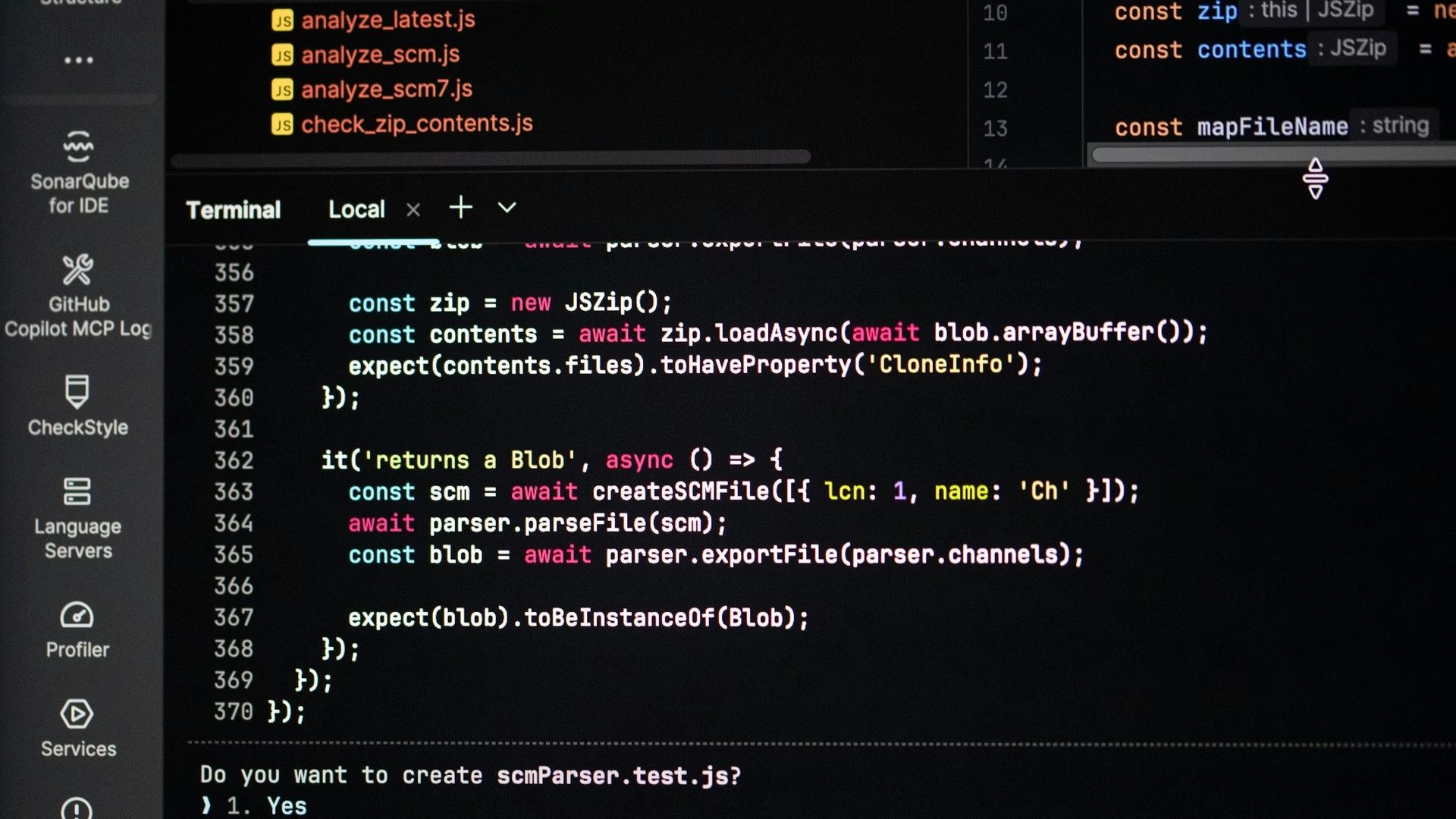

Meta just shipped a terminal-based AI coding agent, and nearly every headline says the same thing: “Meta enters the Claude Code race.” That framing is accurate but lazy — it skips the fact that Muse Code was built and battle-tested inside the company running one of the largest monorepos on the planet, and that pedigree shapes every design choice underneath it.
My thesis: the “built for large codebases” pitch isn’t the differentiator Meta wants it to be, because Claude Code, Codex CLI, Cursor, and Windsurf already claim the same territory. The sharper practitioner question isn’t whether Muse Code beats those tools on Meta-scale work — it’s whether monorepo-first tuning quietly fights you on the 50-file side project you actually maintain.
What Muse Code Actually Is
Meta released Muse Code in beta on Aug. 5, 2026, for macOS and Linux, installable with a single terminal command, according to TechCrunch and 9to5Mac. It’s a terminal coding agent in the literal sense — no browser tab, no IDE plugin, just a process sitting in your shell next to git and your build tools. Under the hood it runs on Muse Spark 1.2, a coding-focused update to Meta’s Muse Spark model, with reported gains in code generation, debugging, and codebase understanding. Mark Zuckerberg framed the goal simply: agents that “complete software engineering tasks across large repos” — a line that tells you exactly which problem Meta solved for first.
Running entirely in the terminal isn’t a stylistic choice, either. It means Muse Code can chain directly into your existing scripts, CI hooks, and git workflow without context-switching to a browser tab or IDE panel — the same reason plenty of data engineers I know still live in tmux instead of a web console. That design mirrors the terminal-first bet Anthropic made with Claude Code and OpenAI made with Codex CLI, so on interface alone, Muse Code isn’t breaking new ground. It’s catching up to a pattern the market already validated.
Two Pricing Tiers, And One Catch
Muse Code ships with two ways to pay. There’s a standard metered rate — Meta hasn’t published a number for it, so treat any specific figure you see elsewhere as unconfirmed. Then there’s a discounted “contributor” tier priced at $0.30 per 1 million tokens, reported by BigGo Finance, that requires developers to consent to their code and usage data being used to train Meta’s own models. That’s a real trade: cheaper inference in exchange for handing Meta training data pulled straight from your working repo.
For a well-funded engineering org already deep in Meta’s infrastructure elsewhere, that contributor discount is close to free money. For an independent developer or small startup guarding proprietary code, handing over training rights for a modest per-token discount is a much harder trade, especially with the standard-tier price still unpublished. Until Meta actually discloses that number, there’s no way to know if the ordinary metered plan is even competitive with what Claude Code or Codex CLI already charge.
Source: BigGo Finance, Aug 2026 — Meta has not published the standard-tier price.
Get the next one by email
Power, cooling, chips and the rules that shape them. No spam, unsubscribe any time.
The Monorepo Assumption Baked Into Muse Code
Here’s the mechanism that actually matters: when a job is big enough, Muse Code doesn’t grind through your repository serially. It fans out into separate sub-agents, each working inside its own isolated git worktree — a full, separate checkout of the same repository, so multiple agents can edit code simultaneously without stepping on each other’s changes. A crash-safe event log records every step along the way, so if a sub-agent dies mid-task, the work doesn’t vanish; it resumes from the log instead of from zero. I’ve watched this exact pattern inside CERN’s distributed computing grid and in data-center job schedulers: shard one enormous task across isolated workers, keep a durable log, and a crashed node never means starting over.
That’s genuinely clever distributed-systems engineering. But fan-out and isolated worktrees are optimizations for a specific kind of pain: repositories with tens of thousands of files, sprawling internal build graphs, and tooling conventions that only make sense at Meta’s scale. A tool tuned to shard a giant monorepo into parallel worktrees is solving a coordination problem your project doesn’t have if the whole codebase already fits in one worktree. Counterintuitively, that same machinery — spinning up sub-agents, juggling multiple worktrees, reconciling parallel diffs — can add pure overhead on a small repo where a single linear agent would just finish the job faster.
The “validate” part of the plan-write-validate loop is doing real work too: Muse Code is designed to run your build and test suite as part of the loop, not just generate a diff and stop. That’s the same discipline good CI pipelines enforce, and it’s a meaningful difference from agents that hand you code and let you discover it’s broken later. But validation loops that assume a Meta-style build graph — hermetic builds, internal caching layers, bespoke test sharding — may need real rework before they’re useful against a typical npm- or pip-based small project’s build tooling.
This is also why “built for large codebases” isn’t much of a differentiator by itself. Claude Code, Codex CLI, Cursor, and Windsurf all market repo-scale reasoning already, and Muse Code arrives making a similar claim in a genuinely crowded field. Meanwhile, the broader agentic tooling ecosystem is still arguing over more basic questions — see the debate over the MCP spec’s authentication model or the friction around GitHub Copilot’s agent skills and MCP control — which suggests the industry hasn’t even agreed on the plumbing, let alone which architecture wins for which repo size.
Source: TechCrunch, 9to5Mac — Muse Code architecture reporting, Aug 2026.
⚡ PHOTON’S TAKE
Muse Code’s fan-out architecture is the most interesting thing Meta shipped this week, and it’s also the tell. You don’t build isolated-worktree sub-agents with a crash-safe event log unless you’re fighting a monorepo the size of a small country’s tax code. That’s an engineering flex for Meta’s internal repos — and a real risk for everyone else. If your codebase fits in your head, Muse Code is solving a problem you don’t have, and the overhead shows. I’d try it on a genuinely large repo first. On a weekend project, I’d reach for something lighter.
Will Muse Code Fight You on a 50-File Repo?
Here’s the forward-looking bet: Meta will keep tuning Muse Code against its own internal monorepo, because that’s the workload its own engineers actually generate, and outside beta feedback will be secondary signal at best. Expect the tool to get very good, very fast, at exactly the kind of repo-scale orchestration Meta needs — and expect that improvement curve to bend toward giant codebases, not small ones. If you run a startup-sized repo, the practical test isn’t a benchmark chart; it’s whether the fan-out logic ever triggers uselessly on a task a single agent could’ve handled directly.
Expect a market segmentation to emerge over the next year: agents tuned for sprawling monorepos, agents tuned for lean single-repo startups, and a shrinking middle ground of “generalist” agents trying to serve both. Muse Code is planting its flag firmly in the first camp, and that’s a legitimate strategy — but it’s not the same claim as being the best agent for you, whoever you are.
My opinion: Muse Code is worth watching closely if you already run a Meta-scale repo, and worth a cautious trial — not a default switch — if you don’t. The industry’s actual fight in 2026 isn’t “whose agent is smartest,” it’s whose agent’s assumptions match your repo’s shape, the same lesson that’s played out around Claude Code’s own permission and security patches. Pick the tool tuned for your scale, not the one with the biggest launch quote.
Get the weekly brief
Sourced analysis of data-centre engineering and regulation, every Monday. No spam, unsubscribe any time.