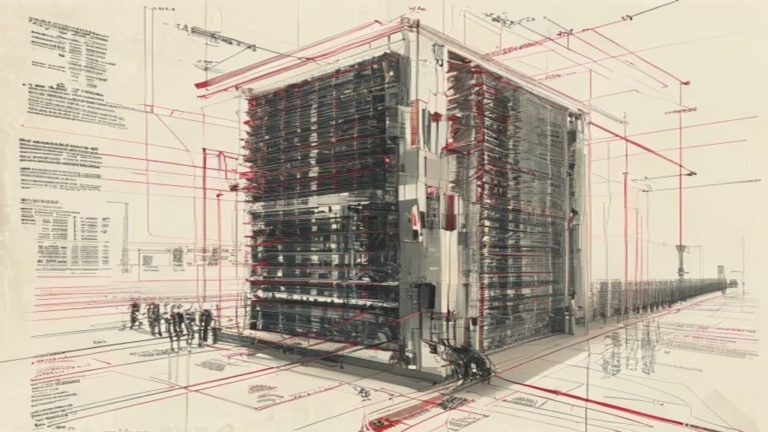
Picture a single server rack pulling 18,500 amps — roughly the current of a small industrial substation — squeezed through copper bars you could still (barely) lift by hand. That’s not a thought experiment. It’s what a 1-megawatt AI rack running on a 54-volt busbar actually demands today, and it’s why the industry is now ripping out that architecture in favor of 800V DC power.
Here’s my thesis, stated plainly: the move to 800V isn’t a grid story. It’s not about utilities or substations. It’s an I²R problem — resistive heating, the same effect that makes a toaster coil glow — happening entirely inside the rack, and the physics of that problem just hit a wall that no amount of clever engineering could push through at 54V.
The 1MW Wall That Broke 54V DC
Start with the equation every physics student meets in week one: P = I × V. Power equals current times voltage. If you fix power — say, at 1 megawatt, which is where a rack of next-generation GPUs now sits — then current and voltage are locked in an inverse relationship. Push voltage down, and current has to go up to compensate.
At 54V, that 1MW rack draws approximately 18,500 amps, according to NVIDIA’s engineering blog and reporting from DataCenterDynamics. The copper busbar needed to carry that current inside a single rack weighs around 200 kilograms. Scale that to a 1-gigawatt AI campus — the size Microsoft, Meta, and others are now building — and you’re talking about roughly 200 tons of copper just for the low-voltage power delivery inside the racks, before a single GPU computes anything. I’ve spent years around large infrastructure, and that’s the kind of number that stops a room.
This is the part most coverage skips: 54V didn’t fail because the industry chose the wrong number. It failed because at constant power, current scales as 1/V, and copper mass has to scale to handle that current safely. The rack didn’t hit a market ceiling. It hit a thermodynamic one.
Source: NVIDIA developer blog / DataCenterDynamics — current at constant 1MW rack power
Why 800V DC Racks Still Need So Much Copper
Jump the bus voltage from 54V to 800V — a 14.8x step — and at the same 1MW, current falls to about 1,250 amps. That’s the easy part of the story, and it’s the part every press release stops at. Here’s where it gets interesting, and where the naive physics prediction and the real engineering diverge.
Resistive loss follows I²R — power dissipated as heat scales with the square of current. Drop current by 14.8x and, for a fixed resistance, that loss term falls by roughly 219x. If you stopped the analysis there, you’d expect copper mass to shrink by something close to 95%, since the whole point of adding copper is to fight I²R heating by lowering resistance. That’s the naive prediction, and it’s wrong — not fraudulently wrong, but instructively wrong.
NVIDIA’s actual quoted figure is 45% less copper, paired with 85% more power through the same conductor compared to 415VAC distribution. Converge Digest’s independent industry figure widens that to a 50–80% reduction range depending on rack design. Both numbers are real, both are impressive — and both are far short of the ~95% the textbook I²R argument implies. That gap, not the raw voltage number, is the actual engineering story here.
The reason is that busbar mass doesn’t track I²R — it tracks something closer to current density. To keep a conductor from overheating, you need to hold amps-per-unit-area within a safe band, and cross-sectional area scales roughly linearly with current, not with current squared. A 14.8x drop in current alone would already predict close to a 93% area reduction on that basis — so even the density argument overshoots what vendors report. The rest of the shortfall comes from constraints that don’t scale down at all: minimum mechanical gauge (a busbar thin enough to satisfy pure current-density math would be too flimsy to survive vibration and handling), insulation and creepage clearances that increase with voltage even as they’d like to shrink with current, and N+1 redundant conductors sized for worst-case fault current rather than typical load. Those three factors are fixed costs that ohmic heating math simply doesn’t see.
I find this genuinely more interesting than “higher voltage, less copper.” It’s a reminder that real hardware lives downstream of several physical constraints stacked on top of each other, and the tightest one wins. CERN’s Large Hadron Collider solves an adjacent version of this problem by going the opposite direction: instead of raising voltage to cut current, its superconducting magnet circuits run currents in the 12,000-amp range through conductors with essentially zero resistance, so I²R loss vanishes regardless of how much current flows. Two completely different solutions to the same equation — one lowers I, the other zeroes out R. Data centers can’t superconduct at scale yet (the cryogenics would eat the power savings), so they’re doing the only other thing the equation allows: raising V.
This copper problem compounds with a separate one worth naming: heat removal, which is why liquid cooling has become mandatory in the same generation of racks that’s abandoning 54V. Lower current also means the conversion chain can collapse. NVIDIA’s design pushes 800VDC through a single 64:1 LLC resonant converter straight down to 12VDC at the GPU socket — one stage instead of the multi-hop AC-to-DC-to-DC chain conventional racks use, and that one-stage design occupies 26% less board area. Fewer stages means fewer compounding conversion losses, which is a big part of why NVIDIA claims up to a 5% end-to-end efficiency gain over the current 54V path.
Get the next one by email
Physics, engineering and the people behind them. No spam, unsubscribe any time.
Who’s Actually Building 800V DC Hardware
This isn’t a paper standard. The Open Compute Project is developing 800VDC as an open specification, with Google, Microsoft, and Nvidia named as backers — a rare moment of competitive alignment that tells you the physics problem is bigger than any one company’s roadmap. NVIDIA’s MGX-compatible 800VDC rack, designed as a bridge for facilities still wired for AC, ships in the second half of 2026. The bigger bet is Kyber, NVIDIA’s successor to its Oberon rack, designed to house 576 Rubin Ultra GPUs by 2027. DataCenterDynamics reports the target once 800VDC and Kyber-class racks hit full production: up to a 30% reduction in total cost of ownership. On the component side, ST Microelectronics is already shipping 6kW, 12kW, and 20kW 800V HVDC power boards, which tells you the supply chain isn’t waiting for the standard to finalize before building toward it.
Converge Digest’s independent figure adds an operating detail worth flagging separately from the copper number: an 8–12% cut in annual energy-related OpEx once 800VDC racks are running at scale — smaller conductors run cooler, and cooler conductors waste less power as heat, a second-order savings on top of the primary copper reduction.
Source: NVIDIA developer blog; Converge Digest — copper reduction figures vs. naive I²R-only extrapolation
⚡ PHOTON’S TAKE
The 95%-vs-45% gap is the whole story, and almost nobody’s writing about it. Ohm’s law says AI racks should need a tenth of the copper they actually do at 800V — but insulation clearance and fault-tolerant redundancy don’t care about your current. I’ve watched enough physical infrastructure to know: the equation on the whiteboard is never the bill of materials. The engineers who win the next decade of AI power delivery are the ones budgeting for that gap, not the ones quoting the formula.
What Comes After 800V
Watch the 2026-2027 window closely. NVIDIA’s bridge rack ships in H2 2026 for facilities still wired for AC, and Kyber’s 576-GPU design targets 2027 alongside the Open Compute Project’s push to standardize 800VDC across vendors rather than lock it inside one company’s silicon. If the 30% TCO reduction DataCenterDynamics reports holds up in production, 800V won’t stay a hyperscaler curiosity — it’ll become the default assumption for anyone building a gigawatt-class AI campus, the same way this generation already assumes the grid, not the GPU, is the real bottleneck.
My honest prediction: 800V is a way station, not a destination. The same I²R pressure that killed 54V doesn’t stop mattering at 800V — it just moves the ceiling further out. Whatever comes after this generation of racks, whether that’s higher DC voltages still or genuinely novel conductor materials, will be decided by the same equation this whole piece has been working through: P equals I times V, and something in that relationship always has to give.
One story like this, most days
Written by a CERN physicist. No spam, unsubscribe any time.