Key takeaways
- Decision: plan a German, Danish or Scottish data-centre connection around how the site behaves on the grid, what it serves and when consent can come. A place in the queue now counts for less.
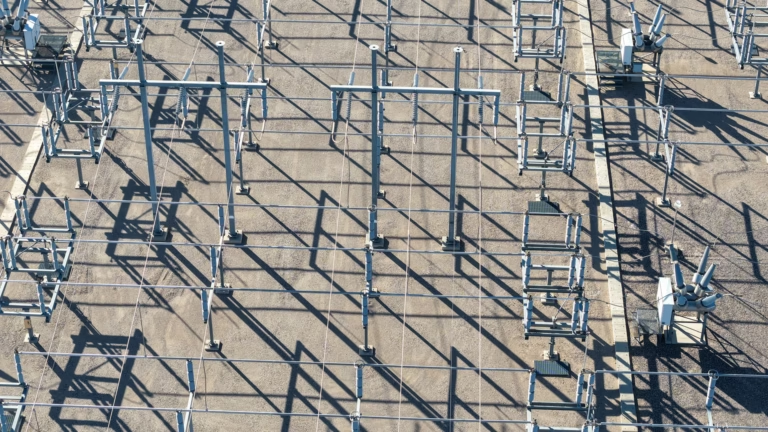
- Germany: the four transmission operators published technical connection requirements for data centres on 16 October 2026. They cover sites connected at 110 kV and above, and they cap power steps at 50 MW or 10% of agreed import power per 10 seconds, whichever is smaller.
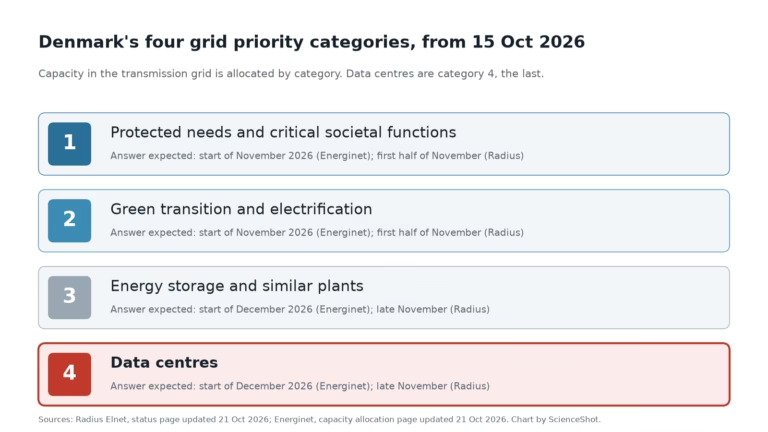
- Denmark: Order 892 is in force from 19 October 2026. Data centres sit in category 4, the last of four, and grid companies must refuse them where capacity is short and higher priorities would be displaced.
- Scotland: on 16 September 2026 the Parliament agreed a motion saying no planning or consenting decisions on hyperscale data centres should be made until national guidance is complete. It is a motion, not law.
Three official texts changed the terms for connecting a data centre to the grid in three European countries within five weeks. Germany’s four transmission system operators set technical rules for how a campus must behave on the high-voltage grid. Denmark’s climate and energy ministry put data centres at the back of the connection queue by executive order. Scotland’s Parliament asked that hyperscale planning decisions wait for national guidance. Each instrument has a different legal weight, and the difference matters for planning.
| Country | Instrument | Date | Legal weight | What it does to a data-centre project |
|---|---|---|---|---|
| Scotland | Parliament motion S7M-01177 | Agreed 16 September 2026 | A statement of the Parliament’s view. Not legislation. | No planning or consenting decisions on hyperscale data centres until national guidance is complete |
| Germany | Technical requirements of the four transmission operators | Published 16 October 2026 | Operator requirements at 110 kV and above, applied by the connecting grid operator. Not a statute. | Ride-through, fast recovery, limits on power steps and oscillations, simulation models |
| Denmark | Order 892 of 9 October 2026 | In force 19 October 2026 | Binding executive order under the Electricity Supply Act | Data centres placed last of four priority categories; refusal where capacity is short |
This article reads each text at the source and explains what it asks of a project. We track the legal instruments in our European data-centre regulation tracker and grid status per market in the grid connection tracker.
Germany: the grid operators now specify how a data centre behaves
On 16 October 2026 the four German transmission system operators, 50Hertz, Amprion, TenneT and TransnetBW, published a 13-page paper titled Technical requirements for the connection of data centers. The operators say the requirements must be put in place with high urgency. The paper supplements the existing German technical rules for customer connections at high voltage (VDE-AR-N 4120) and extra-high voltage (VDE-AR-N 4130). Those rules rest on the EU network code on demand connection, Regulation (EU) 2016/1388.
The paper is an operator document, not a law or a regulator’s decision. It says that applying it to a data-centre connection is up to the grid operator concerned. It covers connections to the 110 kV grid and to grids of 150 kV and more. That includes data centres inside mixed sites or closed distribution networks connected at those levels. Where the paper is applied below 110 kV, the grid operator sets equivalent voltage limits.
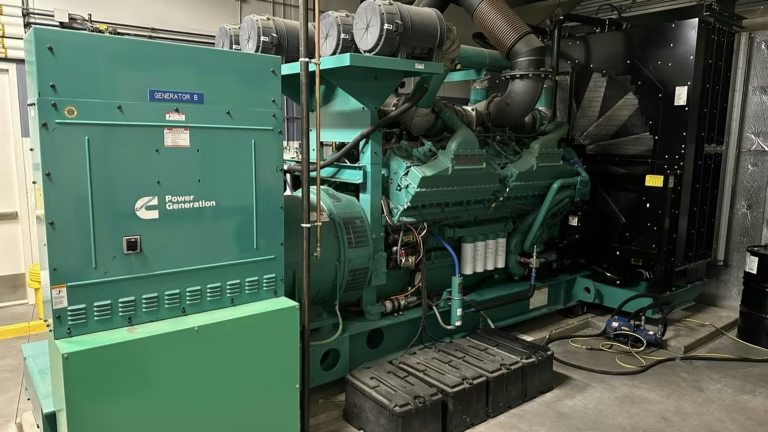
The requirements apply to the whole site at the connection point. That includes cooling, compressors, on-site generation and the uninterruptible power supply.
Why the operators wrote it
The paper gives the reason plainly. During a short circuit, data centres switch to island operation to keep their processes running. Without specific rules they return to the grid only after several minutes. Seen from the transmission grid, that is a sudden loss of load. The resulting imbalance threatens frequency stability and can push voltages too high. The paper adds that AI data centres in particular show periodic, pronounced power swings, which it calls load-induced forced oscillation.
The main requirements
- Frequency changes. The site must stay connected through a rate of change of frequency of 4.0 Hz/s measured over 0.25 s, 2.0 Hz/s over 0.5 s, 1.5 Hz/s over 1 s and 1.25 Hz/s over 2 s.
- Voltage dips and swells. The site must ride through faults inside the operators’ voltage curves. For three-phase faults it must survive at least three undervoltage events within 30 minutes.
- Recovery. Once voltage is back within 10% of the reference value, active power must climb to 90% of its pre-fault value within at most 1 second.
- Underfrequency. Data centres take part in the operator’s load-shedding scheme, inside the plant at unit level, not by tripping the whole connection. A site able to cut its draw as frequency falls must start doing so at a setting between 49.5 and 49.8 Hz, with 49.8 Hz as the default. It may disconnect below 47.5 Hz.
- Power steps. Instantaneous draw is capped at 1.1 times the agreed import power. No sudden change may exceed 50 MW per 10 seconds or 10% of agreed import power per 10 seconds, whichever is smaller. The cap also applies to planned changes of operating point.
- Oscillations. Forced power oscillations at the connection point must stay within 10 MW or 1% of agreed import power, whichever is smaller, between 0.1 and 2.0 Hz. Above 2.0 Hz the limit is 5 MW or 0.5%.
- Ramps and reactive power. Shutting down or starting up compute jobs must follow a ramp set by the grid operator. Reactive power must be controllable, including from standby, by remote command.
- Models and measurement. The operator may install its own meters in the data centre. The owner must supply validated simulation models (RMS, EMT and harmonic) that reproduce the site’s fast power changes.
What the numbers mean for a campus
The percentage limits bind first on most sites. The 50 MW step cap only takes over above 500 MW of agreed import power, and the 10 MW oscillation cap only above 1,000 MW. The table applies the paper’s rules to four connection sizes; the arithmetic is ours.
| Agreed import power | Largest step per 10 s | Oscillation limit, 0.1 to 2.0 Hz | Oscillation limit, above 2.0 Hz |
|---|---|---|---|
| 50 MW | 5 MW | 0.5 MW | 0.25 MW |
| 200 MW | 20 MW | 2 MW | 1 MW |
| 500 MW | 50 MW | 5 MW | 2.5 MW |
| 1,000 MW | 50 MW | 10 MW | 5 MW |
For a 200 MW AI campus, that means the load seen at the connection point may not swing by more than 2 MW in the 0.1 to 2.0 Hz band. The paper names AI data centres as the source of periodic swings, so for an AI campus the limit becomes a design task for the electrical plant and the control software. It has to be settled before the connection agreement, because the models must show it. The ride-through and 1-second recovery rules point the same way. The behaviour the paper describes, islanding on a fault and returning minutes later, would not meet them. Large German campuses in our pipeline include NTT’s Rhein-Selz-Park campus and CloudHQ’s Frankfurt-Höchst campus. The paper applies to them if they connect at 110 kV or above and their grid operator applies it.
Denmark: data centres go to the back of the queue
Denmark’s Order 892 on prioritising capacity and refusal at capacity limits in the public electricity grid was signed by the Ministry of Climate, Energy and Utilities on 9 October 2026. It was published on 15 October and enters into force on 19 October 2026. Unlike the German paper, it is binding law, made under the Electricity Supply Act.
The order sorts every connection request without a binding connection agreement into four categories, served in order.
- Category 1 covers protected needs and critical societal functions. It includes households, small businesses using up to 3 MW in total, functions such as health, defence and water, and ordinary growth in demand.
- Category 2 covers green transition and electrification. It holds every request that is not in categories 1, 3 or 4.
- Category 3 covers batteries and other energy storage built beyond the user’s normal needs, including electric boilers above that level.
- Category 4 covers data centres whose primary purpose is network-based data processing, data storage and related IT functions.
A data centre that meets the definition of a critical societal function moves to category 1. The order defines that test narrowly: lack of power must threaten life, health, safety or central societal interests, and the request must be necessary to keep the function running.
Refusal, pools and flexible terms
The order obliges grid companies to refuse a category 3 or 4 request when two conditions hold. The grid must have capacity constraints, and the request cannot be met without displacing capacity needed for higher-priority demand. The assessment is not limited to the local area. A request can stay in the queue instead when planned grid expansion, or a contract term not yet on offer, is expected to make room within a reasonable time.
Requests of 3 MW or more are handled in regional pools at least twice a year, run by Energinet, the state transmission operator, with the grid companies. Category 1 requests and those under 3 MW are handled continuously, but data-centre requests are excluded from that rolling track. After each pool Energinet must publish how many megawatts went to each category and how many are still waiting.
Within categories 2 to 4, grid companies weigh how grid-friendly a project is. Accepting limited or interruptible grid access, on terms approved by the Danish Utility Regulator, counts in a project’s favour. For a category 4 project, though, grid-friendly means it fits in available or planned capacity without displacing higher priorities. A data centre cannot buy its way up the order with flexibility alone.
Two details matter for existing sites. Restoring a closed connection point, raising a reduced capacity or bringing unused capacity into use is treated as a new request under the model. That covers only steps the grid company must help with and that a binding agreement does not already provide for, and the user keeps the capacity already allocated. A refused applicant can appeal to the Danish Utility Regulator within four weeks.
Danish projects in our pipeline that have not yet signed a connection agreement face this order. They include atNorth’s DEN02 at Ølgod, whose planning basis Varde City Council approved on 6 October 2026, and Prime Data Centers’ ESB01 in Esbjerg. The order applies only where no binding connection agreement exists; we do not know the contract status of either.
Get the next one by email
One new article a week on radiation, particles and the instruments that measure them, with its sources. No spam, unsubscribe any time.
Scotland: a motion asks for a pause on hyperscale decisions
On 16 September 2026 the Scottish Parliament agreed motion S7M-01177 on hyperscale data centres, as amended, by 80 votes to 26 with 15 abstentions. The agreed text calls on the Scottish Government to define what counts as a hyperscale data centre and to issue national planning guidance with environmental standards. It asks the government to report back by the end of 2026 and to publish the guidance in full within 12 months. It closes with the view that no planning or consenting decisions on such applications should be made until this has been completed.
A motion records the Parliament’s view. It does not change planning law, and it is not a moratorium in statute. Its practical weight is political. The motion welcomes the government’s commitment to produce the guidance by the end of the year, and it states that decisions should wait for it. The motion also says new sites should be approved only after robust environmental impact assessments. It asks proposals to show how they would minimise emissions, avoid impacts on water use and build community benefit into the business case.
No definition of hyperscale exists yet, so nobody can say which applications the motion covers. Several large Scottish proposals are in planning in our pipeline. They include the Cato data centre in Fife, the Ravenscraig Energy Campus data centre in North Lanarkshire and the Chapelcross campus in Dumfries and Galloway.
What a project team should do now
- In Germany, ask the grid operator early whether the October 2026 requirements will apply to your connection, and at what voltage. Budget for the simulation models and for power smoothing that holds steps and oscillations inside the limits. Check the UPS ride-through and recovery logic against the 1-second rule.
- In Denmark, assume category 4 unless the site serves a critical societal function, and expect pooled handling. Prepare evidence on grid-friendliness, including acceptance of limited access, and plan for a refusal where capacity is short. Watch Energinet’s pool results for megawatts waiting in category 4.
- In Scotland, plan for hyperscale consents to wait until the national guidance is published, possibly into 2027. Build the environmental impact assessment, water and community-benefit case now, since the motion names them.
- Everywhere, check the market’s grid status and allocation rule in the grid connection tracker and the legal instruments in the regulation tracker, with the date each was checked.
Limits
This article reads the three texts as published on the dates above; we checked them on 18 October 2026. The German paper is in German, and the requirements quoted here are our translation. How each German grid operator applies the paper, and when, is not yet known. The Danish order leaves room for methods the Danish Utility Regulator has still to approve. None of this replaces advice on a specific site or a formal enquiry to the grid operator.
Cite this: ScienceShot, Data-centre grid connection limits in Europe, October 2026, scienceshot.com, scienceshot.com/post/europe-data-centre-grid-connection-limits-october-2026.
Cite this article
Turner, A. (2026, November 2). Data-centre grid connection limits in Europe, October 2026. ScienceShot. https://scienceshot.com/post/europe-data-centre-grid-connection-limits-october-2026
Turner, Alex. “Data-centre grid connection limits in Europe, October 2026.” ScienceShot, 2 Nov. 2026, scienceshot.com/post/europe-data-centre-grid-connection-limits-october-2026.
Turner, Alex. “Data-centre grid connection limits in Europe, October 2026.” ScienceShot, November 2, 2026. https://scienceshot.com/post/europe-data-centre-grid-connection-limits-october-2026.
@online{scienceshot-europe-data-centre-grid-2026,
  author       = {Turner, Alex},
  title        = {{Data-centre grid connection limits in Europe, October 2026}},
  organization = {ScienceShot},
  date         = {2026-11-02},
  year         = {2026},
  url          = {https://scienceshot.com/post/europe-data-centre-grid-connection-limits-october-2026}
}
https://scienceshot.com/post/europe-data-centre-grid-connection-limits-october-2026
Get one article a week
One new article a week on radiation, particles and the instruments that measure them, with its sources. No spam, unsubscribe any time.