Key takeaways
- IceCube is 5,160 light sensors on 86 cables, buried 1,450 to 2,450 m deep in about one cubic kilometre of South Pole ice. It sees the blue light of the charged particle a neutrino makes when it hits an atom in the ice.
- Ice has a refractive index of about 1.31, so a fast muon there emits light at 40.2 degrees to its path. Our estimate is 34,000 photons per metre between 300 and 650 nm.
- By our estimate, a muon that passes 50 m from a sensor leaves about one detected photon in it. Tracks fix direction to 0.3 degrees at 100 TeV, and cascades fix energy to about 8% at 100 TeV.
- About 2,700 events a second, mostly cosmic-ray muons, bury roughly 100 astrophysical neutrinos a year. Selecting upward-going tracks and fencing off an outer veto layer cuts the noise.
- The Upgrade was deployed in February 2026. IceCube-Gen2 is proposed, and KM3NeT’s ARCA site in the Mediterranean had 62 of 230 planned units in the water on 23 September 2026.
IceCube sees a neutrino by watching for the faint blue flash of the particle it creates. The Royal Swedish Academy of Sciences announced on 6 October 2026 that the Nobel Prize in Physics 2026 goes to Francis Halzen for “decisive contributions to the IceCube Neutrino Observatory” and the discovery of high-energy neutrinos of astrophysical origin. Neutrinos are particles with almost no mass and no electric charge. Below a few tens of TeV they cross the whole Earth almost untouched. This page explains the instrument: how it is built, how ice turns a rare collision into light, and how the team picks a few cosmic neutrinos out of a flood of noise.
How the detector is built
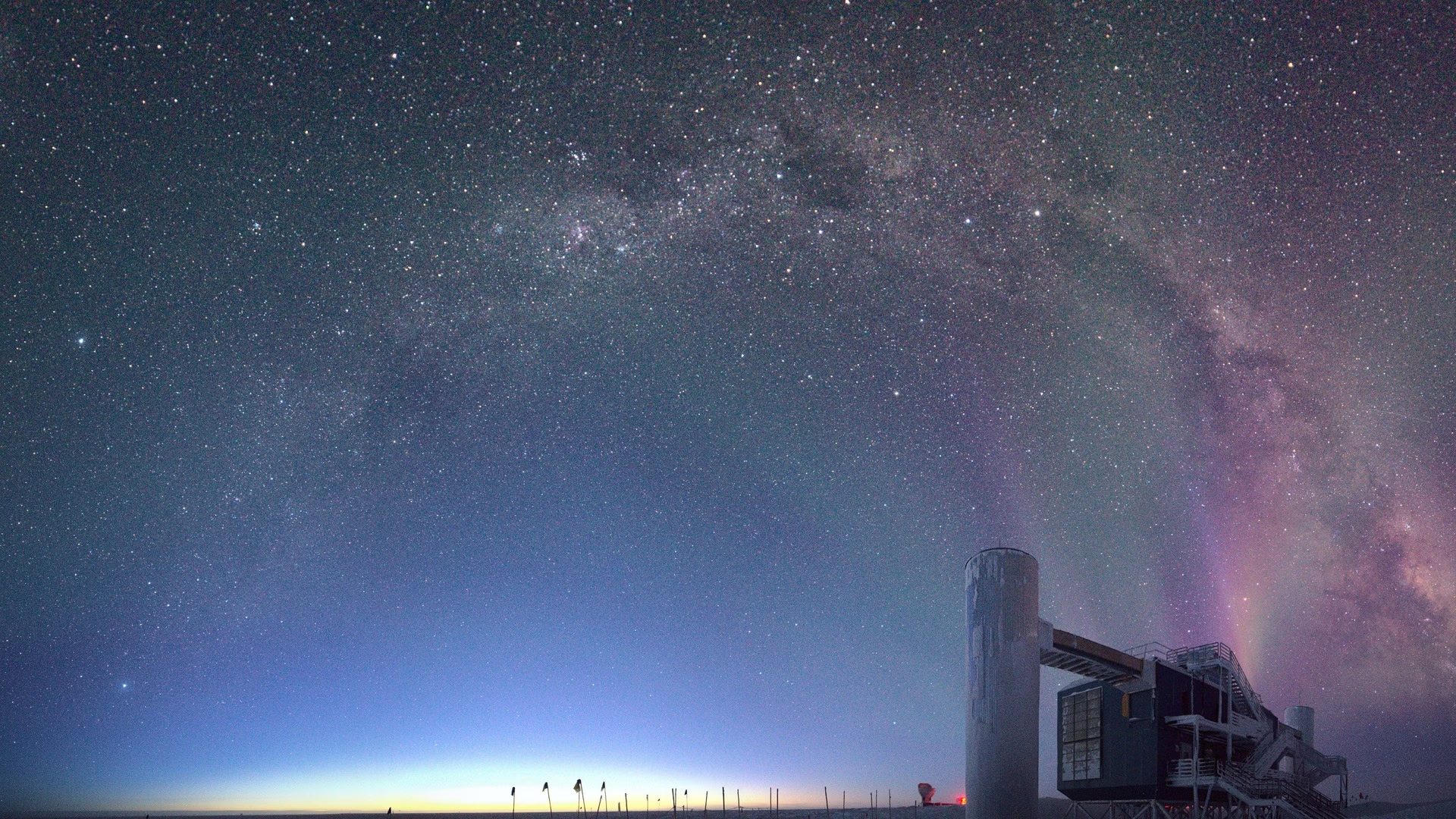
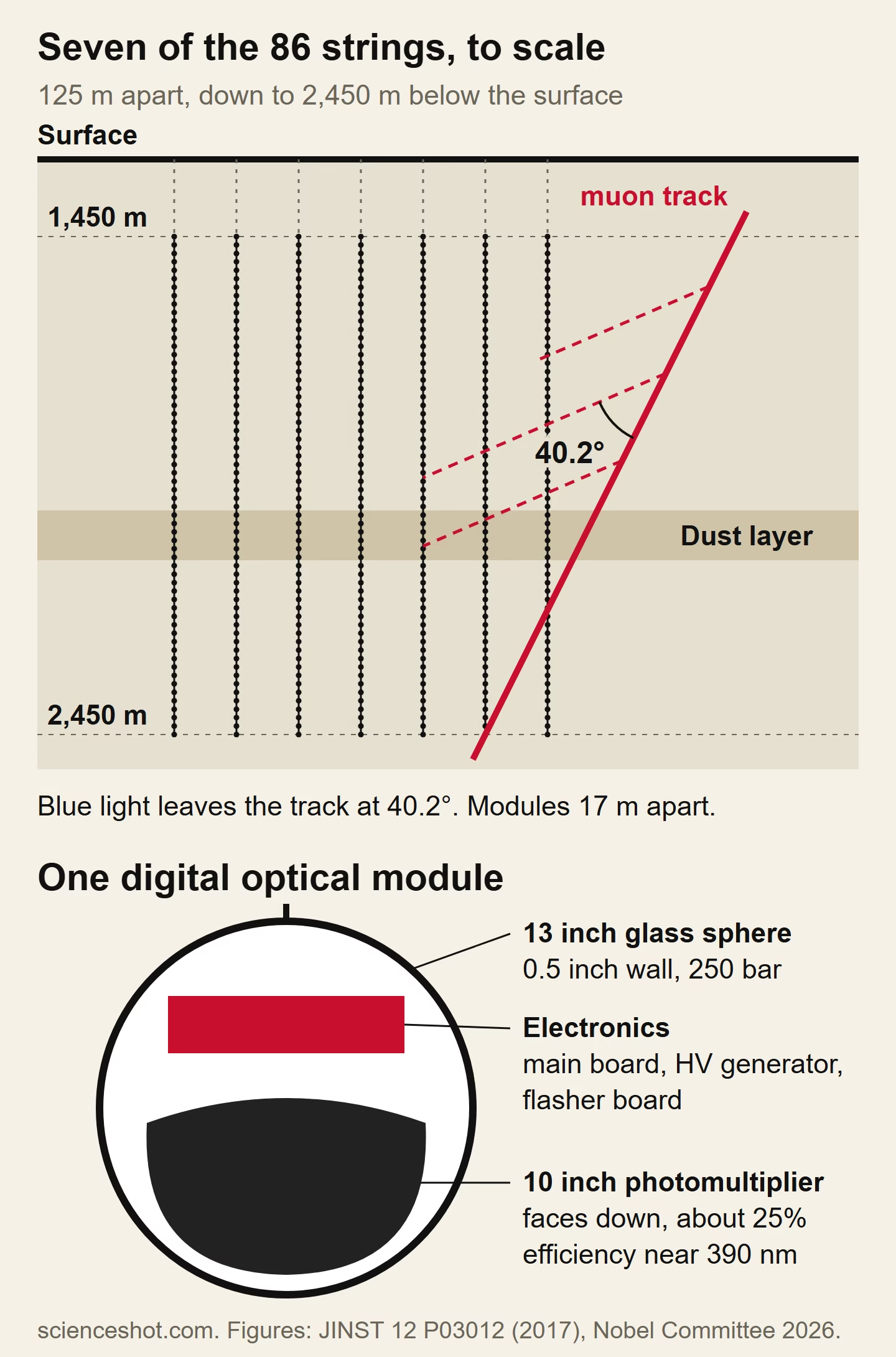
The in-ice array has 86 vertical strings. Each string is one cable with 60 digital optical modules, called DOMs, and so 5,160 in all. They sit between 1,450 and 2,450 m below the surface, as the IceCube instrumentation paper (JINST 2017) records. Seventy-eight standard strings hold the modules 17 m apart along the cable. The strings stand on a triangular grid with 125 m between neighbours. Together they instrument one cubic kilometre of ice, which the Nobel Committee puts at a mass of about 1 gigatonne.
A DOM is a glass sphere 13 inches across with a wall 0.5 inches thick. It is rated for 250 bar of pressure. Inside, a 10 inch photomultiplier tube looks straight down. A photomultiplier is a vacuum tube that turns a single photon into a measurable pulse of electrons. The tube peaks at about 25% quantum efficiency near 390 nm, which means one photon in four becomes a signal. The module also holds the high-voltage supply, the digitising electronics and flasher LEDs for calibration. Each DOM time-stamps its own hits and sends them up the cable.
The holes were melted, not bored. A 5 MW hot-water drill made each hole about 60 cm wide and 2,500 m deep, at best one hole every 48 hours. The water in the hole refroze around the cable, which locked every module in place and coupled it to the ice. The hole had to stay wider than the 35 cm module long enough to lower the string. Drilling took seven field seasons, about 21 months in total. The peak season was 2009 to 2010, with 20 holes. All 86 strings were in by 2010, and the detector was complete in 2011.
Two sub-arrays complete the observatory. DeepCore is eight specialised, closely spaced strings, with modules 7 m apart in the bottom 50 positions, together with the seven central standard strings. The denser layout and higher-efficiency tubes lower the energy threshold to about 10 GeV, against about 100 GeV for most IceCube analyses. IceTop is 162 ice-filled tanks in 81 stations on the surface, 2,835 m above sea level. It records air showers from cosmic rays between PeV and EeV energies, and it acts as a partial veto for downward-going events.
| Quantity | Value | Source |
|---|---|---|
| In-ice strings | 86 (78 standard plus 8 DeepCore) | JINST 2017 |
| Modules per string, total | 60 per string, 5,160 in all | JINST 2017 |
| Depth range | 1,450 to 2,450 m | JINST 2017 |
| Module spacing along a string | 17 m (7 m in the DeepCore bottom 50) | JINST 2017 |
| String spacing | 125 m grid (DeepCore 41 to 105 m, mean 72 m) | JINST 2017 |
| Instrumented volume, mass | about 1 km3, about 1 Gt | Nobel Committee 2026 |
| Photomultiplier tube | 10 inch Hamamatsu R7081-02, gain 107 | JINST 2017 |
| Energy threshold | about 100 GeV standard, about 10 GeV DeepCore | JINST 2017 |
| Clear-ice optics, below about 2,100 m | absorption length about 200 m, scattering about 50 m, n about 1.31 | Nobel Committee 2026 |
| Track direction error | 0.3 degrees at 100 TeV | Nobel Committee 2026 |
| Cascade direction and energy | about 5 degrees above 50 TeV; energy within about 8% at 100 TeV | Nobel Committee 2026 |
| Surface array | IceTop, 162 tanks in 81 stations | JINST 2017 |
| Modules working, uptime | 98.4% of deep-ice modules; about 99% uptime | JINST 2017 |
Why ice works as a detector
A neutrino almost never interacts. When it does, it strikes a quark inside an atomic nucleus. The collision makes a charged particle, such as a muon, plus a burst of debris called a cascade. In ice, light travels at c divided by the refractive index n, and n is about 1.31. A charged particle moving faster than that emits Cherenkov light, a cone of blue and ultraviolet photons, much as a boat leaves a wake. The speed threshold is 1/n, or 0.763 times the speed of light in vacuum. Light speed in a medium also drives the delays in our piece on why light is slower in optical fibre.
The Antarctic ice is clear enough to make this work. Below about 2,100 m the absorption length for Cherenkov light is about 200 m, and the scattering length is about 50 m. The absorption length is the distance after which 1/e of the photons are left. Light is lost slowly, so strings 125 m apart can still share an event. Bubbles near the surface spoil this. The AMANDA pilot detector found that air bubbles at 800 to 1,000 m scattered light within 50 cm, so the team moved deeper. A band near 2,000 to 2,100 m, called the dust layer, absorbs and scatters more. DeepCore leaves it uninstrumented.
Ice also keeps the background low. At this depth there is no sunlight, and nothing living interferes. Seawater detectors face bioluminescence and potassium-40 decays. Each IceCube module still records dark noise, 230 to 250 Hz from random pulses plus 280 to 340 Hz in correlated bursts, and a low-temperature comparison suggests most of it comes from the glass sphere.
Worked example: how much light does one muon leave?
We can estimate what a module sees from first principles. The inputs are n = 1.31 for the ice and a speed of one for the muon, in units of c. Photons are counted between 300 and 650 nm, the tube’s specified range. The fine-structure constant is alpha = 1/137.036. Absorption length is 200 m. The tube is 25.4 cm across, an area of 0.0507 m2, with a quantum efficiency of 25%.
Step 1, the angle. The Cherenkov angle obeys cos(theta) = 1/(n beta). With beta = 1, cos(theta) = 0.763, so theta = 40.2 degrees. Below beta = 0.763 the light stops. For a muon that is a total energy of 164 MeV, or 58 MeV of motion energy. The Nobel text gives 160 MeV for water, where n is 1.33, so the ice value is slightly higher, as expected.
Step 2, photons per metre. The Frank-Tamm formula gives dN/dx = 2 pi alpha sin2(theta) (1/lambda1 – 1/lambda2). Here sin2(theta) = 1 – 1/n2 = 0.417, and 1/300 nm – 1/650 nm = 1.795 million per metre. The product is 34,300 photons per metre of track.
Step 3, one module. The photons spread around the track. At a distance r they arrive at 34,300 / (2 pi r) per square metre. At r = 50 m that is 109 photons per square metre. On the tube’s 0.0507 m2 that is 5.5 photons. Light leaves the track at 40.2 degrees, so a photon reaching a module 50 m away has travelled 50 / sin(40.2 degrees) = 77 m. Absorption keeps exp(-77/200) = 0.68 of them, which leaves 3.8. A quantum efficiency of 25% leaves about 0.9 detected photons.
| Distance from the track | Photons on the tube | After absorption | Detected at 25% |
|---|---|---|---|
| 20 m | 13.8 | 11.9 | 3.0 |
| 50 m | 5.5 | 3.8 | 0.94 |
| 100 m | 2.8 | 1.3 | 0.32 |
One detected photon per module at 50 m is why IceCube needs many sensors and sensitive tubes. A cascade is far brighter. The instrumentation paper gives about 105 visible photons per GeV of shower energy. A 1.14 PeV cascade, like the one in the 2013 data, then makes about 1011 photons. For the part of the muon’s energy loss that is not light, see our Bethe-Bloch explainer and the energy-loss calculator.
Get the next one by email
One new article a week on radiation, particles and the instruments that measure them, with its sources. No spam, unsubscribe any time.
Tracks and cascades
Most events take one of two shapes. A track is a long line of light from a muon. A muon neutrino that interacts makes a muon, and a TeV muon travels about 1 km in ice. IceCube therefore also sees muon neutrinos that interact outside the array. The effective volume is larger than the instrumented ice. The arrival times of the photons give the direction to 0.3 degrees at 100 TeV. The energy is only known to about a factor of 2, because a muon loses energy in random lumps.
A cascade is a ball of light from a shower shorter than about 10 m, smaller than the string spacing. Electron and tau neutrinos make cascades. So do neutral-current interactions of every flavour. The light is contained, so the energy is measured well, to about 8% at 100 TeV. The direction is worse, about 5 degrees above 50 TeV. Tracks are best for finding where a source is. Cascades are best for measuring what energy it emits. Tau neutrinos can show two separate cascades, a “double bang”, with a tau decay length of about 50 m per PeV of energy.
The background problem and how it is cut
The trigger rate is 2.7 kHz, which is about 230 million events a day. Almost all are muons made by cosmic rays in the air above the pole. IceCube also sees about 100,000 atmospheric neutrinos a year above 0.1 TeV, or about 270 a day. The Nobel Committee expects roughly 100 neutrinos a year to be astrophysical. That is about one in a thousand of the atmospheric neutrinos, and about one in 850 million of the triggers. Those ratios are our arithmetic from the published rates.
Two cuts do most of the work. The first is the Earth. The Earth stops muons made in the sky, so a track that rises from below the horizon is a neutrino candidate. In a typical analysis the 3 kHz muon background drops to the hertz level. The price is sky coverage, because the track sample mostly covers the Northern sky. The second cut is the veto. The outer layer of strings acts as a shield, and a “starting event” must first show light inside a quiet inner volume of about 500 megatons. That removes muons that come in from outside, in any direction. DeepCore has its own veto cap for low-energy events, and IceTop gives a partial veto for down-going events.
Atmospheric neutrinos pass both cuts, so the last step is statistics. The astrophysical flux falls as energy to the power -2.5. The atmospheric flux falls as -3.7. Above a few tens of TeV the cosmic neutrinos emerge. A single event cannot always be traced to a source, but a whole sample can be tested against the atmospheric prediction.
What IceCube found
The table gives the main results with the significance each paper reported. Significance is quoted in sigma, and 5 sigma is the usual threshold for a discovery.
| Year | Result | Significance |
|---|---|---|
| 2013 | Two events of 1.04 and 1.14 PeV, then 28 events from 30 TeV to 1.14 PeV (21 cascades, 7 tracks); Science, Aartsen et al. | 4 sigma against atmospheric only; 5.7 sigma with three years (2014) |
| 2017 to 2018 | A 290 TeV muon neutrino, IceCube-170922A, within 0.06 degrees of the flaring blazar TXS 0506+056; an archived neutrino flare in 2014 to 2015 | Coincidence with a gamma-ray flare; flare 3.5 sigma |
| 2022 | An excess of 79 (+22/-20) neutrinos, 1 to 10 TeV, from the direction of the active galaxy NGC 1068, 46 million light-years away | 4.2 sigma |
| 2023 | Neutrinos from the plane of the Milky Way; updated in 2026 with 12 years of data | 4.5 sigma in 2023; 5.7 sigma in 2026 |
| 2024 | Seven tau neutrinos from 20 TeV to 1 PeV | No-astrophysical-tau ruled out at 5 sigma |
| March 2026 | Highest-energy IceCube neutrino published, 11.4 PeV, recorded 31 March 2019 | Single event |
The 2013 pair were found by accident, while the team looked for far higher energies. The TXS 0506+056 alert went out within a minute of the detection on 22 September 2017, and telescopes across the spectrum followed up. The gamma-ray flux of the blazar had risen by a factor of 7 in the preceding months. For NGC 1068, the Nobel text says the evidence is not yet robust enough to name it as a source for certain. The 2026 update made the Milky Way the first source of high-energy neutrinos above the 5 sigma threshold. No single point source has been resolved there. The Committee reports that the sources of the diffuse flux are predominantly extragalactic.
If you want the opposite end of the neutrino energy scale, our report on JUNO’s first data covers a very different neutrino detector.
What comes next, as of 9 November 2026
IceCube Upgrade. The IceCube collaboration announced on 12 February 2026 that the Upgrade was deployed. It adds five new, more closely spaced strings at the bottom centre of the array, with more than 600 new and enhanced sensors and calibration devices. Two new module types, the mDOM and the D-Egg, have two to three times the sensitivity of the current modules. A 5 MW hot-water drill made each hole in about three days. A status report in September 2026 said the five strings were still being commissioned and expected science data in fall 2026. The aim is to measure neutrino oscillations better, to map the ice more exactly, and to reanalyse 15 years of archived data.
IceCube-Gen2. Gen2 is still a proposal. The collaboration describes it as 8 km3 of ice with about 18,000 optical and radio sensors. The IceCube press release says that it would have eight times the instrumented volume “if realized”. The collaboration still calls it proposed. The Nobel Committee lists it with KM3NeT, P-ONE off Vancouver Island, TRIDENT in the South China Sea and Baikal-GVD in Siberia as the next generation.
KM3NeT. The Mediterranean telescope uses seawater in place of ice. Its ARCA site off Sicily is planned for 230 detection units, each about 700 m tall, and its ORCA site off Toulon for 115. On 23 September 2026 the collaboration reported ARCA at 62 units. On 9 October 2026 it reported ORCA at 44. In 2023, ARCA caught KM3-230213A, an event the collaboration estimates at about 220 PeV, with only 21 lines and 378 modules installed.
Cite this: ScienceShot, How IceCube works: the ice detector behind the 2026 physics Nobel, November 2026, scienceshot.com, scienceshot.com/post/how-icecube-works-neutrino-detector-nobel-prize-2026.
Source: Nobel Prize in Physics 2026 press release, Scientific Background and popular information; The IceCube Neutrino Observatory: instrumentation and online systems, JINST 12 P03012; Science 2013, Science 2018, Science 2022, Science 2023; IceCube Upgrade press release and Upgrade status report, IceCube-Gen2; KM3NeT detector, ARCA62, ORCA44 and KM3-230213A. Accessed 8 and 9 Nov 2026.
Cite this article
Turner, A. (2026, November 12). How IceCube works: the ice detector behind the 2026 physics Nobel. ScienceShot. https://scienceshot.com/post/how-icecube-works-neutrino-detector-nobel-prize-2026
Turner, Alex. “How IceCube works: the ice detector behind the 2026 physics Nobel.” ScienceShot, 12 Nov. 2026, scienceshot.com/post/how-icecube-works-neutrino-detector-nobel-prize-2026.
Turner, Alex. “How IceCube works: the ice detector behind the 2026 physics Nobel.” ScienceShot, November 12, 2026. https://scienceshot.com/post/how-icecube-works-neutrino-detector-nobel-prize-2026.
@online{scienceshot-how-icecube-works-neutrino-2026,
  author       = {Turner, Alex},
  title        = {{How IceCube works: the ice detector behind the 2026 physics Nobel}},
  organization = {ScienceShot},
  date         = {2026-11-12},
  year         = {2026},
  url          = {https://scienceshot.com/post/how-icecube-works-neutrino-detector-nobel-prize-2026}
}
https://scienceshot.com/post/how-icecube-works-neutrino-detector-nobel-prize-2026
Get one article a week
One new article a week on radiation, particles and the instruments that measure them, with its sources. No spam, unsubscribe any time.