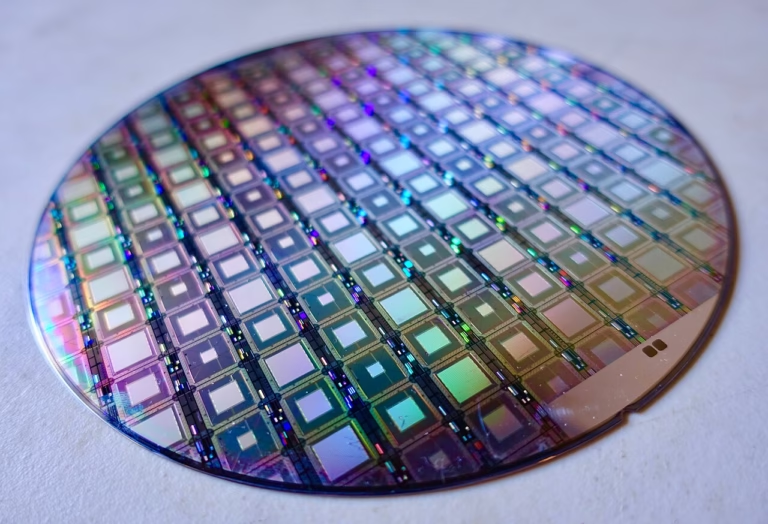
Think of everything inside a room, down to a Rubik’s Cube on the table. The holographic principle says that, in a theory that includes gravity, all the information needed to describe what happens inside a region of space can be written on the region’s boundary, a surface with one dimension fewer. The name comes from optical holograms, where a flat film records a three-dimensional image.
Put simply, the idea is that the maximum amount of information a region can hold grows with the area of its boundary, not with its volume, as it would for any ordinary system.
How does that connect to anything real?
A printed photograph is a useful starting point, with a caveat. A photo stores a flat projection of a scene, and some information about depth is lost. A hologram is different: the flat plate stores enough about the light field that the full three-dimensional image can be rebuilt from it.
The holographic principle borrows that second picture. The proposal is that a description on a boundary surface can carry all the information about the volume it encloses, so nothing is lost by working on the surface instead of in the bulk.
Why would physicists take this seriously?
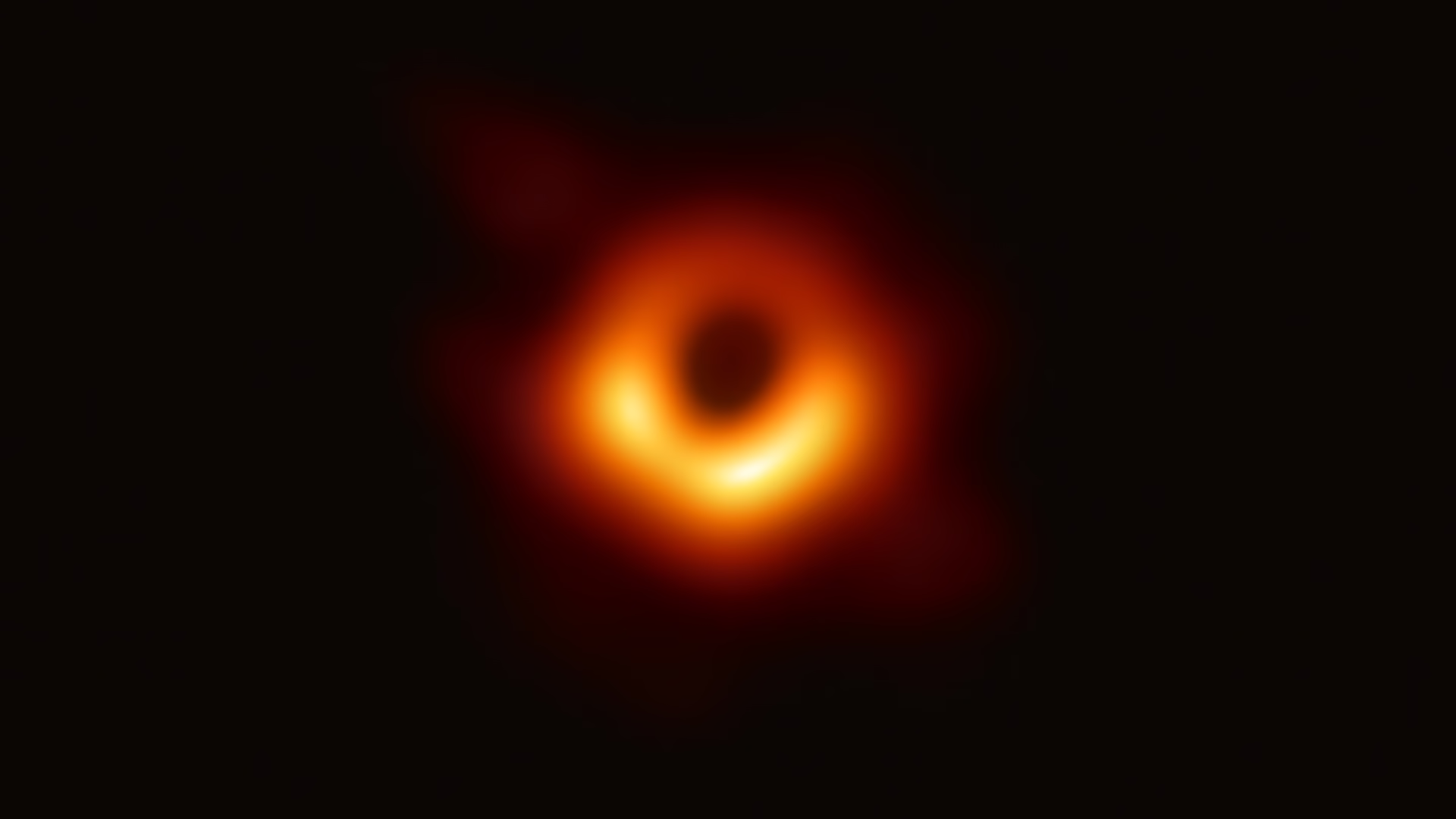
Because it came out of a concrete problem. The principle grew from the physics of black holes, objects whose gravity is strong enough that not even light escapes from inside the event horizon, and from the question of how much information they can contain.
Origins and Legacy of the Holographic Idea
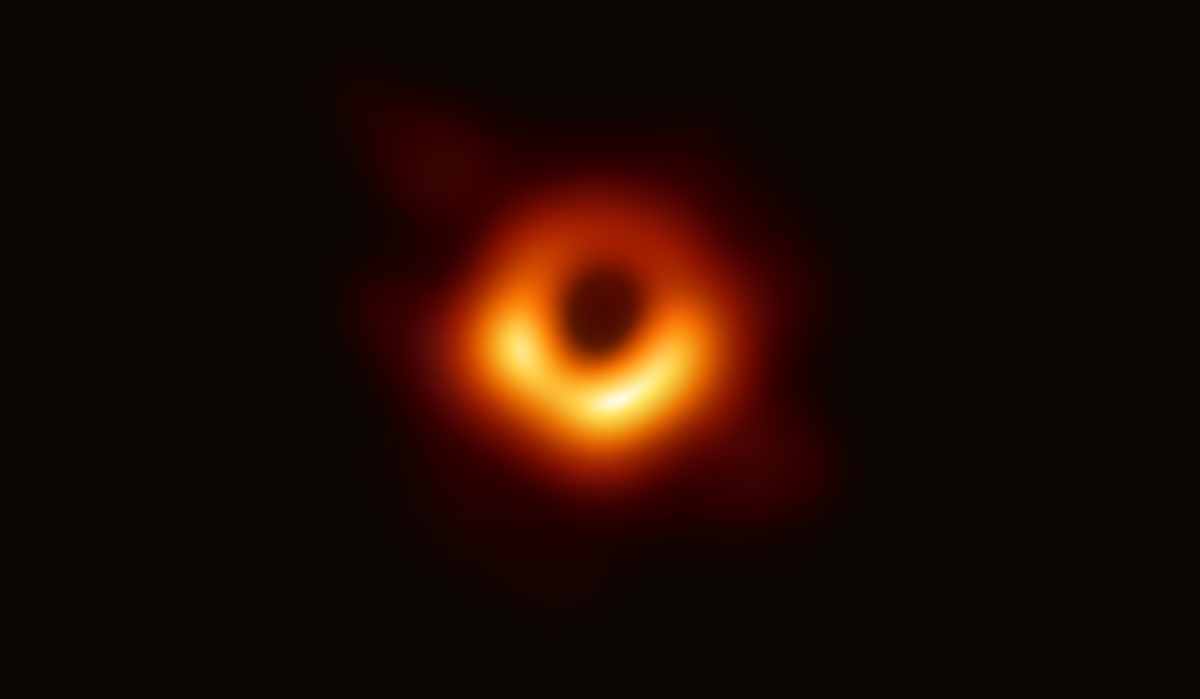
The story starts in the early 1970s. Jacob Bekenstein argued in a 1973 paper that a black hole has an entropy proportional to the area of its event horizon, not to its volume. Stephen Hawking then showed in 1974 and in a 1975 paper that quantum effects make black holes emit radiation, now called Hawking radiation, and so lose mass over time. That raised the information loss problem. Quantum mechanics says information about a system’s initial state is never destroyed, yet in Hawking’s calculation the radiation looks thermal and carries no record of what fell in. If the black hole evaporates completely, the information seems to vanish with it.
In the 1990s Gerard ‘t Hooft and Leonard Susskind turned the area law into a general principle. ‘t Hooft proposed in 1993 that the degrees of freedom of a region with gravity can be counted on a two-dimensional surface, and Susskind developed the idea and its link to string theory in “The World as a Hologram” (J. Math. Phys., 1995). Their proposal does not by itself explain how information escapes a black hole. It says that a complete description should live on the boundary, which is why physicists expect the information to be preserved in the outgoing radiation. How exactly that happens is still an open research question.
Unifying Gravity and Quantum Mechanics
If a theory with gravity in a volume can be fully described by a theory on its boundary, the boundary theory offers a way to study quantum gravity using ordinary quantum physics. That is the main reason the principle matters for attempts to bring gravity and quantum mechanics together.
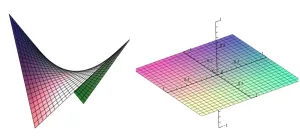
The best worked-out example is the AdS/CFT correspondence, proposed by Juan Maldacena in 1997. It relates a theory with gravity in anti-de Sitter (AdS) space, a spacetime with negative curvature, to a conformal field theory (CFT) without gravity living on its boundary, in one dimension fewer. In Maldacena’s original example, type IIB string theory on five-dimensional AdS space (times a five-dimensional sphere) is equivalent to a four-dimensional quantum field theory called N=4 super Yang-Mills. Calculations that are hard on one side can sometimes be done on the other.
One result is a direct link between geometry and quantum entanglement. Shinsei Ryu and Tadashi Takayanagi proposed in 2006 that the entanglement entropy of a region of the boundary theory equals the area of a minimal surface in the AdS bulk, in a formula with the same form as the Bekenstein-Hawking entropy of a black hole.
That result led to the proposal that spacetime itself may emerge from entanglement. Mark Van Raamsdonk argued in 2010 that, in this framework, reducing the entanglement between two parts of the boundary theory pulls the corresponding regions of space apart. This is an active research direction, not an established result. It is also worth noting that our own universe is not anti-de Sitter: measurements such as Planck 2018 point to a small positive cosmological constant, so AdS/CFT does not apply to it directly.
Get the next one by email
One new article a week on radiation, particles and the instruments that measure them, with its sources. No spam, unsubscribe any time.
Testing the Holographic Principle
Testing the holographic principle in a laboratory is hard. Its effects are expected at the Planck scale, around 10-35 metres, far below anything current experiments probe directly, and the principle does not on its own make a single sharp prediction that an instrument could look for.
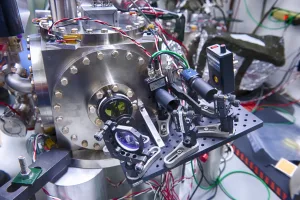
One experiment tried anyway. The Holometer at Fermi National Accelerator Laboratory (Fermilab) looked for a specific kind of jitter in spacetime that a model proposed by Fermilab physicist Craig Hogan predicted would follow from a limited holographic information content.
The Holometer used two co-located laser interferometers with arms of about 39 metres and looked for correlated noise between them. Its first results were published in Physical Review Letters in 2016.
It found no such noise. In December 2015 Fermilab reported that a year of data had ruled out Hogan’s model at a high level of statistical significance. That result rules out one model, not the holographic principle in general; as Hogan himself noted, it was only one theory.
For now there is no agreed experimental test that could confirm or refute the principle. The support for it is theoretical: the area law for black hole entropy and the internal consistency of AdS/CFT, which has passed many mathematical checks.
Conclusion: Holographic Principle
The holographic principle started as a way to make sense of black hole entropy and the information problem. It has since become a working tool, mainly through AdS/CFT, for studying quantum gravity, strongly interacting quantum systems and the link between entanglement and geometry.
Whether our own universe is holographic in this sense is unknown. There is no experimental evidence either way, and the best-understood version of the idea applies to a kind of spacetime our universe does not appear to be.
Cite this article
Turner, A. (2023, August 15). The Astonishing Holographic Principle: Is Reality a 2D Projection? ScienceShot. https://scienceshot.com/post/is-our-universe-a-hologram-exploring-the-implications-of-the-holographic-principle
Turner, Alex. “The Astonishing Holographic Principle: Is Reality a 2D Projection?” ScienceShot, 15 Aug. 2023, scienceshot.com/post/is-our-universe-a-hologram-exploring-the-implications-of-the-holographic-principle.
Turner, Alex. “The Astonishing Holographic Principle: Is Reality a 2D Projection?” ScienceShot, August 15, 2023. https://scienceshot.com/post/is-our-universe-a-hologram-exploring-the-implications-of-the-holographic-principle.
@online{scienceshot-is-our-universe-a-2023,
  author       = {Turner, Alex},
  title        = {{The Astonishing Holographic Principle: Is Reality a 2D Projection?}},
  organization = {ScienceShot},
  date         = {2023-08-15},
  year         = {2023},
  url          = {https://scienceshot.com/post/is-our-universe-a-hologram-exploring-the-implications-of-the-holographic-principle}
}
https://scienceshot.com/post/is-our-universe-a-hologram-exploring-the-implications-of-the-holographic-principle
Get one article a week
One new article a week on radiation, particles and the instruments that measure them, with its sources. No spam, unsubscribe any time.