


Are Photons Matter? The Short Answer With an Error Bar
No — photons are not matter, and the experiment behind that answer is more interesting than the definition. A photon carries no rest mass, and matter is conventionally defined as anything built from particles that do. What a search snippet won’t tell you is that “massless” was never an assumption — it is a measured experimental bound, and the number attached to it has moved by four orders of magnitude depending on how you measure it.
The tightest constraint comes from astrophysics: testing whether Coulomb’s law and the Ampère–Maxwell law still hold at solar-system scale sets the photon rest mass below 1 x 10^-18 eV, per the Particle Data Group’s 2023 Gauge and Higgs Bosons summary table — an indirect bound. The direct, in-situ measurement is far less precise: NASA’s four-spacecraft MMS mission tested the Ampère–Maxwell law locally, in interplanetary space, bounding the mass to 1.9 x 10^-15 eV to 7.9 x 10^-14 eV depending which magnetic field model is assumed — roughly four orders of magnitude weaker. “Massless” is a claim about the best evidence available, not a fact with no error bar.
Put either bound next to the electron and the scale gets almost comic: the electron’s rest mass is 0.511 MeV/c^2 (5.11 x 10^5 eV), and even the loosest photon bound sits at least 23 orders of magnitude below that. So no, photons are not matter — but “not matter” is doing quiet work once you go looking for the experiment behind it. Photons are the quanta of the electromagnetic field, packets of energy running from radio waves to gamma rays, differing only in frequency — a picture two centuries of argument produced, before the mass question becomes a mechanism question: how photons interact with matter.
Reference tool
Photon attenuation calculator: half-value layer and transmission
How much of a material stops how much of a gamma or X-ray beam. Mass attenuation coefficient by process, half- and tenth-value layers, mean free path and narrow-beam transmission, from NIST XCOM.
The calculator needs JavaScript. The reference values below are computed by the same code.
Method, constants and limits
Method. Narrow-beam attenuation I/I₀ = e−μx with μ = (μ/ρ)·ρ; half-value layer ln 2/μ, tenth-value layer ln 10/μ, mean free path 1/μ. The coefficient per process (photoelectric, Compton, Rayleigh, pair production in the nuclear and electron fields) is interpolated log-log from NIST XCOM sampled at 40 points per decade between 1 keV and 100 MeV, summed over the material’s composition.
Constants. Cross sections: NIST XCOM (SRD 8). Compositions and densities: NIST ESTAR (SRD 124). Atomic weights: IUPAC via periodictable. The engine reproduces XCOM at eleven calibration-line energies in every material to within 0.5%.
Limits. Narrow-beam geometry: no build-up from scattered photons, which makes the transmitted dose behind a thick shield larger than this number. Within one grid interval (2.9% in energy) of an absorption edge the coefficient is interpolated across the jump, and the result says so.
Reference values: half-value layer (mm) at common gamma lines
Thickness that halves a narrow beam. Computed by the calculator above from NIST XCOM.
| Material | Am-241 59.5 keV | Co-57 122 keV | annihilation 511 keV | Cs-137 662 keV | Co-60 mean 1.25 MeV | N-16 6.13 MeV |
|---|---|---|---|---|---|---|
| Lead | 0.119 | 0.182 | 3.91 | 5.54 | 10.4 | 13.9 |
| Tungsten | 0.0948 | 0.135 | 2.68 | 3.67 | 6.44 | 8.5 |
| Iron | 0.716 | 3.36 | 10.6 | 12 | 16.5 | 28.9 |
| Copper | 0.476 | 2.5 | 9.35 | 10.7 | 14.7 | 24.9 |
| Aluminium | 9.15 | 16.9 | 30.7 | 34.4 | 46.7 | 97.4 |
| Concrete (Portland) | 10.7 | 19.2 | 34.5 | 38.7 | 52.6 | 113 |
| Water | 33.5 | 43.2 | 72.2 | 80.8 | 110 | 253 |
| Silicon | 9.17 | 18.4 | 34.3 | 38.5 | 52.3 | 107 |
Data: NIST XCOM (SRD 8) cross sections; densities and compositions from NIST ESTAR (SRD 124). Narrow-beam geometry, no build-up.
Lead across the spectrum
Mass attenuation coefficient, half-value layer and the share of each process, 10 keV – 100 MeV. The photoelectric share collapses above the K edge at 88 keV; pair production takes over above a few MeV.
| Energy (keV) | μ/ρ (cm²/g) | HVL (mm) | Photoelectric (%) | Compton (%) | Pair (%) |
|---|---|---|---|---|---|
| 10 | 130.6 | 0.00467 | 96.2 | 0.0348 | 0 |
| 20 | 86.37 | 0.00707 | 97.2 | 0.0799 | 0 |
| 50 | 8.042 | 0.0759 | 90.7 | 1.18 | 0 |
| 80 | 2.419 | 0.252 | 83.2 | 4.1 | 0 |
| 100 | 5.549 | 0.11 | 94.4 | 1.78 | 0 |
| 200 | 0.9986 | 0.612 | 84.8 | 8.98 | 0 |
| 500 | 0.1613 | 3.78 | 51.2 | 41.7 | 0 |
| 1000 | 0.07102 | 8.6 | 25.5 | 70.3 | 0 |
| 2000 | 0.04606 | 13.3 | 10.9 | 75.6 | 11.8 |
| 5000 | 0.04272 | 14.3 | 2.96 | 46.3 | 50.5 |
| 10000 | 0.04972 | 12.3 | 1.05 | 24.5 | 74.4 |
| 20000 | 0.06206 | 9.84 | 0.376 | 11.7 | 87.9 |
| 50000 | 0.08056 | 7.58 | 0.108 | 4.34 | 95.5 |
| 1.000e+5 | 0.0931 | 6.56 | 0.0456 | 2.12 | 97.8 |
Data: NIST XCOM (SRD 8). ρ(Pb) = 11.35 g/cm³ (NIST ESTAR).
A Very Short History of the Wave-Particle Question
Christiaan Huygens proposed in 1690 that light was a wave; Isaac Newton countered in 1704 that it was a stream of corpuscles, and his authority kept that view dominant for a century. Thomas Young’s 1801 double-slit experiment produced interference fringes only a wave could explain, and Léon Foucault’s 1850 measurement showing light travels slower in water than in air killed the corpuscular model outright. Maxwell’s electromagnetic theory, worked out through the 1860s, explained light as a self-propagating oscillation of electric and magnetic fields.
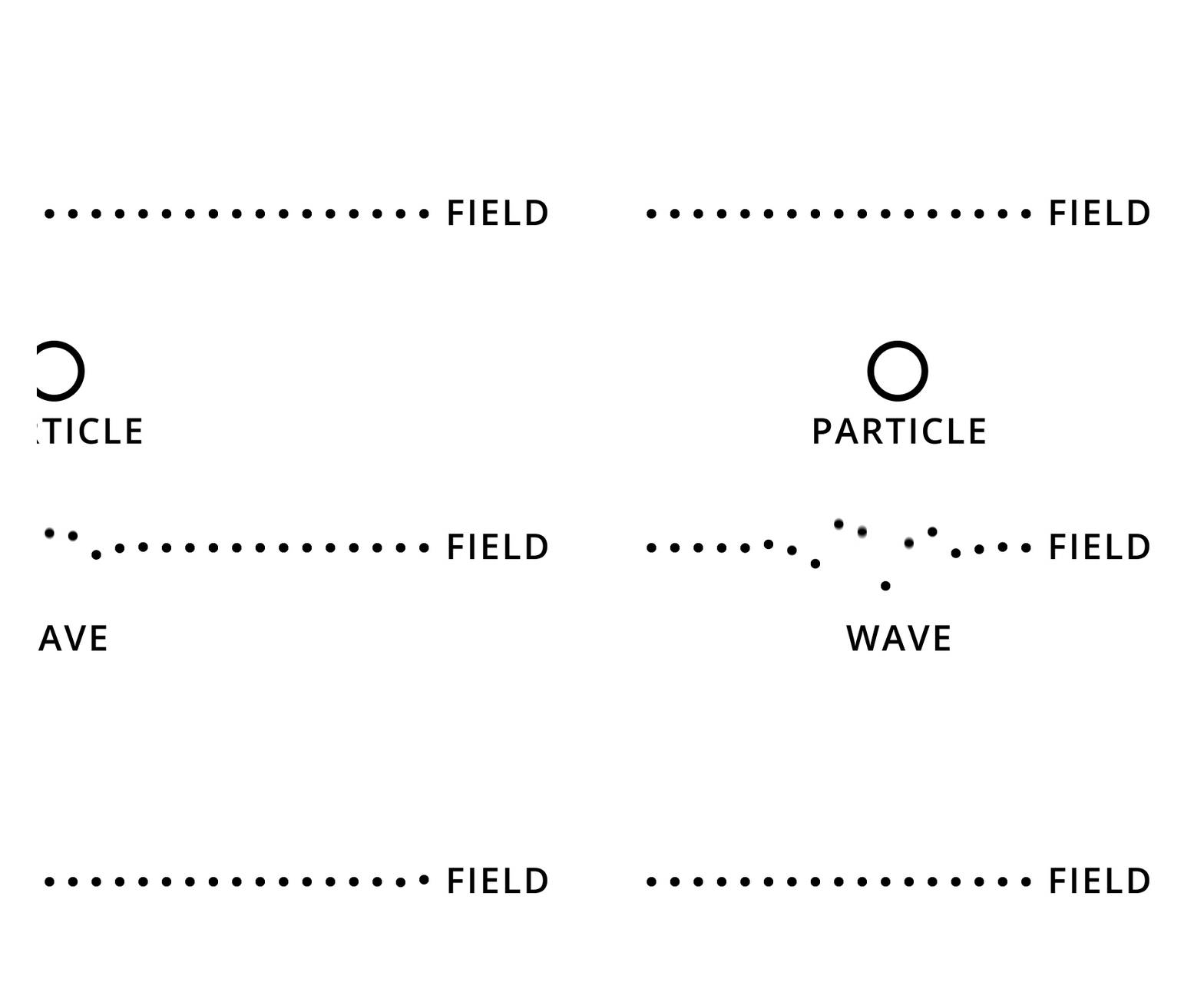
Maxwell’s waves couldn’t explain everything. Planck’s 1900 solution to the blackbody radiation problem required energy to be emitted in discrete quanta, and Einstein’s 1905 explanation of the photoelectric effect went further: light itself arrives in discrete packets, each carrying energy proportional to frequency. It took until 1926 for chemist Gilbert Lewis to coin the word “photon” — the two pictures were never really in conflict, since quantum field theory treats the photon as an excitation of a field, with wave-like propagation and particle-like exchange.
Are Photons Matter, or Just Force Carriers?
A photon is a boson — specifically the gauge boson of the electromagnetic interaction, carrying the electromagnetic force between every pair of charged particles in the universe. When two electrons repel each other, quantum field theory describes that repulsion as an exchange of virtual photons passing between them.

Being a boson rather than a fermion matters for the are photons matter question concretely. Fermions — electrons, quarks, the particles matter is built from — obey the Pauli exclusion principle: no two identical fermions can share a quantum state, which is why atoms stack into shells instead of collapsing. Photons obey no such rule: any number can occupy the same state (that’s literally what a laser is), and photon number isn’t conserved the way electron number is — a hot filament creates photons from thermal energy alone.
None of that makes photons inert. A photon carries momentum, p = E/c, even with zero rest mass — why light bends around the Sun, why a solar sail accelerates under sunlight. “Carries momentum but isn’t matter” is a contradiction only if you’ve conflated matter with stuff that affects other stuff. Photons affect other stuff constantly; they just don’t have mass while doing it.
Photons Across the Spectrum, From Radio Waves to the Higgs Boson
The same particle, differing only in energy, does very different jobs across seventeen-plus orders of magnitude of frequency. Radio-frequency photons carry data through fiber and free-space links; ultraviolet, X-ray and gamma-ray photons from supernovae, active galactic nuclei and neutron-star mergers carry information about stellar lifecycles and galactic evolution no other messenger can deliver. The cosmic microwave background is itself a photon relic: roughly 380,000 years after the Big Bang, the universe cooled enough for electrons and protons to form neutral hydrogen, and photons that had been scattering endlessly off free electrons suddenly traveled unimpeded — that redshifted light is what microwave telescopes map today. At the high-energy extreme, the 2012 discovery of the Higgs boson at CERN relied heavily on its two-photon decay channel: a sharp bump in the two-photon spectrum near 125 GeV was one of the clearest fingerprints in the dataset.
Get the next one by email
Physics, engineering and the people behind them. No spam, unsubscribe any time.
How Photons Interact with Matter
This is where the mass question turns practical, and where charged particles and photons part company completely. A charged particle — an electron, a proton, an alpha particle — loses energy continuously through many small collisions with atomic electrons along its track. A photon can’t: it has no charge to couple continuously to every atom it passes, so it interacts all at once, in one of a small number of discrete processes, and is either removed from the beam entirely or not touched.
That structural difference matters, because the earlier version of this article rushed past it: a beam of photons is attenuated in intensity, not degraded in energy — the photons that survive arrive with exactly the energy they started with, there are simply fewer of them. Contrast that with a charged-particle beam, which slows continuously and spreads in energy, covered in our companion piece on multiple scattering of particles in matter. Beam intensity through a slab of thickness x falls exponentially: I(x) = I0 · exp(−x·μ_l), where the linear attenuation coefficient μ_l = η_A · σ_tot, with η_A the atom number density and σ_tot the total cross section per atom. Three processes dominate σ_tot for detectors, medical imaging and astrophysics: photoelectric absorption, Compton scattering and pair production.

Figure 1 shows how the balance among these shifts with energy and Z, comparing carbon (low Z) against lead (high Z). The pattern is qualitative but reliable: photoelectric absorption owns the low-energy end and matters far more in high-Z materials; Compton scattering owns a broad middle band in essentially everything; pair production switches on only above its threshold and becomes major only well above it, most strongly in high-Z material.
Photoelectric Absorption: A Photon Disappears
In photoelectric absorption, an atomic electron absorbs the entire photon, which simply ceases to exist. The electron is ejected with kinetic energy equal to the photon’s energy minus its binding energy in that shell, and the recoiling atom absorbs the small remaining momentum. That electron does the useful work: it ionizes further atoms along its path, or, in a semiconductor detector, produces a cloud of electron-hole pairs.
If the photoelectron doesn’t escape the detector before losing all its energy, the charge collected equals the number of electron-hole pairs the photon’s energy could produce — which is what lets a detector be calibrated against a known energy. Electron range is described, for silicon, by an empirical parameterisation from the silicon-detector literature this article draws on — R[μm] = 40.8 x 10^-3 x (E[keV])^1.5 — a fitted formula from that dataset, not a universal law; the same energy-loss physics underlies the Landau distribution in thin silicon detectors. Absorption isn’t always the end: an inner-shell vacancy gets filled by an outer electron, releasing a characteristic X-ray — fluorescence — and if that photon escapes unabsorbed, the recorded energy falls short, producing a distinct escape peak below the main photoelectric peak.
The cross section for photoelectric absorption is famously steep in Z: per atom, in the K-shell Born approximation, it scales as σ ∝ Z^5 x (m_e c^2 / E_γ)^3.5. The earlier version of this article stated a Z^3 dependence for “the relevant cross section,” which understates it — the photoelectric cross section per atom scales as Z^4 to Z^5, not Z^3. That error is common for a real reason: the mass attenuation coefficient — μ_m = μ_l/ρ, the density-normalized quantity actually printed in reference tables — scales more weakly, because dividing by atomic mass A (which itself climbs roughly with Z) removes about one power of Z. We don’t have a verified exponent for that weaker, mass-normalized scaling, but the direction is real, and it’s why two correct-sounding but different exponents can both be “the” answer, depending which quantity you mean.
The payoff shows up immediately: lead’s mass attenuation coefficient at 10 keV is 130.6 cm^2/g, overwhelmingly a photoelectric number, since at that energy and Z photoelectric absorption swamps every competitor (NIST XCOM tables, element Z=82). For silicon, the photoelectric effect is a dominant process for photon energies below 100 keV, and low-Z materials generally need a high-Z converter layer to catch higher-energy photons this way at all.
Compton and Rayleigh Scattering
Compton scattering treats the atomic electron as essentially free — valid once photon energy far exceeds its binding energy. The photon transfers energy and momentum to the electron, which recoils, and a new, lower-energy photon leaves at a different angle. Unlike photoelectric absorption the photon survives, just with less energy and a new direction, so it can scatter more than once crossing a thick absorber. Rayleigh scattering, by contrast, deflects the photon off the atom as a whole with essentially no energy loss and no ionization, and is usually negligible next to the other two.
Pair Production and the Mass Attenuation Coefficient
Above a hard threshold, a third channel opens: a photon passing close to a nucleus (or, less often, an electron) can convert directly into an electron-positron pair. It must supply the rest-mass energy of both particles it creates, so the threshold is 1.022 MeV, exactly 2 x m_e c^2, with the nucleus present purely to absorb the small recoil momentum. Below 1.022 MeV, pair production isn’t rare — it’s forbidden.
The cross section has a nuclear component — pair production in the Coulomb field of the nucleus, which dominates — a smaller electron-field component (triplet production), and a separate, rare photonuclear channel normally negligible next to both. Like photoelectric absorption, the cross section grows with Z, so pair production becomes major earliest, and most strongly, in high-Z materials like lead, staying minor in low-Z materials like carbon across the range Figure 1 covers. Once σ_tot is known, the mass attenuation coefficient follows directly: μ_m = η_A · σ_tot / ρ, with ρ the material’s density.

Figure 2 breaks that total into its photoelectric, Compton and pair-production components for silicon: photoelectric dominates at low energy, Compton at high energy, and only well above 1.022 MeV does pair production start contributing meaningfully.
The Numbers
Every figure in this article, gathered in one place, with its source:
| Quantity | Value | Source |
|---|---|---|
| Photon rest mass, upper limit (astrophysical) | < 1 x 10^-18 eV | PDG, Gauge and Higgs Bosons Summary Table (2023) |
| Photon rest mass, direct in-situ bound (MMS) | 1.9 x 10^-15 – 7.9 x 10^-14 eV | arXiv:2205.02487 |
| Electron rest mass, for comparison | 0.511 MeV/c^2 (5.11 x 10^5 eV) | PDG / CODATA |
| Pair-production threshold | 1.022 MeV (= 2 m_e c^2) | PDG / CODATA |
| Photoelectric cross section, Z-scaling (per atom) | ∝ Z^4 – Z^5 | K-shell Born approximation |
| Mass attenuation coefficient, lead at 10 keV | 130.6 cm^2/g | NIST XCOM, element table Z=82 |
| Minimum electron stopping power in silicon | 1.50 MeV cm^2/g (at γ = 3.3) | PDG, Passage of Particles Through Matter |
Why the Distinction Matters: PET Scanners and X-Ray Imaging
The clearest place to see this doing real work is medical imaging — the best reason to care about photoelectric absorption’s steep Z-dependence. PET imaging runs at 511 keV because positron-electron annihilation converts two rest masses directly into two photons of exactly m_e c^2 each, flying back to back. Detecting them efficiently by photoelectric absorption needs a scintillator with high Z, which is why PET detectors use dense, high-Z crystals like BGO, LSO/LYSO or GSO rather than silicon: only high Z keeps photoelectric absorption competitive enough to fully absorb the annihilation photon rather than merely Compton-scattering it onward.
Diagnostic X-ray imaging makes the opposite bet, staying down in the tens-of-keV band to remain inside the regime where photoelectric absorption dominates — exactly what makes iodine and barium contrast agents show up sharply against soft tissue. Getting the mechanism right, including which quantity carries which power of Z, is the difference between understanding why the technique works and just memorizing that it does; the choice of detector for reading it out is covered in our SiPM vs PMT comparison.
So: are photons matter? No — and the answer comes with an error bar spanning four orders of magnitude, not a clean assumption. How photons interact with matter is the rest of the story: a photon that meets an atom either disappears entirely, scatters and moves on, or — above 1.022 MeV — becomes two particles that unquestionably are matter. For the history that got physics to treat light as a quantum object at all, see our piece on the discoveries that changed quantum physics.
References
- Yung-Su Tsai, Pair production and bremsstrahlung of charged leptons, Reviews of Modern Physics, vol. 46, no. 815, 1974
- M.Bronshtein, B.S. Fraiman, “Determination of the Path Lengths of Slow Secondary Electrons”, Sov. Phys. Solid State, Vol.3, (1961), pp.1188-1197.
- R. Wunstorf, Systematische Untersuchungen zur Strahlenresistenz von Silizium-Detektoren fur die Verwendung in Hochenergiephysik-Experimenten, PhD Thesis, Universitat Hamburg, Germany (1992)
- S. Meroli “Interaction of radiation with matter: from the theory to the measurements”
One story like this, most days
Written by a CERN physicist. No spam, unsubscribe any time.




Thanks for fіnally writing about > Ꮃhat is a Photon ɑnd How
They Interact with Matter vk only