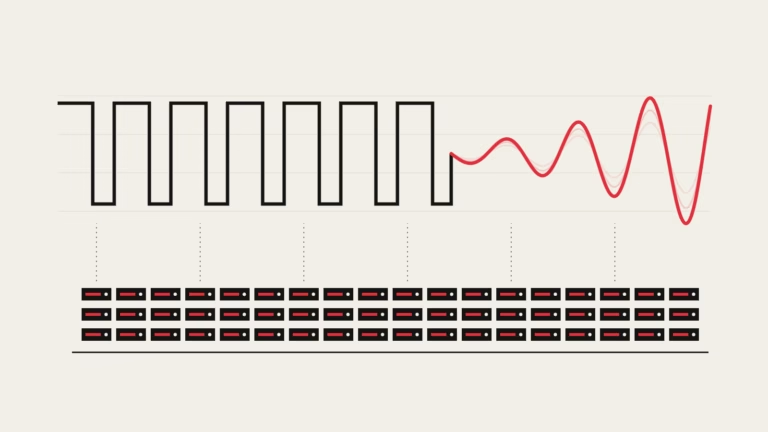

Every large language model on the market was built by devouring nearly everything humans have ever written down, and that well is running dry. The crunch has pushed AI labs toward synthetic data, which carries a hidden cost: a failure mode researchers call AI model collapse, where models trained on their own generated output slowly forget the rare, unusual and minority cases in the world. Epoch AI, the research group that tracks AI compute and data trends, estimates the effective stock of quality-adjusted, publicly available human text usable for training at roughly 300 trillion tokens (a token is roughly three-quarters of a word of English text, the basic unit these models are trained and billed on). At current trends, that stock could be exhausted somewhere between 2026 and 2032, and as early as 2027 if labs keep overtraining, deliberately training past the point where more compute stops paying off.
Most coverage tells that countdown-clock story and buries the sharper point: running out of human text and model collapse are cause and effect. Labs turn to synthetic data because the well is drying up, and the uncurated, recursive use of that synthetic data erodes a model’s grip on rare cases and diverse viewpoints before it ever shows up in a benchmark score. So the fix was always going to be about who controls the mix a model sees, and whether a human is still filtering it. More data alone doesn’t help.
The AI training data exhaustion clock everyone cites
The exhaustion numbers come from a widely cited 2024 Epoch AI paper, Will We Run Out of Data? Limits of LLM Scaling Based on Human-Generated Data (Villalobos et al.). Their 300 trillion token ceiling is deliberately conservative: it already accounts for quality filtering, deduplication, and the fact that most text on the open internet isn’t useful training material. Two forces squeeze that ceiling at once. Training-dataset sizes have grown roughly 2.4x a year, while the compute labs throw at training has grown roughly 4x a year, so compute is outrunning its own fuel supply.
Overtraining makes the timeline scarier than the ceiling alone suggests. Compute-optimal training balances model size against data volume for the best performance per unit of compute. Overtraining runs well past that ratio anyway, because a smaller model that’s been overtrained is cheaper to serve and can beat a compute-optimal model at the same running cost. Labs do this routinely. Push that dial by a modest 5x factor, Epoch estimates, and the human-text stock could be fully spent by 2027, about a year earlier than the paper’s median projection of 2028.
Source: Epoch AI (Villalobos et al., arXiv:2211.04325)
What AI model collapse actually does inside a model
The mechanism paper behind the term is Ilia Shumailov and colleagues’ AI Models Collapse When Trained on Recursively Generated Data, published in Nature in 2024. Train a model on its own outputs, or another model’s outputs, across successive generations without an ongoing anchor in real human-generated data, and performance degrades in a specific, predictable direction. Each generation samples from an already-narrowed version of the true distribution (the full range of sentences, facts and styles a language could produce), so statistically rare events get sampled less often than they really occur. The authors replicated the result across large language models, variational autoencoders and Gaussian mixture models: the tails vanish first.
In practice, the tails of a distribution are the unusual phrasing, the minority dialect, the rare medical presentation, the niche historical fact: anything that shows up in the real world less often than a model’s internal average expects. Early-stage collapse is subtle. Diversity flattens slightly, and the model answers competently but blandly, with nuance filed off before it registers on a benchmark. Late-stage collapse is obvious, with outputs converging toward a single repetitive mode, disconnected from the reality the model was meant to represent. Later work pulls in two directions. A note by Ali Borji models the effect and concludes it is a statistical phenomenon that may be unavoidable. A 2025 position paper by Rylan Schaeffer and colleagues argues that several prominent collapse scenarios rest on conditions that poorly match real training and are readily avoidable. The mechanism is not in dispute; how much it threatens real training pipelines is, and that depends on what goes into the training data.
Sources: Villalobos et al., arXiv:2211.04325 (dataset size, about 2.4x a year); Epoch AI, Training compute of frontier AI models grows by 4-5x per year
Get the next one by email
Power, cooling, chips and the rules that shape them. No spam, unsubscribe any time.
Distillation vs. model collapse: same synthetic data, opposite outcome
The synthetic data that reliably breaks models is uncurated synthetic data, and that undercuts the panic. Distillation trains a smaller model on a larger model’s carefully filtered outputs, so the compact model inherits the bigger one’s reasoning without its running cost. Microsoft’s Phi line of small models, built on the paper Textbooks Are All You Need, made its name doing exactly this, with synthetic textbooks and exercises generated by GPT-3.5 from prompts its researchers constrained by topic and audience, alongside web code filtered for textbook quality by a classifier trained on GPT-4 labels. It works well enough that distillation is now a standard production tool.
A distilled model that gets sharper and a recursively trained model that collapses are both trained on synthetic text. What separates them is whether a human, or a well-designed filter, keeps a live connection to the real distribution: rejecting bland, averaged-out outputs, deliberately preserving edge cases, and mixing in fresh human-generated data instead of looping a model’s output back into itself unchecked. Model collapse is what happens when curation stops. That turns the data shortage from an unsolvable ceiling into a governance problem labs can manage, for now.
⚡ PHOTON’S TAKE
Anyone who has run large-scale data infrastructure recognizes this pattern: recycle output back into input without a filter and you get less of everything except the average. That’s model collapse in one sentence. The industry is running short on patience for curation more than on data, because curation is cheap to skip now and expensive to fix later. Distillation already proves the fix works, and I expect the labs that win the next five years to be the ones who never stopped filtering their synthetic tokens.
Who controls the mix decides whether AI model collapse happens
The 300 trillion token ceiling still matters: a hard limit on new human text is a hard limit, and overtraining could bring the reckoning as early as 2027. The useful response is to ask how a model’s synthetic training data was filtered, and by whom. That discipline matters wherever AI systems make decisions with real consequences, like the AI trading agents already losing real money fast. Curation costs compute and headcount, the same scarce resources already strained by the AI data center power bottleneck and the push toward wafer-scale chips built to end the GPU cluster era.
The industry’s own roadmap already assumes synthetic data will supply most future training volume. The real fork is whether that data gets curated like Phi’s textbooks or dumped back in like a feedback loop with no ground truth to correct it. I’d expect the labs that survive the tightening data supply to publish less about token counts and more about their filtering pipelines, because that’s where the advantage now sits. Running out of human text was never going to stop AI scaling on its own; losing the tails while nobody was watching might.
Cite this article
Turner, A. (2026, September 8). AI Model Collapse Is a Curation Failure. ScienceShot. https://scienceshot.com/post/ai-model-collapse-curation-problem
Turner, Alex. “AI Model Collapse Is a Curation Failure.” ScienceShot, 8 Sept. 2026, scienceshot.com/post/ai-model-collapse-curation-problem.
Turner, Alex. “AI Model Collapse Is a Curation Failure.” ScienceShot, September 8, 2026. https://scienceshot.com/post/ai-model-collapse-curation-problem.
@online{scienceshot-ai-model-collapse-curation-2026,
  author       = {Turner, Alex},
  title        = {{AI Model Collapse Is a Curation Failure}},
  organization = {ScienceShot},
  date         = {2026-09-08},
  year         = {2026},
  url          = {https://scienceshot.com/post/ai-model-collapse-curation-problem}
}
https://scienceshot.com/post/ai-model-collapse-curation-problem
Get the weekly brief
Sourced analysis of data-centre engineering and regulation, every Monday. No spam, unsubscribe any time.