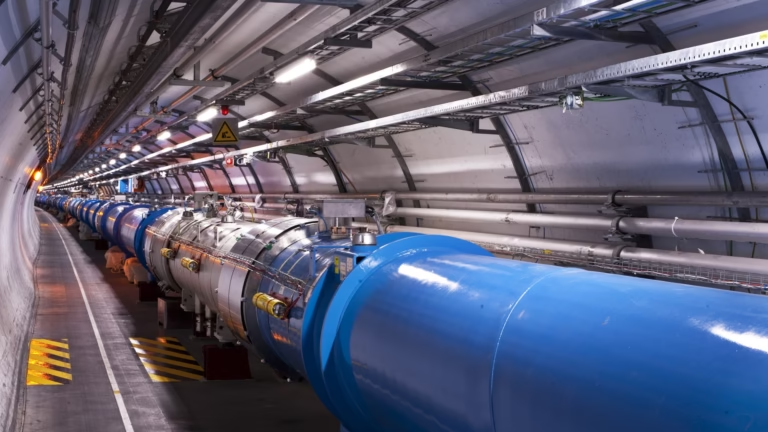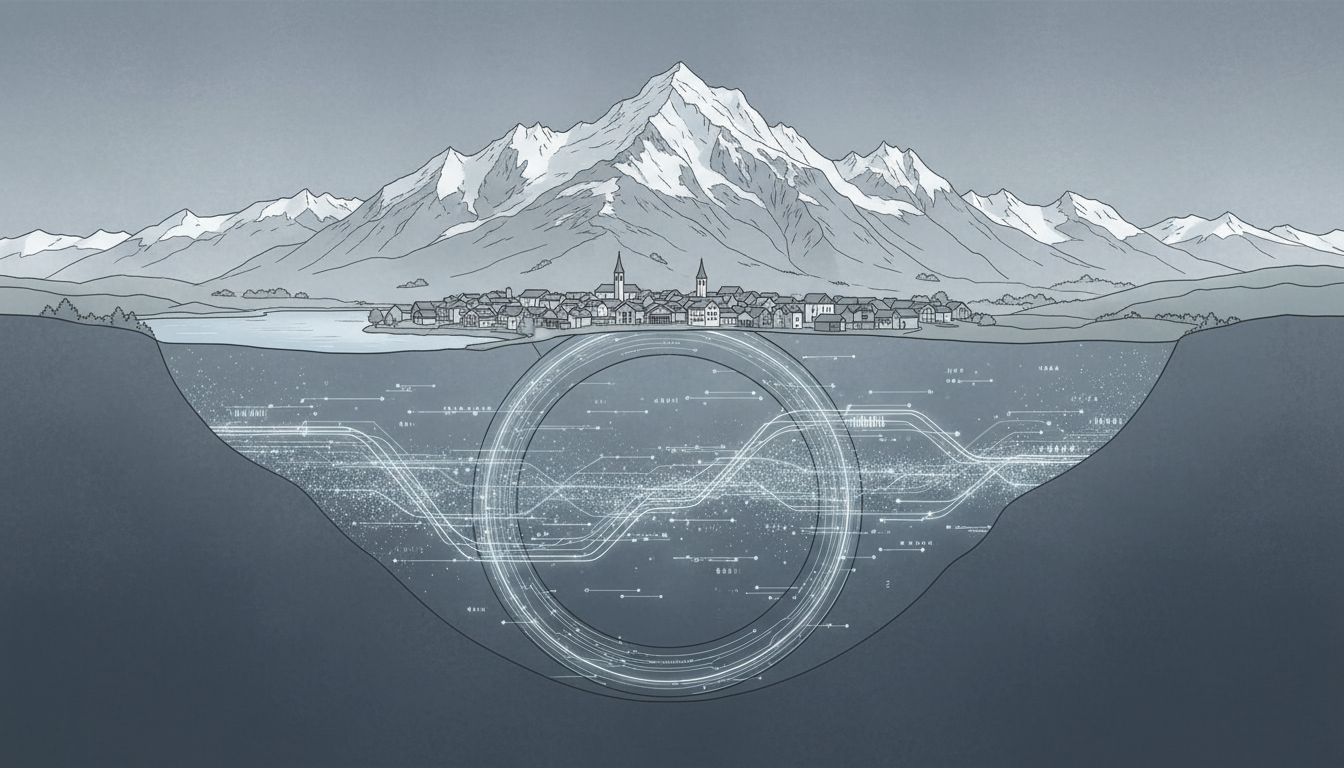
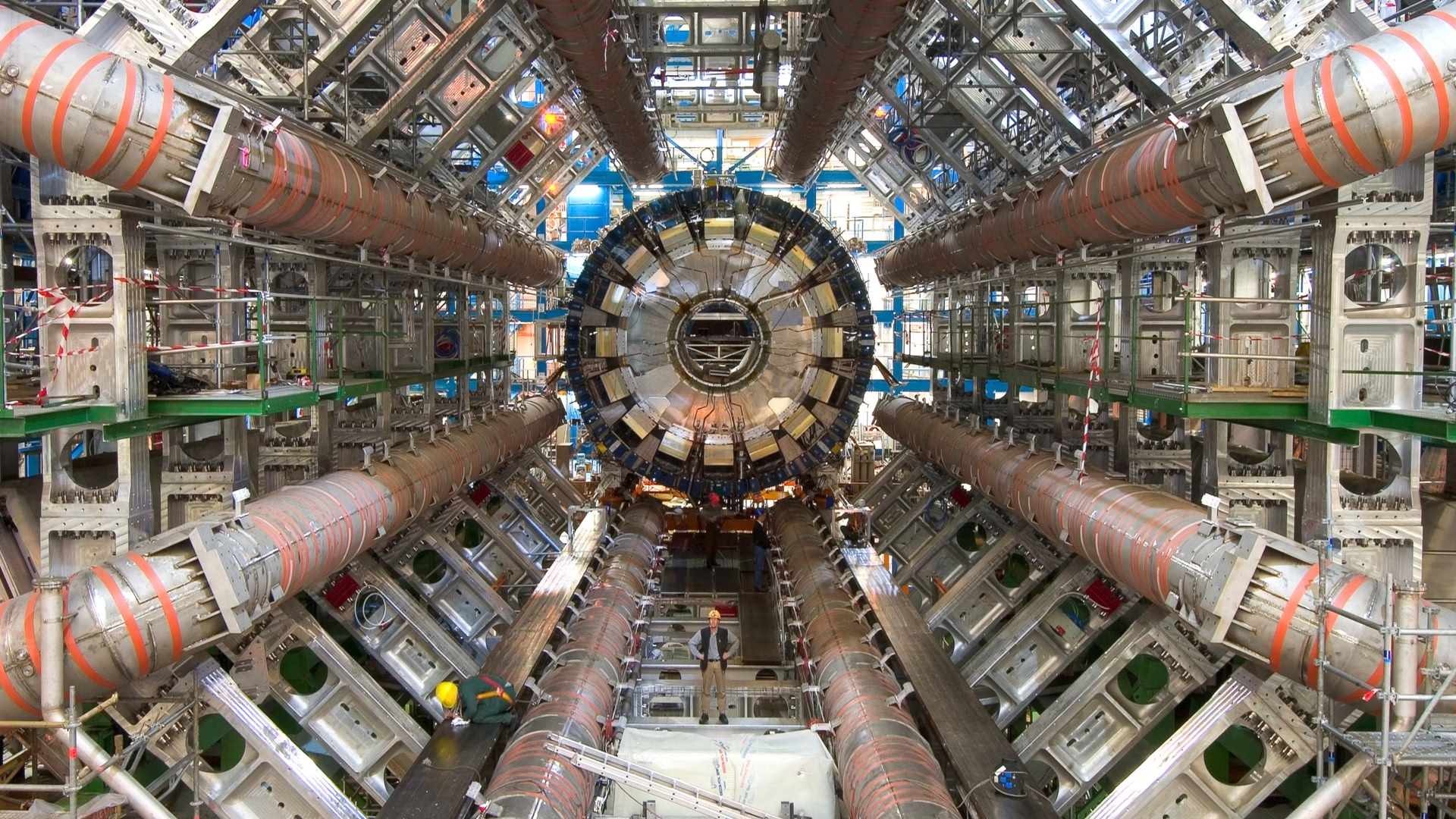
The Higgs boson is an elementary particle, the observable ripple of the Higgs field, an energy field that fills the whole universe. Elementary particles such as electrons, quarks and the W and Z bosons get their mass from the way they interact with this field: the stronger the interaction, the heavier the particle. The photon and the gluon do not interact with it and stay massless. ATLAS and CMS, the two large general-purpose experiments at CERN’s Large Hadron Collider, announced the discovery of the Higgs boson on 4 July 2012, nearly fifty years after it was predicted.
Higgs boson: key facts
| Predicted | 1964, by François Englert and Robert Brout, by Peter Higgs, and by Gerald Guralnik, Carl Hagen and Tom Kibble |
| Discovered | Announced 4 July 2012 by the ATLAS and CMS experiments at CERN |
| Mass | About 125 GeV, roughly 133 times the mass of a proton |
| Spin and charge | Spin 0, electrically neutral |
| Lifetime | About 1.6 × 10⁻²² seconds (Standard Model prediction) |
| Nobel Prize | Physics 2013, François Englert and Peter Higgs |
How Do Particles Get Mass?
In the Standard Model, the W and Z bosons that carry the weak nuclear force, and the quarks and charged leptons that make up matter, would all be massless if the Higgs field did not exist. Shortly after the Big Bang, as the universe cooled, the Higgs field settled into a state with a non-zero value everywhere in space. Particles that interact with this background field behave as if they have mass, and the strength of each particle’s interaction, its coupling, sets how heavy it is. The top quark couples most strongly and is the heaviest known elementary particle; the electron couples weakly and is light.
A common picture is a crowded room that a celebrity has trouble crossing. It helps, but it can mislead: mass from the Higgs field is not friction, and a particle moving through the field at constant speed does not slow down. What the field changes is how hard it is to change a particle’s motion, which is what mass means.
The Higgs field does not explain most of the mass you can weigh. A proton is made of three quarks whose Higgs-generated masses add up to only about one percent of its total mass. The other 99 percent comes from the energy of the quarks and gluons bound inside it, through E = mc². The Higgs boson itself is the smallest possible excitation of the field, in the same way that a photon is the smallest excitation of the electromagnetic field.
How Was The Higgs Boson Discovered Experimentally?
Making a Higgs boson takes a lot of energy concentrated in a tiny space, and it decays almost immediately, so it can only be seen through its decay products. The LHC collides protons at energies of several trillion electronvolts, with up to about a billion collisions per second inside each of the large detectors. Only about one collision in a billion produces a Higgs boson.
The discovery rested mainly on two rare but clean decay channels: a Higgs boson turning into two photons, and one turning into two Z bosons that each decay into a pair of electrons or muons. In both channels the experiments saw an excess of events at a mass of about 125 GeV over the expected background. On 4 July 2012 ATLAS and CMS each reported a signal with a statistical significance of about five sigma, the threshold physicists use to claim a discovery.
Get the next one by email
Power, cooling, chips and the rules that shape them. No spam, unsubscribe any time.
What Evidence Confirms This New Particle Is The Higgs Boson?
Finding a new particle at 125 GeV was not enough on its own. Physicists then had to check that it behaves like the Standard Model Higgs boson. By 2013 the data showed that it has spin 0 and positive parity, as predicted. In the following years the experiments observed it decaying into tau leptons and into bottom quarks, and in 2018 they observed it being produced together with a pair of top quarks, which measures its coupling to the heaviest quark directly. Evidence for its rare decay into muons followed in 2020.
Across all these measurements, the particle’s couplings to other particles grow in proportion to their masses, the defining signature of the Higgs mechanism. So far every measured property agrees with the Standard Model; the main couplings are now known to between about 5 and 12 percent, the rarer ones much less precisely.
What Further Higgs Boson Research Is Being Done?
Several big questions remain. The most important is the Higgs field’s interaction with itself, which determines the shape of the field’s energy and whether our universe’s vacuum is completely stable. Measuring it requires catching pairs of Higgs bosons produced together, which is extremely rare. The High-Luminosity LHC, an upgrade due to start operating around 2030, is designed to collect about ten times more data than the LHC was originally built to gather, enough for a first measurement.
Physicists also look for additional Higgs bosons predicted by some extensions of the Standard Model, for decays into invisible particles that could be dark matter, and for small deviations in the couplings that would point to new physics. The Higgs boson itself cannot be dark matter, because it decays in about 10-22 seconds, but it could act as a “portal” connecting ordinary matter to a hidden dark sector. Theorists have also explored whether the Higgs field played a role in creating the excess of matter over antimatter in the early universe.
How Does Knowing About The Higgs Boson Impact Daily Life?
The Higgs boson has no direct technological use. Its importance is in what it tells us: without the Higgs field electrons would be massless, atoms could not form, and there would be no chemistry and no life. The discovery completed the Standard Model, the theory that describes every known elementary particle and three of the four fundamental forces.
The tools built to find it have had wider uses. Detector technologies developed for particle physics are used in medical imaging such as PET scanners, and the worldwide computing grid created to analyse LHC data has influenced large-scale distributed computing.
Outlook and Impacts
The Higgs boson was predicted in 1964 and found in 2012, in exactly the form the theory required. That success also sharpens the remaining puzzles. The Standard Model does not explain why the Higgs boson’s mass is as small as it is, what dark matter is, or how gravity fits with quantum physics. The Higgs boson is now one of the main places where physicists hope to find the first crack in the theory.
Cite this article
Piro, V. (2024, June 5). Why Does the Higgs Boson Give Particles Mass? The Physics Explained. ScienceShot. https://scienceshot.com/post/unveiling-the-higgs-boson-understanding-the-origins-of-particle-mass
Piro, Viros. “Why Does the Higgs Boson Give Particles Mass? The Physics Explained.” ScienceShot, 5 June 2024, scienceshot.com/post/unveiling-the-higgs-boson-understanding-the-origins-of-particle-mass.
Piro, Viros. “Why Does the Higgs Boson Give Particles Mass? The Physics Explained.” ScienceShot, June 5, 2024. https://scienceshot.com/post/unveiling-the-higgs-boson-understanding-the-origins-of-particle-mass.
@online{scienceshot-unveiling-the-higgs-boson-2024,
  author       = {Piro, Viros},
  title        = {{Why Does the Higgs Boson Give Particles Mass? The Physics Explained}},
  organization = {ScienceShot},
  date         = {2024-06-05},
  year         = {2024},
  url          = {https://scienceshot.com/post/unveiling-the-higgs-boson-understanding-the-origins-of-particle-mass}
}
https://scienceshot.com/post/unveiling-the-higgs-boson-understanding-the-origins-of-particle-mass
Get the weekly brief
Sourced analysis of data-centre engineering and regulation, every Monday. No spam, unsubscribe any time.