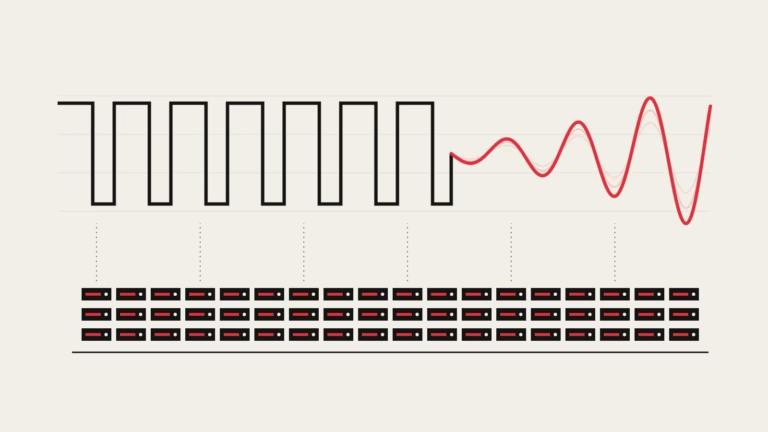
Plan an AI data center from the grid date backwards, because power now sets the schedule before the GPUs do. NVIDIA sizes the cooling of one GB200 NVL72 rack for 120 kW (October 2024). The typical rack in 2025 drew about 9 kW (Uptime Institute, July 2025). Published waits for a new grid connection in Europe run from 7.5 months to an offer in Ireland to the mid 2030s in the Diemen area east of Amsterdam.
Key takeaways
- Ten megawatts of IT load holds roughly 5,300 to 6,000 current NVIDIA GPUs, whichever system they come in*. The megawatt is the unit of AI capacity. The rack decides how much floor and cooling it needs.
- Rack-scale systems are rated at 120 to 135 kW per rack, and Lenovo gives up to 155 kW peak for a GB300 NVL72 rack (Lenovo Press). Few facilities exceed 30 kW per rack (Uptime Institute).
- The IEA expects data-center electricity use to more than double, from 415 TWh in 2024 to about 945 TWh in 2030 (IEA, April 2025).
- In the United States, 2,061 GW of generation and storage was waiting in interconnection queues at the end of 2025, and in regions with data, projects built in 2025 took a median of over five years from request to operation (Berkeley Lab, May 2026).
- In Europe the harder question is often who gets scarce capacity, and more grid operators now decide that by rule instead of by queue.
What 10 MW of IT load holds
The table turns one 10 MW block of IT load into equipment at each density. IT load is the power the servers, storage and network draw, before cooling and power losses. It uses each vendor’s own rating, which is a maximum or a design capacity, so a real hall plans for fewer units.
| Equipment | Power per unit | What the figure is | Units in 10 MW of IT load* | GPUs in 10 MW* |
|---|---|---|---|---|
| Typical rack in 2025 (average of operators’ most common density) | about 9 kW | Uptime Institute survey, 2025 | about 1,100 racks | none |
| Dense rack, top of the band operators are adopting | 30 kW | Uptime Institute survey, 2025 | 333 racks | none |
| NVIDIA DGX B200 server, 8 GPUs | 14.3 kW | NVIDIA, maximum system power | 699 servers | 5,592 |
| NVIDIA GB200 NVL72 rack, 72 GPUs | 120 kW | NVIDIA, cooling capacity of the rack design | 83 racks | 5,976 |
| NVIDIA GB200 NVL72 rack, 72 GPUs | 132 kW | Supermicro, stated total rack power | 75 racks | 5,400 |
| NVIDIA GB300 NVL72 rack by Lenovo, 72 GPUs | 135 kW (up to 155 kW peak) | Lenovo, rack TDP | 74 racks | 5,328 |
Two things stand out. First, the GPU count barely moves: about 5,600 GPUs in DGX B200 servers and about 5,300 to 6,000 in rack-scale systems*. What changes is the floor and the cooling. The same 10 MW fills about 1,100 typical racks or about 80 rack-scale ones*. Second, the ratings measure different things. NVIDIA states the rack’s cooling capacity, Supermicro a total rack power of 132 kW (Supermicro), and Lenovo a rack TDP with a higher peak. Use the peak for the electrical design and the TDP for the energy budget.
The grid sees more than the IT load. In 2025 the weighted average PUE in the Uptime survey was 1.54 (Uptime Institute). PUE (power usage effectiveness) is the facility’s total energy divided by its IT energy. At 1.54 the 10 MW hall draws about 15.4 MW from the grid, and at 1.3 it draws 13 MW*. Our PUE reference sets out which measures move that number. The AI accelerator power dataset lists the board power of current NVIDIA, AMD and Intel accelerators and the rated power of the servers and racks built on them.
Why the grid sets the date
A GPU order has a delivery date. A grid connection at a congested node often has none. Gartner forecast in November 2024 that 40% of existing AI data centers will be operationally constrained by power availability by 2027 (Gartner). That is a forecast, and it is now two years old, but the queue data point the same way.
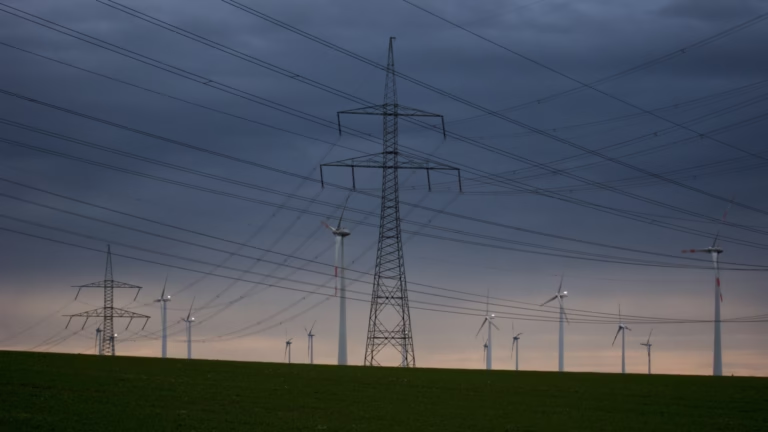
In the United States, Berkeley Lab counted 1,312 GW of generation and about 749 GW of storage seeking a transmission connection at the end of 2025 (Queued Up, 2026 edition). In the regions with data, for projects built in 2025, the median time from interconnection request to commercial operation was over five years. Those are power plants waiting to connect. A data center needs that new supply and its own connection too.
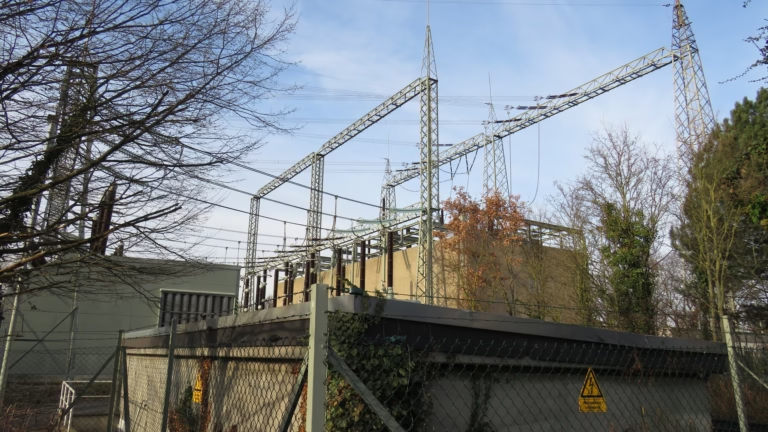
In Europe, grid operators publish waits that measure different things. Ireland’s transmission operator quotes about 7.5 months from a complete application to a connection offer, and up to 18 months where the site’s own generation has not yet been through its process. It also states that an application in a constrained area cannot be progressed. In the Netherlands, the transmission operator expects to connect customers from the waiting list in the Diemen area, east of Amsterdam, again between 2034 and 2037. In west London, a London Assembly committee investigation heard that the transmission reinforcement needed to relieve the constraint is not expected until 2037.
More European operators now ration capacity instead of serving the first application. In February 2026 Germany’s four transmission operators announced a maturity procedure to replace first come, first served. Applications for large loads such as data centers are collected in cycles from 1 April 2026, and when a cycle is oversubscribed the most advanced projects get an offer first. The grid connection tracker follows these pauses, caps, queues and published waits by country, with the date each was checked.
Grid to chip: where the power goes on the way in
Grid to chip is the chain of conversions between the utility supply and the GPU. Power arrives at medium or high voltage, is stepped down and converted on site, passes through the UPS (uninterruptible power supply) and distribution, and reaches the rack. Each stage loses a little energy and needs copper and floor space. Current rack-scale systems distribute 54 V DC inside the rack. NVIDIA says a single 1 MW rack at 54 V would need up to 200 kg of copper busbar, and it plans full-scale production of 800 V DC data centers with its Kyber rack-scale systems in 2027 (NVIDIA, May 2025).
Our 800 V DC rack power reference works through one 1 MW block at 54 V, 400 V and 800 V DC against 415 V AC. It shows the current, copper and losses at each voltage and where the European rules stand.
Cooling: the second gate
The rack-scale systems in the table are designed for liquid cooling. NVIDIA built the GB200 NVL72 around direct liquid cooling to remove its 120 kW (NVIDIA), and the rack holds 72 Blackwell GPUs and 36 Grace CPUs (NVIDIA). Even so, the Lenovo GB300 rack sends about 10% of its heat to air and 90% to liquid. At its 135 kW TDP that is roughly 13.5 kW of air-side heat per rack*, more than a whole typical rack draws today.
Most operators’ highest-density racks still peak below 30 kW, according to the same Uptime survey. A hall built for that needs liquid cooling and its heat-rejection plant added before it can take rack-scale systems. Our liquid cooling reference compares direct-to-chip and immersion. For existing air-cooled halls on conventional loads, the containment worked case shows how far that first step moves PUE.
PHOTON’S TAKE
Watch the grid operators more closely than the GPU launch calendar. A GPU order comes with a delivery date. A connection at a congested node often comes with a year in the 2030s, or with a rule that decides who goes first. The megawatt you can energise is the real unit of AI capacity, and the table above shows why: it holds roughly the same number of GPUs whichever system you pick.
What to check before you commit to a site
- The published wait at that node, and what it measures: an offer, a commissioning date or the end of a waiting list.
- The allocation rule: first come, first served, an annual share, a maturity ranking, a tender or a priority order.
- The grid draw at your expected PUE, not the IT load. Ten megawatts of IT at PUE 1.3 is a 13 MW connection*.
- The rack density the cooling can remove. Current rack-scale systems are rated at 120 to 135 kW, with peaks above that.
- The electrical design against the peak rating, and the energy budget against the TDP.
The data-centre master plan tool plans a European project from the site through design, cost plan, programme and operating plan to the business case.
Sources
- NVIDIA Technical Blog, NVIDIA Contributes NVIDIA GB200 NVL72 Designs to Open Compute Project, 15 October 2024
- NVIDIA, GB200 NVL72 product page (read 16 October 2026)
- NVIDIA, DGX B200 product page and specifications (read 16 October 2026)
- Supermicro, SRS-GB200-NVL72 rack specifications (read 16 October 2026)
- Lenovo Press LP2357, NVIDIA GB300 NVL72 by Lenovo
- Uptime Institute, Global Data Center Survey 2025 (Keynote Report 180), July 2025
- International Energy Agency, Energy and AI, executive summary, April 2025
- Gartner, Gartner Predicts Power Shortages Will Restrict 40% of AI Data Centers By 2027, 12 November 2024
- NVIDIA Technical Blog, NVIDIA 800 V HVDC Architecture Will Power the Next Generation of AI Factories, 20 May 2025
- Lawrence Berkeley National Laboratory, Queued Up: 2026 Edition, May 2026
Cite this article
Editorial, S. (2026, July 10). AI Data Center Power Bottleneck: Rack Power and Grid Waits, 2026. ScienceShot. https://scienceshot.com/post/ai-data-center-power-bottleneck
Editorial, ScienceShot. “AI Data Center Power Bottleneck: Rack Power and Grid Waits, 2026.” ScienceShot, 10 July 2026, scienceshot.com/post/ai-data-center-power-bottleneck.
Editorial, ScienceShot. “AI Data Center Power Bottleneck: Rack Power and Grid Waits, 2026.” ScienceShot, July 10, 2026. https://scienceshot.com/post/ai-data-center-power-bottleneck.
@online{scienceshot-ai-data-center-power-2026,
  author       = {Editorial, ScienceShot},
  title        = {{AI Data Center Power Bottleneck: Rack Power and Grid Waits, 2026}},
  organization = {ScienceShot},
  date         = {2026-07-10},
  year         = {2026},
  url          = {https://scienceshot.com/post/ai-data-center-power-bottleneck}
}
https://scienceshot.com/post/ai-data-center-power-bottleneck
Get the weekly brief
Sourced analysis of data-centre engineering and regulation, every Monday. No spam, unsubscribe any time.