
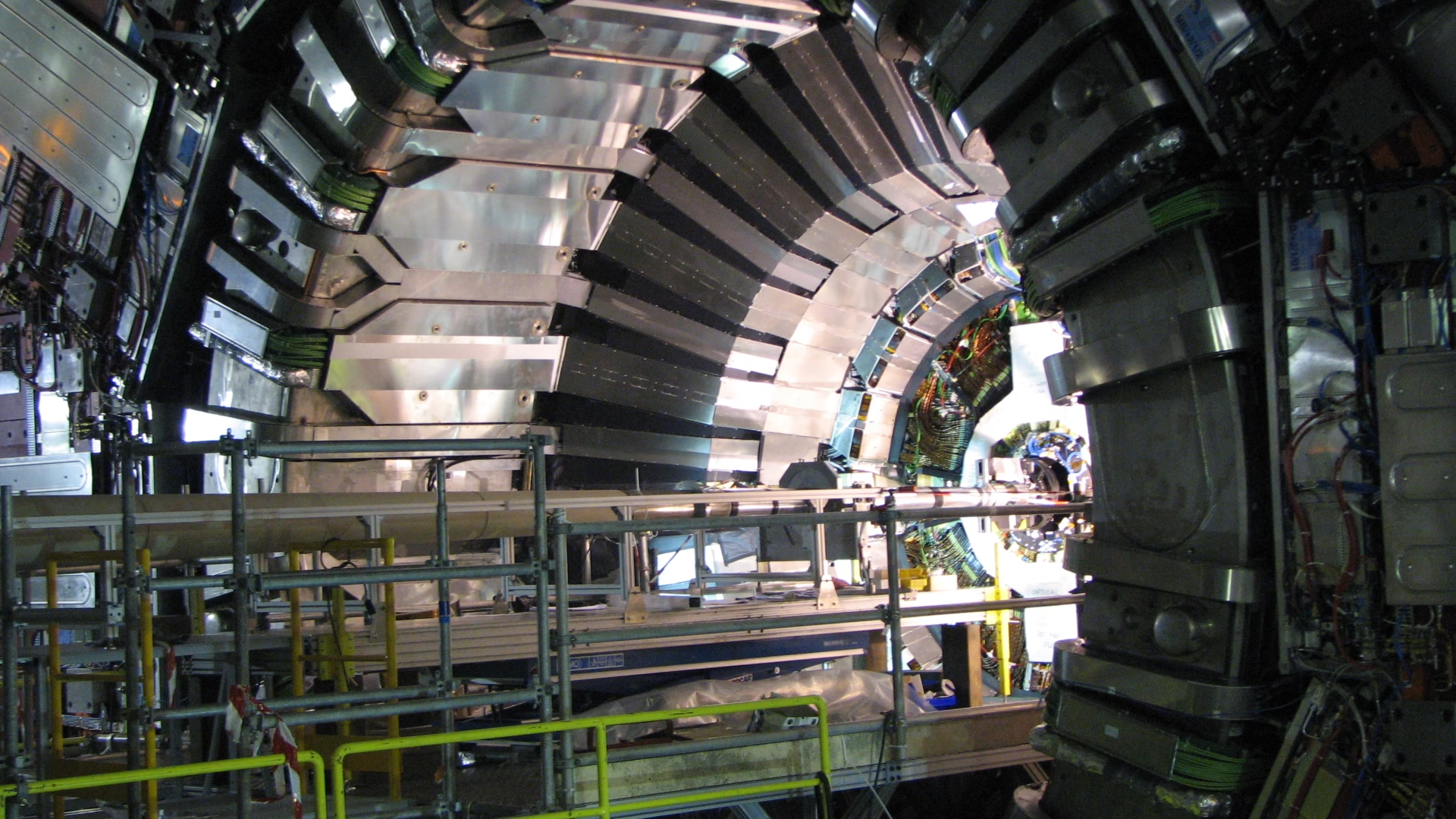
A charged particle crossing a silicon sensor does not deposit the average amount of energy. It deposits whatever a handful of random collisions happen to give it — usually less than the average, occasionally very much more. Design a readout chip around the mean and you will mis-set the threshold on almost every event.
That is the practical content of the Landau distribution. Bethe-Bloch tells you the mean energy loss; Landau, in 1944, told you how wildly individual events scatter around it — and why the mean is the wrong number to build hardware on.
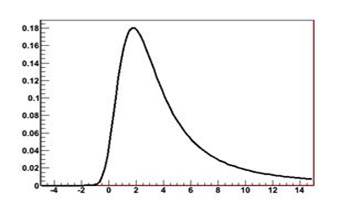
The Bethe-Bloch formula is well recognised for describing the average energy loss of charged particles passing through matter, whereas Landau theoretically described the fluctuations of energy loss by ionisation of a charged particle in a thin layer of matter in 1944 [1]. This description concludes with Landau Distribution, a universal asymmetric probability density function.
Why the peak sits below the mean
In reality, if a particle does not stop in the sensor, the response ranges around the distribution’s peak, with a high possibility of strong signals. Because of this tail, the average value exceeds the distribution’s most probable value. The variation around the maximum of this distribution increases as the sensor gets thinner. When constructing the readout circuit for these devices, the dynamic range must be considered.
What that looks like in a 300 µm sensor
Put numbers on it. For silicon at the minimum-ionising point, Bethe-Bloch gives a mean loss of about 1.664 MeV·cm²/g (Particle Data Group), which for a 300 µm sensor is roughly 116 keV. The most probable loss, the peak you actually record event after event, is only about 82 keV. That 34 keV gap is not noise or miscalibration. It is ionisation straggling: a few violent collisions drag the mean out into the tail while most events pile up near the peak.
At about 3.6 eV per electron-hole pair, that 82 keV peak frees roughly 22,000 pairs, and that is the signal a readout chip has to be designed around. I measured the most probable energy loss directly in very thin silicon layers (energy-loss measurement in thin silicon), and the numbers held up against experiment.
Source: Particle Data Group, dE/dx|min = 1.664 MeV·cm²/g in silicon; ρ = 2.33 g/cm³.
Energy-loss calculator: mean, most probable value and straggling
Your particle, your absorber. Mean rate from the Bethe formula with the density-effect correction, the most probable loss from the Landau theory as given in the PDG review, and the straggling curve for your case.
The calculator needs JavaScript. The reference values below are computed by the same code.
Method, constants and limits
Method. Mean rate: Bethe formula, ⟨−dE/dx⟩ = K z² (Z/A) β⁻² [ ½ ln(2mec²β²γ²Tmax/I²) − β² − δ/2 ], without shell or Barkas terms (they exceed a few percent only below βγ ≈ 0.1). Most probable loss: Δp = ξ [ ln(2mec²β²γ²/I) + ln(ξ/I) + 0.200 − β² − δ ], ξ = (K/2) z² (Z/A) x/β². Regime from κ = ξ/Tmax: Landau below 0.01, Vavilov to 10, Gaussian above. The Landau density is evaluated by direct quadrature of its defining integral, not an approximation. Both formulas and their notation follow the Particle Data Group review Passage of particles through matter.
Electron-hole pairs (silicon only). Pairs per micrometre = energy deposited per micrometre ÷ w, w = 3.62 eV (silicon, room temperature; PDG review / silicon-detector literature, e.g. Knoll, Radiation Detection and Measurement). Two figures are reported, not one, because they answer different questions: the mean rate uses ⟨dE/dx⟩ and does not depend on thickness (≈108/µm for a minimum-ionising particle in silicon); the most probable rate uses Δp at the thickness entered above and does depend on it, because Δp is not linear in thickness — it is what a thin detector actually reads out on a single pass, the same Landau/straggling quantity this tool otherwise reports in keV. Quoting only the mean figure for a thin-detector signal is a common error this tool deliberately avoids.
Constants. I, density, Z/A and δ(βγ) per material from NIST ESTAR (SRD 124); K = 4πNAre²mec² and mec² from CODATA; particle masses from the PDG; w = 3.62 eV for silicon as above — not an ESTAR/XCOM quantity, typed directly in the engine with its source. The Bethe engine reproduces NIST PSTAR proton stopping powers to within 1% from 50 MeV to 10 GeV in every material offered; the deviations are on record in the repository tests.
Limits. Heavy charged particles only (no electrons). βγ from 0.1 to about 2×10⁴. Thin absorbers: when the mean loss exceeds 10% of the kinetic energy the constant-velocity assumption fails and the result says so. The e-h pair figures are silicon-only: no sourced w is offered for any other material.
Reference values: a minimum-ionising muon in silicon
Muon at βγ = 3.5 (369.8 MeV/c), where the mean rate in silicon is at its minimum. Computed by the calculator above. The last two columns are the e-h pair yield per micrometre (w = 3.62 eV): the most-probable column changes with thickness because Δp is not linear in x; the mean column does not.
| Thickness (µm) | Most probable loss Δp (keV) | Mean loss (keV) | FWHM (keV) | Δp / mean | κ | e-h pairs/µm (most probable) | e-h pairs/µm (mean) |
|---|---|---|---|---|---|---|---|
| 50 | 11.31 | 19.33 | 3.876 | 0.585 | 8.0e-5 | 62.48 | 106.8 |
| 100 | 23.96 | 38.65 | 7.751 | 0.62 | 1.6e-4 | 66.17 | 106.8 |
| 150 | 37.11 | 57.98 | 11.63 | 0.64 | 2.4e-4 | 68.34 | 106.8 |
| 200 | 50.58 | 77.3 | 15.5 | 0.654 | 3.2e-4 | 69.87 | 106.8 |
| 300 | 78.22 | 116 | 23.25 | 0.675 | 4.8e-4 | 72.03 | 106.8 |
| 500 | 135.3 | 193.3 | 38.76 | 0.7 | 8.0e-4 | 74.75 | 106.8 |
| 1000 | 284 | 386.5 | 77.51 | 0.735 | 1.6e-3 | 78.44 | 106.8 |
Method: PDG review Passage of particles through matter (Bethe formula, Landau most probable value). Constants: NIST ESTAR silicon (I = 173 eV, ρ = 2.33 g/cm³), CODATA, PDG masses. Pair-creation energy w = 3.62 eV (silicon, room temperature; PDG review / silicon-detector literature) is not an ESTAR/XCOM quantity and is typed directly in the engine.
Minimum ionisation by material
The minimum of the mean rate ⟨−dE/dx⟩ for a singly charged heavy particle, and the βγ at which it occurs.
| Material | ρ (g/cm³) | I (eV) | Z/A | βγ at minimum | ⟨−dE/dx⟩min (MeV cm²/g) | (keV/µm) |
|---|---|---|---|---|---|---|
| Silicon | 2.33 | 173 | 0.4985 | 3.42 | 1.659 | 0.3865 |
| Germanium | 5.323 | 350 | 0.4408 | 3.26 | 1.372 | 0.7301 |
| Carbon (amorphous) | 2 | 81 | 0.4995 | 3.92 | 1.743 | 0.3486 |
| Aluminium | 2.699 | 166 | 0.4818 | 3.42 | 1.611 | 0.4347 |
| Iron | 7.874 | 286 | 0.4656 | 3.44 | 1.45 | 1.142 |
| Copper | 8.96 | 322 | 0.4564 | 3.42 | 1.402 | 1.257 |
| Tungsten | 19.3 | 727 | 0.4025 | 3.16 | 1.144 | 2.207 |
| Lead | 11.35 | 823 | 0.3958 | 3.02 | 1.121 | 1.273 |
| Argon (gas) | 0.001662 | 188 | 0.4506 | 3.16 | 1.519 | 2.524e-4 |
| Water | 1 | 75 | 0.5551 | 4 | 1.998 | 0.1998 |
| Air (dry, sea level) | 0.001205 | 85.7 | 0.4992 | 3.3 | 1.815 | 2.186e-4 |
| Plastic scintillator | 1.032 | 64.7 | 0.5414 | 4.04 | 1.956 | 0.2018 |
| Kapton | 1.42 | 79.6 | 0.5126 | 3.96 | 1.82 | 0.2584 |
| Silicon dioxide | 2.32 | 139.2 | 0.4993 | 3.64 | 1.697 | 0.3937 |
| Concrete (Portland) | 2.3 | 135.2 | 0.5027 | 3.66 | 1.711 | 0.3936 |
| Bone (compact, ICRU) | 1.85 | 91.9 | 0.5301 | 3.92 | 1.849 | 0.3421 |
| Soft tissue (ICRP) | 1 | 72.3 | 0.5512 | 4.02 | 1.985 | 0.1985 |
Bethe formula with the NIST ESTAR density-effect correction; no shell or Barkas terms. Material constants: NIST ESTAR (SRD 124). Checked against NIST PSTAR to within 1% (50 MeV – 10 GeV protons).
Prefer a bare calculator? Open the energy-loss tool on its own page →
Knock-on electrons: where the tail comes from
The Landau fluctuation is principally induced by the uncommon but measurable occurrence of knock-on electrons, which gain enough energy from the contact to become ionising particles themselves. The direction of the knock-on electron is often perpendicular to the direction of the incoming particle, resulting in uneven charge clouds and reduced spatial resolution.
Knock-on electrons are also called delta rays. They are rare, but each one carries off a large share of the energy, and in a thin sensor a single delta ray can dominate an entire event. That is the physical reason averaging is the wrong instinct: you would be letting a few outliers set the calibration.
The convolution property
The convolution of two Landau distributions results in another Landau distribution. This property can be illustrated by the energy loss of a particle traversing a layer of thickness D or two subsequent layers of thickness D/2, respectively. The overall energy loss must be the same in both cases, implying the convolution property mentioned above.
Although the Landau distribution has a finite area, it is impossible to calculate mean values due to the infinite tail. One proposed remedy is to cut the Landau tail, which would result in the loss of the convolution characteristic.
Protons, pions and other types of charged particles, which are in most cases close to MIPs, all produce approximately Landau-distributed spectra when traversing the matter. There are several approximations; the simplest is to apply the Gaussian function if the goal is to fit only the most probable value (peak).
The first and second momenta Φ (1,x) and Φ (2, x) of the density function truncated on the right-hand tail can be defined through the general formula

When Landau applies — and the assumptions behind it
It is possible to use the Landau function for all situations where k < 0.01 (where k is the ratio of the mean energy loss and the Maximum Transferable Energy) with the assumptions that:
- The maximum energy transfer is infinite
- The electron binding energy in a collision is negligible, in other words, the electrons involved in collisions are treated as free and the distant collision is ignored
- The particle velocity remains approximately the same
- Taking only the first term of Bethe-Block formula, the mean energy loss is approximated to:
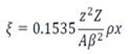
The Landau distribution is then given by:

r is an arbitrary real constant and the variable l is:

where CE is the Euler constant. The function φ(λ) is a universal function that must be evaluated numerically. A tabulation for various λ can be found in some articles. In addition, computer program has been developed and can be found here (Matlab code).
The most probable energy loss
The φ(λ) has a maximum for a λ of 0.229 and a full width at half maximum: WL=4.02ξ. The energy loss corresponding to the maximum of the function fL(x,Δ) is called the most probable energy loss ( Δp).
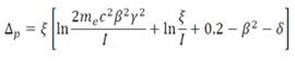
Earlier values for the constant 0.2000 were 0.37 [1] and 0.198 [3]. The equation includes the density effect, which had not been used by Landau.
For γ >> 100, we get
Δp= ξ ( 12.325 + ln(ξ/I) )
If we enter the I value, we obtain
Δp(keV) = t (0.1791 + 0.01782 lnt ) with t in um.
Get the next one by email
Power, cooling, chips and the rules that shape them. No spam, unsubscribe any time.
Where Landau breaks down: very thin absorbers
For small thicknesses, the Landau fails to fit the experimental energy loss distribution [2]. In fact, for small thicknesses, the Landau shows a lower position of the peak with respect to the energy loss distribution measured (Fig. 2(a)).
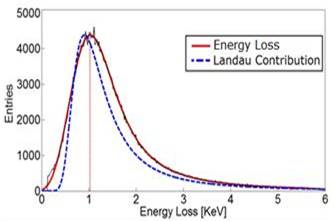 | 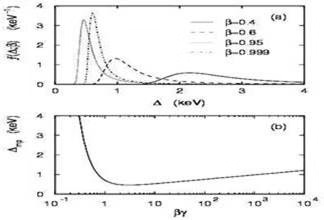 |
It can be understood qualitatively: for very thin absorbers, K-shell electrons do not contribute to the energy loss. Thus, the effective thickness of the absorber can be considered to be te=12/14 t. For t = 10 um, te=8.57 um.
The full width at half maximum of the Landau function, w, depends on the absorber thickness and is independent of particle type and speed.
How thin is too thin? Landau’s assumptions (unlimited energy transfer, free electrons, many collisions) barely matter in a thick slab. In a 300 µm wafer they start to bite, and in the sensors of a few tens of micrometres now common they fail outright: there are too few collisions, and the binding energies of silicon’s atomic shells distort exactly the region near the peak. For 300 µm, ξ is about 5.34 keV, so Landau’s own width of 4.02ξ comes to about 21 keV, while the measured width is around 25 keV. Even at 300 µm the distribution only settles into a clean Landau shape for protons above roughly 550 MeV/c.
After Landau: Vavilov and Bichsel
Pyotr Vavilov generalised the theory in 1957 to handle the finite maximum energy transfer that Landau had sent to infinity. The Vavilov distribution bridges the thick-absorber Landau limit and the thin-absorber Gaussian limit. It was real progress, but it still treats the atomic electrons as free, and binding is the problem that matters most in thin silicon.
Hans Bichsel dropped the shortcuts. He computed the straggling function from silicon’s real dielectric response, its measured photoabsorption cross sections and generalised oscillator strengths, including the atomic shell corrections Landau ignored (see the shell-correction analysis). His model reproduces measured silicon spectra where Landau cannot, which is why the Particle Data Group now publishes Bichsel straggling functions rather than the raw Landau curve. The measured distributions, and how the binding corrections broaden them, are in the straggling function.
Why this matters more every year
Sensors are getting thinner, not thicker. The High-Luminosity LHC upgrades, CMOS monolithic active pixel sensors and the timing layers going into every major experiment all push towards silicon in the 50 to 150 µm range, which is exactly where the Landau curve is least trustworthy.
Energy loss per unit length is a workhorse for particle identification, so a predicted peak that is off by a few keV drags the particle-ID separation and the energy calibration with it. The hardware is being reinvented, as I wrote in how silicon sensors are evolving for future colliders, and the physics used to interpret it has to keep pace. Landau’s curve is where the story starts, not where it ends.
References
- L. Landau, On the Energy Loss of Fast Particles by Ionization, J. Phys. USSR 8 (1944) 201.
- Blunck and S. Leisegang, Zum Energieverlust schneller Elektronen in d nnen Schichten, Z. Physik 128 (1950) 500.
- Maccabee and Papworth (1969), quoted by Sternheimer and Peierls (1971); see, also, Ahlen (1980)
⚡ PHOTON’S TAKE
Every silicon detector I have calibrated is calibrated on the peak, never the mean — and the reason is in the shape of this curve. The Landau tail has no upper bound, so the mean is a number the distribution refuses to give you. Thin the sensor and it gets worse: the peak sharpens, the tail lengthens, and the gap between what a particle typically deposits and what it deposits on average widens. Engineers who size a dynamic range from Bethe-Bloch alone discover this in the test beam, which is an expensive place to discover it.
If you want the experimental side of this — what the measured distributions actually look like in thin silicon, and where the Landau prediction parts company with them — that is covered in the straggling function. For what happens to the liberated charge once it exists, see charge carrier generation in semiconductors.
Cite this article
Editorial, S. (2024, April 9). The Landau Distribution and Energy Loss For Ionizing Particles. ScienceShot. https://scienceshot.com/post/the-landau-distribution-and-energy-loss-for-ionizing-particles
Editorial, ScienceShot. “The Landau Distribution and Energy Loss For Ionizing Particles.” ScienceShot, 9 Apr. 2024, scienceshot.com/post/the-landau-distribution-and-energy-loss-for-ionizing-particles.
Editorial, ScienceShot. “The Landau Distribution and Energy Loss For Ionizing Particles.” ScienceShot, April 9, 2024. https://scienceshot.com/post/the-landau-distribution-and-energy-loss-for-ionizing-particles.
@online{scienceshot-the-landau-distribution-and-2024,
  author       = {Editorial, ScienceShot},
  title        = {{The Landau Distribution and Energy Loss For Ionizing Particles}},
  organization = {ScienceShot},
  date         = {2024-04-09},
  year         = {2024},
  url          = {https://scienceshot.com/post/the-landau-distribution-and-energy-loss-for-ionizing-particles}
}
https://scienceshot.com/post/the-landau-distribution-and-energy-loss-for-ionizing-particles
Get the weekly brief
Sourced analysis of data-centre engineering and regulation, every Monday. No spam, unsubscribe any time.



_(2544825416).jpg)