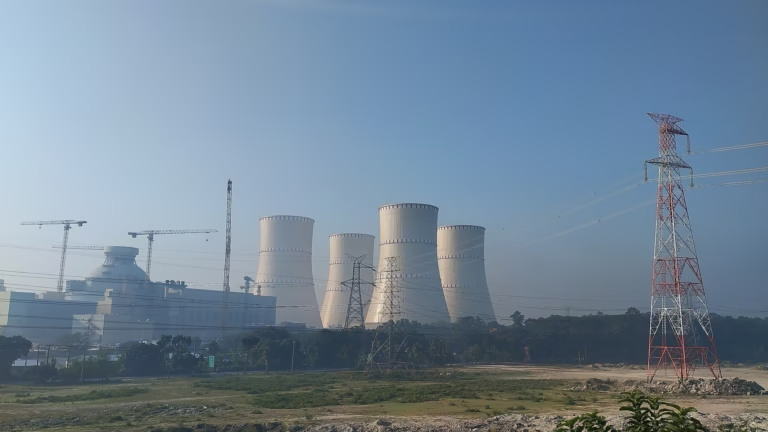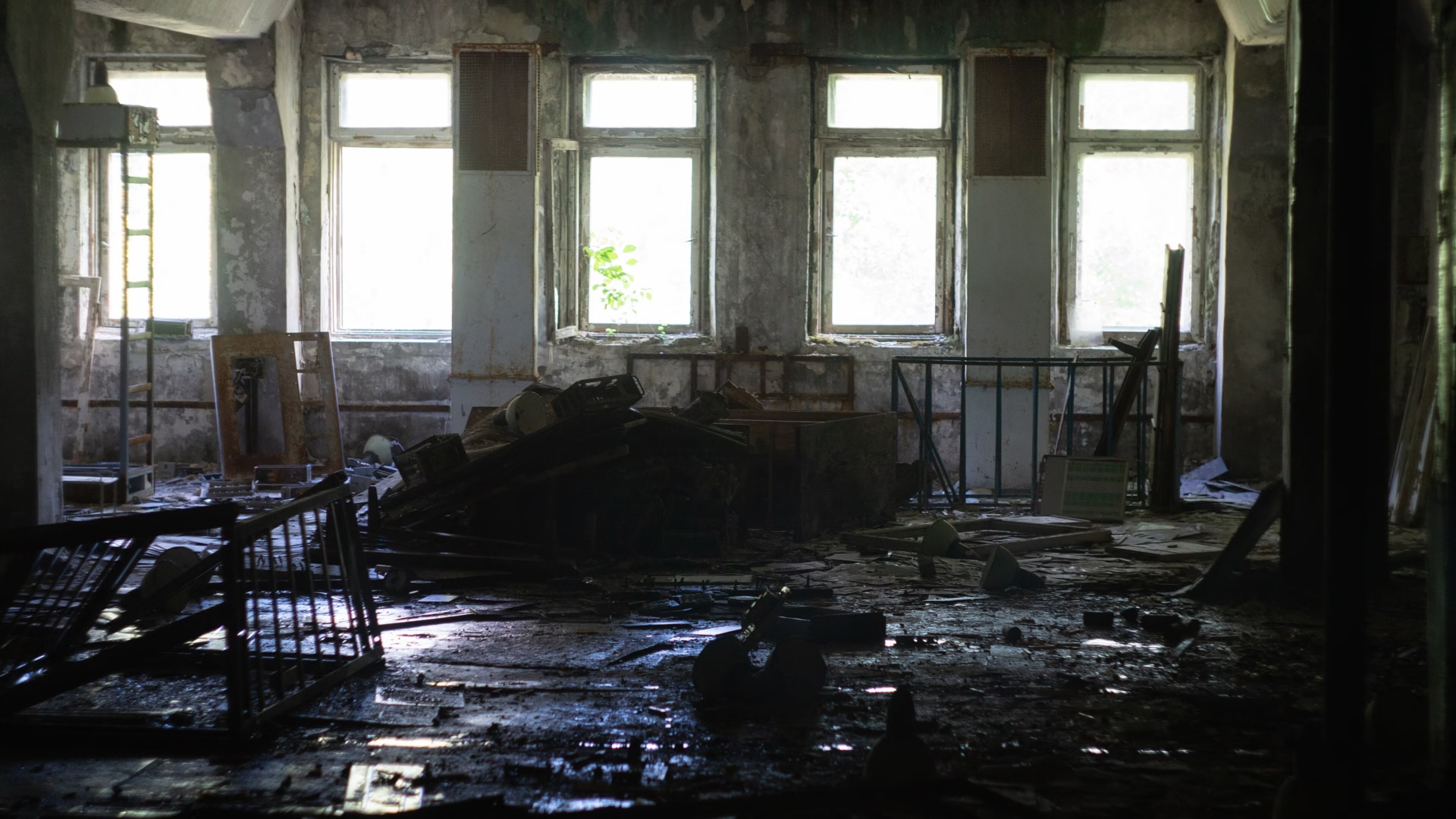

Firefighters converging on OVHcloud’s Strasbourg campus that night faced a five-storey tower that would not stop breathing. SBG2, the company’s most cost-efficient data centre, drew cool air in at its base and pushed hot air out at the roof by design, and that same design was now pulling a fresh draft of oxygen up through the fire, floor by floor. It was just after 00:47 local time on 10 March 2021. This was the start of the OVHcloud data centre fire that would destroy SBG2, damage its neighbour SBG1, and put an estimated 3.6 million websites offline within hours, according to wire coverage at the time.
Inside the OVHcloud Data Centre Fire: A Tower Built to Breathe
SBG2 had been built in 2011 around a specific bet: skip the chillers. Most data centres cool servers with mechanical refrigeration, measured by PUE — power usage effectiveness, the ratio of total facility power to the power actually reaching the servers — and on a chiller-heavy site a large share of the electricity goes to cooling rather than to computing. OVH instead used a free cooling data centre design, auto-ventilation in its own terminology, built on the chimney effect: hot air is less dense than cold air, so it rises and exits at the roof on its own, pulling cool outside air in behind it without a compressor doing any of the work. That pushed OVH’s PUE down toward the floor, and let it undercut chiller-dependent rivals on price across Europe — the same efficiency logic operators still chase when they redesign 800V DC power distribution to cut copper losses in AI racks: cheaper by design, at the cost of a constraint that stays invisible until it fails.
The tower shape was not incidental. It was the mechanism. Floor to roof, the building needed one continuous open air column for the physics to work at all, and that same column is what let a fire that started nine years later travel upward through the whole structure instead of staying in one room.
The OVHcloud Data Centre Fire, Hour by Hour
Here is the sequence as it was later reconstructed by investigators and covered in trade press, set against what was actually known at each point rather than what was concluded a year or two afterward.
| Time | What happened | What was known then |
|---|---|---|
| 2011 | SBG2 built as a multi-storey free-cooling “tower,” no mechanical chillers | Marketed as OVH’s cost and energy efficiency edge |
| Morning, 9 March 2021 | External supplier technician services a UPS/inverter unit in SBG2, hours before the fire | Routine maintenance, nothing publicly flagged as anomalous |
| ~00:47, 10 March 2021 | Fire breaks out in SBG2, starting in rooms F and G | Cause unknown |
| Overnight to dawn, 10 March 2021 | SDIS Bas-Rhin fights the blaze; SBG2 destroyed, part of SBG1 damaged; OVH cuts power to the entire Strasbourg campus, SBG1, SBG3 and SBG4 included | Customers told to activate disaster-recovery plans; full scale of damage still unclear |
| 16 March 2021 | OVH hands the damaged electrical equipment to police investigators | Cause an open criminal and technical inquiry |
| Late March 2021 | OVH publishes a restoration roadmap, commits to rebuilding with a revised fire-safety design | Read at the time as OVH’s own admission the original design needed to change |
| 10 June 2022 | France’s BEA-RI publishes its technical investigation, covered by The Register | Report stops short of a definitive cause but cites three contributing factors to the fire’s spread |
| March 2023 | A French court orders OVHcloud to pay damages over lost backup data | Confirms that a backup hosted inside the same campus was not real redundancy |
Why the Gas Never Had a Chance
Standard data centre fire suppression does not use water on live electrical equipment. It uses clean-agent gas — FM-200, Novec 1230, or an inert-gas blend — flooded into a sealed room to a specific design concentration and held there long enough to starve the fire of oxygen. Holding is the operative word: the system depends on the room keeping the gas in, not venting it outside within minutes. SBG2 had no automatic fire-extinguishing system, a fact the 2022 BEA-RI report — France’s Bureau d’Enquêtes et d’Analyses sur les risques industriels — later listed as the first of three factors behind the fire’s destructive spread, as detailed in The Register’s coverage of the investigation.
That is not an oversight so much as an incompatibility. A building engineered to continuously exchange air from floor to roof cannot also hold a stable gas concentration in a sealed room; the two designs cancel each other out. Put the chillers back and you could seal the room and gas it. Skip the chillers, as OVH did, and you also skip the option to smother a fire in its first minutes.
Get the next one by email
Physics, engineering and the people behind them. No spam, unsubscribe any time.
Three Factors, One Root Cause
The OVH BEA-RI report stopped short of naming a definitive cause. The probable trigger it identified was a water leak on an inverter, in equipment that had been serviced by an external technician’s team that same morning — and the report is explicit that this is probable, not proven. What it states with more confidence is what let a single ignition become a five-storey write-off: no automatic suppression, a delay in cutting electrical power that hampered firefighters working the blaze, and toxic fumes from burning lead-acid batteries in the building’s UPS — uninterruptible power supply — banks.
The power-cut delay matters because crews cannot hose down live electrical equipment. They have to wait for confirmation that circuits are dead before fighting a fire at close range, and every minute of that wait is a minute the fire burns unopposed — the same electrical dependency that makes grid interconnection such a binding constraint for new data centre capacity everywhere, not just in a crisis. Lead-acid batteries, the same chemistry as a car battery scaled up to room size, release corrosive and toxic fumes when they burn, which slows firefighting further and adds a second hazard crews have to manage alongside the flames.
A Backup in the Same Postcode Is Not a Backup
OVH’s response that night went beyond the burning building. It cut power to the entire Strasbourg campus — SBG1, SBG3 and SBG4 included — none of which were on fire, purely as a precaution while the blaze was fought next door. That is what site-level blast radius actually looks like in practice, as DataCenterDynamics later laid out in its analysis: three buildings went dark because a fourth one, sharing their electrical infrastructure and their address, was burning.
For customers who had paid for a backup option hosted inside that same campus, the distinction between a backup and a copy turned out to matter more than the marketing had suggested. A copy sitting one building over shares every risk the original has: the same substation, the same site, in this case the same fire. A class action brought by more than 100 affected companies, later reported near 140, sought roughly €10 million in damages, and in March 2023 a French court ordered OVHcloud to pay damages over lost backup data. Geography, not a second disk in the next room, is the redundancy that survives a building.
The Tradeoff Nobody Priced In
Most coverage of the OVHcloud data centre fire settled on a familiar moral: a cloud provider had a bad night, and customers who skipped backups paid for it. That reading survives the headline but not the report. BEA-RI’s three factors — no suppression, a slow power cut, toxic battery fumes — do not read like three unrelated equipment failures stacked on top of each other by bad luck. They read like the itemised cost of one decision made in 2011.
The free-cooling design that made SBG2 the cheapest large hosting a company could put a website on in Europe is the same open floor-to-roof air path that a sealed-room gas system needs and cannot have. That is not two separate design flaws sitting next to each other. It is one engineering tradeoff, priced into the product as efficiency and never priced into the product as risk. OVHcloud rebuilt with a revised fire-safety design afterward, which is itself an admission that the original one needed to change.
Every large operator pushing PUE lower is making some version of the same bet, whether that means fighting a local zoning fight just to get a permit to build or arguing over where the megawatts come from at all. None of that changes what a room needs to hold a fire back: a seal. Take the seal away to save on chillers, and you have redesigned what fire means for that building — not made a small compromise at the margins.
⚡ PHOTON’S TAKE
I don’t think OVHcloud got unlucky. A building that trades a sealed envelope for a chimney effect has made a decision about what happens when something inside it ignites, whether anyone wrote that decision down or not. The report’s three factors are one factor wearing three hats. If you want free cooling’s PUE, you inherit its fire physics — you don’t get to keep the airflow and add the gas system back later. A backup inside the same campus was never redundancy. It was proximity with better branding.
One story like this, most days
Written by a CERN physicist. No spam, unsubscribe any time.