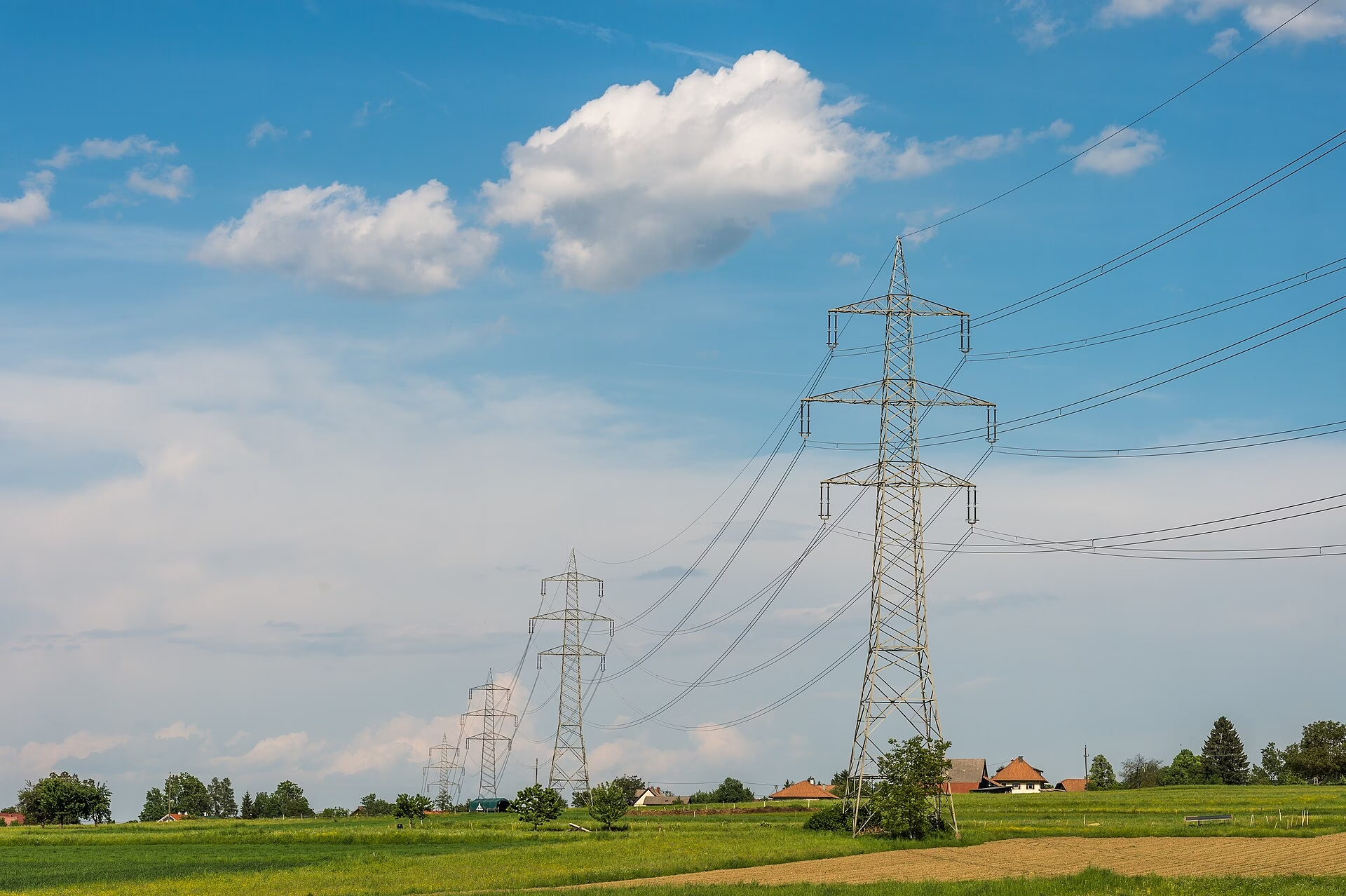

You can put up a hyperscale data centre in eighteen months. Getting it connected to the European grid takes seven to ten years, and thirteen at the worst nodes. Nobody fails at this because they picked a bad field. They fail because they picked a field they couldn’t energise.
So siting isn’t really a property search. It’s an overlay. You take five maps of the same continent, put them on top of each other, and look for the places where all five agree. Each map deletes most of Europe. What’s left is a shortlist you can count on one hand.
The order you apply them in decides whether you waste two years. But there’s a second question underneath, and it’s the one that should shape anything you’re planning past this decade: three of these constraints are being dissolved by engineering right now. Two of them can’t be, and won’t be.
Map one: ground somebody will insure
You’re asking an investor to put somewhere between a hundred million and several billion euro into one fenced compound and leave it there for twenty years. The land has to be boring, in a very particular way.
Three things rule a site out on the spot. Geopolitical exposure, meaning any jurisdiction where the rules around your asset can change faster than you can depreciate it. Seismic hazard, where the design acceleration pushes you into structural work that adds cost and not one megawatt of capacity. And flood, which is where people are still sloppiest: the screen that matters isn’t the 1-in-100-year line, it’s the 1-in-1000 and the climate-adjusted maps, and it has to cover pluvial as well as fluvial. Plenty of sites are dry on the river map and sitting under drainage that was sized for a different century.
The quickest proxy for all three is whether anyone will insure it. If underwriters won’t quote twenty years on the shell and the contents without a war exclusion or a flood carve-out, you have your answer.
Regulatory stability belongs on this map too. A site can be seismically dead, hydrologically dry and politically calm, and still find its host has changed its mind: in August 2026, Texas ordered its grid operator to audit the same data-centre industry it had spent a decade courting.
Map two: close to the business you serve
Most siting exercises treat this map as a preference, ranked below cost and land price. That’s backwards — it’s the one map on this list that outlives every technology shift.
It has two halves. The first is latency. A data centre exists to serve somebody, and for most enterprise workloads that somebody is a business with users, branches and machines in a specific place. Light in glass does about 200,000 km/s, which works out at roughly 1 ms per 100 km each way before anything touches the packet, and real fibre routes are never straight lines. For trading, industrial control, or anything with a person waiting on the other end, that budget goes fast. You can’t negotiate it. It’s a property of the universe.
The second half is sovereignty, and it’s the harder one. A European bank, hospital or manufacturer often can’t put certain data outside a defined jurisdiction, and increasingly won’t put it anywhere a foreign authority could compel disclosure. That’s why customers ask where the building physically stands before they ask what a rack costs. They’re treating data the way a bank treats deposits. Safe isn’t enough. It has to be safe here, under rules they recognise.
That’s why data centres cluster around commercial and industrial cores instead of the cheapest field two hundred kilometres out.
Map three: power you can actually draw
This is the map that kills the most individual sites. Everything else on this list is negotiable. Electrons aren’t.
Don’t go looking for a substation. A substation nearby is necessary and nowhere near sufficient. What you need is a firm connection offer for a stated capacity, on a network with the upstream headroom to actually deliver it, which means transmission and not just distribution. A 400 kV line overhead is scenery if everyone ahead of you in the queue has already claimed its capacity.
Across the EU, connection waits run from two to ten years depending where you are, and seven to ten in the markets everybody wants — the IEA’s own figures, not a developer’s complaint. Ireland made the arithmetic explicit: the CRU blocked EirGrid from connecting new data centres in greater Dublin, a freeze that ran towards 2028 before reopening in December 2025 on condition that new load bring 80% of its energy from newly built Irish renewables, because data centres — overwhelmingly sited around Dublin — already took about a fifth of the country’s electricity. That’s not a planning row. That’s a grid operator saying the arithmetic doesn’t close.
Which is why the thing you’re actually buying isn’t land. It’s powered land — a plot with a signed connection agreement and a date on it. The market has repriced accordingly: JLL puts prime powered land in Europe’s five biggest markets at €2.26 million per megawatt, up 82% from €1.24 million in 2021. Its same mid-2026 figures put the premium at 2.3× over secondary sites and 4× over tertiary ones. You’re not buying hectares. You’re buying a place in a queue.
Source: JLL, EMEA Data Centre Report (mid-2026), jll.com — retrieved 2026-09-18
Map four: fibre, and what the building is for
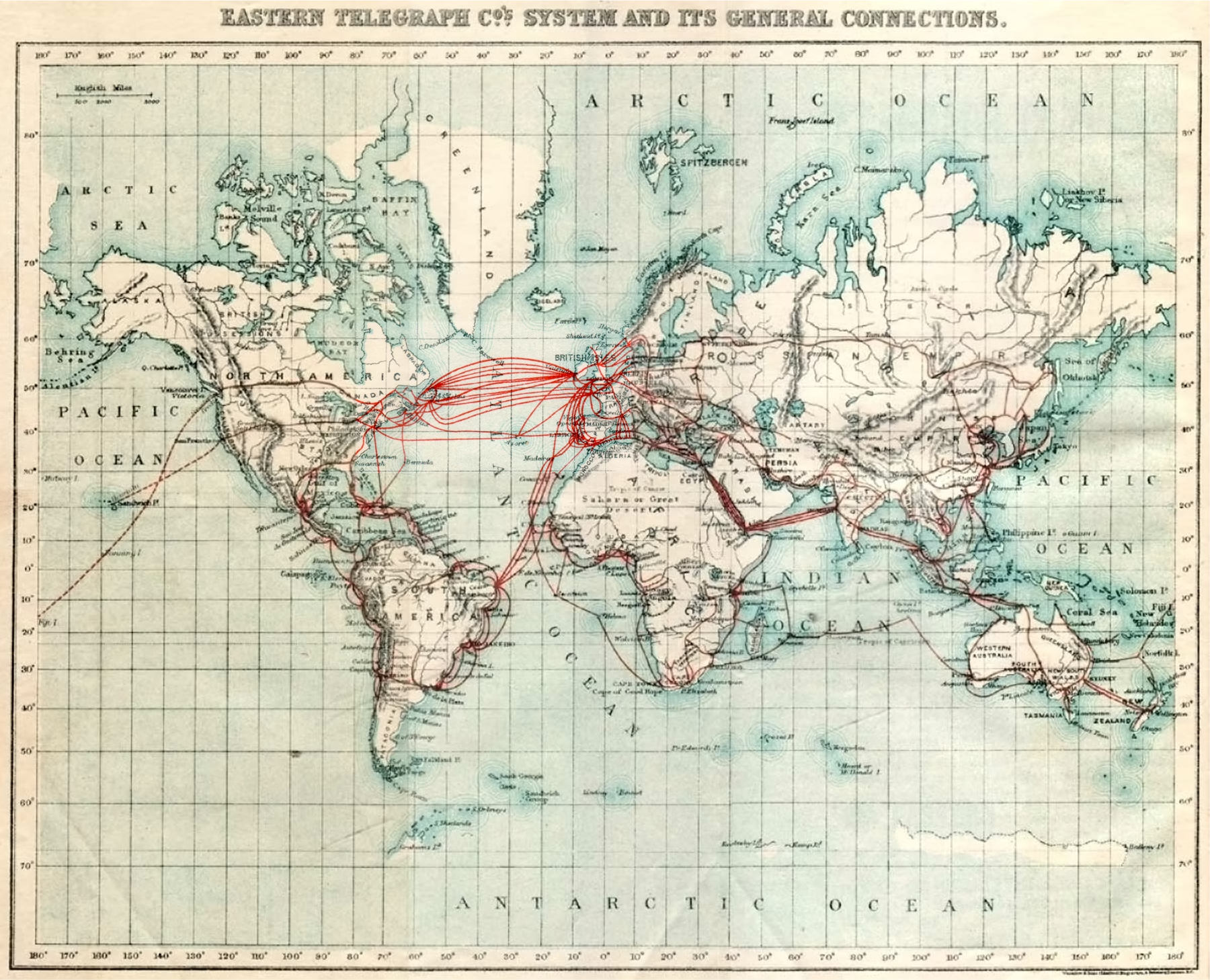
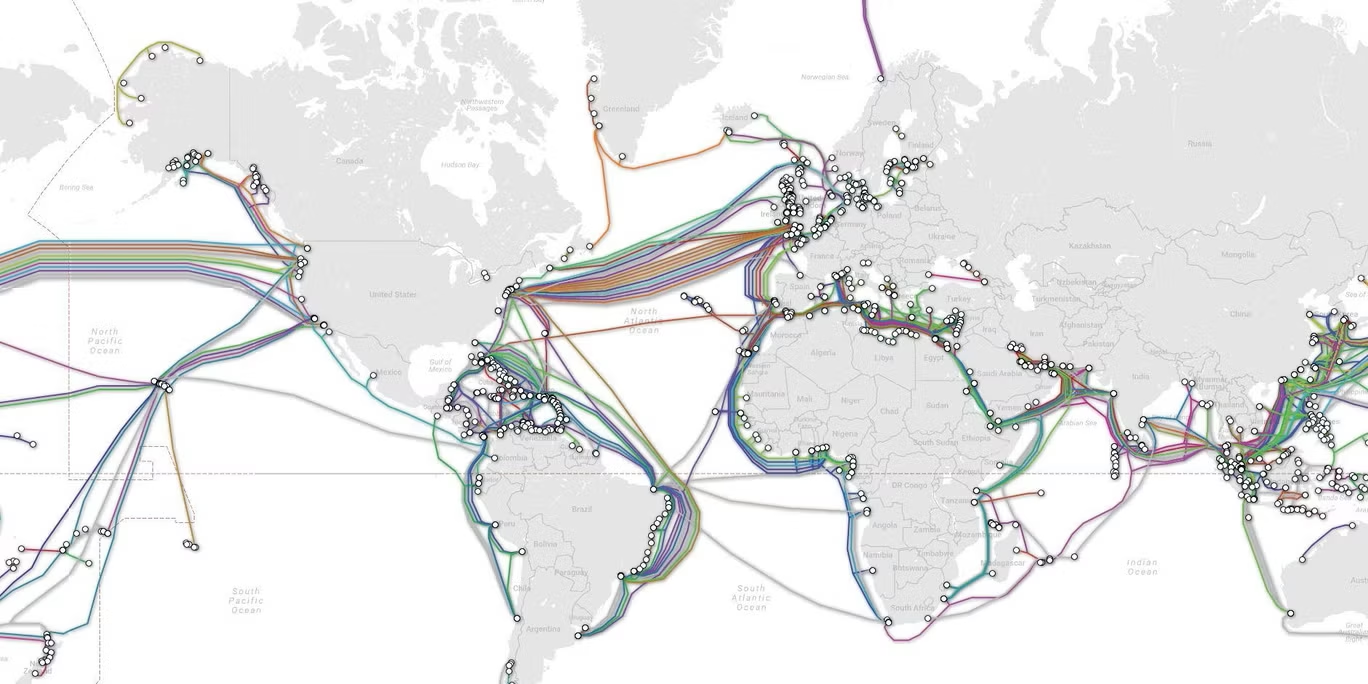
Put the subsea cables and the terrestrial long-haul routes on the same sheet. The pattern isn’t even. Capacity comes ashore at a handful of coastal points, and inland the long-haul follows old rights of way — railways, motorways, pipelines — so it runs in corridors rather than spreading out.
Those corridors are older than the industry using them. Below are two maps of the same planet, 125 years apart: the Eastern Telegraph Company’s chart of the world’s cable routes in 1901, and every submarine cable in service today. Almost everything about the technology changed. The routes did not. The same Atlantic crossings, the same Mediterranean corridor through Gibraltar and Suez, the same run down the west coast of Africa, the same choke point at the Red Sea. Cable follows the cheapest seabed and the friendliest shore, and neither has moved.
How much this map matters depends entirely on what the building does, and this is where people weight it wrong.
For a colocation business, being on those routes is the product. Customers are buying cross-connects: the ability to reach carriers, clouds and each other inside your building. A colocation hall off the fibre map isn’t a cheap data centre, it’s an empty one. For a training campus the maths is much looser. A cluster chewing through a run for three weeks needs enormous internal bandwidth and not much egress, which is exactly why training load is the workload drifting towards wherever the power happens to be. Work out which building you’re siting before you decide how much this map counts.
Get the next one by email
Physics, engineering and the people behind them. No spam, unsubscribe any time.
Map five: the people who keep it running
The last map doesn’t exist in any dataset, and it’s the one that quietly kills projects.
A data centre is not an unmanned asset. It needs an airport within a sane drive, because vendors, auditors and customers turn up in person. It needs a city close enough that the people you hire will stay. Most of all it needs an ecosystem: electrical contractors who have commissioned switchgear of this class before, mechanical firms who have run chilled water at scale, controls integrators, a spares chain — and enough of each that no single vendor can hold your commissioning date hostage.
The first building in a region pays to build that ecosystem. The tenth gets it for free. If you’re the first, be honest with yourself about the schedule.
The rule: screen in this order, and know which screens expire
Run the maps in order of how fast a failure ends the conversation. A site has to clear all five, and the first failure stops the work rather than starting a negotiation.
The last column is the one to plan against. It says whether a screen is a fact about this decade or a fact about the world.
| Order | Screen | Pass condition | Fails if | Permanent? |
|---|---|---|---|---|
| 1 | Power | Firm connection offer, stated MW, contractual energisation date inside the investment window | Queue position only, or capacity “expected” without a signed offer | No — loosening from about 2030 |
| 2 | Safe ground | Outside the 1-in-1000 flood extent on climate-adjusted maps, low seismic design category, twenty years insurable with no war or flood carve-out | Any underwriter exclusion, or rules that can change inside the depreciation period | Yes |
| 3 | Proximity to demand | Inside the latency budget of the users served (about 1 ms per 100 km of fibre, each way), in a jurisdiction the customer’s data may legally sit in | The data would land under a legal regime the customer can’t accept, at any price | Yes |
| 4 | Connectivity | Colocation: two or more diverse long-haul routes in physically separate ducts. Training: adequate egress, no single path | One route, or two routes sharing a duct or a bridge crossing | No — loosening now |
| 5 | Ecosystem | International airport inside about 90 minutes, commissioning contractors with class-relevant references in region, competing vendors on every critical trade | Single-source on any critical trade, or a talent pool you’d be the only employer in | No — loosening slowly |
Power goes first because it fails fastest, and it’s also the constraint most likely to be gone in ten years. Safe ground and proximity to demand rarely kill a site on day one — they’re the only two that will still be standing once everything else here has been engineered away.
Where Europe can build
Switch each screen off to see what it is removing. Three of these dissolve this decade; two never will.
Permanent
Dissolving
Thresholds
Illustrative, not survey data. Regions are scored 0–3 from published conditions to show how the overlay behaves. A real screen runs on licensed hazard, grid and route data, per plot. Boundaries: Natural Earth, public domain.
Three of the five are dissolving
Each of the temporary constraints has a technology aimed squarely at it. They’re at wildly different stages.
Power is decoupling from the grid. Rather than wait in a queue, operators are contracting their own nuclear capacity direct from the plant: Microsoft’s 835 MW deal with Constellation to restart Three Mile Island Unit 1, Meta’s 1,121 MW deal for Constellation’s Clinton plant, Amazon’s 1,920 MW purchase from Talen Energy’s Susquehanna plant (on top of its earlier $700 million bet on X-energy’s small modular reactors), and Google’s 500 MW order from Kairos Power. That’s 4.4 GW across four deals alone — and across roughly a dozen like them, U.S. hyperscalers had more than 10 GW of nuclear capacity under contract within about a year.
Source: Microsoft/Constellation (Sept. 2024, Three Mile Island Unit 1 restart), Google/Kairos Power (Oct. 2024, SMR fleet order), Meta/Constellation (June 2025, Clinton Clean Energy Center) and Amazon/Talen Energy (June 2025, Susquehanna PPA) — contracted or ordered capacity, not all of it generating yet. Retrieved 2026-09-18.
Be careful with this one, because it gets oversold constantly. What’s coming online first is restarted conventional plant, not small modular reactors. Crane is a 1970s pressurised water reactor being brought back from the dead. The SMR orders are for first units around 2030 and fleets by 2035. This constraint loosens at the end of the decade, not this year, and it loosens in America before it loosens here.
Connectivity is becoming less positional. Low-earth-orbit constellations and each new mobile generation chip away at the penalty for sitting off a fibre corridor. That matters far more for training campuses and edge sites than for colocation, where the cross-connect is the product and a satellite link is no substitute for a carrier-dense meet-me room.
Operations are needing fewer local hands. Automated routine maintenance, remote-hands robotics and lights-out running all weaken the fifth map, which is the one tying sites to existing hubs. It’s the least mature of the three and the one I’d discount hardest, but it’s directionally real, and if it arrives properly it would widen the map more than either of the others.
There is no roadmap anywhere that moves a fault line, drains a floodplain, or makes an untrustworthy jurisdiction trustworthy. Nothing repeals the speed of light. And nothing is going to talk a regulated European institution into accepting that its data may sit under a foreign compulsion regime. Maps one and two aren’t engineering problems.
Why this points somewhere obvious
Three constraints get engineered away over the next decade. Two don’t. So the places that win in the long run are the ones that score well on the two nobody can fix, and badly — for now — on the three everybody is fixing.
That is a description of Europe.
Most of its northern and central landmass is seismically quiet. It is politically stable over the horizons this kind of money needs. And it holds one of the largest concentrations of regulated industrial and financial demand anywhere: the banks, manufacturers, hospitals and public institutions whose data is subject to exactly the sovereignty rules that make map two binding.
Europe’s weaknesses are precisely the three temporary ones: the grid queues are the worst in the developed world, power is expensive, permitting is slow. The market is already routing around them — CBRE’s mid-2026 figures show only 37% of the roughly 700 MW of new European capacity added that quarter went to Frankfurt, London, Amsterdam, Paris or Dublin. The rest went to Spain, Italy, Poland and the Nordics, where the first screen still passes.
The European shortlist is short today because of the three constraints that are dissolving, not the two that are permanent. Fix the grid and Europe stops being one option among several for European data. On the only two maps that will still matter in 2040, it’s the obvious answer — which is roughly what the schemes to float data centres offshore are really admitting: they’re not looking for a better site, they’re trying to escape an overlay that, for anyone who actually has to comply with something, can’t be escaped.
One story like this, most days
Written by a CERN physicist. No spam, unsubscribe any time.