Key takeaways
- No. Stephen Hawking did not discover black holes. The idea is from John Michell in 1783, the mathematics from Karl Schwarzschild in 1916, and the proof that they must form from Roger Penrose in January 1965.
- Hawking’s own discoveries came later and are about what black holes do. In 1971 he showed that their total horizon area cannot shrink. In 1974 he predicted that they glow and slowly evaporate, now called Hawking radiation.
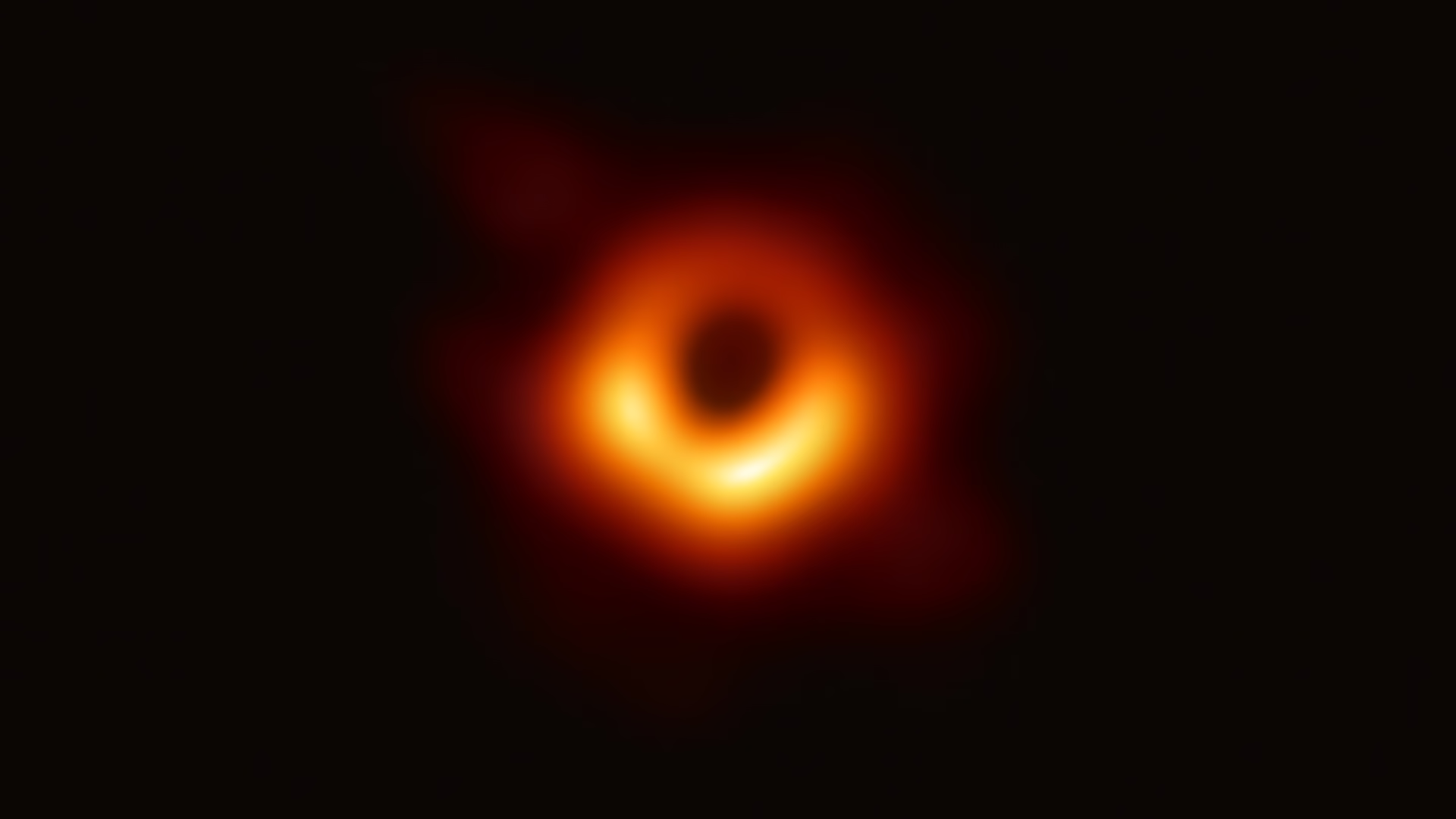
- The first strong candidate in the sky was Cygnus X-1, identified in two Nature papers in January and February 1972. The first image of a black hole’s shadow was released on 10 April 2019.
- Hawking died on 14 March 2018 without a Nobel Prize. His radiation has never been observed. The 2020 physics prize went to Penrose, Reinhard Genzel and Andrea Ghez.
Stephen Hawking did not discover black holes. By the time he published his first paper on them, the idea was almost two centuries old, the equations were half a century old, and Roger Penrose had already proved in January 1965 that real stars can collapse into them (Nobel Prize 2020). What Hawking found, in 1971 and 1974, was how black holes behave: they can only grow, and they are not completely black.
If you know one name connected with black holes, it is probably his, and that is why the question gets asked. The answer has more than a dozen names in it, and each one did something different. Some predicted, some solved, one named, and some pointed telescopes. The dates below are taken from the original papers and records.
The first idea: a dark star, 1783
The first person to describe a star whose light cannot escape was John Michell, an English clergyman and Fellow of the Royal Society. His paper was read to the Royal Society on 27 November 1783 and printed in the Philosophical Transactions in 1784 (Phil. Trans. 74, 35). Michell worked with Newton’s gravity and Newton’s idea that light is made of particles. He calculated that a star with the Sun’s density and about 500 times its radius would pull hard enough that its own light “would be made to return towards it”.
He also saw how to find one. Such a body would be invisible, he wrote, but a bright companion orbiting it could give it away. That is how the first real candidate was found in 1972. In France, Pierre-Simon Laplace reached the same idea in 1796 with different numbers: a body with the Earth’s density and 250 times the Sun’s diameter. He called such objects “corps obscurs”, dark bodies (Exposition du système du monde, vol. 2, p. 305).
Neither man had a black hole in the modern sense. A dark star in Newton’s physics has no event horizon, and light could still leave it briefly before falling back.
The mathematics: Schwarzschild, 1916
Einstein published general relativity in November 1915. Karl Schwarzschild found the first exact solution of its equations within weeks. His paper on the gravitational field of a mass point was communicated to the Prussian Academy of Sciences on 13 January 1916 (English translation, arXiv). The solution contains the distance now called the Schwarzschild radius, the size of the horizon.
Schwarzschild did not describe it as a black hole, and for decades most physicists did not think nature would ever squeeze matter inside that radius. The Nobel committee notes that Einstein “did not himself believe that black holes really exist” (Nobel Prize 2020). Our explainer on gravity and general relativity covers the theory itself.
Collapse, the horizon and spin: 1939 to 1963
On 1 September 1939, J. Robert Oppenheimer and Hartland Snyder published “On Continued Gravitational Contraction” (Physical Review 56, 455). A heavy star that has burned its fuel, they found, can keep contracting. Someone riding on its surface reaches the end in finite time. A distant observer sees the star approach its gravitational radius and never quite cross it.
In 1958 David Finkelstein showed that the surface at the Schwarzschild radius works as a one-way membrane, something you can fall through but never come back out of (Physical Review 110, 965). On 1 September 1963 Roy Kerr published the solution for a spinning mass (Physical Review Letters 11, 237). The American Physical Society notes that it turned out to describe the space around every astrophysical black hole.
The proof that they form: Penrose, 1965
The step that turned black holes from a mathematical curiosity into a prediction came from Roger Penrose. His paper “Gravitational Collapse and Space-Time Singularities” was received on 18 December 1964 and published on 18 January 1965 (Physical Review Letters 14, 57). It showed that once collapse passes a certain point, a singularity forms whether or not the star is perfectly round. The old objection, that a real lumpy star would avoid collapse, no longer worked.
This is the work the Nobel committee rewarded 55 years later. Penrose received half of the 2020 physics prize “for the discovery that black hole formation is a robust prediction of the general theory of relativity” (nobelprize.org). If one person deserves the word “discovered” for the theory, it is him.
Who named them
The name is usually credited to the American physicist John Wheeler, who used it in a lecture in New York on 29 December 1967 and then in print in 1968 (Herdeiro and Lemos, 2019). It is older than that. Science News Letter used “black holes” on 18 January 1964, in a report by Ann Ewing from a scientific meeting in Cleveland (Science News). Ewing did not say who had used the term, and nobody has settled it since (Science News, 2013). Wheeler made the name popular. He did not invent it.
Get the next one by email
One new article a week on radiation, particles and the instruments that measure them, with its sources. No spam, unsubscribe any time.
What Stephen Hawking actually discovered
Hawking’s first big result on the subject was written with Penrose. Their paper on the singularities of gravitational collapse and cosmology appeared in the Proceedings of the Royal Society in January 1970 and extended the singularity theorems to the universe as a whole (Proc. R. Soc. A 314, 529).
The next year he worked alone. In a paper published on 24 May 1971 he set an upper limit on the energy two colliding black holes can radiate (Physical Review Letters 26, 1344). The limit follows from a rule now called Hawking’s area theorem: the total area of black hole horizons never decreases (Cornell University, 2025). In 1973 Jacob Bekenstein argued that a black hole has entropy in proportion to that area (Physical Review D 7, 2333).
Then came the result his name is attached to. In “Black hole explosions?”, published in Nature on 1 March 1974, Hawking calculated with quantum theory that a black hole should “create and emit particles such as neutrinos or photons” as if it had a temperature (Nature 248, 30). The letter estimated, and the full paper in 1975 confirmed, that any primordial black hole lighter than about 1015 grams would have evaporated by now (Nature 248, 30; Communications in Mathematical Physics 43, 199). The University of Cambridge summarises it this way: black holes “have a temperature and produce radiation, now known as Hawking radiation” (Cambridge obituary).
More on the man himself is in our profile of Stephen Hawking.
Finding them in the sky
Michell’s trick from 1783 worked in 1971. Louise Webster and Paul Murdin, and separately C. T. Bolton, measured the star HDE 226868 and found its velocity swinging with a period that matched the X-ray source Cygnus X-1 (Nature 235, 37; Nature 235, 271). The papers appeared on 7 January and 4 February 1972. The visible star was orbiting a heavy companion that gave off X-rays and no light: the first strong black hole candidate.
The direct evidence took another 43 years. On 14 September 2015 at 09:50:45 UTC, the two LIGO detectors recorded gravitational waves from two black holes of about 36 and 29 solar masses merging into one of about 62 (Physical Review Letters 116, 061102). About 3 solar masses of energy left as gravitational waves. On 10 April 2019 the Event Horizon Telescope released the first image of a black hole’s shadow, in the galaxy Messier 87, 55 million light years away and 6.5 billion times the mass of the Sun (ESO). The image of Sagittarius A*, at the centre of our own galaxy, followed on 12 May 2022 (ESO).
The other half of the 2020 Nobel went to Reinhard Genzel and Andrea Ghez “for the discovery of a supermassive compact object at the centre of our galaxy”, for tracking stars that orbit an invisible, very massive object there (nobelprize.org). For what happens to anything that falls in, see what happens if you fall into a black hole.
Who discovered black holes: the dated record
| Date | Who | What | Record |
|---|---|---|---|
| 27 Nov 1783 | John Michell | Dark star: a body with the Sun’s density and about 500 times its radius holds in its own light | Phil. Trans. 74, 35 |
| 1796 | Pierre-Simon Laplace | “Corps obscurs” with the Earth’s density and 250 solar diameters | Exposition, vol. 2 |
| 13 Jan 1916 | Karl Schwarzschild | First exact solution of Einstein’s equations for a point mass | Sitzungsberichte 1916, 189 |
| 1 Sep 1939 | J. R. Oppenheimer, H. Snyder | A star collapsing without end | Phys. Rev. 56, 455 |
| 15 May 1958 | David Finkelstein | The horizon as a one-way membrane | Phys. Rev. 110, 965 |
| 1 Sep 1963 | Roy Kerr | Solution for a spinning black hole | PRL 11, 237 |
| 18 Jan 1964 | Science News Letter (Ann Ewing) | Earliest known printed use of “black holes” | Science News |
| 18 Jan 1965 | Roger Penrose | Proof that collapse produces a singularity | PRL 14, 57 |
| 29 Dec 1967 | John Wheeler | Lecture that made the name popular | Herdeiro and Lemos |
| Jan 1970 | Stephen Hawking, Roger Penrose | Singularity theorems for collapse and cosmology | Proc. R. Soc. A 314, 529 |
| 24 May 1971 | Stephen Hawking | Limit on radiation from colliding black holes (area theorem) | PRL 26, 1344 |
| Jan and Feb 1972 | Webster and Murdin; Bolton | Cygnus X-1: a star orbiting a heavy unseen companion | Nature 235, 37; 271 |
| 15 Apr 1973 | Jacob Bekenstein | Black hole entropy in proportion to horizon area | Phys. Rev. D 7, 2333 |
| 1 Mar 1974 | Stephen Hawking | Black holes emit particles: Hawking radiation | Nature 248, 30 |
| 14 Sep 2015 | LIGO (LIGO and Virgo collaborations) | First detected black hole merger | PRL 116, 061102 |
| 10 Apr 2019 | Event Horizon Telescope | First image of a black hole shadow, M87* | ESO |
| 6 Oct 2020 | Royal Swedish Academy of Sciences | Physics prize to Penrose, Genzel and Ghez | nobelprize.org |
| 12 May 2022 | Event Horizon Telescope | First image of Sagittarius A* | ESO |
| 10 Sep 2025 | LIGO, Virgo and KAGRA | GW250114 confirms the area theorem with the clearest merger signal yet | PRL 135, 111403 |
Was Hawking right?
Half of it has been tested. In 2021 a team led by Maximiliano Isi checked the area theorem on the first LIGO signal and found agreement with 97 percent probability (Physical Review Letters 127, 011103). A paper published on 10 September 2025, on the merger GW250114, went further. With a signal-to-noise ratio of 80, the final horizon area was larger than the two starting areas “to high credibility” (Physical Review Letters 135, 111403).
Hawking radiation is another matter. A 2025 paper still describes the prediction as unverified because the radiation is so faint (arXiv 2509.17599). Hawking died on 14 March 2018, aged 76 (University of Cambridge), and the Nobel Prize database lists no prize for him (Nobel Prize API). The search for small primordial black holes, the best known candidates for black holes evaporating today, goes on: see our piece on the candidate S251112cm.
References
- John Michell, “On the means of discovering the distance, magnitude, &c. of the fixed stars”, Philosophical Transactions 74 (1784), 35 to 57
- Pierre-Simon Laplace, Exposition du système du monde, vol. 2 (1796)
- Karl Schwarzschild, “On the Gravitational Field of a Mass Point according to Einstein’s Theory” (1916), English translation, arXiv physics/9905030
- J. R. Oppenheimer and H. Snyder, “On Continued Gravitational Contraction”, Physical Review 56, 455 (1939)
- David Finkelstein, “Past-Future Asymmetry of the Gravitational Field of a Point Particle”, Physical Review 110, 965 (1958)
- Roy P. Kerr, “Gravitational Field of a Spinning Mass as an Example of Algebraically Special Metrics”, Physical Review Letters 11, 237 (1963)
- Roger Penrose, “Gravitational Collapse and Space-Time Singularities”, Physical Review Letters 14, 57 (1965)
- The Nobel Prize in Physics 2020, press release
- Ann Ewing, “Black holes in space”, Science News Letter, 18 January 1964
- Tom Siegfried, “50 years later, it’s hard to say who named black holes”, Science News (2013)
- Carlos Herdeiro and José Lemos, “The black hole fifty years after: Genesis of the name”, arXiv 1811.06587
- B. Louise Webster and Paul Murdin, “Cygnus X-1, a Spectroscopic Binary with a Heavy Companion?”, Nature 235, 37 (1972)
- C. T. Bolton, “Identification of Cygnus X-1 with HDE 226868”, Nature 235, 271 (1972)
- S. W. Hawking and R. Penrose, “The singularities of gravitational collapse and cosmology”, Proc. R. Soc. A 314, 529 (1970)
- S. W. Hawking, “Gravitational Radiation from Colliding Black Holes”, Physical Review Letters 26, 1344 (1971)
- Jacob D. Bekenstein, “Black Holes and Entropy”, Physical Review D 7, 2333 (1973)
- S. W. Hawking, “Black hole explosions?”, Nature 248, 30 (1974)
- S. W. Hawking, “Particle creation by black holes”, Communications in Mathematical Physics 43, 199 (1975)
- LIGO Scientific Collaboration and Virgo Collaboration, “Observation of Gravitational Waves from a Binary Black Hole Merger”, Physical Review Letters 116, 061102 (2016)
- M. Isi et al., “Testing the Black-Hole Area Law with GW150914”, Physical Review Letters 127, 011103 (2021)
- LIGO, Virgo and KAGRA, GW250114, Physical Review Letters 135, 111403 (2025)
- Cornell University, LIGO verifies Hawking’s theorem (2025)
- ESO, Astronomers capture first image of a black hole (10 April 2019)
- ESO, Astronomers reveal first image of the black hole at the heart of our galaxy (12 May 2022)
- University of Cambridge, Professor Stephen Hawking 1942 to 2018
- arXiv 2509.17599 (2025), on the unverified status of Hawking radiation
- Nobel Prize API, laureate search for Hawking
Cite this article
Turner, A. (2026, November 21). Did Stephen Hawking Discover Black Holes? Who Really Did. ScienceShot. https://scienceshot.com/post/did-stephen-hawking-discover-black-holes
Turner, Alex. “Did Stephen Hawking Discover Black Holes? Who Really Did.” ScienceShot, 21 Nov. 2026, scienceshot.com/post/did-stephen-hawking-discover-black-holes.
Turner, Alex. “Did Stephen Hawking Discover Black Holes? Who Really Did.” ScienceShot, November 21, 2026. https://scienceshot.com/post/did-stephen-hawking-discover-black-holes.
@online{scienceshot-did-stephen-hawking-discover-2026,
  author       = {Turner, Alex},
  title        = {{Did Stephen Hawking Discover Black Holes? Who Really Did}},
  organization = {ScienceShot},
  date         = {2026-11-21},
  year         = {2026},
  url          = {https://scienceshot.com/post/did-stephen-hawking-discover-black-holes}
}
https://scienceshot.com/post/did-stephen-hawking-discover-black-holes
Get one article a week
One new article a week on radiation, particles and the instruments that measure them, with its sources. No spam, unsubscribe any time.