
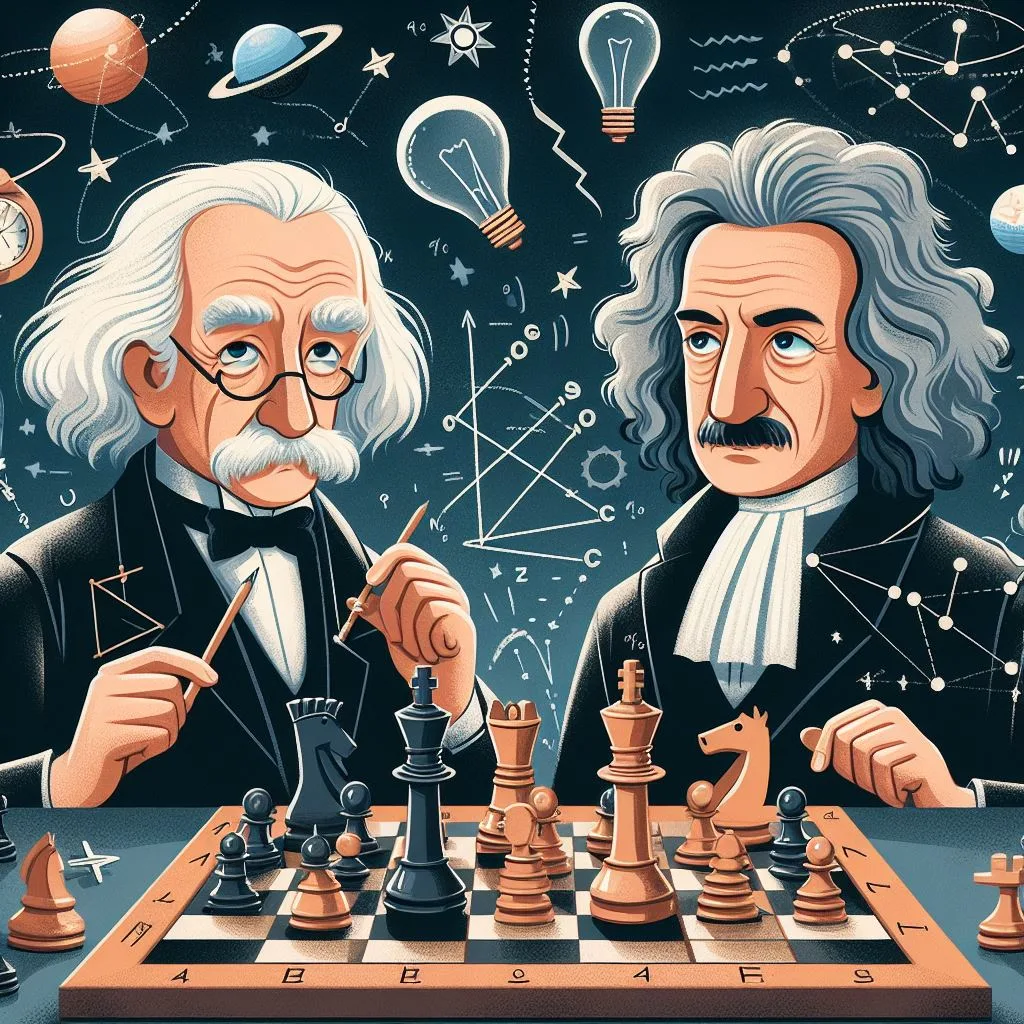
Did Einstein play chess? Yes, but only casually. By his own account he was no chess player, and he disliked the game’s fierce competitive spirit. In a foreword to a biography of the world champion Emanuel Lasker he wrote that he was no chess player and had always disliked the game’s fierce competitive spirit. He never had an Elo rating.
Search for “physicists who played chess” and you will find confident lists of Nobel laureates with master titles, blindfold exhibitions and Elo ratings. Most of those claims have no source. This article separates what is documented about Einstein, Hawking and other great scientists at the board from what has been invented, and explains why the game attracts people who think in models and probabilities.
Was Einstein good at chess?
Einstein knew the rules, but in a 1936 interview he said he had played chess only once or twice as a boy and had no time for games. He was never a club player and there is no record of him competing. The best evidence of his attitude is his foreword to Jacques Hannak’s biography of Emanuel Lasker, world champion from 1894 to 1921. The two men knew each other in Berlin, and Lasker, who had a doctorate in mathematics, published a critique of relativity. In the foreword Einstein called Lasker one of the most interesting people he had come to know, then confessed that he had “always disliked the fierce competitive spirit” of the game.
The famous “game” in which Einstein beats J. Robert Oppenheimer in Princeton, reprinted in many chess books and websites, has no reliable origin. The chess historian Edward Winter traced it to a 1959 German book that gave no date or venue, and found no evidence that Einstein had anything to do with it. For what Einstein did achieve, see our guide to Einstein’s discoveries that changed history.
What was Einstein’s chess Elo rating?
He had none. Arpad Elo’s rating system was adopted by the United States Chess Federation in 1960 and by FIDE, the world chess federation, in 1970. Einstein died in 1955, before either, and there is no record of him playing in any rated event. Any Elo figure you see quoted for Einstein is a guess presented as a fact.
Was Stephen Hawking good at chess?
There is no published evidence either way. The often repeated claim that Hawking had an Elo rating above 2000 traces to no tournament record, biography or rating list. His best documented chess appearance is a comedy: in the 2016 short film Anyone Can Quantum, made for Caltech’s Institute for Quantum Information and Matter, he plays a game of quantum chess against the actor Paul Rudd, with Keanu Reeves narrating. Hawking’s real legacy lies elsewhere, as our profile of Stephen Hawking and black holes explains.
Chess claims about famous scientists: what holds up
| Scientist | Common claim | What the record shows |
|---|---|---|
| Albert Einstein | Strong player who beat Oppenheimer | Casual player who disliked the game’s competitiveness; the Oppenheimer game is unsourced; no Elo rating |
| Stephen Hawking | Elo rating above 2000 | No published source found; played quantum chess on film in 2016 |
| Richard Feynman | Club and tournament player | Used chess as his best known analogy for discovering the laws of physics; no record of tournament play found |
| Carl Friedrich Gauss | Obsessive recorder of his games | Discussed the eight queens puzzle in letters of 1850 |
| Alan Turing | Rarely mentioned | Wrote one of the first chess programs, Turochamp, in 1948 |
| Claude Shannon | Rarely mentioned | Published the first paper on programming a computer to play chess, in 1950 |
| Pauli, Dirac, Schrödinger, Planck, Fermi | Expert players, blindfold exhibitions, games with Einstein | No published source found |
Feynman’s chess analogy
Richard Feynman’s real contribution to chess and physics is an analogy. In the second chapter of The Feynman Lectures on Physics he compared the world to a great chess game being played by the gods, with physicists as observers who do not know the rules and can only watch. Discovering the laws of physics is like working out the rules from the moves. Even with all the rules known, Feynman added, we might not understand why a particular move is made, because the game is too complicated for our minds. It remains one of the clearest descriptions of what physicists actually do, and it fits the man described in our profile of Richard Feynman.
Gauss and the eight queens
The eight queens puzzle asks how to place eight queens on a chessboard so that none attacks another. The chess composer Max Bezzel posed it in 1848, and in 1850 Franz Nauck published all 92 solutions. Carl Friedrich Gauss discussed the problem in letters to the astronomer Heinrich Schumacher that year and remarked that Nauck’s count could be confirmed by systematic trial in a few hours. Gauss did not invent the puzzle or solve it first, as is sometimes claimed, but the step by step search he described is the idea behind the backtracking algorithms programmers still use.
Get the next one by email
One new article a week on radiation, particles and the instruments that measure them, with its sources. No spam, unsubscribe any time.
Scientists who taught machines to play
The deepest link between science and chess came from computing. In 1948 Alan Turing and David Champernowne wrote Turochamp, one of the first chess programs, before any computer existed that could run it; Turing played it in 1952 by working through the instructions by hand. In 1950 Claude Shannon, the founder of information theory, published “Programming a Computer for Playing Chess”, which laid out the search strategies chess engines still use and estimated the number of possible games. Their line of work led to IBM’s Deep Blue beating world champion Garry Kasparov in 1997.
Chess players who were scientists
The link runs more clearly the other way: several of the strongest chess players were trained scientists. Emanuel Lasker proved a theorem in algebra still taught as the Lasker-Noether theorem. Max Euwe, world champion from 1935 to 1937, had a doctorate in mathematics and taught it for most of his life. Mikhail Botvinnik, world champion for most of the period from 1948 to 1963, was an electrical engineer with a doctorate in technical sciences. Among modern grandmasters, John Nunn holds a doctorate in mathematics from Oxford, and the economist Kenneth Rogoff, later chief economist of the International Monetary Fund, earned the grandmaster title in 1978.
The Game Complexity
Part of chess’s appeal to scientists is its combinatorics. White has 20 possible first moves, and after both players have moved there are 400 possible sequences. After two moves each there are 197,281 possible move sequences, and after four moves each more than 84 billion. Shannon estimated the number of possible games at around 10120, far more than the roughly 1080 atoms in the observable universe. The number of legal positions is much smaller, about 4.8 × 1044 by a 2021 estimate, but still far beyond what any computer could list.
Strong players cope with this by pattern recognition rather than brute calculation. In a classic 1973 study, Chase and Simon showed a master, a strong amateur and a beginner chess positions for five seconds. On the first attempt the master correctly replaced about 16 pieces from a real game position, the beginner about 4. When the pieces were arranged at random, the master’s advantage disappeared. Expertise in chess is memory for meaningful patterns, built over years of play, which is also a fair description of expertise in science.
A Relaxing Game?
For some scientists chess has been a relaxation, for others, like Einstein, a contest they preferred to avoid. Since Deep Blue, engines far stronger than any human have become analysis tools for grandmasters, and the modern descendants of Turing’s and Shannon’s programs now teach humans new ideas about a very old game. More stories from the history of physics are collected in our Science section. The question that remains open is a scientific one: chess has never been solved, and nobody knows whether perfect play from the starting position ends in a win for White or a draw.
Updated October 2026: rewritten against primary sources. Unsupported claims about scientists’ chess titles and ratings were removed, and sections on Einstein’s Elo rating and Hawking’s chess were added.
References
- Edward Winter, Alleged Games by Einstein and Stalin, Chess Notes
- J. Hannak, Emanuel Lasker: The Life of a Chess Master, with a foreword by Albert Einstein, London, 1959
- Caltech IQIM, One Entangled Evening (premiere of Anyone Can Quantum, 26 January 2016)
- R. P. Feynman, R. B. Leighton and M. Sands, The Feynman Lectures on Physics, Vol. I, chapter 2
- C. E. Shannon, “Programming a Computer for Playing Chess”, Philosophical Magazine 41, 256 (1950)
- W. G. Chase and H. A. Simon, “Perception in chess”, Cognitive Psychology 4, 55 (1973)
- OEIS A048987: number of possible chess games after n plies
Cite this article
Turner, A. (2024, June 4). Did Einstein Play Chess? How Good He Was and His Elo. ScienceShot. https://scienceshot.com/post/from-physics-to-checkmate-einstein-fermi-the-surprising-chess-skills-of-scientists
Turner, Alex. “Did Einstein Play Chess? How Good He Was and His Elo.” ScienceShot, 4 June 2024, scienceshot.com/post/from-physics-to-checkmate-einstein-fermi-the-surprising-chess-skills-of-scientists.
Turner, Alex. “Did Einstein Play Chess? How Good He Was and His Elo.” ScienceShot, June 4, 2024. https://scienceshot.com/post/from-physics-to-checkmate-einstein-fermi-the-surprising-chess-skills-of-scientists.
@online{scienceshot-from-physics-to-checkmate-2024,
  author       = {Turner, Alex},
  title        = {{Did Einstein Play Chess? How Good He Was and His Elo}},
  organization = {ScienceShot},
  date         = {2024-06-04},
  year         = {2024},
  url          = {https://scienceshot.com/post/from-physics-to-checkmate-einstein-fermi-the-surprising-chess-skills-of-scientists}
}
https://scienceshot.com/post/from-physics-to-checkmate-einstein-fermi-the-surprising-chess-skills-of-scientists
Get one article a week
One new article a week on radiation, particles and the instruments that measure them, with its sources. No spam, unsubscribe any time.




awesome