Key takeaways
- Google’s Sycamore had 53 qubits and a 0.62 percent two-qubit gate error in 2019. The lowest peer-reviewed or preprint errors we found are about 0.08 percent, from a superconducting fluxonium pair (2023) and Quantinuum’s Helios (2025).
- The largest arrays are neutral atoms: 6,100 trapped atoms in a 2025 paper and a vendor claim of 1,180 qubits in 2023. Neither source reports a two-qubit gate error for the whole array.
- IonQ claims a gate fidelity above 99.99 percent. That is a vendor statement with no method given, so it is drawn hollow and kept apart from the papers.
- Photonic machines have no comparable gate error. PsiQuantum reports a 99.22 percent fusion fidelity, which measures something else.
In 2019 the best-known quantum processor had 53 qubits and, in the Nature paper that announced it, an average two-qubit error of 0.62 percent. By late 2025 the table below holds a device with 98 qubits and an average two-qubit infidelity of 0.079 percent, and an atom array of 6,100. The two numbers did not move together. No row here pairs a count above 1,000 with a published gate error.
Three metrics, kept apart
Headlines mix three numbers, so we do not. A physical qubit count is how many qubits sit on one device or array. A two-qubit gate error is how often the basic entangling operation fails, taken as 100 percent minus the reported fidelity. A logical qubit count is how many error-protected qubits were shown, which depends on the code. Each has its own table, and a row appears only where a paper, a preprint or a vendor announcement gives the number.
Gate errors: superconducting and trapped ions lead
| Platform | System | Date | Two-qubit gate error | Metric as reported | Source type | Source |
|---|---|---|---|---|---|---|
| superconducting | Google Sycamore | 2019-10-23 | 0.62% | average two-qubit Pauli error e2, simultaneous operation (cross-entropy benchmarking) | paper | Arute et al., Nature 574, 505, Fig. 2 |
| superconducting | MIT fluxonium pair | 2023-09-25 | 0.078% | mean CZ gate fidelity 99.922 +/- 0.009 percent, averaged over about an hour | paper | Ding et al., Phys. Rev. X 13, 031035 |
| superconducting | USTC Zuchongzhi 3.0 | 2025-03-03 | 0.38% | reported two-qubit gate fidelity 99.62 percent | paper | Gao et al., Phys. Rev. Lett. 134, 090601 |
| trapped ion | Quantinuum race-track (H2) | 2023-12-18 | 0.184% | average two-qubit gate infidelity 1.84(5)e-3 across the device | paper | Moses et al., Phys. Rev. X 13, 041052 |
| trapped ion | IonQ electronic qubit control | 2025-10-21 | under 0.01% | fidelity 'exceeding 99.99 percent'; method not stated in the release, so 0.01 is an upper bound | vendor claim | IonQ press release, 21 Oct 2025 |
| trapped ion | Quantinuum Helios | 2025-11-07 | 0.079% | average two-qubit gate infidelity 7.9(2)e-4 over all operational zones | paper | Ransford et al., arXiv:2511.05465 (preprint) |
| neutral atom | Harvard/QuEra/MIT array | 2023-10-11 | 0.5% | two-qubit entangling gate fidelity 99.5 percent, up to 60 atoms in parallel | paper | Evered et al., Nature 622, 268 |
| spin | QuTech silicon processor | 2022-01-19 | 0.5% | two-qubit gate fidelity above 99.5 percent, gate set tomography | paper | Xue et al., Nature 601, 343 |
| spin | RIKEN silicon processor | 2022-01-19 | 0.5% | two-qubit gate fidelity 99.5 percent | paper | Noiri et al., Nature 601, 338 |
| photonic | PsiQuantum silicon-photonics modules | 2024-04-26 | not a gate error | two-qubit fusion fidelity 99.22 +/- 0.12 percent (a probabilistic measurement on two photons, not a gate); state preparation and measurement 99.98 percent | paper | Alexander et al., arXiv:2404.17570 |
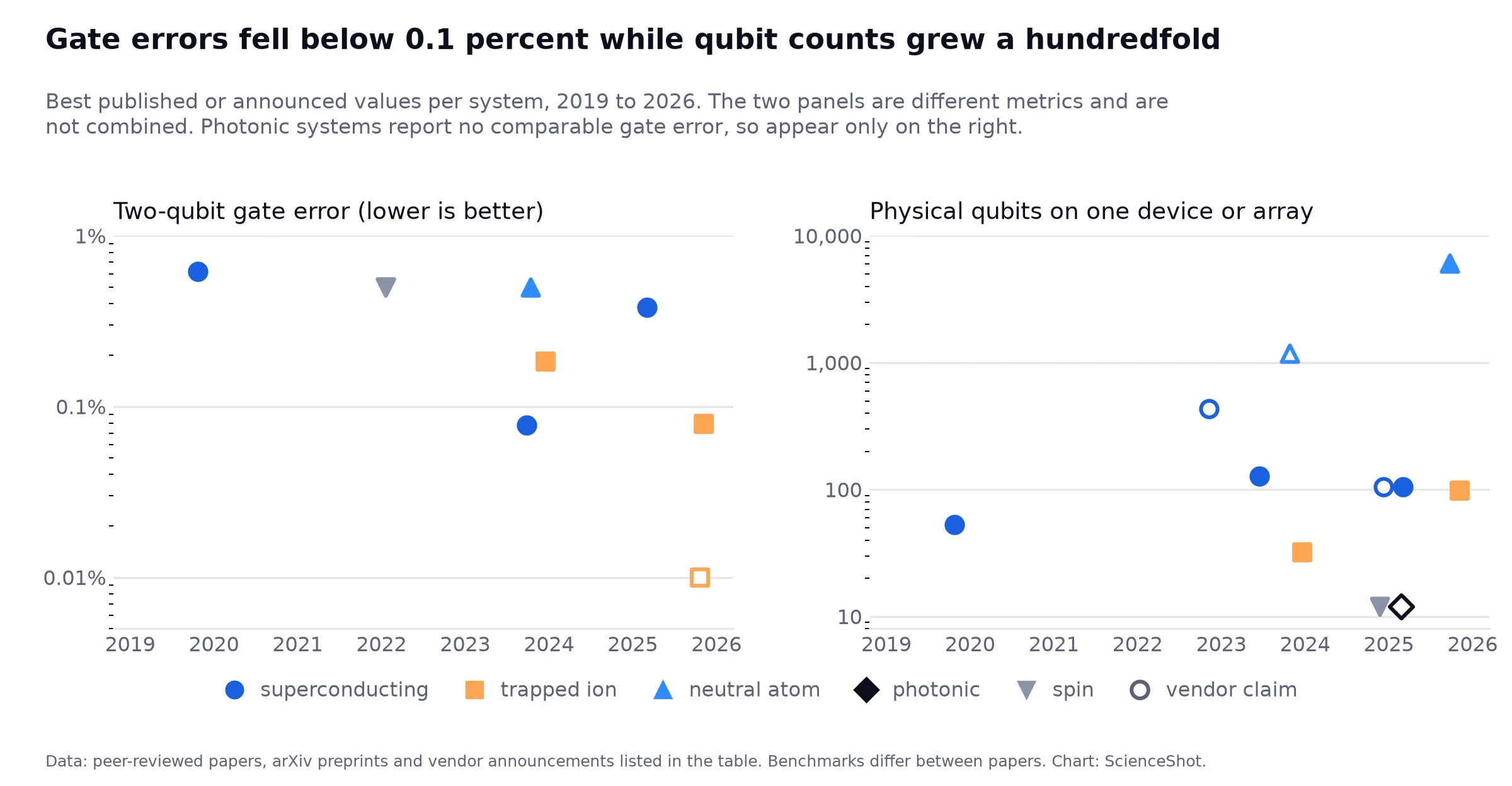
Two systems sit near 0.08 percent. An MIT fluxonium pair reached a mean controlled-Z fidelity of 99.922 percent, averaged over about an hour of operation with machine-tuned pulses. Quantinuum’s Helios, a 98-qubit trapped-ion machine, reports an average two-qubit infidelity of 0.079 percent over all its zones, in a preprint written by the vendor’s own team. A broad superconducting chip does worse: the 105-qubit Zuchongzhi 3.0 reports 99.62 percent, or 0.38 percent error.
Neutral atoms reached 99.5 percent on up to 60 atoms in parallel in 2023, and two groups reported the same for silicon spin qubits in 2022. Benchmarks differ: Sycamore’s figure is a Pauli error from cross-entropy benchmarking, the spin results come from gate set tomography, so small gaps between rows mean little.
Get the next one by email
One new article a week on radiation, particles and the instruments that measure them, with its sources. No spam, unsubscribe any time.
Counts: the biggest numbers are the loosest
| Platform | System | Date | Physical qubits | Note | Source type | Source |
|---|---|---|---|---|---|---|
| superconducting | Google Sycamore | 2019-10-23 | 53 | 53 qubits used of 54 on the chip | paper | Arute et al., Nature 574, 505, doi:10.1038/s41586-019-1666-5 |
| superconducting | IBM Osprey | 2022-11-09 | 433 | vendor announcement; no gate-error figure in the release | vendor claim | IBM Newsroom, 9 Nov 2022 |
| superconducting | IBM Eagle | 2023-06-14 | 127 | 127 qubits of the Eagle processor used in the experiment | paper | Kim et al., Nature 618, 500, doi:10.1038/s41586-023-06096-3 |
| superconducting | Google Willow | 2024-12-09 | 105 | qubit count from Google's announcement | vendor claim | Google blog, Willow chip |
| superconducting | USTC Zuchongzhi 3.0 | 2025-03-03 | 105 | n/a | paper | Gao et al., Phys. Rev. Lett. 134, 090601, doi:10.1103/PhysRevLett.134.090601 |
| trapped ion | Quantinuum race-track (H2) | 2023-12-18 | 32 | initially operated with 32 qubits | paper | Moses et al., Phys. Rev. X 13, 041052, doi:10.1103/PhysRevX.13.041052 |
| trapped ion | Quantinuum Helios | 2025-11-07 | 98 | preprint by the vendor's own team, not peer reviewed at compilation | paper | Ransford et al., arXiv:2511.05465 |
| neutral atom | Atom Computing array | 2023-10-24 | 1,180 | 1,225-site array populated with 1,180 qubits; vendor claim | vendor claim | Atom Computing press release, 24 Oct 2023 |
| neutral atom | Caltech tweezer array | 2025-09-24 | 6,100 | atoms trapped in about 12,000 sites; array size with coherent single-qubit control, not a full computer | paper | Manetsch et al., Nature 647, 60, doi:10.1038/s41586-025-09641-4 |
| photonic | Xanadu Aurora | 2025-01-22 | 12 | 12-qubit machine across 35 photonic chips; count from the vendor release, system described in the paper | vendor claim | Xanadu release (count); Nature 638, doi:10.1038/s41586-024-08406-9 (system) |
| spin | Intel Tunnel Falls | 2024-12-25 | 12 | 12-quantum-dot linear arrays on 300 mm wafers | paper | George et al., Nano Lett., doi:10.1021/acs.nanolett.4c05205 |
IBM’s 433-qubit Osprey is the largest superconducting chip in the table, and its announcement gives no gate error. The two atom rows differ in kind: the Caltech paper traps about 6,100 atoms and shows coherent control, while Atom Computing’s 1,180 qubits is a company statement about a 1,225-site array. Xanadu’s photonic Aurora, at 12 qubits across 35 chips, is counted from the company’s release.
Logical qubits
Counting logical qubits is a different exercise. A 2023 neutral-atom processor ran up to 48 logical qubits, but with codes that only detect errors. Google’s Willow ran one distance-7 surface-code memory below the error threshold, with 0.143 percent logical error per cycle.
| Platform | System | Date | Logical qubits | Note | Source type | Source |
|---|---|---|---|---|---|---|
| superconducting | Google Willow | 2024-12-09 | 1 | one distance-7 surface-code memory on 101 qubits, 0.143 percent logical error per cycle, below threshold | paper | Google Quantum AI, Nature 638, 920, doi:10.1038/s41586-024-08449-y |
| neutral atom | Harvard/QuEra/MIT logical processor | 2023-12-06 | 48 | up to 48 logical qubits with [[8,3,2]] codes, which detect but do not correct errors; up to 280 physical qubits | paper | Bluvstein et al., Nature, doi:10.1038/s41586-023-06927-3 |
Limits
This is a selection, not a census. We kept systems whose numbers trace to a paper or an announcement. Best values come from single devices or short runs, vendor claims are marked, and where a source gives no method we say so.
Cite this: ScienceShot, Qubit counts and error rates by platform, 2019 to 2026, November 2026, scienceshot.com, scienceshot.com/post/qubit-counts-error-rates-by-platform.
Sources: peer-reviewed papers, arXiv preprints and company releases from IBM, IonQ, Atom Computing, Xanadu and Google, each linked in the tables.
Cite this article
Turner, A. (2026, November 17). Qubit counts and error rates by platform, 2019 to 2026. ScienceShot. https://scienceshot.com/post/qubit-counts-error-rates-by-platform
Turner, Alex. “Qubit counts and error rates by platform, 2019 to 2026.” ScienceShot, 17 Nov. 2026, scienceshot.com/post/qubit-counts-error-rates-by-platform.
Turner, Alex. “Qubit counts and error rates by platform, 2019 to 2026.” ScienceShot, November 17, 2026. https://scienceshot.com/post/qubit-counts-error-rates-by-platform.
@online{scienceshot-qubit-counts-error-rates-2026,
  author       = {Turner, Alex},
  title        = {{Qubit counts and error rates by platform, 2019 to 2026}},
  organization = {ScienceShot},
  date         = {2026-11-17},
  year         = {2026},
  url          = {https://scienceshot.com/post/qubit-counts-error-rates-by-platform}
}
https://scienceshot.com/post/qubit-counts-error-rates-by-platform
Get one article a week
One new article a week on radiation, particles and the instruments that measure them, with its sources. No spam, unsubscribe any time.