Key takeaways
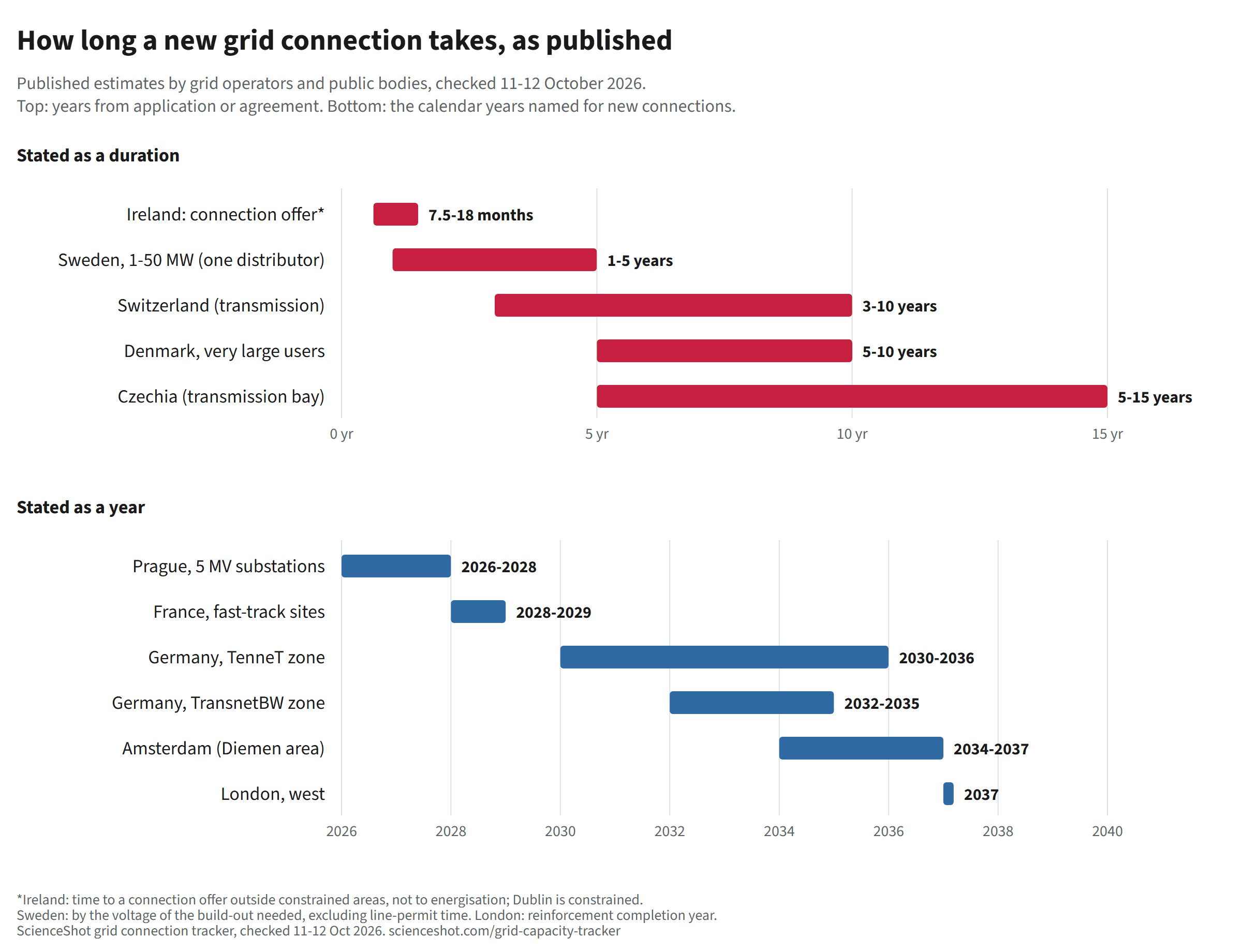
- There is no single European answer. Where grid operators publish a figure, it runs from 7.5 months to a connection offer in Ireland to 5 to 15 years for a new transmission bay in Czechia, and to the late 2030s in Amsterdam and west London.
- Most published waits are estimates of when capacity might exist, not connection dates. Several measure different things: an offer, a commissioning date, the end of a waiting list.
- In the big markets the harder question is who gets the capacity. Frankfurt and Berlin ration it once a year, Germany’s transmission operators rank by maturity, Spain tenders congested nodes, and Denmark puts data centres last in line.
- For a site search, check three things per market: the published wait, the allocation rule and the date the figure was checked. Our grid connection tracker covers 32 markets, with the published wait where one exists, the allocation rule and the date each was checked.
A data-centre developer in Europe can wait anywhere from under a year to well over a decade for grid power, and the published numbers do not measure the same thing. In Ireland, the transmission operator quotes 7.5 to 18 months, but that is the time to a connection offer outside constrained areas, and the Dublin region is constrained. In Czechia, the transmission operator quotes about five years for a new bay where a substation has space, and 10 to 15 years where a new substation must be built. In Amsterdam and west London, grid operators and public bodies name years, not durations: the end of 2037, and 2037.
This article answers the question with the figures operators have actually published, then shows why the wait is often the easier half of the problem. Every figure below is in the ScienceShot grid connection tracker, which follows published connection capacity, queues and rules in 32 European markets.
The published waits, market by market
| Market | Published wait | Applies to | What it measures |
|---|---|---|---|
| Ireland | 7.5 to 18 months to a connection offer; Dublin cannot be progressed | Data centres, transmission | Offer processing only, outside constrained areas; the range depends on how far the required on-site or nearby generation has progressed |
| Sweden (one large distributor) | 1 to 2, 2 to 3 or 3 to 5 years | New consumption of 1 to 50 MW | Banded by the voltage of the build-out needed (10 to 20 kV, 30 to 50 kV, 70 to 130 kV); excludes line-permit time and national-grid investments |
| Switzerland | 3 to 10 years from application | Transmission connections | Experience-based estimate to commissioning |
| Denmark | 5 to 10 years | Very large customers | Where new transmission lines or stations must first be decided and built |
| Czechia | About 5, 5 to 10, or 10 to 15 years | Any device on the transmission grid | Spare bay, substation extension, or new substation; counted from the preliminary connection agreement |
| Germany, TenneT zone | Earliest 2030 to 2036 | Large consumers, transmission | Ten substations open in the first maturity-based cycle |
| Germany, TransnetBW zone | Earliest 2032 to 2035 | Large consumers, transmission | Substations marked available on the operator’s map |
| France, fast-track sites | 2028 to 2029 | Five major data-centre projects | At sites the State identified in advance |
| Amsterdam, Diemen area | 2034 to 2037 (transmission); end of 2037 for about 150 queued requests (distribution) | All new demand | Waiting-list estimates, revised in January 2026 |
| London, west | 2037 | All new demand | Completion year of the transmission reinforcement that would relieve the constraint |
| Prague | 2026 to 2028 | Medium-voltage offtake at five substations | Years the distributor expects to lift its connection restrictions |
Three cautions before comparing rows. First, an offer is not a connection: the Irish figure stops where construction starts. Second, a range that starts in 2030 means the earliest year at the best substations, not a typical one. Third, many markets publish nothing comparable. We found no published wait figure for Belgium or Portugal, and Poland’s transmission operator states only that new offtake capacity will come at stations still to be built under its 2025 to 2034 development plan. A blank in the tracker reads “Not published” with the date it was checked, never zero.
Why the allocation rule matters more than the wait
A wait assumes there is a queue that moves. In a growing number of European markets there is no simple queue any more. Grid operators and regulators have replaced first come, first served with rules that decide who gets scarce capacity. For a developer, that rule decides whether an early application helps at all.
- Shared out once a year. In Frankfurt, requests of 3.5 MW and more are no longer served in order of arrival. The distributor splits the capacity at each grid node once a year, in proportion to what each applicant asked for, after priority uses such as heat pumps and charging are served. The current window closes on 31 January 2027 and applicants hear from about 15 April 2027. The operator expects restrictions until the mid-2030s. Berlin runs a similar annual allocation round above 3.5 MVA, splitting capacity equally among complete requests. Its 2025 round gave 365 MVA to 37 of 70 requests that together asked for 2,300 MVA. The 2026 round was postponed by six months over a court case, and the distributor expects it to open in mid-October 2026, though it has not ruled out further delays.
- Ranked by maturity. Germany’s four transmission operators replaced first come, first served with cycles in which the most mature projects win: land, permits, a technical concept, financing. The first cycle opened on 1 April 2026. Denmark and Finland apply maturity tests too: a Finnish distributor signs a large connection only once the zoning and building permits are legally valid.
- Put to tender. In Spain, when requests at a node exceed its capacity, access is tendered, with credit for avoided emissions, investment and start date. The first tender awarded 928 MW at five nodes, none of it described as a data centre. Four Madrid nodes are on the list where a tender can be called. Mainland Portugal allocates large connections through a procedure with deposits.
- Placed last. Denmark’s grid-priority law has been in force since 12 October 2026. The executive order made under it, in force from 19 October, sorts new requests into four priority categories. Data centres form the lowest, category 4, unless they serve a critical societal function. Grid companies must refuse category 3 and 4 requests where capacity is limited and connecting them would displace higher-priority needs.
- Closed or full. Great Britain’s transmission queue has been closed to new applications since the end of June 2025, with no reopening date. The Polish transmission operator shows zero offtake capacity at its existing stations. The Dublin region is constrained for new data centres. Central and southern Stockholm has no transmission capacity left to allocate.
The direction is clear: when capacity runs short, operators stop rewarding the first application. Instead they reward readiness or policy priority, or give everyone a share. A project with land, permits and a financed plan is better placed under most of these rules; a speculative reservation is not. Belgium shows the same pressure another way: its regulator kept first come, first served but added deadlines, proof of land and use-it-or-lose-it rules. Our regulation tracker follows the laws behind these rules.
Get the next one by email
Power, cooling, chips and the rules that shape them. No spam, unsubscribe any time.
Worked example: a 40 MW site in three markets
Take a 40 MW campus and read the tracker as a siting team would. The figures are the operators’ own; the comparison is ours.
- Frankfurt. At distribution level, the request enters the annual pro-rata round: apply by 31 January 2027, hear from about 15 April 2027, and expect a share of the node’s capacity, not the full 40 MW. At transmission level, the transmission operators’ maturity procedure applies, run by whichever operator serves the site; the Frankfurt distributor’s upstream operator is TenneT. Amprion, for example, charges €50,000 per application and a deposit of €1,500 per MW when an offer is accepted: €60,000 for 40 MW, on top of the fee. Its first cycle closed on 30 June 2026. The market page for Frankfurt shows the projects already in the pipeline competing for the same nodes.
- Sweden. One large distributor’s capacity map shows 1 to 2 years where a 10 to 20 kV build-out is enough and 3 to 5 years where 70 to 130 kV work is needed. Those bands exclude line permits and any national-grid reinforcement, and the map does not yet show national-grid capacity; the distributor says connections above 50 MW always depend on it. In central and southern Stockholm the transmission capacity is already allocated. The Sweden page shows where projects are going instead.
- Ireland. Outside constrained areas, an offer takes 7.5 to 18 months, but only for a project that brings dispatchable generation or storage on site or nearby, matching its import capacity, and a plan to meet at least 80% of its annual demand from additional Irish renewables within six years. In the Dublin region the application cannot be progressed. The rule is under judicial review. See the Ireland page.
What a siting team should take from this is a list of questions for the grid operator: which allocation round applies, what evidence of maturity counts, and whether a flexible connection is on offer while reinforcement is built. In Helsinki, for example, a high-voltage connection gets 10 MVA of firm capacity by default during reinforcement, with the rest flexible.
Check your own market in two minutes
- Open the grid connection tracker and pick the market from the map or the list. Each market shows a status per voltage level: open, conditional, rationed, congested or paused.
- Read the figures underneath: published waits, queues and contracted capacity, each with the date we last checked it.
- Read the rules section for the allocation method and any fee or deposit. A rule marked as proposed is not yet in force.
- Then open the market page for the projects, power prices and grid carbon in the same market.
Limits
Published waits are operators’ estimates and change with every reinforcement plan; three Amsterdam estimates moved later, by one to five years, in a single update in January 2026, while one subgrid could release capacity sooner. Figures cover what was published and checked on 11 and 12 October 2026. Where an operator publishes nothing comparable, we say so rather than estimate. None of this replaces a formal connection enquiry, which is the only binding answer.
Cite this: ScienceShot, How long does a data-centre grid connection take in Europe?, October 2026, scienceshot.com, scienceshot.com/post/data-centre-grid-connection-wait-europe.
Cite this article
Turner, A. (2026, October 19). How long does a data-centre grid connection take in Europe? ScienceShot. https://scienceshot.com/post/data-centre-grid-connection-wait-europe
Turner, Alex. “How long does a data-centre grid connection take in Europe?” ScienceShot, 19 Oct. 2026, scienceshot.com/post/data-centre-grid-connection-wait-europe.
Turner, Alex. “How long does a data-centre grid connection take in Europe?” ScienceShot, October 19, 2026. https://scienceshot.com/post/data-centre-grid-connection-wait-europe.
@online{scienceshot-data-centre-grid-connection-2026,
  author       = {Turner, Alex},
  title        = {{How long does a data-centre grid connection take in Europe?}},
  organization = {ScienceShot},
  date         = {2026-10-19},
  year         = {2026},
  url          = {https://scienceshot.com/post/data-centre-grid-connection-wait-europe}
}
https://scienceshot.com/post/data-centre-grid-connection-wait-europe
Get the weekly brief
Sourced analysis of data-centre engineering and regulation, every Monday. No spam, unsubscribe any time.