Water covers about 71 percent of Earth’s surface, yet where it came from is still an open question. For decades the favourite answer was that icy comets delivered it after the planet formed. Measurements of comet water, meteorites and the oldest minerals on Earth have since shifted the picture: most of the water seems to have been present from the start, inherited from rocky building blocks similar to some asteroids, with comets adding at most a small share.
The Quest for Earth’s Primitive Oceans
Earth formed about 4.5 billion years ago from dust and rock orbiting the young Sun. Its early history was violent: repeated giant impacts, including the collision that formed the Moon, melted much of the planet into a magma ocean. Yet tiny crystals of the mineral zircon from the Jack Hills of Western Australia, about 4.4 billion years old, carry oxygen isotope signatures that point to liquid water at the surface within roughly 150 million years of Earth’s formation [6].
So the water arrived early. The question is from where, and scientists test the candidates with a chemical fingerprint: the ratio of deuterium, the heavy isotope of hydrogen, to ordinary hydrogen. Earth’s oceans have a deuterium to hydrogen (D/H) ratio of about 1.56 × 10⁻⁴. A source that delivered most of the oceans should have a similar value.
Comets: the theory that did not fit
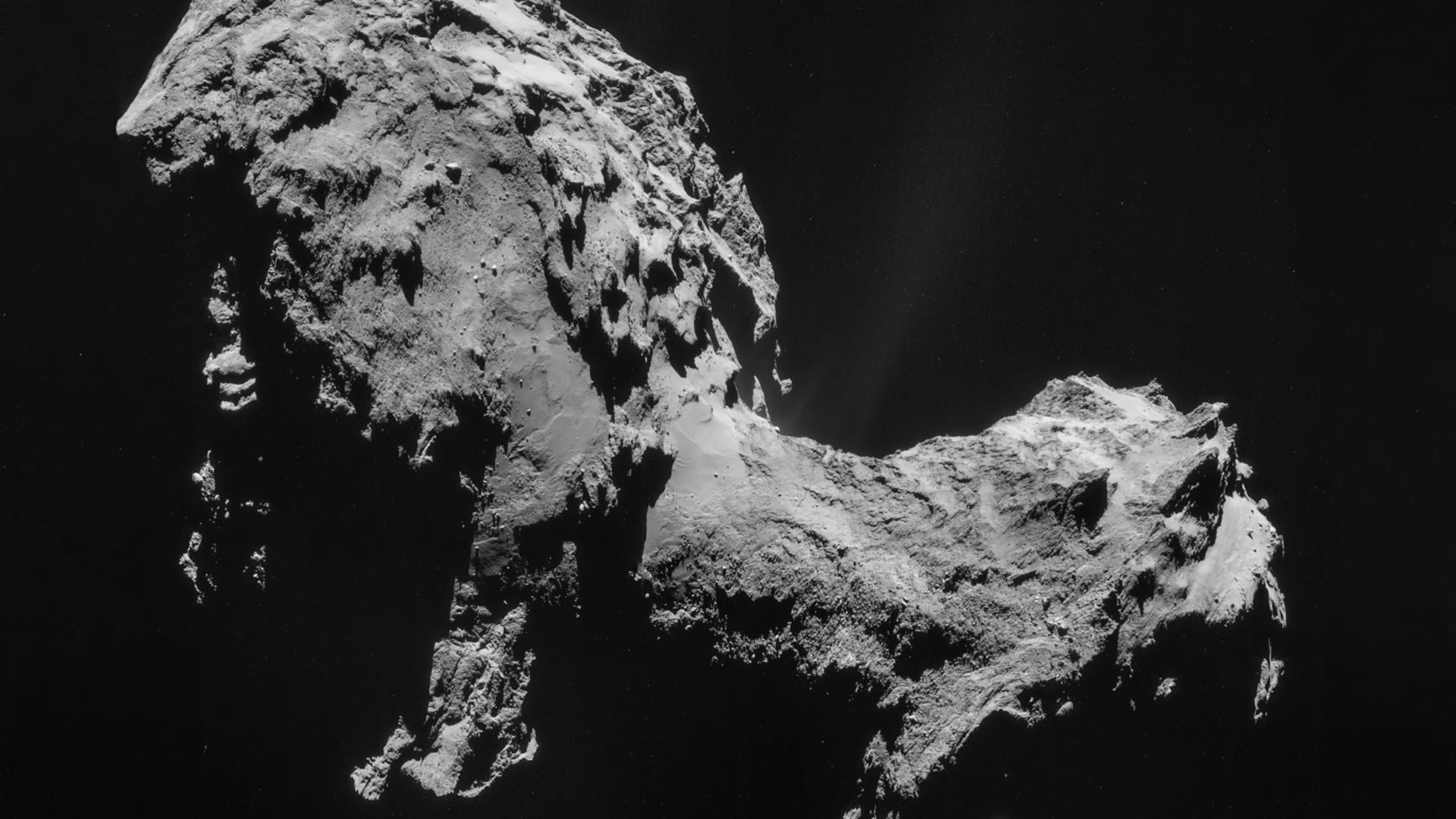
Comets are rich in ice, so they were the obvious suppliers. The isotope data mostly disagree. Comet Halley, measured by the Giotto probe in 1986, had about twice the ocean D/H ratio. In 2014 the ROSINA instrument on ESA’s Rosetta spacecraft measured the water around comet 67P/Churyumov-Gerasimenko and found a ratio of about 5.3 × 10⁻⁴, more than three times the ocean value [7]. A few comets, such as 103P/Hartley 2 [5] and 46P/Wirtanen [11], did show ocean-like ratios, so comets are not uniform, but most measured comets fail the test.
Comets did reach the young Earth. In 2017 Rosetta data showed that about a fifth of the xenon in Earth’s atmosphere has a cometary isotopic signature [8]. The same evidence that proves the impacts, though, leaves room for only a minor cometary contribution to the oceans.
Asteroids and the late veneer
Carbonaceous chondrites, meteorites from water-rich asteroids that formed farther from the Sun, have D/H ratios close to Earth’s oceans. That made them the favoured late source. Geochemists call the last material Earth accreted, after its iron core had separated, the “late veneer”. It amounted to only about half a percent of Earth’s mass, delivered within the first few hundred million years, not billions of years later.
The late veneer can explain some of Earth’s water and its supply of certain metals, but most models struggle to deliver the whole ocean this way while matching other isotopic constraints, such as those of nitrogen and the noble gases.
Get the next one by email
Power, cooling, chips and the rules that shape them. No spam, unsubscribe any time.
Water from Earth’s own building blocks
The strongest recent evidence points to water that was there from the beginning. Enstatite chondrites are meteorites whose isotopic composition is the closest known match to Earth’s, so they are thought to resemble the material that built our planet in the inner Solar System. They were long assumed to be bone dry. In 2020 a team led by Laurette Piani measured hydrogen in thirteen of them and found enough to supply at least three times the water in Earth’s oceans, with hydrogen and nitrogen isotopes matching those of Earth’s mantle [9].
A second route makes water on the spot. If the young Earth gathered a thick envelope of hydrogen from the gas disc around the Sun, that hydrogen would react with oxygen-bearing minerals in the magma ocean to produce water. A 2023 study by Edward Young and colleagues found that this process could account for Earth’s water and for some puzzling features of its composition [10].
From steam to the first oceans
Wherever the water came from, during the magma ocean phase much of it would have been in a dense steam atmosphere. Models of this phase suggest that once the surface cooled enough, the steam condensed and rained out to form oceans within a few million years [1]. A thick carbon dioxide atmosphere would have kept the surface hot, possibly around 200 to 250 °C under pressures far above today’s, with the oceans staying liquid because of the high pressure. As carbon dioxide was drawn into rocks, conditions became milder.
Conclusion: Origins of Earth’s Water
The current view is a mixture, weighted towards an early origin. Most of Earth’s water probably came with the rocky material that built the planet, perhaps topped up by water-rich asteroids and by chemistry in the magma ocean, while comets contributed a small fraction. If that is right, water-rich rocky planets may be common around other stars, because the water does not depend on a lucky delivery of comets.
Important uncertainties remain. Only a handful of comets have measured D/H ratios, sample-return missions such as Hayabusa2 and OSIRIS-REx are still being analysed, and the balance between inherited and delivered water is still debated.
References
[2] Elkins-Tanton, L. T. (2008). Linked magma ocean solidification and atmospheric growth for Earth and Mars. Earth and Planetary Science Letters, 271(1-4), 181-191.
[3] Sleep, N. H. (2010). The Hadean-Archaean Environment. Cold Spring Harbor Perspectives in Biology, 2(6), a002527.
[4] Zahnle, K., Arndt, N., Cockell, C., Halliday, A., Nisbet, E., Selsis, F., & Sleep, N. H. (2007). Emergence of a habitable planet. Space Science Reviews, 129(1), 35-78.
[5] Hartogh, P., et al. (2011). Ocean-like water in the Jupiter-family comet 103P/Hartley 2. Nature, 478, 218-220.
[6] Wilde, S. A., Valley, J. W., Peck, W. H., & Graham, C. M. (2001). Evidence from detrital zircons for the existence of continental crust and oceans on the Earth 4.4 Gyr ago. Nature, 409, 175-178.
[7] Altwegg, K., et al. (2015). 67P/Churyumov-Gerasimenko, a Jupiter family comet with a high D/H ratio. Science, 347, 1261952.
[8] Marty, B., et al. (2017). Xenon isotopes in 67P/Churyumov-Gerasimenko show that comets contributed to Earth’s atmosphere. Science, 356, 1069-1072.
[9] Piani, L., et al. (2020). Earth’s water may have been inherited from material similar to enstatite chondrite meteorites. Science, 369, 1110-1113.
[10] Young, E. D., Shahar, A., & Schlichting, H. E. (2023). Earth shaped by primordial H2 atmospheres. Nature, 616, 306-311.
[11] Lis, D. C., et al. (2019). Terrestrial deuterium-to-hydrogen ratio in water in hyperactive comets. Astronomy & Astrophysics, 625, L5.
Cite this article
Piro, V. (2024, December 21). Where Did Earth's Water Actually Come From? New Theories Explained. ScienceShot. https://scienceshot.com/post/the-mysterious-origins-of-earths-water-new-theories-unveiled
Piro, Viros. “Where Did Earth's Water Actually Come From? New Theories Explained.” ScienceShot, 21 Dec. 2024, scienceshot.com/post/the-mysterious-origins-of-earths-water-new-theories-unveiled.
Piro, Viros. “Where Did Earth's Water Actually Come From? New Theories Explained.” ScienceShot, December 21, 2024. https://scienceshot.com/post/the-mysterious-origins-of-earths-water-new-theories-unveiled.
@online{scienceshot-the-mysterious-origins-of-2024,
  author       = {Piro, Viros},
  title        = {{Where Did Earth's Water Actually Come From? New Theories Explained}},
  organization = {ScienceShot},
  date         = {2024-12-21},
  year         = {2024},
  url          = {https://scienceshot.com/post/the-mysterious-origins-of-earths-water-new-theories-unveiled}
}
https://scienceshot.com/post/the-mysterious-origins-of-earths-water-new-theories-unveiled
Get the weekly brief
Sourced analysis of data-centre engineering and regulation, every Monday. No spam, unsubscribe any time.