
Ask Google “is 6G a thing” and you will get two kinds of answers: breathless promises of terabit speeds, and cynics telling you 5G was a letdown so 6G must be vapour. Both are wrong. 6G became officially “a thing” in the most bureaucratic way possible — in standards committees — and 2026 is precisely the year it is happening. Everyone covers 6G as a faster phone plan; the real story is that 6G is quietly being redesigned as infrastructure for machines, not humans.
Here is the honest status report: what exists today, what is genuinely decided, and what remains marketing.
Yes, 6G Is a Thing — the Paperwork Proves It
Mobile generations are born twice: once in the lab, once in the standards bodies. The second birth is the one that counts, and it is underway. 3GPP — the body that has written every mobile standard since 3G — started formal 6G requirement studies in 2024 (Release 19), ran architecture studies through 2025 (Release 20), and with Release 21 is now beginning the first normative 6G specifications, with the work-plan decision landing in mid-2026.
In parallel, the ITU — the UN agency for telecoms — is finalising the performance requirements for IMT-2030, the official name of 6G, by the end of 2026. Technology submissions run 2027 to early 2029, and the final designation is expected around 2030. This is exactly the machinery that produced 4G and 5G, running on schedule.
Source: 3GPP Release 19–21 planning, ITU-R IMT-2030 process, Ericsson
What 6G Will Actually Deliver (and What Got Downsized)
The headline targets are spectacular: peak rates up to 1 terabit per second and radio latency around 100 microseconds — roughly 50 times faster and 10 times more responsive than 5G’s targets. But read the engineering fine print and a more interesting picture emerges.
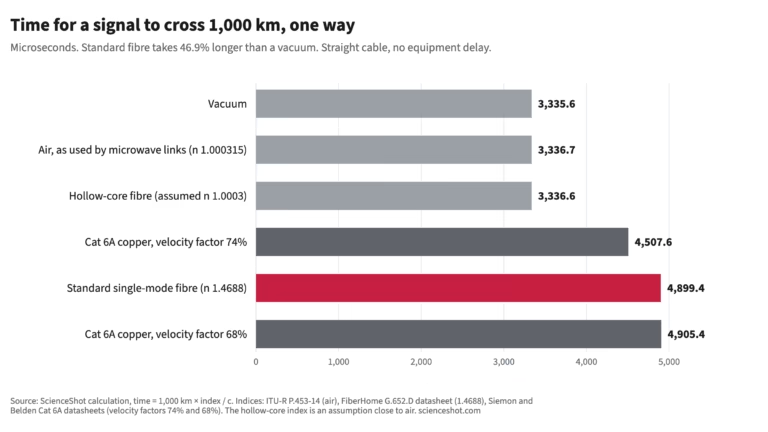
The famous terahertz bands — the ones behind the “1 Tbps” number — remain largely research territory: those frequencies carry enormous data but die over short distances and hate walls. The spectrum where 6G will actually live first is the 7–24 GHz upper mid-band: less glamorous, far more practical. As I wrote about hollow-core fibres, the physics of moving photons fast is rarely the bottleneck — moving them fast reliably and economically is the whole game.
Source: ITU-R IMT-2030 performance targets, industry 6G research programmes
Get the next one by email
Power, cooling, chips and the rules that shape them. No spam, unsubscribe any time.
The Real Point of 6G: a Network for Machines
5G was sold to consumers and largely wasted on them — few humans need 10 Gbps on a phone. The 6G design documents make a quieter, smarter bet: the heavy users of the next network are not people but machines and AI systems. Native AI in the network core, integrated sensing (the network locating and imaging objects, not just connecting them), digital twins, swarms of sensors and agents talking to each other.
That vision plugs directly into infrastructure trends I cover here: compute is being metered like a utility, as I argued in Intelligence like Electricity, and even the quantum internet is being prototyped between real cities. 6G is the radio layer of that world — the piece that lets the AI-era infrastructure reach beyond the fibre.
⚡ PHOTON’S TAKE
6G is real, but it is not for you — and that is fine. Nobody’s phone needs a terabit per second. The machines do: AI agents, sensor swarms, digital twins, networks that position and sense as well as they transmit. I spent years building infrastructure that ordinary people never see, first under Geneva and now in data centers, and 6G belongs to that family. The generation that stops being about phones is the most interesting one yet.
Is 6G a Thing? Frequently Asked Questions
Does 6G exist today?
As deployed technology, no. As an official standards programme with committed timelines, yes — normative specification work started with 3GPP Release 21, and first specifications are expected around 2028.
When will 6G launch?
Industry consensus points to around 2030 for first commercial deployments, with Nokia, Ericsson and Huawei all targeting that window. Expect the usual pattern: flagship cities first, broad coverage years later.
Will 6G replace 5G?
Not quickly. 6G is designed to build on the 5G core rather than discard it, and 5G (and even 4G) will carry most human traffic well into the 2030s.
Do I need to care about 6G now?
As a consumer, no. As an investor, engineer or policy watcher — yes: the spectrum decisions and standards battles being fought in 2026–2028 will decide who owns the next decade of connectivity.
The Bottom Line
So, is 6G a thing? It is the most concrete “not yet” in technology: funded, scheduled, and being written into international standards at this moment — but half a decade from your pocket, and honestly, your pocket was never the point.
Cite this article
Turner, A. (2023, December 6). Is 6G a Thing? What Is Real and What Is Hype. ScienceShot. https://scienceshot.com/post/unlocking-the-future-exploring-the-wonders-of-6g-technology
Turner, Alex. “Is 6G a Thing? What Is Real and What Is Hype.” ScienceShot, 6 Dec. 2023, scienceshot.com/post/unlocking-the-future-exploring-the-wonders-of-6g-technology.
Turner, Alex. “Is 6G a Thing? What Is Real and What Is Hype.” ScienceShot, December 6, 2023. https://scienceshot.com/post/unlocking-the-future-exploring-the-wonders-of-6g-technology.
@online{scienceshot-unlocking-the-future-exploring-2023,
  author       = {Turner, Alex},
  title        = {{Is 6G a Thing? What Is Real and What Is Hype}},
  organization = {ScienceShot},
  date         = {2023-12-06},
  year         = {2023},
  url          = {https://scienceshot.com/post/unlocking-the-future-exploring-the-wonders-of-6g-technology}
}
https://scienceshot.com/post/unlocking-the-future-exploring-the-wonders-of-6g-technology
Get the weekly brief
Sourced analysis of data-centre engineering and regulation, every Monday. No spam, unsubscribe any time.