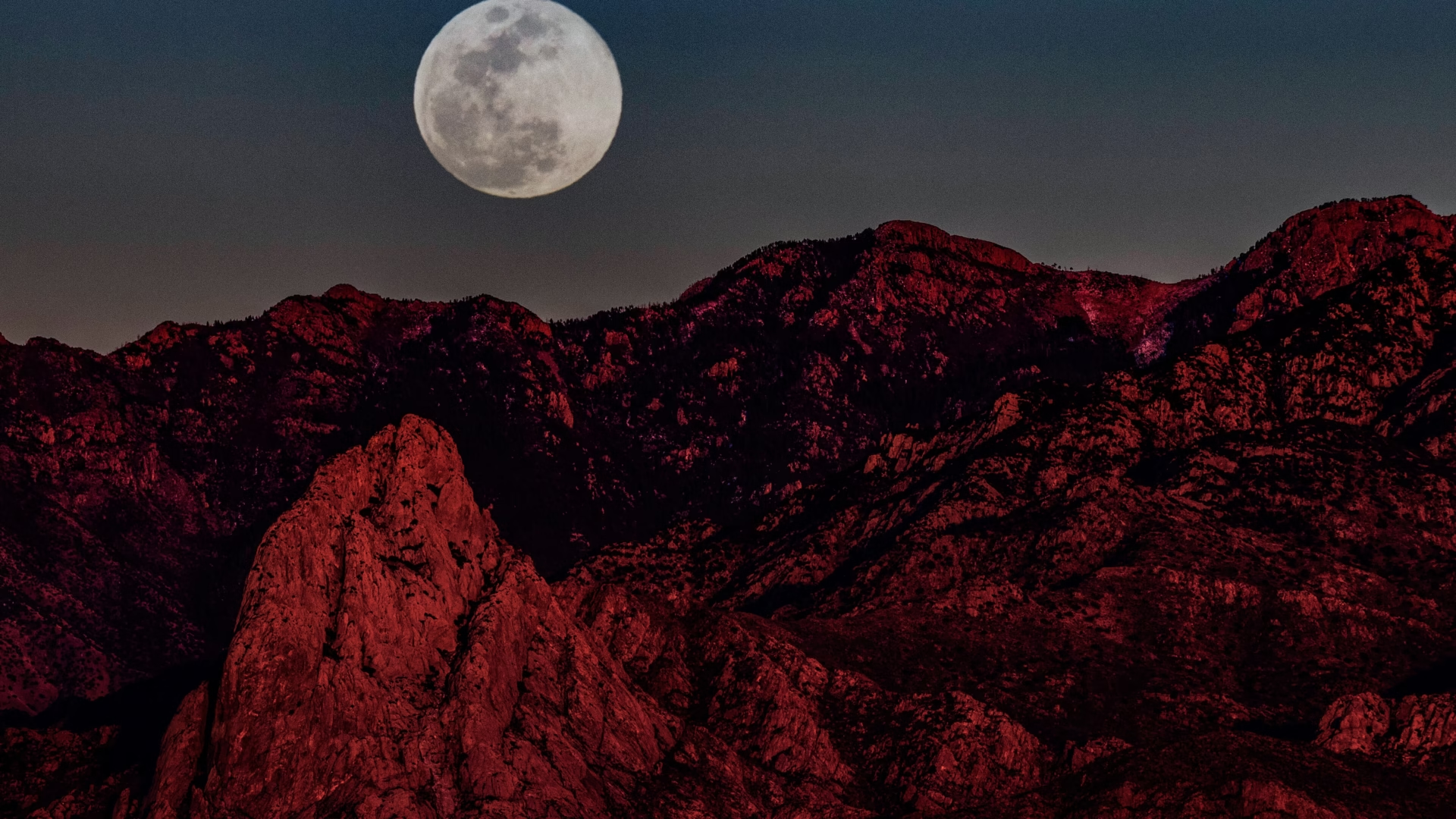

You have seen the Moon rise over a ridge or a rooftop and look far too big. The huge Moon was the smaller one. When the Moon sits on the horizon it is farther away from you than when it is high in the sky, and the image it makes inside your eye is smaller too. Four hours later you can cover that same Moon with a fingertip, and nothing about it has changed.
It does not feel like an illusion when you are standing there. A harvest Moon comes up orange behind a line of trees and looks enormous. People stop the car to look at it. Then they take a photo, and the photo shows a small pale dot near the bottom of the frame. That gap between what you saw and what the camera recorded is the whole problem. The moon illusion is the oldest open question in the science of vision, and it is open in the real sense: two groups of researchers have been reading the same evidence in opposite ways since 1962.
So what causes it?
Why the moon illusion is not caused by the atmosphere
Start with the answer most people give: thick air near the horizon works like a lens and magnifies the Moon. Aristotle wrote this down in the Meteorologica in the fourth century BCE, blaming mist near the ground. About 2,300 years later it is still the first answer I hear. Air near the horizon does bend light. It bends it the wrong way.
The bending happens up and down, never side to side. The bottom edge of the Moon is seen through more air than the top edge, so the bottom edge is lifted more, and the disc gets squashed from top to bottom while the width stays exactly where it was. Astronomers measure sizes in the sky in degrees and arcminutes, which are sixtieths of a degree. The Moon is about 31 arcminutes across. Close to the horizon its height falls to roughly 26 arcminutes. A lens would make the whole disc bigger in both directions. The air gives you a flattened oval, wider than it is tall. You can see this on the next clear evening: watch the Sun in its final minute above a flat horizon and it looks visibly squashed before it goes.
The second answer people give is that the Moon is closer when it is low. Geometry says the opposite, by a precise amount. When the Moon is straight overhead, you are standing on the part of the Earth nearest to it. When the Moon is down on your horizon, the Earth has turned and carried you round to the side, about one planet radius farther back. The Earth’s radius at the equator is 6,378.137 km, and the average distance to the Moon is 384,400 km. So the low Moon is about 1.66% more distant, and looks smaller by that fraction. (For scale: the deepest hole anyone has drilled into the Earth, the Kola Superdeep Borehole, stopped at 12.262 km.)
The third answer is that the change is out there in the light, which would mean a camera could record it. Photograph the Moon as it rises, then again when it is high, on the same night with the same lens. The two discs come out the same width, to within that 1.66%. Astronomers in Ptolemy’s tradition got the same result with measuring sticks, a thousand years before cameras existed.
The case against every moon illusion explanation
The full list, in the order people reach for them. Each one has an answer.
| Claim | Counter-claim | Evidence |
|---|---|---|
| Thick air near the horizon magnifies the Moon | Air bends light up and down only. It squashes the disc from 31 to about 26 arcminutes tall and leaves the width unchanged | Standard atmospheric refraction tables; Aristotle, Meteorologica, 4th c. BCE |
| The Moon is closer when it is on the horizon | About one Earth radius farther: 6,378.137 km against an average 384,400 km, so 1.66% more distant and smaller | Orbital geometry; the Moon’s diameter of 3,474.8 km gives 0.5178 degrees |
| The change is physical, so a camera would record it | Same lens, same night: both discs measure the same width, to within 1.66% | Kaufman and Rock, Science, 1962 |
| Nearby trees and buildings make it look big by comparison | It still works over an empty sea horizon, and inside a sealed machine with no landscape in view | Kaufman and Rock, 1962; Kaufman and Kaufman, PNAS 97(1):500-505, 2000 |
| Apparent distance: the landscape and the flattened sky make the brain judge the low Moon as far away, so it scales it up | McCready: this mixes up how big the Moon looks with how big you judge it to be. The angle of your eyes alone changes how big it looks | Ptolemy, c. 150 CE; Ibn al-Haytham, c. 1021; Kaufman and Rock, 1962; McCready, UW-Whitewater |
| A purely mental illusion should not be beaten by a physical trick | Looking at it upside down between your legs measurably weakens it | Kaufman and Rock, 1962 |
Get the next one by email
Physics, engineering and the people behind them. No spam, unsubscribe any time.
Kaufman against McCready, and nobody wins
Lloyd Kaufman and Irvin Rock published the modern version in Science in 1962. They called it apparent distance, and the idea behind it is very old. Ptolemy suggested around 150 CE that we see the sky as a flattened dome, nearer above our heads and farther away at its edges, so a Moon at the edge reads as distant. Ibn al-Haytham, working in Cairo around 1021, added the part that does most of the work today. The ground between you and the horizon tells your visual system that anything beyond it must be a long way off. Keep the image in the eye the same size, convince the brain the object is far away, and the brain reports a bigger object.
In 2000 Kaufman returned to the problem with his son James and built a machine to settle it. A computer screen sat 38.3 cm below a black panel with two holes in it, 6.4 cm apart, each hole holding a lens of 38.3 cm focal length. Volunteers looked through a half-silvered mirror the experimenters could tilt, and saw artificial Moons 0.62 degrees wide at any height they chose. The low one was judged about 1.5 times the size of the identical high one. There was no sky in the machine, no landscape and no air.
Don McCready, at the University of Wisconsin-Whitewater, spent much of his career arguing that this proves nothing of the kind. His objection turns on a distinction, and it is a good one. When you say the Moon looks huge, you are describing how much of your field of view it fills. That is angular size. Apparent distance theory is about something else: how large you judge the object to be in kilometres, which is linear size. McCready put the cause in the eyes themselves. Rolling your eyes upward to look high in the sky makes things look smaller, an effect called oculomotor micropsia. On his account the landscape and your sense of distance play no part.
Helen Ross and Cornelis Plug reviewed the field for Oxford University Press in 2002 and refused to name a winner, though they called McCready’s separation of angular size from linear size the most important idea the problem has produced. My own view: McCready is right about what the question means, Kaufman is right about what the measurements show, and the angle of your gaze does more work than the apparent distance camp wants to admit. That is a guess. Two good measurements read in opposite ways is a common situation in physics, and it lasts for decades, as it has with the Vela satellite flash of 1979.
How to break the moon illusion with your own hands
Wait for a full Moon and look at it just after it clears the horizon. Hold something small at arm’s length. Not a coin: a coin is far too big. An adult arm is 57 to 71 cm long, and at that distance an object between 5.2 and 6.4 mm wide is enough to cover the Moon’s 0.5178 degrees. A peppercorn does it, and so does the rubber on the end of a pencil. Blot out the giant Moon. Four hours later, when the Moon is high and looks ordinary, blot that one out too. Same peppercorn, same arm, same fit.
Next, roll a sheet of A4 paper into a tube and look at the low Moon through it, hiding the trees and the rooftops. The Moon shrinks. Kaufman and Rock reported this in 1962, and it takes seconds to repeat. So the landscape does contribute something, even though the sealed machine showed it cannot be the only cause.
The last test looks silly and works best. Bend forward and look at the rising Moon upside down, between your knees. Most people see it shrink at once. Turning your head over disturbs whatever your visual system was doing with the flattened sky and the angle of your gaze.
The Moon is not a special case. Kaufman and Rock found the same swelling in the Sun. That is why a setting Sun looks fat while a midday Sun looks like a small bright coin. They found it in the constellations too: star patterns low in the east look stretched compared with the same patterns overhead six hours later. Your eye receives 0.5178 degrees of Moon. Somewhere between the back of your eye and the moment you describe what you saw, your brain hands you a different number, and in two thousand years nobody has talked it out of that.
One story like this, most days
Written by a CERN physicist. No spam, unsubscribe any time.